
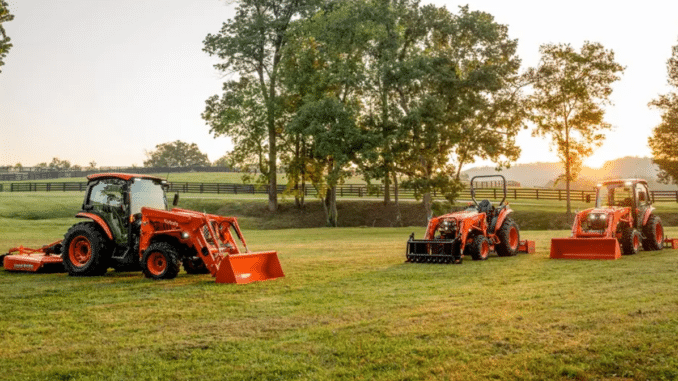
Kubota L3400 Transmission and Drivetrain: Maintenance, Parts and Repair Guide
This guide covers the transmission and drivetrain of the Kubota L3400 compact tractor: the gearbox or hydrostatic unit, range and shift controls, transmission fluid and filter, the HST pedal linkage, the rear axle and differential housings, and the four-wheel-drive engagement. It explains how to match parts to your tractor and sorts shifting, grinding, slow-movement, leak and housing-damage problems into diagnostic groups. The L3400 was sold in more than one drivetrain configuration, and most advice depends on which one you own.
Which L3400 do you have? Kubota literature describes an L3400 as a hydrostatic (HST) tractor with a three-range shift (L-M-H) and as an 8-forward/4-reverse gear-drive tractor, in 2WD and 4WD. The two share a model name but have different service procedures, and the workshop manual covers them in separate chapters. Each section below says which version it applies to. Anything marked “either version” applies to both.comdac+1
Kubota L3400 Transmission Maintenance
Stop the engine, remove the key and apply the parking brake before checking or changing transmission fluid. Kubota’s own procedure says to stop the engine before checking or draining the fluid. Use a drain pan, and let the unit cool first, because the fluid and case get hot in use. Hydraulic pressure can remain in the lines on a machine that has just been working, so don’t loosen lines or fittings until the tractor has been shut down for a while and the lift arms are fully lowered.kubotarepairmanual
Maintenance Schedule and Service Points
The operator’s manual contents list transmission checks and changes under hour-based headings. The transmission fluid level check sits in the daily checks, and the HST filter and fluid sit under the 200-hour and 400-hour headings. A dealer parts-catalog maintenance chart shows slightly different interval markings, so check the table in your own operator’s manual before you rely on any one figure. I could not verify a separate “first service” interval for the transmission, so I haven’t listed one.manualslib+1
| Maintenance task | Interval or trigger | Inspection point or specification | Owner action |
|---|---|---|---|
| Transmission fluid level | Operator’s manual lists it among routine checks before use manualslib | Fluid must sit at the gauge’s upper line, never above it | Top up with the specified fluid only |
| Transmission fluid change | Every 400 hours per the operator’s manual contents manualslib; confirm in your copy | Gear 2WD about 27 L, gear 4WD about 27.5 L, HST about 23.5 L (total fill) kubotarepairmanual | Drain at the case plugs, refit plugs, refill to the gauge, run briefly, recheck |
| HST filter (HST only) | Every 200 hours per the operator’s manual contents manualslib | Cartridge on the transmission | Wet the seal with clean fluid, tighten until it touches, then a further half turn by hand only kubotarepairmanual |
| HST oil line check | Listed in the operator’s manual maintenance schedule manualslib | Hoses, fittings and clamps for seepage or chafing | Replace damaged lines |
| Clutch pedal free travel (gear only) | Every 100 hours per the operator’s manual contents manualslib | Measure at the top of the pedal stroke; the factory range is in the manual | Adjust the turnbuckle and lock nut |
| 4WD front axle case oil | Listed under 400 hours manualslib | Separate from the transmission fluid | Follow the front-axle section of the manual |
Transmission Lubrication and Control Checks
Kubota specifies its own UDT or Super UDT fluid for the transmission case, and the manual warns against mixing different brands. That fluid also feeds the hydraulics and, on HST models, the hydrostatic circuit. Generic substitutes are a common cause of noisy or jerky HST operation, but I haven’t verified that for this model, so treat it as a reason to stay with the specified fluid.kubotarepairmanual
Check the fluid with the tractor level. Fill to the upper line and run the engine for a few minutes. Stop it and recheck, as the manual instructs. Don’t leave the level above the gauge mark (see the overfill section below).kubotarepairmanual
Gear models have a clutch pedal, and its free travel affects shifting. The manual’s adjustment is to slightly depress the pedal, measure free travel at the top of the stroke, and adjust the turnbuckle within the factory specification. I haven’t reproduced the figure, because the sources I found disagree on units and format. Read it from your manual.kubotarepairmanual
Wear Checks That Reveal Repair Needs
-
Metal glitter or shavings in drained fluid: gear, bearing or pump wear. Stop using the tractor and have the unit inspected before refilling.
-
Fluid seepage at the filter, lines or HST valve area: repair the leak and check the level before further use.
-
Pedal play at the control arm or a drifting neutral (HST): look for a loose or worn linkage before suspecting internal faults.
-
Cracks or weeping at the case, axle housings or top-link area: treat as structural damage (see the housing section).
-
Noise that changes with range, pedal or 4WD selection: use the symptom sections below to place the fault.
Finding the Correct Kubota L3400 Transmission Parts
Identification and Configuration Checks
Before ordering, record the following from your tractor:
-
Whether it is gear-drive or HST, and 2WD or 4WD.
-
The tractor serial number and the transmission case markings.
-
The part name and diagram number from the parts catalog, not only the visible shape.
-
Whether the tractor has been repaired with non-original parts or fitted with loader or implement brackets that interface with the case.
I couldn’t verify serial-number breaks for the transmission, so don’t assume a part fits because it suits another L3400. Ask a Kubota dealer to confirm against your serial number.
Manuals and Parts Diagrams
Three documents cover this system:
-
The operator’s manual, for routine checks and operating limits.
-
The workshop manual, for adjustments and repair procedures. The L2800/L3400 workshop manual includes separate sections for the manual-transmission and HST models.manualslib
-
The illustrated parts catalog, which splits the machine into the “L3400DT” and “L3400DT/HST” groups, including a speed-control pedal (HST) diagram.messicks
The publication numbers I found were inconsistent between sources (for example, different numbers for the owner’s manual), so confirm the number on the cover of the manual you buy or download. A diagram reference number is not an orderable part number, and some items are sold as kits or assemblies.
Replacement Parts and Fitment Checks
I did not find verified part numbers for this application, so none are listed.
| Component | Part number | Fitment qualification | What to check before ordering |
|---|---|---|---|
| HST filter cartridge | Not verified | HST models only | Match to the catalog entry for your serial number and compare the old cartridge |
| Transmission fluid | Kubota UDT or Super UDT kubotarepairmanual | All versions | Use the fluid named in your manual |
| HST speed-control pedal and linkage | Not verified; catalog shows a dedicated diagram messicks | HST only | Compare pedal, arm and bushings with the diagram |
| Clutch pedal turnbuckle and linkage | Not verified | Gear models only | Match the linkage diagram |
| Front wheel drive lever and linkage | Not verified; separate catalog entry for non-HST and HST messicks | 4WD only | The catalog separates versions, so choose the right one |
| Transmission or axle housings, shift forks, gears | Not verified | Version- and serial-dependent | Order only after the damage has been confirmed and measured |
Protective Components and Critical Hardware
Don’t bypass or defeat the start-interlock switches, and don’t fit stronger substitutes for fasteners in the housing or axle mountings. Use fasteners and torque values from the workshop manual, which I haven’t reproduced.
Parts Resources
Use a Kubota dealer in your country with your serial number, or a dealer-hosted parts catalog. Parts catalogs and manuals vary by market, so check that the diagram matches your tractor’s market and drivetrain.
Kubota L3400 Transmission Problems and Repairs
The maintenance data above comes from Kubota manuals. The symptom sections below mix manual-based information with owner reports, which describe experiences and don’t prove universal causes. I did not find a service bulletin or recall for this system, but that doesn’t prove none exists. Ask a dealer to check against your serial number.
Troubleshooting at a Glance
| Symptom group | Plausible causes requiring confirmation | First safe check | Repair direction |
|---|---|---|---|
| Grinding when shifting from neutral or into gear (gear) | Clutch not fully releasing, shifting too soon, low fluid | Fluid level, clutch free travel | Adjust the clutch; internal inspection if it persists |
| Range or gear shifts hard or locks (HST or gear) | Linkage binding, shifting while moving, damaged forks or synchronizers | Linkage, whether the tractor is fully stopped | Adjust or repair the linkage; professional teardown for internal damage |
| No movement or slow movement (HST) | Low fluid, blocked filter, pedal linkage, pump or motor wear | Fluid level, filter, pedal linkage | Correct the level, filter or linkage; professional pressure testing |
| Noise in specific gears or ranges | Gear or bearing wear, low fluid | Fluid condition | Professional inspection |
| Fluid leaks and line separation | Damaged seals, hoses or clamps | Visual inspection | Replace the confirmed component |
| Fluid overfill | Over-topping, wrong gauge reading | Level on level ground | Drain to the gauge mark |
| 4WD problems | Linkage, engagement damage, worn gears | Lever movement and linkage | Dealer inspection |
| Cracked housings | Impact, overload, loader or implement stress | Visual inspection | Stop use; dealer assessment |
Grinding When Shifting (Gear-Drive Models)
This covers the reports “tractor grinds when shifting from neutral,” “grinds when shifting into gear,” “grinds when shifting out of neutral,” “gears grind when shifting ranges” and “sometimes won’t shift without grinding.” The meaning of each differs slightly:
-
Neutral to gear while stopped: grinding is often caused by gears that are still turning, because the clutch has not fully released, and the clutch free travel is the first check. One owner thread describes a dealer advising a pause of a couple of seconds with the clutch held before shifting, and another owner says waiting is normal from neutral. This is owner opinion, not a manual-confirmed procedure.tractorbynet
-
Range shifting: the range lever should be moved only with the tractor stopped. Shifting while moving can produce grinding and may damage the forks or gears.
-
Intermittent refusal to engage: this can follow a dragging clutch, a stiff linkage or worn shift parts.
If a correct clutch adjustment and correct fluid level don’t cure the grinding, the next step is professional inspection of the clutch and gear train. Don’t force the lever.
Shifting Without the Clutch
A gear L3400 needs the clutch pedal pressed for gear and range changes, because the transmission isn’t a synchronized-shuttle design as far as I could verify. Shifting without it is a likely cause of the grinding above. On an HST tractor, driving is done with the pedals, and the range lever (L-M-H) is shifted when the tractor is stopped. I couldn’t verify a clutch-pedal function on HST models, so if your HST tractor has a clutch-type pedal, check the operator’s manual before using it with the HST pedal. “Using the HST pedal with the clutch depressed” can’t be answered from verified information, and the manual for your serial number is the test.comdac
Range Selector or L/H/R Lever Stuck
This covers “range selector locks up when stopped,” “HST gear range switch difficult to shift” and “L/H/R lever stuck preventing start.”
-
Locks up when stopped: the range gears may not be aligned, so try small pedal or clutch movement (depending on version) before applying force. Persistent lock-up points to linkage or internal fork damage.
-
Hard to shift (HST): check the linkage for binding and the fluid level. Don’t use extension levers or hammer the lever.
-
Prevents starting: some Kubota tractors use a neutral or range position safety switch. I haven’t verified the L3400’s exact switch arrangement, so check that the range lever and pedal are in neutral first. Don’t bridge or bypass the switch. A dealer should test the circuit.
No Movement, Slow Movement or Loss of Drive
This covers “no forward movement in all gears,” “tractor stopped moving while cutting,” “moves very slowly in reverse,” “moves slower in forward,” “slows down in forward,” and “rear drive slips and grinds in gear.”
-
Stopped suddenly while working (HST): check the fluid level first, then for leaks or a separated line. A low level or a ruptured line can stop the hydrostatic drive.
-
Slow in one direction: possible linkage misadjustment, a restricted filter, or wear in the hydrostatic unit. An owner report can’t establish which.
-
No forward in all gears (gear): possible causes include a clutch fault, a broken shaft or gear, or a failed range engagement. Check that the clutch is moving and the shift linkage is connected.
-
Rear drive slips and grinds: stop driving. This points to internal drivetrain damage, and a dealer teardown is the next step.
The hydrostatic pump and motor can’t be assessed by eye. Measuring them requires pressure testing, which I haven’t established a safe owner procedure for, so refer it to a qualified technician.
HST Pedal Linkage, Looseness and Grinding
For “HST pedal loose at control arm,” “HST pedal adjustment lost after digging,” and “grinding noise when depressing HST pedals,” inspect the pedal, control arm, fasteners and bushings with the engine off. A loose arm or worn bushing gives play and a drifting neutral. Heavy loader or backhoe work can shift adjustments.
Do not reset the neutral adjustment from guesswork. The workshop manual contains the adjustment procedure, and a dealer can complete it if you don’t have the manual. A grinding noise at the pedal suggests worn linkage parts, but the manual doesn’t confirm a cause. If the noise comes from inside the case, stop and have it inspected.
Gear Noises: Fourth Gear High Range and Rear Clanging
“Loud transmission in fourth gear high range” and “clanging noise from rear in high range” apply to the gear model, where four gears and high range mean a particular gear pair is working. Possible causes include a worn gear or bearing, a damaged tooth or a loose component, so check the fluid for metal. I can’t determine the cause from the description. A professional inspection is needed, and continued use risks greater damage.
Fluid Level and Leaks
-
Level above the indicator: drain to the gauge mark. Overfilling can also happen by misreading the gauge on a slope. Persistent overfill may mean another fluid, such as water or hydraulic oil from a different circuit, is entering, so check the fluid’s appearance.
-
Line separated: stop at once, because fluid loss can damage the pump. Replace the line or clamp after finding why it failed, such as rubbing or a loose clamp. Refill with correct fluid and check the level.
-
HST valve-area drips: identify the exact leak point and clean the area to trace it. Replace the confirmed seal, line or fitting. If it comes from the valve body itself, a dealer should handle it.
Cracked or Broken Housings
This covers “rear differential housing broke off,” “transmission case cracked at top link area” and “rear axle housing cracked and needs replacement.” A cracked case or axle housing is a structural failure, so stop using the tractor and don’t use a loader or implement on it. Whether the housing can be repaired or must be replaced, and what else was damaged, can only be decided after a teardown and a dealer’s check of parts availability. I can’t confirm that a repair, weld or replacement is suitable, and I haven’t included costs or labor times. The top-link area is a mounting point for implements, so look at what loads the case.
Four-Wheel-Drive Engagement and Use
The L3400 4WD uses a front-wheel-drive lever, and the parts catalog separates the HST and non-HST lever diagrams. The entries here are:messicks
-
4WD disengages while working: the linkage, lever or shift collar may be worn, and one general guide says low front-axle fluid can cause intermittent engagement. That guide isn’t specific to the L3400, so check it against your manual.tractorpartscentral
-
Enormous effort to shift 2WD to 4WD: engage the lever as the manual describes (with the tractor stopped or at the specified condition). Check the linkage and clean it. Don’t force it.
-
Stripped 4WD gear mesh: this is internal damage, and repair means dismantling the drive by a professional.
-
4WD on dry pavement and engaging on HST: I couldn’t verify the manual’s wording on using 4WD on hard surfaces, so follow it. Tight turns in 4WD on pavement can cause drivetrain wind-up and wear on most 4WD tractors, but this isn’t L3400-specific. For HST engagement, read the 4WD lever section of the operator’s manual for the correct state of the pedal and tractor.
Owner Maintenance or Professional Repair?
You can reasonably do these yourself, following the manual: checking and topping up fluid, changing the transmission fluid and HST filter, adjusting the clutch free travel (gear), and inspecting lines and linkages visually.kubotarepairmanual
These need a dealer or specialist: internal gear, fork, bearing or hydrostatic unit faults, neutral and pump adjustments needing pressure tests, cracked housings, stripped 4WD gears and any case split. For each, the repair decision depends on the confirmed fault, the extent of damage, related components, parts availability and a local quotation. I haven’t given prices or times.
Frequently Asked Questions
Is the transmission fluid the same on gear and HST models?
Kubota names UDT or Super UDT for the transmission case. Capacities differ: about 27 L (2WD gear), 27.5 L (4WD gear) and 23.5 L (HST). Confirm in your manual and fill to the gauge.kubotarepairmanual
Does the HST have a filter to change?
Yes. The manual includes replacing the HST transmission oil filter, with a seal-wetting step and a half turn after contact.kubotarepairmanual
Is grinding from neutral a fault?
On gear models it can be a technique or clutch-release matter, and owners disagree about how long to wait. If grinding persists with a correctly adjusted clutch and correct fluid, have it inspected.tractorbynet
Can I weld a cracked housing?
I couldn’t verify a manufacturer-approved repair. Ask a dealer to assess it.
Kubota L3400 Gear-Drive Transmission Problems and Repairs
This section applies to the gear-drive (non-HST) L3400, which has a clutch pedal, a main gear lever, a range lever and an optional 4WD lever. Check your tractor’s configuration first. If the only drive control is a pair of foot pedals, you have an HST and need the HST sections instead. Owner reports below describe experiences, not confirmed causes. I haven’t verified a service bulletin or recall for this system, and that doesn’t prove none exists.
Troubleshooting at a Glance
| Symptom | Plausible causes requiring confirmation | First safe check | Repair direction |
|---|---|---|---|
| Grinds from neutral or into gear | Clutch not fully releasing, shifting too soon, low fluid | Clutch free travel, fluid level | Adjust the clutch; professional inspection if it persists |
| Grinds when changing ranges | Shifting while moving, linkage wear, damaged forks or gears | Is the tractor fully stopped? Lever movement | Linkage repair; teardown if internal damage is confirmed |
| Range selector locks up when stopped | Gears not aligned, binding linkage | Linkage freedom with the engine off | Adjust or repair the linkage; do not force it |
| No forward movement in any gear | Clutch fault, broken shaft or gear, disconnected linkage | Does the pedal and lever move, and does the linkage connect? | Dealer diagnosis |
| Stopped moving while cutting | Clutch, shaft or drivetrain failure, a PTO or implement fault | Is the engine running and the linkage connected? | Separate drive failure from the implement, then escalate |
| Slow or slipping drive | Clutch slip, low fluid, internal wear | Fluid level, clutch free travel | Adjust, then professional diagnosis |
| Loud in fourth gear, high range, or clanging at the rear | Gear or bearing wear, loose or damaged part | Fluid condition and level | Stop and have it inspected |
| 4WD disengages, hard to engage or stripped | Linkage, shift collar or gear wear | Lever movement and linkage | Dealer inspection |
| Fluid overfill, line separated, cracked housings | Over-topping, hose failure, impact or overload | Visual inspection and level | Drain, replace the confirmed part, or stop using the tractor |
Grinding When Shifting From Neutral or Into Gear
This covers “tractor grinds when shifting from neutral,” “grinds when shifting into gear,” “grinds gears when shifting out of neutral” and “sometimes won’t shift without grinding.” They share one diagnostic path but differ in the conditions.
-
Stationary, engine running, clutch pressed: grinding usually means the input shaft is still turning. A clutch that isn’t fully releasing is the leading suspect.
-
Intermittent refusal to engage: gear teeth may be meeting end to end. Releasing the clutch slightly and pressing again can let them align. This is an owner-reported technique, not a documented procedure.
-
Grinding only when moving: this is a shift-timing problem rather than a fault.
Start with clutch pedal free travel and the fluid level. The workshop manual gives the factory free-travel figure and the turnbuckle adjustment, and I haven’t reproduced a number here. If a correct adjustment and level don’t cure it, the clutch and shift parts need professional inspection.
Shifting Without the Clutch
A gear L3400 is built for clutch use during gear and range changes, as far as I could verify. Shifting without the clutch is a likely cause of grinding and can wear gears and forks. I haven’t confirmed that any gear can be shifted without it, so use the clutch for every change.
Range Selector Problems
-
Grinds when changing range: change range only with the tractor stopped, clutch pressed. Shifting while moving can damage the range gears or forks.
-
Locks up when stopped: try a small clutch release and re-press, since gear teeth may be aligned tooth to tooth. If the lever stays stuck, check the linkage with the engine off. Don’t use a hammer or extension.
-
“L/H/R” lever stuck, preventing starting: this depends on a start-safety arrangement I couldn’t verify for the gear model. Check the clutch pedal is fully pressed and the levers are in neutral. Never bridge a switch. A dealer should test the circuit.
No Drive or Loss of Drive
For “no forward movement in all gears” and “tractor stopped moving while cutting”:
-
With the engine off and the tractor secured, check that the clutch pedal, shift linkage and range linkage are connected and moving.
-
Check the fluid level.
-
Separate a drive failure from an implement problem. If the PTO-driven implement stopped but the tractor moves, the fault isn’t in the transmission.
If the engine runs and the linkages are intact but nothing moves, the cause could be the clutch or a broken internal part. Diagnosing it means splitting the tractor, which needs a dealer. Don’t keep trying to drive it.
Slow or Slipping Drive
“Rear drive slips and grinds in gear,” “tractor moves slower in forward” and “tractor slows down in forward” are different from one another:
-
Slowing under load, engine speed rising: possible clutch slip. Check free travel (too little can cause slipping).
-
Slipping with grinding: suggests internal damage. Stop driving.
-
Slow in forward only: I couldn’t verify a gear-model cause. Compare against the engine speed and check the clutch.
“Moves very slowly in reverse” isn’t a typical gear-model symptom. It is more usually reported on HST machines, so confirm which drive you have. On a gear model, treat it like a slipping drive.
Noise in Specific Gears
“Loud transmission in fourth gear, high range” and “clanging noise from rear in high range” depend on which gear train is carrying the load. Possible causes are worn gears, a damaged bearing or a loose component. Check the fluid level and drained fluid for metal. I can’t pinpoint the cause from a sound, so a dealer should inspect it, and continued use risks greater damage.
Four-Wheel Drive Problems
-
Disengages while working: check the lever, linkage and shift collar for wear. The front axle case holds separate oil on 4WD models, so check its level per the manual.
-
Enormous effort to shift 2WD to 4WD: engage as the manual directs, and clean and inspect the linkage. Don’t force it.
-
Stripped gear mesh: this is internal damage. Repair is a professional job, and it’s a case-opening repair.
-
4WD on dry pavement: I couldn’t verify the manual wording, so follow your operator’s manual. On many 4WD tractors, prolonged use on hard surfaces increases drivetrain wear, but I haven’t confirmed that for this model.
-
“Engaging 4WD on HST”: this is an HST-specific entry and belongs in the HST section.
Fluid and Leak Problems
-
Level above the indicator: drain to the mark and recheck on level ground. If it rises again, suspect another fluid entering the case and have it checked.
-
Line separated: stop at once. Replace the line or clamp, find out why it came loose, refill and recheck the level.
Cracked or Broken Housings
“Rear differential housing broke off,” “transmission case cracked at top link area” and “rear axle housing cracked” are structural failures. Stop using the tractor and any attached implement. Whether to repair or replace depends on the damage, other components, parts availability and a local quotation. I haven’t confirmed that welding is suitable, and I haven’t included prices or labor times.
HST-Only Entries
These belong to the HST sections, not the gear model: HST pedal looseness, lost pedal adjustment, grinding when pressing pedals, HST range switch difficulty, HST valve-area leaks, and using the HST pedal with the clutch depressed. If you have a gear model and notice these symptoms, check whether you’ve misidentified the tractor.