
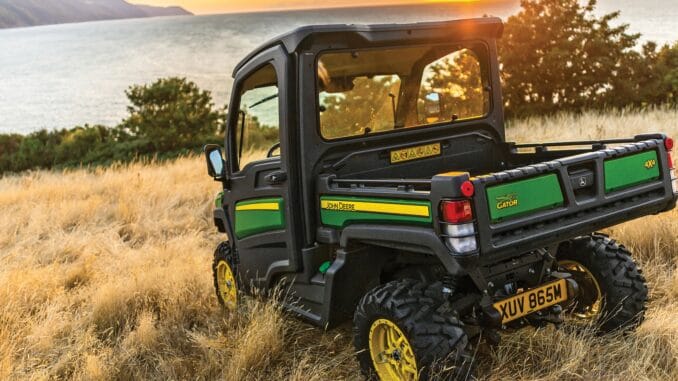
The John Deere ProGator is a heavy-duty turf and grounds-maintenance utility vehicle designed for hauling materials, operating attachments and working across golf courses, sports fields, estates and larger properties. This guide focuses on the John Deere ProGator 2020A gas and 2030A diesel models, giving DIY-minded owners a symptom-first approach to repairs, routine maintenance, parts identification and sensible limits for dealer-level work.
Unlike a lawn tractor, a ProGator combines an engine, manual transmission, hydraulic system, cargo box, electrical safety circuits and, on some machines, four-wheel drive and PTO-driven equipment. Regular inspection matters because a small issue such as a blocked radiator screen, loose belt, contaminated fuel filter or leaking hydraulic hose can quickly become a more expensive repair.
John Deere Pro Gator model overview
The John Deere ProGator 2020A and 2030A are commercial utility vehicles from Deere’s golf, sports turf and grounds-care equipment range. The 2020A is gasoline powered, while the 2030A uses a diesel engine. Both are designed for more demanding work than a homeowner utility vehicle, including transporting materials, towing approved loads and powering compatible turf-care attachments.
The main systems owners need to understand are:
-
Engine and fuel system
-
Cooling system and radiator screen
-
Air-cleaner system
-
Five-speed synchronized transmission
-
Hydraulic lift and optional auxiliary hydraulic circuits
-
Brakes, steering and park brake
-
Electrical charging, lighting and safety-switch circuits
-
Cargo box, ROPS, tires and wheel hardware
-
PTO and driveline components on equipped machines
Common ProGator service parts include engine oil filters, fuel filters, air filters, hydraulic filters, transmission strainers, spark plugs for gas models, batteries, water-pump belts, ignition switches and lighting bulbs.
John Deere Pro Gator troubleshooting approach
Start with the symptom you can see, hear or feel. For example, “the engine cranks but will not start” is more useful than assuming the fuel filter is bad. “The ProGator loses power under load” points you toward fuel delivery, air restriction, overheating, engine condition or an attachment that is overloaded.
The main symptom categories are:
-
Engine will not crank or will not start
-
Engine starts but runs rough, smokes or lacks power
-
Overheating, coolant loss or warning lights
-
Transmission, clutch or drive problems
-
Hydraulic lift or auxiliary-hydraulic faults
-
Brake, steering or tire problems
-
Vibration, noise and rattles
-
Electrical, lighting and safety-switch faults
-
PTO or attachment operating problems
Always park on level ground, set the park brake, lower attachments, stop the engine and remove the key before inspecting moving parts. Let the engine and exhaust cool before working around the cooling system, belts or exhaust components.
Immediate John Deere Pro Gator repair needs
John Deere Pro Gator starting issues
A no-start condition can leave the machine stranded, but it can also signal a safety-switch, neutral-switch, battery or fuel-system problem. Do not bypass interlocks permanently, even if the machine starts after doing so.
Common causes include:
-
Weak battery or corroded terminals
-
Blown fuse
-
Faulty ignition switch
-
Neutral switch not recognizing neutral
-
Seat or park-brake safety switch fault
-
Fuel shut-off valve closed on diesel models
-
Plugged fuel filter or water contamination
-
Worn spark plug on the 2020A
-
Air in the fuel system on the 2030A
Basic checks:
-
Confirm the transmission is in neutral and the park brake is applied.
-
Check battery terminals for looseness, corrosion or damaged cables.
-
Inspect the fuse panel and replace only with the correct fuse rating.
-
Verify there is clean fuel in the tank and that the diesel fuel shut-off valve is open.
-
Inspect the fuel filter and fuel lines for contamination, leaks or cracks.
-
If the starter clicks but does not turn, test battery condition before replacing the starter.
John Deere Pro Gator overheating and coolant leaks
A ProGator that overheats can suffer engine damage if it is kept working. Stop immediately if the temperature warning appears, coolant boils over or power drops sharply with a hot-engine smell.
Common causes include:
-
Clogged radiator screen
-
Grass, dust or chaff packed into cooling fins
-
Low coolant level
-
Loose or damaged water-pump belt
-
Leaking hose, clamp, radiator or water pump
-
Faulty thermostat
-
Fan or shroud damage
Basic checks:
-
Stop the engine and allow it to cool completely.
-
Remove debris from the radiator screen and surrounding air path.
-
Check coolant level only when the engine is cold.
-
Inspect hoses, clamps and the radiator for wet spots or dried coolant residue.
-
Check the water-pump or alternator belt for cracking, looseness or glazing.
-
Do not remove a hot radiator cap.
John Deere Pro Gator transmission and drive problems
Difficulty selecting gears, slipping drive, poor hill performance or unusual transmission noise should be investigated before heavy use. Continued operation with low or contaminated transmission oil can damage internal components.
Common causes include:
-
Low transmission or hydraulic oil
-
Plugged transmission strainer
-
Contaminated oil
-
Incorrect clutch or accelerator cable adjustment
-
Worn clutch components
-
Damaged drive shaft or universal joints
-
Four-wheel-drive linkage or front-axle issue on equipped machines
-
Incorrect tire size or major tire-pressure mismatch
Basic checks:
-
Check transmission oil level following the correct manual procedure.
-
Look for leaks around the transmission, axle housings, hydraulic lines and filters.
-
Confirm the clutch pedal has normal movement and returns fully.
-
Check tire pressures and inspect all tires for damage.
-
Listen for noise that changes with vehicle speed, gear selection or four-wheel-drive engagement.
-
Stop using the machine if the driveline knocks, binds or vibrates heavily.
John Deere Pro Gator hydraulic problems
A slow cargo-box lift, weak auxiliary hydraulics or a whining hydraulic system can result from low oil, restricted filtration, overheating or a leaking hose. Hydraulic oil under pressure can penetrate skin, so never search for leaks with your hands.
Common causes include:
-
Low transmission/hydraulic oil
-
Plugged hydraulic oil filter
-
Restricted auxiliary hydraulic strainer
-
Leaking hose, fitting or cylinder
-
Damaged quick couplers
-
Contaminated hydraulic oil
-
Hydraulic oil cooler blocked by debris
Basic checks:
-
Lower the cargo box and attachments before checking fluid levels.
-
Inspect hoses and fittings without touching suspected leaks.
-
Check for wet areas under the machine and around cylinder rods.
-
Clean debris from the hydraulic oil cooler.
-
Replace a damaged hose rather than attempting a temporary repair.
-
Use cardboard or wood to locate a suspected pressurized leak, never fingers.
Vibration and noise
New vibration should never be ignored. It may be as simple as loose cargo-box hardware or as serious as a damaged driveline, wheel, tire or ROPS mounting point.
Common causes include:
-
Loose wheel nuts or damaged wheel studs
-
Tire damage, low pressure or mud-packed wheels
-
Worn rear axle or wheel-bearing components
-
Loose cargo-box or ROPS hardware
-
Failing universal joint or driveshaft
-
Loose exhaust system or heat shield
-
Worn engine or transmission mounts
Basic checks:
-
Park the machine and inspect tires for cuts, bulges and loose debris.
-
Check wheel hardware to the correct specification in the operator’s manual.
-
Inspect the cargo box, tailgate, ROPS and exhaust mounting points.
-
Look for shiny wear marks around driveline joints or guards.
-
Do not operate the machine until serious wheel, tire or driveline faults are corrected.
Electrical and safety-system problems
Electrical faults can show up as no crank, no lights, intermittent running, weak charging or warning lamps. Safety circuits must function correctly because they prevent unsafe starts and operation.
Common causes include:
-
Dirty or loose battery connections
-
Weak battery
-
Blown fuse
-
Failed ignition switch
-
Bad ground connection
-
Corroded connector
-
Faulty seat, neutral or park-brake switch
-
Charging-system fault
-
Damaged wiring near moving or hot components
Basic checks:
-
Check the battery, terminal tightness and ground cable condition.
-
Inspect fuses one at a time and use the correct replacement rating.
-
Wiggle-test accessible connectors only with the engine off.
-
Check wiring near the battery, exhaust, steering linkage and cargo-box pivot points.
-
Use a multimeter before replacing expensive electrical components.
-
Never bypass a safety switch as a permanent repair.
DIY or dealer repair guide
The practical dividing line for John Deere ProGator repairs is whether the job can be completed safely with basic hand tools, correct lifting support and a reliable service procedure. Routine servicing is realistic for many owners, but internal engine, transmission, brake-hydraulic and high-pressure hydraulic work is better left to a John Deere dealer or experienced commercial-equipment technician.
Good DIY jobs
-
Engine oil and oil-filter changes
-
Air-filter inspection and replacement
-
Fuel-filter replacement where accessible
-
Spark-plug replacement on the 2020A
-
Battery cleaning, replacement and terminal service
-
Fuse and bulb replacement
-
Cleaning radiator screens, cooling fins and oil coolers
-
Greasing specified fittings
-
Replacing water-pump belts when access and belt routing are clear
-
Checking tire pressures and tightening wheel hardware
-
Replacing accessible hydraulic filters
-
Replacing damaged seats, lights, keys and simple switches
Advanced DIY or dealer jobs
-
Diesel fuel-system bleeding and injector diagnosis
-
Engine compression, timing or internal engine repairs
-
Clutch adjustment beyond basic cable checks
-
Transmission teardown or gear-selection repairs
-
Front-axle or four-wheel-drive repairs
-
Brake hydraulic-system repairs and bleeding
-
High-pressure hydraulic-cylinder rebuilding
-
Hydraulic pump or valve repairs
-
ROPS repairs or replacement
-
Electrical diagnosis involving wiring harness damage or controller faults
Skill level guide
-
Beginner: Cleaning, visual inspections, checking fluid levels, battery care, fuse replacement and tire-pressure checks
-
Intermediate: Oil and filter changes, spark plugs, fuel filters, belt replacement, light switches and hydraulic-filter service
-
Advanced: Electrical testing, clutch adjustment, driveline repairs, hydraulic diagnosis and diesel fuel-system work
John Deere Pro Gator parts and part numbers
Always identify the exact machine before ordering. “John Deere ProGator” is not enough because parts differ between the 2020A and 2030A, and several items change by serial-number range.
Collect the following information:
-
Full model designation: 2020A or 2030A
-
Product Identification Number, also called the PIN
-
Machine serial number
-
Engine model and engine serial number
-
Whether the machine is gas or diesel
-
Two-wheel-drive or four-wheel-drive configuration
-
Installed cargo box, hydraulic and PTO options
-
Existing part number from the old part where available
OEM parts are usually the safest choice for belts, filters with unusual fittings, safety switches, ignition components, hydraulic parts, brake components and serial-number-sensitive parts. Aftermarket parts can be reasonable for batteries, common fluids, some filters and certain bulbs, but only if the supplier provides a confirmed cross-reference for the exact ProGator model and serial range.
John Deere Pro Gator diagrams and manuals
Use diagrams and manuals before dismantling anything. A parts diagram helps confirm how components fit together, while the operator’s manual provides maintenance intervals, operating procedures, safety information and basic adjustment details.
Useful sources include:
-
John Deere ProGator 2020A/2030A owner information for model support, manuals and service information
-
John Deere ProGator 2020A/2030A quick-reference guide for common service part numbers and fluid references
-
John Deere online operator’s manual for operating, maintenance, troubleshooting and storage information
-
John Deere manuals and training for operator manuals, technical manuals and parts catalogs
-
Green Farm Parts ProGator 2020A maintenance guide for a model-focused service-parts reference
The operator’s manual is the best first source for routine maintenance and safety procedures. Use official parts catalogs to verify exploded diagrams and serial-number breaks. A technical service manual is more appropriate for transmission, hydraulic, engine and complex electrical work.
Finding Pro Gator identification numbers
Identification numbers matter because many ProGator service parts change by serial number. Ordering by appearance alone can result in the wrong belt, filter, ignition switch, key, fuel filter or engine component.
-
Park the machine on level ground, set the park brake, stop the engine and remove the key.
-
Locate the machine Product Identification Number plate or decal on the ProGator frame. Clean it carefully so the full number can be read.
-
Record the model, serial number and any configuration details such as four-wheel drive, PTO or hydraulic options.
-
Locate the engine identification label on the engine itself. The location varies by engine, but it is normally on an engine cover, valve-cover area, blower housing or side-mounted identification plate.
-
Photograph the identification labels and save the images with your service records.
Do not rely on a previous owner’s written notes if they conflict with the machine’s actual PIN or engine serial number.
Buying John Deere Pro Gator parts
Use a planned buying strategy rather than ordering every part from one source. Routine items can often be ordered online, while serial-number-specific components and complex hydraulic or drivetrain parts are usually best confirmed at a dealer parts counter.
-
Online: Check the OEM number, serial-number break and product description before ordering. This works well for filters, spark plugs, belts, bulbs, keys and maintenance fluids.
-
Dealer counter: Best for transmission components, hydraulic hoses, ignition parts, ROPS hardware, safety switches and any item with several serial-number variations.
-
Retail stores: Suitable for approved engine oil, grease, batteries and generic shop supplies when packaging clearly lists the correct specification.
Useful starting points include John Deere Parts, John Deere manuals and training and Green Farm Parts.
John Deere Pro Gator common parts fitting guide
Replacing the engine oil and filter
Changing the oil and filter protects the engine from wear, overheating and contamination. Use the correct oil grade and filter for the exact gas or diesel machine.
-
Run the engine briefly so the oil warms, then park on level ground and shut it off.
-
Apply the park brake, remove the key and place a drain pan under the drain point.
-
Remove the drain plug carefully and allow the oil to drain fully.
-
Remove the old oil filter, ensuring the old gasket has not remained on the engine.
-
Lightly oil the new filter gasket, install the new filter by hand and refit the drain plug to the correct specification.
-
Refill with the correct oil, start briefly, check for leaks, stop the engine and recheck the oil level.
Replacing the John Deere Pro Gator air filters
A restricted air filter can cause low power, poor fuel economy, smoke and overheating under load. Do not clean or reuse a damaged paper element.
-
Park safely with the engine off and allow hot components to cool.
-
Open the air-cleaner housing carefully to avoid dropping dirt into the intake.
-
Remove the primary filter and inspect the housing for dust, leaves and debris.
-
Clean the housing with a clean, dry cloth; do not force dirt into the intake tube.
-
Replace the primary element and secondary element if required by the service interval or condition.
-
Refit the cover correctly and confirm all latches are secure.
Replacing a John Deere Pro Gator fuel filter
A new fuel filter can correct fuel starvation, rough running and poor power caused by contaminated fuel. Keep sparks, flames and cigarettes away from the work area.
-
Park outdoors or in a well-ventilated area and allow the engine to cool.
-
Close the fuel shut-off valve where fitted, especially on diesel models.
-
Place absorbent material beneath the filter to catch spilled fuel.
-
Note the fuel-flow direction, remove the old filter and inspect the fuel lines for cracks.
-
Install the correct new filter in the proper direction and secure the clamps.
-
Open the shut-off valve, check for leaks and follow the correct priming procedure before starting the diesel engine.
Replacing a water-pump or alternator belt
A worn or loose belt can contribute to overheating, poor charging or sudden breakdown. Confirm the correct serial-range belt before removal.
-
Stop the engine, remove the key and allow the engine compartment to cool.
-
Photograph or sketch the belt routing before loosening any tensioning hardware.
-
Inspect pulleys for damage, wobble or built-up debris.
-
Release belt tension, remove the old belt and compare it with the replacement.
-
Install the new belt following the original routing and adjust tension to the manual specification.
-
Start the engine briefly and watch the belt from a safe distance for proper tracking.
John Deere Pro Gator maintenance priorities
Routine maintenance reduces most avoidable ProGator failures. The machine works in dusty, grassy and often wet conditions, so cooling-system cleanliness, air filtration, fluid condition and driveline inspection deserve as much attention as engine oil changes.
Focus on these areas:
-
Starting reliability: Keep the battery charged, terminals clean and safety switches functional.
-
Engine protection: Change oil and filters on schedule and inspect fuel quality.
-
Cooling performance: Clean the radiator screen, cooling fins, fan shroud and hydraulic oil cooler.
-
Drive performance: Maintain correct transmission oil, inspect the strainer and check clutch operation.
-
Hydraulic reliability: Inspect hoses, fittings and cylinder areas for damage or leaks.
-
Electrical reliability: Protect wiring from abrasion, moisture and rodent damage.
-
Safety: Inspect tires, wheel hardware, brakes, seat belts, cargo-box latches and ROPS hardware.
John Deere Pro Gator maintenance schedule
Always use the official operator’s manual for your serial-number range as the final authority. The following schedule is a practical owner checklist based on the ProGator 2020A and 2030A service intervals.
Before each use
-
Check engine oil level.
-
Check coolant level when the engine is cold.
-
Inspect fuel level and look for fuel leaks.
-
Check tire condition and inflation pressure.
-
Inspect the radiator screen and remove debris.
-
Test brakes, steering, park brake and safety systems.
-
Check for hydraulic leaks, loose hardware and damaged hoses.
After each use
-
Remove grass, dust, mud and debris from the machine.
-
Clean the radiator screen and cooling-air intake areas.
-
Inspect the cargo box and tailgate for damage.
-
Look underneath for fresh oil, fuel, coolant or hydraulic leaks.
-
Park in a dry, secure location with the cargo box lowered.
After the first 50 hours
-
Change engine oil and filter if specified for your engine and operating conditions.
-
Service transmission and hydraulic components according to the applicable schedule.
-
Check wheel hardware, belt condition and hose clamps.
-
Inspect clutch and accelerator cable adjustment.
-
Inspect for leaks around filters, drain plugs and fittings.
Every 100 hours
-
Clean and inspect the cooling system.
-
Inspect the air-cleaner system and service as needed.
-
Inspect battery terminals, wiring and charging-system connections.
-
Check brake-fluid level.
-
Check the park-brake operation.
-
Inspect the drive shaft and universal joints on equipped models.
Every 200 hours
-
Change engine oil and filter where specified.
-
Inspect or replace fuel-filter components as required.
-
Inspect spark plugs on the 2020A.
-
Check air-filter condition and replace if restricted, damaged or due by schedule.
-
Inspect hoses, clamps, belts and cooling-system components.
-
Check transmission oil level and inspect for contamination.
Every 500 hours or yearly
-
Service the cooling system as required by the operator’s manual.
-
Inspect and service transmission, hydraulic and front-axle oils where applicable.
-
Replace filters and clean strainers according to the official interval.
-
Check brake components and steering linkage.
-
Inspect ROPS hardware and seat-belt condition.
-
Perform a close inspection of tires, wheels, driveline guards and cargo-box mounts.
Longer-interval service
-
Follow the operator’s manual for 800-hour, 1,500-hour, 2,000-hour and 3,000-hour service requirements.
-
Schedule professional inspection for engine, transmission, brake and hydraulic systems if service history is incomplete.
-
Replace coolant, fluids and filters at the stated interval rather than waiting for a failure.
-
Use the correct procedures if the machine has been converted to biodiesel fuel or Bio Hy-Gard fluid.
Seasonal checklist
-
Before the working season: Service oil, filters, battery, belts, brakes, tires and cooling system.
-
Mid-season: Clean cooling components more often in dusty work, inspect filters and check fluid levels weekly.
-
End of season: Wash the machine, repair leaks, stabilize or manage fuel correctly and inspect for corrosion.
-
Storage period: Remove debris, protect the battery, follow the manual’s storage procedure and keep rodents out of wiring and air-intake areas.
Repair, upgrade or replace?
A John Deere ProGator is often worth repairing because it is a commercial-grade utility vehicle with a strong support network for many common maintenance parts. The decision changes when repair costs approach the value of the machine, structural safety is compromised or repeated failures indicate that the machine no longer suits the workload.
Repair if:
-
The issue is limited to normal wear items such as filters, belts, switches, hoses, lights or battery components.
-
The engine, transmission and chassis are otherwise sound.
-
Parts availability is good and the repair solves a known problem.
-
The cargo box, ROPS, brakes and steering remain structurally safe.
Upgrade if:
-
You regularly need more payload, better traction, more hydraulic capacity or a different attachment setup.
-
Downtime is becoming costly for commercial grounds work.
-
The current machine lacks the PTO, four-wheel drive or hydraulic features required for the job.
Replace if:
-
The frame, ROPS or major safety structure is damaged.
-
The engine and transmission both require expensive rebuilding.
-
Major hydraulic, drivetrain and electrical faults occur together.
-
Parts availability for your exact serial range becomes impractical.
John Deere Pro Gator troubleshooting FAQ
1. Why will my John Deere Pro Gator not start?
Start with the basics: battery condition, battery terminals, fuses, ignition switch, neutral position and park-brake or seat safety switches. On diesel 2030A models, also confirm that the fuel shut-off valve is open and fuel is reaching the filter. If the starter turns normally but the engine does not fire, focus on fuel, air and ignition or glow-related diagnosis rather than the starter.
2. Why does my John Deere Pro Gator crank but not fire?
A cranking engine usually means the battery and starter have enough power to turn the engine, but combustion is not happening. On a 2020A, check fuel supply, spark plugs, ignition and air intake. On a 2030A, inspect fuel delivery, water contamination, air in the fuel system and fuel-filter condition before moving to advanced diesel diagnosis.
3. Why does my ProGator starter only click?
A clicking starter commonly points to a weak battery, corroded terminals, poor ground connection or a failing starter solenoid. Clean and tighten the battery connections first, then test battery voltage under load. If the battery and cables are sound, inspect the starter circuit and safety-switch system.
4. Why does my John Deere Pro Gator lose power under load?
Low power can be caused by a restricted air filter, dirty fuel filter, contaminated fuel, overheating, slipping belt or engine condition. Check the radiator screen and air intake before replacing parts. If the machine runs normally unloaded but struggles with a heavy load, also inspect the transmission, clutch adjustment, brakes and attachment load.
5. Why is my ProGator overheating?
The most common cause is restricted airflow through the radiator screen, cooling fins, fan shroud or oil cooler. Stop the machine, allow it to cool and clean these areas thoroughly. Also inspect coolant level, hose condition, belt tension and signs of a coolant leak.
6. Can I keep using a ProGator after the temperature warning comes on?
No. Stop work promptly and let the engine cool. Continuing to operate an overheated gas or diesel engine can damage head gaskets, cylinder heads, pistons and other costly components. Find the reason for overheating before returning the machine to work.
7. Why is my John Deere Pro Gator leaking coolant?
Look for wet hoses, loose clamps, radiator damage, water-pump seepage or dried coolant residue. A leak may only appear when the system is hot and pressurized, so inspect carefully after cool-down. Do not open the radiator cap while hot.
8. Why does the ProGator have poor fuel economy?
Poor fuel economy can come from a dirty air filter, fuel-system problem, incorrect engine operation, dragging brakes, low tires or excessive load. A gas 2020A may also need spark-plug or ignition checks. A diesel 2030A should be checked for restricted fuel flow and correct engine maintenance.
9. Why does my John Deere Pro Gator run rough?
First determine whether the issue happens at idle, under load or all the time. Check fuel quality, fuel filter, air filter, loose intake hoses and obvious electrical connections. Gas engines may need spark-plug inspection, while diesel engines may require fuel-system diagnosis if filters and fuel quality are not the cause.
10. Why does a 2020A ProGator backfire or misfire?
A backfire or misfire can result from worn spark plugs, damaged plug wires, contaminated fuel, incorrect ignition timing or an intake issue. Inspect plugs and ignition components before assuming there is an internal engine fault. Avoid running the machine hard until the cause is known.
11. Why does my 2030A ProGator smoke?
Black smoke often indicates restricted air flow, excess fuel or heavy loading. White smoke may indicate unburned fuel, cold-start conditions or a more serious engine issue. Blue smoke can indicate oil consumption. Check the air cleaner, fuel quality and engine oil level first, then seek professional diesel diagnosis if smoke persists.
12. Why does my John Deere Pro Gator shift hard?
Hard shifting may be caused by clutch adjustment, clutch wear, incorrect idle speed, transmission oil issues or internal transmission wear. Start by checking the clutch and accelerator cables for correct adjustment. Do not force the gear lever, as this can damage shift components.
13. Why will my ProGator not move in gear?
Confirm that the park brake is released, the transmission is fully engaged and the clutch is operating correctly. Check for driveline damage, axle faults or a transmission issue. If the engine revs but the machine does not move, stop operation and inspect before further use.
14. Why does my ProGator slip on hills?
Low traction can result from worn tires, incorrect tire pressure, excessive load, poor surface conditions or four-wheel-drive problems on equipped machines. If the engine revs but vehicle speed does not increase normally, investigate clutch and drivetrain issues. Avoid steep slopes until the machine is repaired.
15. Why is the clutch pedal difficult to press?
A stiff clutch pedal may indicate dry linkage, cable problems, incorrect adjustment or clutch-component wear. Inspect the cable routing and visible linkage for binding. If adjustment does not restore normal pedal action, a dealer-level clutch inspection may be needed.
16. Why does my John Deere Pro Gator have hydraulic lift problems?
Check the transmission/hydraulic oil level, hydraulic filter, oil cooler and hoses first. Slow operation can indicate restricted filtration, low oil or an overheating hydraulic system. If the cargo box will not lift or lower correctly, inspect the control linkage, cylinder and hose connections.
17. Why is my ProGator hydraulic system noisy?
Whining or growling can occur when oil is low, aerated, contaminated or restricted by a plugged filter or strainer. Check for leaks that allow air entry and verify the correct oil level. Persistent noise should be investigated promptly because hydraulic pump damage can be expensive.
18. Why is hydraulic oil leaking from my ProGator?
Inspect hose fittings, quick couplers, filters, cylinder seals and damaged hoses. Replace hoses that are cracked, chafed, swollen or cut. Never use your hands to search for a pressurized hydraulic leak because fluid injection injuries are medical emergencies.
19. Why does my ProGator vibrate while driving?
Check tires, wheel hardware, wheel damage and mud buildup first. Then inspect the driveshaft, universal joints, rear axles, cargo-box mounts and exhaust system. A vibration that rises with speed often points to tires, wheels or driveline components.
20. Why does my John Deere Pro Gator make a knocking noise?
A knock can come from loose cargo-box hardware, worn universal joints, axle components, exhaust mounts or engine problems. Identify whether the noise changes with engine speed, vehicle speed, bumps or gear selection. Do not continue operating if the sound comes from the driveline or wheel area.
21. Why are my ProGator brakes weak?
Weak brakes can result from low brake fluid, worn brake components, leaks, air in the system or incorrect park-brake adjustment. Check the fluid level and inspect for leaks. Brake-hydraulic repairs and bleeding should be handled by a competent technician if you are not experienced.
22. Why will the John Deere Pro Gator park brake not hold?
The park brake may need adjustment, or the brake system may be worn or contaminated. Do not rely on a weak park brake when parking on slopes or servicing the machine. Correct the issue before routine operation.
23. Why do my ProGator headlights not work?
Start with the bulb, fuse, battery condition and light switch. Check for corrosion in connectors, especially if the machine is stored outdoors or washed frequently. If both lights fail together, a common fuse, switch, ground or wiring issue is more likely than two failed bulbs.
24. Why does my John Deere Pro Gator battery keep going flat?
A repeatedly flat battery can result from loose terminals, a weak battery, poor charging output, parasitic electrical draw or long periods without use. Clean the terminals and test battery voltage before and after starting. If charging voltage is low while running, inspect the belt and charging system.
25. Can I jump-start a John Deere Pro Gator?
Yes, but follow the operator’s manual and use a correctly rated booster battery. Connect positive to positive and make the final negative connection to a suitable ground point away from the battery. Avoid sparks around fuel and batteries, and do not use jump-starting to hide a recurring charging-system fault.
26. Why does my ProGator blow fuses?
A fuse that blows repeatedly indicates a short circuit, damaged wiring, incorrect accessory installation or failed electrical component. Do not install a larger fuse to “solve” the problem. Inspect wiring around high-movement, high-heat and moisture-prone areas.
27. How often should I change ProGator engine oil?
Follow the official operator’s manual for your engine and operating conditions. The ProGator maintenance information includes an initial break-in service and regular service intervals, with engine oil and filter changes commonly listed at 200-hour intervals after the initial service. Heavy dust, heat, idling and severe work may justify more frequent servicing.
28. How often should I clean the radiator screen?
Check the radiator screen before each use and clean it whenever debris is visible. In dusty, dry or grass-heavy work, cleaning may be needed several times a day. A clean screen is one of the simplest ways to prevent overheating.
29. What oil should I use in a John Deere Pro Gator?
Use the oil grade and specification listed for your exact engine and climate. The 2020A and 2030A use different engine types, so do not assume the same engine oil applies to both. For transmission and hydraulic service, use the specified J20C-compatible Hy-Gard-type fluid and confirm capacity from the operator’s manual.
30. What transmission oil does a ProGator use?
The transmission and hydraulic system use the specified John Deere J20C Hy-Gard fluid or an approved equivalent meeting the exact specification. Do not substitute generic gear oil unless the manual specifically calls for it. Incorrect oil can affect shifting, hydraulic performance and component life.
31. How do I know if the ProGator air filter needs replacing?
Replace the air filter if it is damaged, heavily restricted, contaminated by oil or due under the maintenance schedule. A loss of power, black smoke on diesel machines or an air-restriction indication can also point to a restricted filter. Do not use compressed air in a way that damages paper filter media.
32. Can I use aftermarket filters on a John Deere Pro Gator?
You can use a reputable aftermarket filter only when it is a confirmed cross-reference for the exact OEM part number and application. OEM filters are usually the safest choice for fuel, hydraulic and serial-number-specific applications. Avoid unbranded filters with unclear bypass, sealing or micron specifications.
33. Where can I find a John Deere Pro Gator parts diagram?
Use the John Deere parts catalog and enter the machine’s exact model and PIN. The parts diagrams show exploded views, component names and serial-number breaks. This is especially important for transmission, hydraulic, electrical and cargo-box parts.
34. Where can I get a ProGator service manual?
Start with John Deere’s manuals and training portal or your local dealer. The operator’s manual covers routine service and troubleshooting, while a technical manual provides deeper repair procedures, specifications and diagnostic information. Use a technical manual for complex engine, drivetrain, hydraulic and electrical repairs.
35. Should I repair or replace an older John Deere Pro Gator?
Repair is usually sensible when the fault is isolated and the engine, transmission, chassis, brakes and ROPS are sound. Consider replacement when multiple major systems need rebuilding, downtime is hurting your work or structural safety is compromised. A complete inspection and realistic repair estimate will make the decision clearer.