
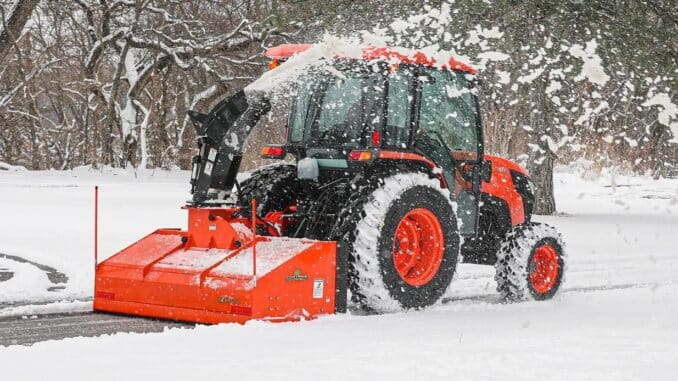
Kubota BX1880 Snow Blower Guide
The Kubota BX1880 can operate a front-mounted snow blower when equipped with the correct hitch, mid-PTO driveline and hydraulic controls. A verified option is the 50-inch Kubota BX2816 two-stage residential snow blower; Kubota also lists the BX2816A in its snow-implement documentation. Buying the blower alone does not provide a complete installation.kubotausa+1
The BX1880’s hydrostatic transmission allows you to reduce travel speed as snow becomes deeper without immediately reducing blower speed. However, attachment compatibility, traction, rear ballast and proper PTO operation matter more than engine horsepower alone.
This guide covers blower selection, mounting requirements, gravel-driveway setup, winter preparation, operating technique, maintenance and troubleshooting.
Kubota BX1880 Snow Blower Compatibility
Start with the tractor’s identification plate and the snow blower’s model and serial numbers. Do not purchase an attachment simply because an advertisement describes it as fitting “Kubota BX tractors.”
The BX1880 is a liquid-cooled, three-cylinder diesel subcompact tractor with four-wheel drive and a two-range hydrostatic transmission. Its rated PTO output is 13.7 horsepower, with a 2,500-rpm mid PTO and a 540-rpm rear PTO. Those two PTO speeds serve different attachment arrangements and are not interchangeable.kubotausa+1
Verified front-mounted equipment
| Component | Verified application or requirement |
|---|---|
| Kubota BX2816 | 50-inch, approximately 127-cm, two-stage residential snow blower listed for the BX1880 |
| Kubota BX2816A | 50-inch two-stage residential snow blower also listed in Kubota snow-implement documentation |
| BX2810 | Four-point front quick hitch |
| BX2811 | Mid-PTO driveline |
| Loader control valve | Required if the tractor does not already have the specified valve; documentation lists BX2417 or BX2417A, depending on the package |
Kubota’s published installation requirements identify the hitch, driveline and applicable loader valve as separate components. Have the dealer verify the correct valve version and any additional hardware against the tractor and attachment serial numbers, particularly when assembling a used package.kubotausa+1
The BX2816 and BX2816A listings describe manual chute rotation and manual chute deflection. Do not assume a used blower includes hydraulic chute rotation, an electric deflector or the components needed to add either feature.kubotausa
Why a BX-series listing is not enough
A general BX attachment list can include equipment intended for several tractor sizes. It does not establish that every listed width or mounting package suits the BX1880.
Kubota’s BX80 implement-limitations document lists a maximum front snow-blower working width of 50 inches and maximum implement weight of 353 pounds, approximately 160 kg, for the BX1880, with a subframe required. Do not substitute a wider blower based solely on a general series brochure or a seller’s horsepower estimate.kubotausa
For a particular tractor, check its operator’s manual and the attachment documentation before purchase. Intake height, attachment weight, operating controls and included mounting components should all be verified rather than inferred from clearing width.
Choosing the Right Snow-Removal Arrangement
A front-mounted blower is useful when you want to clear snow while facing forward and throw it beyond the driveway edge. It can reduce the need to maintain large roadside piles, although wind direction and nearby buildings still determine where discharge is practical.
Different snow-removal arrangements solve different problems.
| Arrangement | Main advantage | Main limitation |
|---|---|---|
| Approved front-mounted blower | Forward-facing operation and controlled snow placement | Requires the correct front hitch, driveline and controls |
| Conventional rear three-point blower | Can leave the front available for other equipment | Usually requires backing into snow and frequent rearward observation |
| Pull-type or inverted rear blower | Clears while the tractor travels forward | Tractor must pass through the snow before the blower reaches it |
| Separate walk-behind blower | Useful for narrow paths and confined areas | Requires a separate engine or battery system and more walking |
| Approved front blade | Effective for pushing manageable snowfalls | Requires space to store pushed snow |
A rear blower’s three-point attachment points do not establish suitability by themselves. Confirm PTO horsepower requirements, 540-rpm operation, weight, driveline length, hitch geometry and operating clearance. Do not assume a rear blower approved for a larger BX model is approved for the BX1880.
A tow-behind blower with its own engine is another distinct category. Its tongue load, towing requirements and controls need separate assessment; it is not equivalent to a PTO-driven three-point implement.
For short paths, steps and tightly enclosed areas, a walk-behind machine may remain useful even when the tractor handles the main driveway. For longer drives, a front-mounted tractor blower can reduce walking and repeated manual maneuvering.
Mounting a Kubota BX1880 Snow Blower
Mount the equipment on a firm, level surface with enough space to align the tractor and attachment without anyone standing between moving components.
Kubota specifies removal of the mid-mount mower deck and bracing to install the BX2810 front hitch. Plan the seasonal changeover rather than assuming the mower and front snow-blower mounting arrangement can remain installed together.kubotausa
Installation sequence
-
Read the tractor, hitch, driveline and blower instructions before removing or fitting components.
-
Park securely, lower installed equipment, stop the engine, remove the key and wait for movement to stop.
-
Remove equipment that conflicts with the specified front-hitch installation.
-
Install the correct hitch and mounting hardware in the prescribed sequence.
-
Fit the specified driveline, checking shaft engagement, retention and guarding.
-
Clean hydraulic couplers before connecting them, following the pressure-relief procedure.
-
Secure hoses and control cables away from rotating shafts, steering movement and pinch points.
-
Install the required ballast and check tire pressures.
-
Test lift and control functions in a clear area before engaging the blower as directed.
Do not improvise shaft adapters, weld mounting brackets or modify guards to make an incompatible assembly fit. Incorrect driveline geometry can damage the PTO, bearings or attachment gearbox.
The first installation is a sensible dealer job if the tractor lacks the required valve, the mounting package is incomplete or the driveline’s identity is uncertain.
Buying a used package
Ask the seller to identify every included component. Check for missing stands, pins, brackets, shaft sections, guards, chute-control parts and hydraulic connections.
Inspect the housing for cracks, bent edges and evidence of auger or impeller contact. Look for damaged shaft splines, leaking gearbox seals, stiff bearings and heavily corroded fasteners.
Replacement parts can turn an apparently inexpensive blower into a costly project. Price the complete, correct installation—not just the blower housing.
Traction and Ballast for the Kubota BX1880
Four-wheel drive helps the tractor move, but it does not guarantee steering control or short stopping distances on ice.
Traction equipment and counterweight perform different jobs. Chains improve tire grip; required rear ballast helps balance the tractor against the weight carried at the front. One does not automatically replace the other.
Selecting chains
Size chains for the tires actually fitted to the tractor. Confirm approval and clearance before purchase, especially around fenders, steering components, hoses and the front driveline.
Cross-chain spacing and chain pattern influence ride quality and grip. Steel chains can mark asphalt, concrete and decorative paving, while rubber traction products have their own fitment and performance limitations.
After fitting chains:
-
Check clearance throughout the permitted steering range.
-
Check tension after initial operation.
-
Remove loose ends that could strike components.
-
Stop immediately if chains slap, rub or shift.
-
Recheck clearance with the attachment fitted and the tractor correctly ballasted.
Do not add wheel spacers merely to create chain clearance unless the configuration is approved.
Choosing counterweight
Use the ballast arrangement specified for the tractor and front attachment. Approved arrangements may involve rear weights or a suitable rear-mounted counterweight, but the required configuration must be verified.
Weight mounted farther behind the rear axle changes balance differently from wheel weights or liquid tire ballast. Excessive ballast can overload components, increase ground pressure and add transport weight.
Keep the blower low during travel while maintaining enough clearance to avoid striking obstacles. Raise it only as much as necessary.
Preparing the Kubota BX1880 for Cold Starts
Reliable blower operation depends on adequate engine power and responsive hydraulic controls. Prepare the tractor before the first significant snowfall rather than diagnosing fuel and battery problems in the driveway.
Diesel fuel and water control
Buy clean, seasonally appropriate diesel from a supplier serving local winter conditions. Summer fuel remaining in the tank can become a problem during a sharp temperature drop.
No. 1 diesel generally provides better cold-flow performance than No. 2, with an energy-content tradeoff. Suitable winter blends depend on expected temperatures and the tractor’s fuel requirements; do not use a universal blending ratio.
Wax formation can restrict the fuel filter as diesel cools. Cloud point concerns the appearance of wax crystals, while filter-plugging performance is particularly important to whether the engine continues receiving fuel.
Inspect and service the fuel-filter or water-separator arrangement fitted to your tractor as instructed. Water can freeze and restrict flow independently of fuel waxing.
If an approved anti-gel treatment is needed, use its specified rate before the fuel gels. Do not assume additional additive will restore a plugged filter, and never add gasoline, alcohol or unapproved solvents.
If fuel flow is already restricted, stop repeated starting attempts. Move the tractor to a safely heated location where practical and follow the approved recovery procedure. Never use a torch or open flame.
Battery and electrical condition
Clean the battery case and terminals, inspect cable connections and grounds, and secure the hold-down hardware. Slow cranking can prevent a diesel from starting even when fuel quality is satisfactory.
Use a charger or automatic maintainer compatible with the installed battery chemistry. Check electrolyte only if the battery is a serviceable flooded design.
Do not charge a frozen, cracked, swollen or leaking battery. Battery damage and persistent electrical faults require professional attention.
Oil, coolant and warm-up
Check engine oil, transmission-hydraulic fluid and coolant using the procedures in the tractor manual. Cold fluid can slow hydraulic response, but that is not a reason to install an unapproved thinner product.
Test coolant freeze protection and inspect the radiator, hoses and clamps with the engine cold. Correct weak protection or contamination before freezing conditions arrive.
Use only an approved starting or engine-heating arrangement. Follow the glow-plug procedure, do not use unapproved starting fluid, and allow the engine and hydraulics to warm gradually without immediately demanding full blower output.
Operating the Snow Blower Effectively
The BX1880’s hydrostatic drive lets you adjust ground speed to match the snow load. Use that control instead of repeatedly forcing the blower into more snow than it can process.
Set the tractor before entering snow
Select the transmission range appropriate to the work and terrain, following the manual’s shifting procedure. Confirm the correct PTO selection and use the specified engagement procedure and operating speed.
Test steering, braking, lift and chute controls before approaching obstacles. Do not enter public roads or discharge across traffic lanes without complying with applicable rules.
Match forward speed to snow conditions
Begin conservatively. Increase travel speed only while the engine maintains normal operation and the blower clears its intake effectively.
For deep, dense or wet snow:
-
Reduce travel speed first.
-
Take narrower overlapping passes.
-
Avoid forcing the entire intake into compacted banks.
-
Clear before repeated traffic packs snow into hard layers.
-
Keep discharge directed away from people, vehicles, buildings and roads.
Throwing distance varies with snow consistency, wind, chute position and feed rate. Wet snow will not necessarily travel as far as light, dry snow.
Do not use the blower housing as a blade to ram frozen banks or break solid ice.
Adjust for gravel and finished surfaces
On gravel, set the skid shoes to leave the scraper above loose material, using the attachment’s adjustment procedure. Early-season clearing may require leaving a protective snow layer rather than scraping to bare stone.
On asphalt and concrete, inspect for raised joints, broken edges and protruding covers. Decorative surfaces may need additional protection, and steel chains can cause damage independently of the scraper setting.
Mark culverts, ditches, driveway edges and other hidden hazards before snowfall. Never use the blower to find the boundary of an unfamiliar surface.
Clear blockages without entering the housing
-
Stop travel and disengage the PTO.
-
Lower the attachment and secure the tractor.
-
Stop the engine, remove the key and wait for all movement to stop.
-
Follow the attachment’s isolation procedure.
-
Use a suitable clean-out tool from a safe position.
Never put a hand or foot into the chute, auger or impeller area. A jammed mechanism can move when stored tension releases.
Visibility and Daily Safety Checks
The BX1880’s open operating position exposes the operator to wind and recirculating snow. Wear insulated, close-fitting clothing, slip-resistant boots, suitable gloves, and hearing and eye protection.
If an enclosure is installed, confirm compatibility with the tractor and attachment controls. Do not drill or weld the ROPS to mount a cab, light or heater. Maintain clear windows, ventilation and access to all controls.
Use the ROPS and seat belt as directed by the tractor manual. Keep passengers off the tractor.
Before starting
-
Clear snow from steps, lights, cooling screens and air-intake areas.
-
Inspect hydraulic hoses, wiring and driveline guards.
-
Check attachment locks, pins, chains and ballast.
-
Verify fluid and fuel levels.
-
Keep bystanders and pets outside the operating area.
While working
Travel slowly enough to stop within the visible clear area. Avoid abrupt steering, braking and direction changes, especially on slopes.
Do not coast downhill or assume hydrostatic drive can overcome poor traction. Stop when visibility, steering or braking becomes unreliable.
At shutdown
Park on firm, level ground, lower the blower and stop the tractor before inspection. Remove packed snow and ice safely, and inspect for damage before it freezes into place.
Connect an approved heater or maintainer only with sound cords and an appropriate electrical supply. Never run the tractor in an enclosed garage.
Kubota BX1880 Snow Blower Troubleshooting
| Symptom | Likely causes | Safe first checks | When professional service is needed |
|---|---|---|---|
| Slow cranking | Low charge, poor connections, battery deterioration | Inspect terminals, grounds and battery condition; charge appropriately | Repeated discharge, damaged cables, starter faults or battery damage |
| Engine starts but loses power | Restricted fuel supply, unsuitable winter fuel, excessive blower load | Reduce travel speed; inspect accessible filters and fuel condition | Persistent restriction, injection faults or abnormal exhaust |
| Repeated clogging | Wet snow, excessive feed rate, obstructed chute | Isolate the machine, clear with a tool and reduce pass width | Repeated plugging despite correct setup or visible internal damage |
| Poor discharge | Low operating speed, overfeeding, wear or obstruction | Confirm specified operating speed and inspect after shutdown | Damaged impeller, bearing problems or gearbox faults |
| Sudden loss of blower drive | Shear-device failure, disengaged connection or drivetrain fault | Stop, isolate and inspect accessible connections and specified shear devices | Repeated failures, damaged shafts or gearbox noise |
| Slow lift response | Cold fluid, low level, restriction or hydraulic fault | Warm gradually and check fluid as instructed | Persistent weakness, high-pressure leaks or abnormal noise |
| Wheelspin or poor steering | Ice, unsuitable traction equipment, incorrect balance | Check chains, tire condition and approved ballast | Unresolved handling problems or damaged running gear |
Replace shear bolts or other protective devices only with the exact specification required by the attachment manual. A stronger substitute can transfer damage into more expensive components.
Never search for a pressurized hydraulic leak with bare hands. Internal hydrostatic faults, high-pressure leaks, structural cracks and complex electrical repairs require qualified service.
Maintenance and Off-Season Storage
Inspect skid shoes, scraper edges, auger components, chute mechanisms, guards and fasteners regularly. Follow the attachment manual for lubrication points, chain adjustment, gearbox checks and service intervals.
Remove salt and treated-snow residue promptly. Avoid directing pressure-washer spray into bearings, seals, electrical connections or ventilation openings.
At the end of the season:
-
Clean and dry the blower thoroughly.
-
Inspect wear parts and repair damage.
-
Lubricate the specified components.
-
Protect exposed metal with suitable products.
-
Cap disconnected hydraulic couplers.
-
Protect driveline ends and retain all guards.
-
Store on approved stands or stable blocking.
-
Keep hoses and controls clear of pinch points.
-
Record parts needed before the next winter.
Never leave the blower suspended by hydraulic pressure. Before reinstalling it, check for corrosion, seized mechanisms, rodent damage and missing hardware.
Kubota BX1880 Snow Blower FAQs
Which snow blower fits the Kubota BX1880?
Kubota lists the 50-inch BX2816 and BX2816A two-stage residential blowers for the BX1880. Confirm the complete mounting package and serial-number applicability before buying, particularly when components come from different used machines.kubotausa+1
What mounting parts are required?
The documented package uses the BX2810 front quick hitch and BX2811 mid-PTO driveline. The appropriate loader valve is also required if not already installed, with its exact version verified for the tractor.kubotausa
Can the mower stay installed with the front snow blower?
Kubota specifies removing the mid-mount mower deck and bracing for BX2810 hitch installation. Follow the installation instructions for the complete seasonal changeover.kubotausa
Can I use a larger BX-series blower?
Do not assume so. The BX1880’s published front-blower limit is 50 inches, and series-wide attachment advertising does not override model-specific limits.kubotausa
Is rear ballast still necessary with tire chains?
Chains and ballast serve different purposes. Follow the specified counterweight arrangement even when chains provide adequate forward traction.
Can the blower clear a gravel driveway?
It can be set up to reduce gravel pickup by raising the scraper with the skid shoes. Loose stones remain a discharge hazard, especially before the driveway develops a firm winter base.
Why does the blower clog in wet snow?
The blower may be receiving snow faster than it can discharge it, or the chute may be obstructed. Reduce travel speed and pass width, and clear blockages only after complete shutdown and isolation.
What should I do if the auger suddenly stops?
Disengage the PTO, stop the engine and isolate the attachment before inspecting it. Check only the accessible components identified in the manual; repeated shear-device failures or damaged driveline parts need further diagnosis.
Priorities Before the Next Snowfall
Verify the complete blower package, establish the required ballast arrangement and test all controls before working near buildings or traffic. Resolve fuel restrictions, weak starting, driveline noise and hydraulic leaks before putting the tractor under sustained load.
Keep the tractor and attachment manuals available for operating speeds, adjustments, lubrication and shutdown procedures. Correct fitment and controlled feeding are more useful than trying to push through a heavy snowfall faster.
