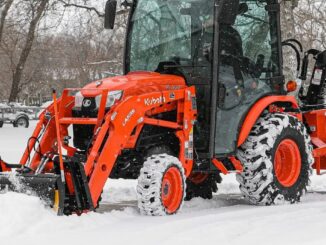

Kubota BX2750B Snow Blower Guide
The Kubota BX2750B is a 50-inch front-mounted tractor snow blower, not a walk-behind machine or rear three-point attachment. Its usefulness depends on having the correct tractor-specific front mounting system, PTO drive components, lift arrangement, and controls—not simply owning a Kubota BX tractor.messicks+1
For owners clearing driveways, parking areas, and property access routes, the front-mounted layout provides a clear view of the intake while working forward. For used-equipment buyers, missing mounting and driveline components can be more important than the condition of the blower housing.
This guide explains how to evaluate compatibility, inspect a used BX2750B, prepare the tractor, manage traction, clear different surfaces, and maintain the attachment safely.
Kubota BX2750B Specifications and Basic Design
The BX2750B belongs to Kubota’s tractor-mounted snow-blower attachment range. It has no engine of its own: power comes from the host tractor through the appropriate PTO driveline.
| Item | BX2750B configuration or purchasing consideration |
|---|---|
| Equipment type | Front-mounted tractor snow blower |
| Nominal clearing width | 50 inches, approximately 127 cm |
| Snow-handling design | Two-stage: an auger gathers snow and an impeller discharges it |
| Power arrangement | Tractor PTO through the appropriate mounting and drive system |
| Mounting | Requires a compatible front hitch or subframe arrangement |
| Chute equipment | Parts documentation includes a chute with deflector and manual chute-rotation components |
| Identification | Match the complete model designation and serial number before ordering parts |
The 50-inch front-mounted designation and chute components are documented for the BX2750B; period equipment listings identify it as a two-stage blower.messicks+1
Do not substitute BX2750, BX2750A, BX2750C, or BX2750D information without checking applicability. Similar model names do not establish identical driveline components, maintenance instructions, or replacement parts.
Confirm intake height in the correct attachment manual. It is not a promise that the blower can process a full-height bank of wet or compacted snow in one pass.
Kubota BX2750B Compatibility: Check the Complete System
Compatibility must be established for the tractor, mounting hardware, and driveline together. A seller’s statement that the attachment “fits a BX” is not sufficient.
Kubota’s parts listings distinguish BX2750B serial-number applications. Tractor parts catalogs also identify different mounting arrangements: examples include BX2751 quick-hitch and BX2752-series mid-PTO components in BX1800 and BX2200 attachment listings, while BX1500 listings include BX2711 and BX2712-series equipment. These listings identify components to investigate, not universal interchangeability.shop.kubotausa+3
Information to collect before buying
Record:
-
Tractor model and serial number.
-
Snow-blower model and serial number.
-
Front hitch or subframe identification.
-
PTO drive-kit identification.
-
Included shafts, supports, locking pins, and guards.
-
Lift connections and hydraulic couplers.
-
Chute crank, support brackets, and deflector hardware.
-
Any tractor-side brackets still attached to the seller’s machine.
Have an authorized dealer verify the complete combination before purchasing missing parts.
PTO, hydraulic, and electrical requirements
The blower’s rotating mechanism uses mechanical PTO power. The mounting system’s lift connections must also match the tractor.
Confirm the specified PTO source, operating speed, shaft arrangement, rotation requirements, and coupling method in the matching manuals. Do not treat it as a conventional rear-PTO implement or adapt it using an arbitrary shaft.
Inspect any electric or hydraulic chute conversion separately. Its presence does not establish factory approval, correct wiring, suitable hose routing, or compatibility with your tractor.
Why shaft fit matters
A shaft that connects at rest may still be unsuitable. Incorrect length or geometry can cause binding, inadequate engagement, or interference as the attachment moves.
Do not shorten, extend, weld, or otherwise modify driveline parts merely to make the attachment fit. Uncertain shaft selection requires qualified assistance.
Inspecting a Used BX2750B
Evaluate completeness before appearance. Fresh paint cannot compensate for missing drive equipment, a twisted housing, or damaged mounting points.
With the attachment securely supported and disconnected from power, inspect:
-
Housing panels and mounting areas for cracks, distortion, or previous repairs.
-
Auger flights for bends, cracks, and contact marks.
-
Accessible impeller areas for damage.
-
Bearings and shafts for obvious looseness.
-
Drive components for leaks, damaged guards, and abnormal play.
-
Skid shoes and scraper edge for uneven or excessive wear.
-
Chute rotation and deflector adjustment for binding.
-
PTO joints, locking devices, and protective shields.
-
Lift hardware, pins, clips, hoses, and couplers.
-
Safety labels and clean-out equipment.
Do not reach into the intake or discharge opening to test movement. Packed material or loaded components can move unexpectedly.
If the seller demonstrates operation, remain clear of the intake, discharge, and driveline. Persistent vibration, grinding, knocking, or housing contact warrants stopping the test.
Structural cracks, bent shafts, and improvised mounting repairs deserve professional evaluation before purchase.
Mounting the Kubota BX2750B Safely
Install the attachment on firm, level ground with enough room to align components without standing between moving equipment.
The following is a preparation sequence, not a substitute for the mounting instructions:
-
Confirm that the tractor, hitch, drive kit, and blower are an approved combination.
-
Park securely, lower equipment, disengage the PTO, stop the engine, and remove the key.
-
Relieve hydraulic pressure as directed before connecting or disconnecting hoses.
-
Inspect and install the specified mounting components and locking hardware.
-
Connect the correct PTO driveline and verify its locking mechanism.
-
Connect the lift arrangement and controls without pinching hoses or restricting movement.
-
Install every required guard and shield.
-
Check the permitted range of movement for interference before operating.
Follow the tractor instructions for removing or retaining other equipment. Do not assume that the loader, mower deck, front hardware, and snow-blower driveline can remain installed together.
Keep hands away from coupling pinch points. Never work beneath an attachment supported only by hydraulic pressure.
Traction, Ballast, and Tractor Balance
A front snow blower changes the tractor’s weight distribution. Tire traction and rear counterweight address different problems.
Chains may improve grip, but they do not automatically provide the rear ballast required for a front attachment. Likewise, adding weight does not guarantee adequate steering or braking on ice.
Select traction equipment carefully
For chains or other approved traction aids, verify:
-
Exact tire size.
-
Clearance around fenders, steering components, hoses, and other equipment.
-
Clearance throughout the permitted range of movement.
-
Tractor restrictions on front or rear installation.
-
Potential damage to concrete, asphalt, pavers, and decorative surfaces.
Different chain patterns produce different ride and grip characteristics. Choose only equipment that fits the tractor and operating surface rather than assuming a more aggressive chain is always better.
Stop immediately if a chain strikes the machine.
Use approved ballast
Consult the tractor and attachment instructions for ballast type, amount, and placement. Approved options may differ between tractor configurations.
Rear-mounted ballast affects leverage and maneuverability differently from wheel weights or liquid tire ballast. A rear implement also increases overall length and can strike obstacles during turns.
Do not select ballast solely by matching the blower’s weight. Excessive weight can overload tires, axles, mounting points, or transport equipment.
Four-wheel drive does not eliminate longer stopping distances or the need for careful speed control.
Operating the Kubota BX2750B on Different Surfaces
The best results come from controlling the rate at which snow enters the housing. Reduce ground speed or take a narrower cut when the blower begins to overload.
Use the specified PTO operating procedure. Do not compensate for excessive travel speed by allowing the engine to labor continuously.
Asphalt and concrete
Set skid shoes and scraper clearance using the attachment instructions. Consider uneven slabs, raised joints, drain covers, and repaired pavement.
Avoid forcing the scraper into irregular surfaces. Stop and reset the attachment if it catches repeatedly rather than driving through the obstruction.
Gravel driveways
Gravel presents a projectile hazard. Adjust the blower to leave suitable clearance above loose material, recognizing that stones can still enter the housing.
During early-season clearing, preserve a protective snow layer where practical. Do not scrape aggressively into unfrozen gravel.
Direct discharge away from people, vehicles, buildings, livestock, and roads.
Wet snow, drifts, and plow banks
Wet snow and compacted banks can require substantially slower travel than loose snow.
-
Take narrower passes when discharge weakens.
-
Approach plow deposits cautiously because they may conceal ice and debris.
-
Avoid ramming the housing into compacted banks.
-
Stop if the tractor loses steering control or the blower vibrates.
-
Use another appropriate removal method when the material exceeds the attachment’s capabilities.
Do not assume frozen banks will break apart safely because ordinary snow passes through the blower.
Plan the discharge route
Choose a discharge direction before engaging the blower. Account for wind, nearby traffic, parked vehicles, and areas where thrown snow could create a hazard.
Keep the discharge area clear even when visibility is good. Never rotate the chute across bystanders.
A separate walk-behind blower may be more practical for narrow paths and confined entrances. A correctly equipped tractor-mounted blower is better suited to areas with enough space for its width, turning radius, and discharge clearance.
Prepare the Tractor for Snow-Blower Work
The BX2750B is unpowered by itself. Engine, battery, coolant, and transmission maintenance belong to the host tractor and must follow that tractor’s manual.
Fuel and cold starting
For a compatible diesel tractor, use clean, seasonally appropriate fuel. Summer fuel left in the tank can create cold-flow problems when temperatures fall.
Inspect the fuel-water separator where fitted, and service filters when required. Use only approved fuel treatments at the specified rate, normally before cold-flow problems develop.
If fuel restriction or gelling is suspected, stop and use an approved recovery procedure. Do not add gasoline, alcohol, or unapproved solvents.
Follow the prescribed preheat and starting sequence. Do not use starting fluid unless the tractor manufacturer expressly permits it.
Battery, fluids, and coolant
Check battery terminals, cables, grounds, and hold-down hardware. Use a maintainer suitable for the installed battery chemistry, and do not charge a frozen, leaking, swollen, or damaged battery.
Confirm that engine oil, transmission fluid, hydraulic fluid, and grease meet the tractor’s requirements for the expected conditions. Cold, sluggish response is not a reason to mix in an unapproved thinner fluid.
For the host tractor’s liquid-cooling system, check coolant level safely and test freeze protection. Inspect any approved engine heater and electrical cord before use.
Warm the tractor gradually according to its manual. Confirm steering, braking, lift, and transmission response before engaging heavy loads.
Daily Snow-Blower Operating Checklist
Before starting
-
Inspect the work area for hidden obstacles and overhead discharge hazards.
-
Check mounting locks, driveline guards, and visible fasteners.
-
Inspect skid shoes, scraper wear, and chute movement.
-
Check tires, chains, and ballast security.
-
Clear steps, lights, windows, cooling screens, and air intakes.
-
Check applicable tractor fluids and fuel.
-
Confirm that nobody is near the attachment.
During warm-up and work
-
Follow the specified PTO engagement procedure.
-
Test attachment lift and control response in a clear area.
-
Travel slowly enough to maintain steering and braking control.
-
Avoid abrupt turns, direction changes, and shock loading.
-
Keep the attachment low during transport as instructed.
-
Stop for abnormal vibration, noise, or reduced visibility.
Use ROPS and the seat belt as directed by the tractor manual. Never modify ROPS to accommodate a weather enclosure.
An enclosure is not automatically a heated cab. Keep its windows clear and preserve ventilation and visibility. Wear close-fitting insulated clothing, suitable footwear, and gloves that allow precise control.
At shutdown
Park on firm, level ground, lower the attachment, disengage the PTO, stop the engine, and remove the key.
Once movement has stopped, remove accumulated snow and inspect for damage. Do not leave the blower suspended overnight or rely on hydraulic pressure as a storage support.
Clearing Blockages and Replacing Shear Hardware
A stopped engine does not guarantee that packed snow or loaded components cannot move.
Before clearing a blockage:
-
Disengage the PTO.
-
Lower the attachment and secure the tractor.
-
Stop the engine and remove the key.
-
Wait for all rotating components to stop.
-
Use the prescribed clean-out tool from a safe position.
Never use hands or feet inside the intake, impeller housing, or chute.
If shear hardware has failed, identify and remove the obstruction safely before replacement. Use the exact specified hardware for that location and serial-number application.
Do not substitute a harder bolt, random fastener, or welded connection. Repeated failures require investigation rather than stronger hardware.
Kubota BX2750B Troubleshooting
Perform checks only after shutdown and isolation unless the manual specifically requires a controlled running test.
| Symptom | Likely causes | Safe first checks | When professional service is needed |
|---|---|---|---|
| Repeated clogging | Wet snow, excessive feed rate, restricted chute, inadequate operating speed | Isolate power, clear with a tool, check chute, reduce travel speed | Clogging persists with unusual noise or suspected internal damage |
| Weak discharge | Overfeeding, worn components, blockage, incorrect operating procedure | Check the prescribed PTO setting and inspect accessible areas after shutdown | Suspected gearbox, impeller, or driveline fault |
| Unexpected loss of drive | Failed shear hardware, disconnected coupling, damaged drive component | Stop immediately; inspect guards, couplings, and specified shear locations | Shaft damage, gearbox noise, or repeated failure |
| Heavy vibration | Ice buildup, bent rotating parts, loose hardware, bearing damage | Shut down and inspect without reaching into the housing | Vibration remains after safe cleaning or damage is visible |
| Blower catches pavement | Incorrect skid setting, uneven surface, worn scraper | Recheck adjustment and inspect the surface | Housing distortion or mounting damage |
| Stones in discharge | Inadequate gravel clearance, loose surface material | Stop and adjust clearance appropriately | Adjustment cannot be maintained because of damage |
| Wheelspin or poor steering | Ice, unsuitable tires, incorrect balance, excessive load | Check approved traction and ballast arrangements; reduce load | Steering, axle, or drivetrain fault is suspected |
| Slow attachment lift | Cold fluid, low level, connection problem, hydraulic fault | Follow warm-up instructions and inspect connections safely | Persistent weakness or any high-pressure leak |
| Chute difficult to turn | Ice, corrosion, binding linkage, damaged components | Isolate power, remove accessible ice, inspect linkage | Bent controls, damaged gearing, or unsafe modifications |
Never check a hydraulic leak with bare hands. High-pressure injection injuries require immediate medical attention.
Maintenance and Off-Season Storage
Follow the BX2750B manual that matches the serial number. Do not borrow lubrication intervals, lubricant specifications, or adjustment values from a similarly named blower.
Routine owner maintenance
Suitable owner tasks include:
-
Cleaning and drying the attachment.
-
Inspecting wear surfaces, guards, and visible fasteners.
-
Lubricating designated points with the specified product.
-
Checking accessible driveline locks and shields.
-
Maintaining chute movement.
-
Replacing approved wear parts and shear hardware when the procedure is understood.
Gearbox repair, bearing replacement requiring special tools, shaft straightening, structural welding, and uncertain driveline work belong with a qualified technician.
End-of-season storage
-
Clean away snow residue, road salt, grit, and dirt.
-
Allow the attachment to dry fully.
-
Inspect skid shoes, scraper edge, bearings, guards, and mounting points.
-
Lubricate the specified components.
-
Protect bare metal and repair damaged coatings appropriately.
-
Disconnect and protect hydraulic couplers and electrical connectors where fitted.
-
Store the attachment on approved stands or stable blocking on a firm surface.
-
Record repairs and missing parts before the next season.
Do not direct high-pressure water into bearings, seals, or gear housings. Store under cover where possible without trapping moisture.
Before reinstalling, remove covers and temporary protection, inspect for rodents and corrosion, reinstall guards, and verify all mounting locks. Test operation in a clear area and stop immediately if vibration or abnormal noise appears.
Kubota BX2750B FAQs
Will the BX2750B fit every Kubota BX tractor?
No. Compatibility depends on the tractor, mounting system, drive kit, and attachment configuration. Verify the complete combination using both serial numbers before purchasing or installing it.
What mounting components should come with a used blower?
Check for the correct hitch or subframe, tractor-side brackets, PTO drive components, lift connections, locking hardware, guards, and chute controls. Missing tractor-side equipment can make an otherwise sound blower expensive to install.
Is it a rear three-point snow blower?
No. The BX2750B is a front-mounted attachment. A rear three-point blower uses a different mounting and driveline arrangement and is not interchangeable with it.
Can it clear a gravel driveway?
Yes, provided conditions and adjustments allow safe operation. Set suitable clearance, avoid scraping into loose gravel, and recognize that stones can still be thrown from the discharge.
Does it need chains and rear ballast?
Those are separate decisions. Chains address traction; approved ballast addresses machine balance and loading. Follow the tractor and attachment requirements rather than prescribing one setup for every BX.
Why does it keep clogging in wet snow?
Excessive feed rate, restricted discharge, and incorrect operating speed can contribute. After safely clearing the blockage, reduce travel speed or cutting width. Persistent poor performance requires inspection for wear or drive problems.
Can a stronger bolt replace a broken shear bolt?
No. Use only the specified replacement hardware. A stronger fastener can defeat the intended protection and transfer damage into more expensive components.
How should it be stored after winter?
Clean, dry, inspect, and lubricate it, then support it securely on an appropriate surface or stable blocking. Protect couplers and exposed metal, and never store it raised on hydraulic pressure.
Resolve Fit and Drive Problems Before Snowfall
For the BX2750B, prioritize a verified mounting combination, complete guarded driveline, correct shear hardware, sound wear components, and appropriate tractor balance.
Use the matching tractor, mounting-kit, and attachment manuals together. Resolve missing parts, vibration, hydraulic faults, and questionable modifications before the next snow-removal job.