Kubota LX Snowblowers: Models, Parts, Repairs, and Owner’s Guide
Kubota LX tractors can operate matched front snowblowers, suitable rear-mounted snowblowers, blades, and loader-mounted snow-removal attachments. The correct equipment depends on the exact tractor configuration, PTO provision, hitch, driveline, hydraulic controls, and ballast—not simply the LX name.
The most important distinction for owners is compatibility between standard, Special Utility, cab, ROPS, and narrow configurations. Kubota specifically positions LX Special Utility models for work that does not require a mid-PTO, such as loader operation and rear-implement use. Do not assume an SU tractor can operate the front snowblower package shown on a standard LX.kubotausa
This guide covers current and legacy US LX models, snowblower identification, replacement parts, routine repairs, troubleshooting, and used-equipment inspections. Keep the tractor and attachment manuals together: the tractor parts catalog will not identify every component in a complete snowblower installation.
Kubota LX Tractor Models Sold in the USA
The US LX range includes the original LX10 models and the later LX20 family. Each includes configurations that must be distinguished when ordering parts or selecting winter attachments.
Legacy LX10 models
| Full model designation | Configuration | Main snow-removal consideration |
|---|---|---|
| LX2610HSD | Hydrostatic tractor with ROPS | Verify front hitch, mid-PTO driveline, controls, and ballast |
| LX2610HSDC | Hydrostatic tractor with factory cab | Check cab-specific driveline and control installation |
| LX2610SUHSD | Special Utility hydrostatic tractor with ROPS | Do not assume standard-model mid-PTO or front snowblower capability |
| LX3310HSD | Hydrostatic tractor with ROPS | Match blower package, hydraulic controls, and tractor equipment |
| LX3310HSDC | Hydrostatic tractor with factory cab | Verify cab application and all tractor-side components |
These five configurations appear in Kubota’s original US LX brochure and associated workshop-manual applications. The LX2610SU is a separate equipment configuration, not simply an LX2610 with different decals.kubotausa+1
The LX3310 also uses a common-rail diesel engine, a meaningful distinction when diagnosing fuel-system and emissions-related problems. Its repair procedures should not be borrowed from the LX2610 solely because the tractors belong to the same family.kubotausa
Current LX20 models and configurations
| Full model designation | Configuration | Main snow-equipment checks |
|---|---|---|
| LX2620HSD | Hydrostatic, ROPS | Correct front hitch, PTO driveline, valve equipment, and blower |
| LX2620HSDC | Hydrostatic, factory cab | Cab-specific installation details and control routing |
| LX2620SUHSD | Special Utility, hydrostatic, ROPS | Verify rear-implement application; do not assume front PTO equipment |
| LX3520HSD | Hydrostatic, ROPS | Complete front attachment package and installed PTO equipment |
| LX3520HSDC | Hydrostatic, factory cab | PTO equipment, cab installation, controls, and ballast |
| LX3520SUHSDC | Special Utility, hydrostatic, factory cab | SU-specific equipment limitations despite the cab |
| LX4020HSD | Hydrostatic, ROPS | Tractor-specific hitch, driveline, controls, and attachment limits |
| LX4020HSDC | Hydrostatic, factory cab | Cab application, PTO equipment, and correct attachment package |
| LX3520DTN | Narrow specialty tractor | Separate transmission, clearance, stability, and attachment approval |
Kubota’s current US LX20 brochure identifies these configurations. The main product page groups the family under LX2620, LX3520, and LX4020, so the full designation remains essential when requesting parts.kubotausa+1
The LX3520DTN is particularly important to keep separate. It is a narrow specialty configuration, not the ordinary hydrostatic LX3520 in a narrower tire setting. Do not extend standard-model snowblower approval to it without specific documentation.kubotausa
Related B-Series tractors are not LX models
Owners sometimes encounter listings that combine B and LX tractors because certain attachments or related designs appear across both families.
That does not make a B2650 or B3350 an LX tractor, nor does it establish that its front hitch, PTO shafts, or control kits interchange. Identify the machine from its plate, not from a seller’s statement that it is “basically the same.”
Identify Your Kubota LX Snowblower System Before Ordering Parts
A complete front snowblower installation contains several independently identifiable assemblies.
Record these details
Create an equipment record containing:
-
Tractor model and serial number.
-
Snowblower model and serial number.
-
Front hitch or subframe identification.
-
Mid-PTO and connecting driveline identification.
-
Intermediate shaft and support-bearing details.
-
Chute-rotation kit identification.
-
Deflector-control kit identification.
-
Hydraulic valve and coupler arrangement.
-
Loader model, if fitted.
-
Cab or ROPS configuration.
Photograph identification plates and the installed components before dismantling anything. Include the shaft connections, support brackets, hose routing, and wiring.
Use the right document for the job
| Document | What it establishes |
|---|---|
| Tractor operator’s manual | Safe operation, routine maintenance, fluids, and normal checks |
| Tractor workshop manual | Diagnosis, repair procedures, measurements, and service specifications |
| Snowblower operator’s manual | Attachment operation, adjustments, maintenance, and safety |
| Snowblower parts catalog | Component identification and serial applicability |
| Front-hitch instructions | Mounting parts, assembly, locks, and tractor application |
| PTO-kit instructions | Shaft arrangement, supports, guards, and installation |
| Chute-control instructions | Accessory-specific hydraulic or electrical components |
Dealer manual listings separate the original LX2610/LX3310 family, LX2620/LX2620SU, and LX3520/LX4020 workshop literature. Selecting the correct manual is part of selecting the correct repair procedure.messicks
An exploded drawing is useful for identifying components. It does not necessarily explain safe removal, bearing fits, shaft alignment, seal installation, or torque.
Kubota LX Front Snowblower Models
The principal LX snowblower models owners are likely to encounter include the LX2963, LX2970, and LX2980.
Kubota’s LX product page identifies 63-inch residential, 51-inch commercial, and 64-inch commercial front snowblower options. These categories should be matched to the exact attachment model and installation package rather than treated as universal LX fitment.kubotausa
LX2963 residential snowblower
The LX2963 is identified as a 63-inch residential snowblower in Kubota’s LX implement parts catalog.kubotausa
For owners, the main identification points are:
-
Blower serial number.
-
Applicable parts-catalog revision.
-
Installed chute controls.
-
Hitch and driveline package.
-
Tractor configuration.
“Residential” does not mean maintenance-free. The housing, bearings, protective fasteners, drive components, and cutting parts still need regular inspection.
LX2970 commercial snowblower
The LX2970 is marketed as a 51-inch commercial two-stage front snowblower with hydraulic chute rotation and manual deflection.acmekubota+1
Parts listings distinguish serial-specific LX2970 applications. Use the complete serial number when ordering rather than assuming all LX2970 components remained unchanged.germanbliss
A narrower commercial blower should not automatically be regarded as a lighter or less demanding installation. Confirm actual weight, power requirements, and tractor approval.
LX2980 commercial snowblower
The LX2980 is marketed as a 64-inch commercial two-stage front snowblower. Dealer listings associate it with selected B and LX tractor applications, but the complete mounting and drive arrangement still needs confirmation.lochenequipment+1
Do not assume the LX2963 and LX2980 share internal parts because their clearing widths are similar.
Snowblower identification table
| Attachment | Published category | Owner’s parts priority |
|---|---|---|
| LX2963 | 63-inch residential | Exact serial application, drive components, wear parts, control kit |
| LX2970 | 51-inch commercial | Serial-specific catalog, hydraulic rotation components, shafts and bearings |
| LX2980 | 64-inch commercial | Complete model and serial identification; do not substitute LX2963 parts by appearance |
These are established LX attachment models, not a promise that every version fits every LX tractor.kubotausa+2
Front Hitch, Mid-PTO, and Driveline Compatibility
Front snowblower selection begins at the tractor, not at the blower housing.
Standard tractors versus SU models
Before buying a front blower, establish:
-
Whether the tractor has the required mid-PTO equipment.
-
Whether that equipment is standard, optional, or unavailable for the configuration.
-
Which front hitch applies.
-
Which connecting driveline applies.
-
Whether the required control valve is installed.
-
Whether other equipment must be removed.
Kubota describes SU models as an alternative for owners who do not need mid-PTO applications such as mid-mount mowers and front snow implements. A factory cab on an SU tractor does not remove that distinction.kubotausa
Do not assume a mid-PTO conversion is possible or economical. Obtain written confirmation for the exact tractor.
ROPS and cab installations
A cab can change shaft routing, support components, control mounting, and access.
Never order a driveline solely from a photograph of another LX. Confirm the tractor model, cab configuration, hitch generation, and installation instructions.
Inspect the hitch and mounting points
With the attachment lowered and power isolated, inspect:
-
Locking mechanisms.
-
Pins and retainers.
-
Subframe mounts.
-
Loose fasteners.
-
Elongated holes.
-
Bent brackets.
-
Cracked welds.
-
Lift-cylinder attachments.
-
Evidence of contact with tractor components.
A hitch that still lifts the blower may be unsafe if its locks or mounting points are worn.
Structural cracks, damaged mounting points, and improvised welding require professional assessment.
Inspect the complete PTO power path
Check the manual-listed service points from the tractor to the attachment:
-
PTO connection.
-
Intermediate shaft.
-
Support bearings.
-
Universal joints.
-
Telescoping sections.
-
Coupler locks.
-
Blower input shaft.
-
Guards and restraints.
Look for rust staining, loose supports, damaged splines, displaced retainers, and rubbing marks.
Do not operate the system with guards removed to watch the shaft. Dynamic diagnosis requires an approved service procedure.
Kubota LX Snowblower Wear Parts and Routine Repairs
A preseason inspection should identify wear before it damages the housing, gearbox, or shafts.
Skid shoes
Inspect for:
-
Uneven wear.
-
Worn-through metal.
-
Loose mounting hardware.
-
Distorted brackets.
-
Different settings from side to side.
Adjust clearance for the surface using the attachment manual. Gravel needs particular care because loose stones can enter the housing and be thrown.
If the blower consistently digs into the ground, check setup and wear before blaming tractor power or traction.
Cutting edge
Replace or reverse the cutting edge where the design permits before wear reaches the housing or mounting holes.
Check the bolt pattern and edge specification against the exact blower. A strip of similar width is not necessarily an appropriate replacement.
Inspect the surrounding housing for distortion if the edge has struck an obstacle.
Shear bolts and protective fasteners
Use the specified fastener at every protected location.
Do not install a stronger bolt to stop repeated failures. An unsuitable bolt may defeat the protection system, while an incorrectly sized substitute may fail prematurely or damage the holes.
Keep approved spares labeled by location. The auger and driveline should not be assumed to use identical hardware.
Auger and impeller
With power isolated and all movement stopped, inspect for:
-
Bent flights.
-
Cracked welds.
-
Loose hardware.
-
Wrapped debris.
-
Housing-contact marks.
-
Damaged impeller blades.
-
Abnormal shaft movement.
Never reach into the auger, impeller, or discharge chute. Stored mechanical energy can move components after power is disconnected.
Cracked, distorted, or repeatedly vibrating rotating assemblies need proper assessment before reuse.
Bearings and bearing supports
Look for loose flanges, displaced seals, corrosion, damaged retainers, and excessive movement.
A failed bearing may be the result of a bent shaft, misalignment, water entry, or a distorted housing. Replacing only the bearing can leave the original cause unresolved.
Bearing replacement may require pullers, a press, controlled support, and the correct installation method. Do not hammer a new bearing into place without understanding how the assembly is designed.
Gearbox, Chain, and Shaft Repairs
Identify the actual drive arrangement before applying maintenance advice. A procedure for another Kubota blower may not suit an LX attachment.
Gearbox inspection
Check for:
-
Leakage around seals and joints.
-
Damaged housings.
-
Loose mounting hardware.
-
Abnormal shaft movement.
-
Unusual noise.
-
Contaminated lubricant.
-
Damaged vents or breathers, where fitted.
Use the specified lubricant and level-checking procedure. Do not fill a casing completely or substitute grease for oil unless the attachment manual explicitly requires it.
Milky lubricant, metal particles, recurring leakage, or shaft movement warrants further diagnosis.
Chain-driven components, where fitted
Inspect chains, sprockets, tensioners, alignment, retaining hardware, and guards.
Use the manual’s adjustment procedure. An overtight chain can load bearings and shafts; excessive slack can produce impact, noise, and derailment.
Assess worn chains and sprockets together rather than installing a new chain on badly worn teeth.
Shaft and spline damage
Check for twisting, cracks, excessive wear, loose keys, and damaged retaining grooves.
Do not weld or reshape a damaged PTO shaft as a routine repair. Shaft balance, alignment, guarding, and strength are safety-critical.
Internal gearbox work and shaft replacement may require specialist tools and service measurements.
Chute Rotation and Deflector Repairs
A chute that will not move may have a control fault, a mechanical obstruction, or both.
Hydraulic chute rotation
Before assuming the motor or valve has failed:
-
Check for ice and packed snow.
-
Inspect accessible hose routing.
-
Confirm couplers are connected correctly.
-
Look for external leakage.
-
Check that the chute mechanism is not mechanically jammed.
Relieve pressure only by the prescribed procedure. Never loosen a pressurized fitting to “see whether oil comes out.”
Pressure testing, motor diagnosis, and valve repair require suitable equipment and skills.
Manual deflector mechanisms
Inspect pivots, locking hardware, cables or linkage where fitted, and ice buildup.
Do not force a frozen mechanism. Thaw it safely, isolate power, and inspect for distortion before adjustment.
Electric accessories
Where an electric control kit is fitted, inspect:
-
Correct fuse.
-
Ground connection.
-
Connector corrosion.
-
Chafed wiring.
-
Switch condition.
-
Motor or actuator mounting.
-
Mechanical binding.
Never fit a larger fuse to overcome repeated failure. Identify the accessory kit before ordering a motor, switch, actuator, or harness.
Rear Snowblowers for Kubota LX Tractors
A suitable rear blower may be an option for owners who want to retain the loader or whose tractor does not have the required front PTO equipment.
However, rear compatibility still requires more than an engine-horsepower match.
Check the complete rear installation
Verify:
-
Rear PTO speed.
-
Available PTO power.
-
Hitch category and geometry.
-
Implement weight.
-
Lift capacity at the relevant position.
-
PTO shaft length and overlap.
-
Clearance throughout hitch movement.
-
Stabilizer adjustment.
-
Required front ballast.
An incorrectly sized PTO shaft can bind or separate as the hitch moves. Shaft sizing should follow the implement instructions and be completed by someone competent to make the measurements.
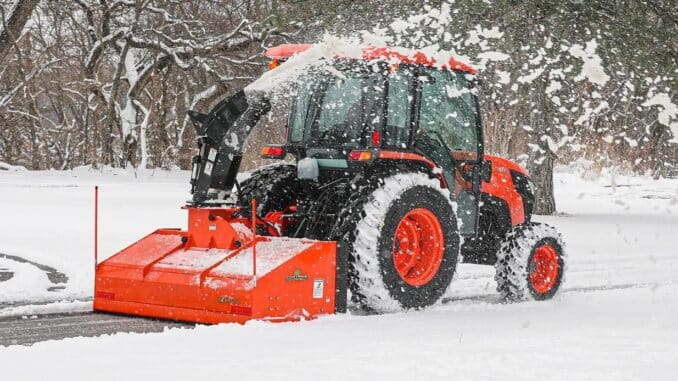
Conventional and pull-type blowers
A conventional rear blower normally clears while reversing. A pull-type blower clears while traveling forward after the tractor passes through the snow.
Consider drift depth, ground clearance, traction, reversing distance, and operator visibility. A forward-travel arrangement is not automatically the best choice for opening deep, untouched drifts.
SU tractors and rear equipment
An SU tractor’s lack of the required front PTO arrangement does not by itself prevent rear-implement use. Kubota specifically positions these tractors for loader and rear-implement applications. The individual rear blower must still be approved for the tractor’s capabilities.kubotausa
Blades, Pushers, and Loader Snow Attachments
A snowblower is useful when snow must be thrown beyond the clearing route. A blade or pusher can be more practical where there is adequate room to store it.
Front hitch-mounted blades
Kubota lists a 60-inch front blade among LX attachment options. Confirm the applicable hitch, hydraulic controls, and installation instructions.kubotausa
Inspect pivots, cutting edges, shoes, angle cylinders, hoses, and any spring-loaded trip mechanism.
Do not adjust loaded springs by guesswork.
Loader-mounted pushers and blades
Identify the loader and its attachment interface separately from the tractor.
Check:
-
Coupler compatibility.
-
Attachment weight.
-
Loader capacity and operating limits.
-
Visibility.
-
Hydraulic requirements, where applicable.
-
Clearance around the tractor.
Do not ram frozen piles. Keep the attachment low during travel and watch for hidden curbs, drains, and obstacles.
Rear blades and spreaders
A suitable rear blade can handle lighter clearing and cleanup. A spreader can support ice-control work, but loaded material weight and corrosive residue require attention.
Confirm hitch or mounting approval, electrical demand where applicable, material compatibility, and local de-icing restrictions.
Clean salt residue promptly and lubricate as instructed.
Tires, Chains, and Ballast for LX Snow Removal
Traction and balance are related but different.
Chains may improve grip. Ballast establishes the weight distribution required for steering, braking, stability, and attachment operation.
Chain installation
Before fitting chains:
-
Confirm the installed tire size.
-
Check tractor approval.
-
Verify fender and chassis clearance.
-
Check steering clearance.
-
Inspect proximity to hoses and brake components.
-
Follow fitting and retensioning instructions.
Stop if chains strike the machine. Chains may damage paved or decorative surfaces, and four-wheel drive does not prevent sliding on ice.
Ballast selection
Use the specified arrangement for the tractor and attachment.
Wheel weights, liquid tire ballast, suitcase weights, and a ballast box do not necessarily produce equivalent balance. A loader or backhoe should not be assumed to replace prescribed counterweight.
Excess ballast can overload tires, axles, bearings, or the transport trailer. Include the complete winter setup when calculating transport weight.
Cold-Weather Maintenance for Kubota LX Owners
All LX tractors discussed here are diesel-powered, but engine management, emissions equipment, PTO provision, and service procedures vary.
Winter diesel and water contamination
Use clean fuel suited to expected temperatures.
No. 2 diesel generally offers higher energy content, while No. 1 diesel and approved winter blends can provide better severe-cold flow characteristics. Wax crystals can restrict filters before fuel appears completely solid.
Use approved anti-gel at the specified rate before cold-flow problems develop. Do not add gasoline, alcohol, or unapproved solvents.
Drain accumulated water as instructed and investigate repeated contamination rather than repeatedly changing filters.
Battery and starting checks
Inspect terminals, cables, grounds, and hold-downs. Charge and test a weak battery before the clearing season.
Use glow plugs and approved heaters according to the manual. Do not use starting fluid unless expressly permitted.
Never charge a frozen, cracked, swollen, or leaking battery.
Engine oil and transmission-hydraulic fluid
Use the approved products for the model and temperature range.
Do not replace specified transmission-hydraulic fluid with an unverified “arctic” hydraulic oil. The transmission and hydraulic system must receive compatible lubrication.
Allow warm-up according to the manual. Normal engine operation does not prove that the transmission and hydraulic system are ready for heavy work.
Coolant and cab heat
Check coolant condition and freeze protection when safe. Inspect hoses, clamps, radiator condition, and the heater circuit where fitted.
Weak cab heat can have several causes. Do not open a hot cooling system or assume the heater fault is simply a blocked vent.
Emissions warnings
Where emissions equipment is fitted, follow the exact regeneration and warning instructions.
Repeated warnings, power reduction, or unsuccessful regeneration require proper diagnosis. Do not bypass sensors or modify emissions equipment as a winter troubleshooting shortcut.
Troubleshooting Kubota LX Snowblower Problems
| Symptom | Likely causes | Safe first checks | When professional service is needed |
|---|---|---|---|
| Blower does not turn | PTO selection, disconnected shaft, protective-fastener failure, drive fault | Isolate power; inspect manual-listed connections and protection | Internal PTO, gearbox, or shaft fault |
| One auger section stops | Failed protective fastener, obstruction, damaged connection | Inspect with power isolated | Bent shaft, damaged hub, recurring failure |
| Weak discharge | Excessive feed rate, blockage, operating setting, drive problem | Reduce travel speed; review operating instructions | Persistent weakness or abnormal noise |
| Repeated shear failures | Obstacles, wrong fasteners, binding, damaged holes | Confirm correct parts and inspect for obstruction | Failure continues without an identifiable cause |
| Strong vibration | Debris, bent rotating parts, bearing or shaft fault | Stop immediately and inspect externally | Cracks, distortion, bearing or shaft damage |
| Gearbox leaks | Seal, housing, shaft, vent, or level problem | Check external condition and prescribed level | Metal debris, shaft movement, recurring leakage |
| Chute will not rotate | Ice, obstruction, coupler issue, hydraulic or electrical fault | Thaw safely; inspect accessible connections | Motor, valve, wiring, or structural repair |
| Blower lifts slowly | Cold fluid, coupler issue, low level, hydraulic fault | Warm correctly and check routine service items | Persistent weak response, pressure fault, unusual noise |
| Blower digs into gravel | Shoe setting, worn edge, setup | Inspect wear parts and reset as instructed | Housing or mounting distortion |
| Tractor spins | Ice, excessive bite, tires, incorrect balance | Reduce load and review traction and ballast | Drivetrain fault or unsafe installation |
| Engine loses power | Excessive load, fuel restriction, engine or emissions fault | Reduce load; check approved routine items | Persistent power loss or warning indicators |
| Cab windows fog | Moisture, poor airflow, ventilation or heater fault | Clear vents and use controls correctly | Coolant leakage or persistent heating fault |
Stop using the attachment if vibration, recurring protective-fastener failure, or structural damage is present.
Buying a Used LX Snowblower
A low purchase price can be misleading if the tractor-side components are missing.
Request a complete inventory
Ask for identification and photographs of:
-
Blower and serial plate.
-
Front hitch.
-
Tractor mounting brackets.
-
PTO driveline.
-
Intermediate supports.
-
Lift components.
-
Guards.
-
Hydraulic hoses and couplers.
-
Chute controls.
-
Installation hardware.
-
Manuals.
Have the complete combination checked against your tractor before paying.
Inspect for expensive repairs
Look for bent augers, impeller contact, cracked housings, gearbox leakage, shaft movement, worn splines, rusted-through metal, and improvised welding.
A fresh paint finish does not establish bearing or gearbox condition.
Confirm major-parts availability before dismantling. A catalog listing does not guarantee immediate stock or continued supply of every component.
Preseason Service and End-of-Season Storage
Before the first storm
-
Complete overdue tractor maintenance.
-
Inspect battery and starting equipment.
-
Check fuel and coolant suitability.
-
Inspect tires, chains, and ballast.
-
Check attachment locks and mounts.
-
Inspect shafts and guards.
-
Check wear parts and approved protective fasteners.
-
Service drive components as specified.
-
Test chute controls and lift.
-
Verify lights, wipers, and visibility.
Keep correctly identified spare shear bolts and relevant fuses available. Do not stock expensive assemblies before diagnosis establishes what is needed.
After the season
Remove salt, grit, and debris, then allow the equipment to dry.
Lubricate specified points, protect exposed metal, cap hydraulic couplers, inspect wiring, and label detached components.
Store the blower on approved stands or stable supports. Never leave it suspended by hydraulic pressure.
Before returning to service, inspect for rodents, leaks, missing guards, damaged hoses, and loose fasteners. Warm up correctly and test all functions in a clear area.
Frequently Asked Questions
Can every Kubota LX tractor operate a front snowblower?
No. Standard, SU, and narrow configurations have different equipment and applications. Kubota specifically distinguishes SU models from tractors intended for mid-PTO work.kubotausa+1
Does an LX3520SU cab model have the same front snowblower capability as a standard LX3520 cab?
Do not assume so. The SU designation remains important even with a factory cab. Verify PTO equipment and attachment approval for the complete model designation.kubotausa+1
Are LX2610 and LX2620 snowblower mounting parts interchangeable?
Not automatically. Check the hitch, driveline, tractor configuration, and current parts application. A blower housing that can be used in both applications may still require different tractor-side components.
What is the difference between LX2963, LX2970, and LX2980?
They are different attachment models associated with 63-inch residential, 51-inch commercial, and 64-inch commercial categories. Use the actual model and serial number for service parts rather than choosing by width alone.kubotausa+2
Why does my LX snowblower keep breaking shear bolts?
Possible causes include hidden obstacles, incorrect bolts, binding, damaged holes, and distorted rotating parts. Verify the specified hardware and inspect the cause. Do not substitute stronger bolts.
Can I repair snowblower bearings myself?
A competent owner may be able to complete some bearing repairs, but the job can require pullers, pressing equipment, alignment checks, and model-specific instructions. Obtain help if shafts, housings, or rotating assemblies are damaged.
Can I keep the loader installed with a front snowblower?
Check the exact installation instructions. Loader brackets, loader booms, grille guards, and the front hitch are separate clearance considerations.
Is a rear snowblower suitable for an LX SU tractor?
Potentially, provided the blower matches the tractor’s rear PTO, hitch, lift capability, ballast requirements, and operating limits. SU configuration does not establish compatibility with every rear implement.kubotausa
How long should an LX warm up before clearing snow?
Follow the tractor manual rather than a universal time. Temperature, fluid condition, and the system involved affect the procedure. Confirm normal steering, braking, and hydraulic response before loading the machine.
Keep One Parts Record for the Complete Winter Setup
Maintain a single record for the tractor, blower, hitch, driveline, and control kits. This reduces ordering mistakes and makes diagnosis faster.
Repair worn locks, damaged guards, recurring shear failures, vibration, and gearbox leakage before severe weather. Use the tractor and attachment manuals together, and refer internal PTO, high-pressure hydraulic, structural, common-rail fuel, and complex electrical repairs to qualified service personnel.