
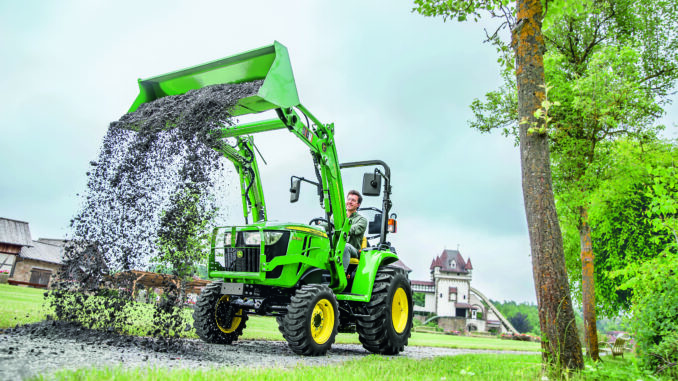
The John Deere 5075M is a 5M Series utility tractor built for loader work, mowing, transport, light field work, and general property maintenance, with official operator information and a North America replacement parts guide available directly from John Deere. This guide is written for USA and Canada owners who handle routine maintenance and want a clear, symptom-first repair reference covering troubleshooting, service parts, manuals, diagrams, and realistic DIY limits.
John Deere 5075M overview
The John Deere 5075M sits in Deere’s 5M utility tractor range and is positioned as a heavier-duty machine than a typical lawn tractor, with diesel power, hydraulic systems, and cab or open-station configurations depending on spec. Official Deere material for the North America edition confirms key service systems including engine oil filtration, fuel filtration, air intake filtration, hydraulic/transmission filtration, cab air filters, and the open crankcase ventilation system.
For most homeowner-acreage and light farm users, the John Deere 5075M is used for rotary cutting, finish mowing with suitable attachments, loader work, driveway maintenance, towing, and year-round property jobs where reliability matters more than outright complexity. In practice, the repairs owners ask about most often center on no-start complaints, hard starting, loss of power, warning lights, hydraulic issues, charging faults, belt wear, and service interval confusion rather than internal engine failures.
General overview of the John Deere 5075M
The most important John Deere 5075M systems for repair and maintenance are the diesel engine and fuel system, intake and emissions-related service items, hydraulic/transmission system, charging and starting system, cooling system, and front axle or MFWD components if equipped. Unlike a small lawn tractor, this model’s maintenance picture is shaped by higher fluid capacities, longer service intervals, and more serial-number-sensitive parts ordering.
Common John Deere 5075M service parts owners regularly buy include the engine oil filter RE519626 on earlier serial ranges and DZ114256 on later serial ranges, fuel filter DZ114096, hydraulic filter SJ11784, primary air filter SU20768, secondary air filter RE253519, OCV filter RE553871, fresh air filter RE198488, recirculation air filter RE195491, battery AXE66451, and fan belt drive parts including SU39383. Those are the parts most worth verifying first before placing an online order, especially because Deere’s own guide splits some parts by serial range.
Troubleshooting approach for the John Deere 5075M
The best way to diagnose a John Deere 5075M is to start with the symptom the owner actually sees, then narrow the fault to the related system instead of guessing and replacing parts at random. On this tractor, the main symptom groups are starting issues, poor running or loss of power, hydraulic or transmission concerns, vibration or belt noise, overheating or fluid leaks, and electrical or warning-light problems.
That symptom-first approach matters because many complaints overlap: a restricted air filter, fuel restriction, battery weakness, or charging issue can all produce a similar “it cranks badly and won’t work properly” description. Owners usually save time by confirming filters, battery condition, visible wiring, fluid levels, and warning indicators before digging deeper.
John Deere 5075M emergency repair needs
Some John Deere 5075M faults need immediate attention because they can quickly turn a service issue into a major repair bill or create an unsafe tractor. The big red-flag categories are engine oil pressure concerns, overheating, hydraulic leaks under pressure, brake or steering faults, charging failures that stop safe starting, and severe belt or driveline noise.
Starting issues on the John Deere 5075M
If the tractor will not crank, cranks slowly, or starts and dies, the problem matters because repeated attempts can flatten the battery, overheat cables, and hide the real fault. Common causes include a weak battery, poor cable connections, fuel supply restriction, dirty filters, or a safety/interlock-related starting problem.
-
Battery discharged or failing.
-
Corroded battery terminals or ground connection.
-
Plugged fuel filter DZ114096.
-
Dirty primary or secondary air filter.
-
Operator-control or start-circuit fault described in the operator’s manual.
-
Check battery terminals for corrosion and tightness.
-
Confirm battery voltage and charging condition.
-
Inspect the fuel filter service history.
-
Check air restriction indicators or visibly dirty filters.
-
Stop if the tractor shows warning messages or repeated no-start without a clear basic cause.
John Deere 5075M running and power-loss problems
A John Deere 5075M that starts but lacks power, surges, smokes excessively, or struggles under load often has an air, fuel, or maintenance-related issue before it has a major engine fault. This matters because continued operation under restriction can raise exhaust temperatures, reduce efficiency, and stress other components.
-
Dirty primary air filter SU20768.
-
Dirty secondary air filter RE253519.
-
Fuel filter overdue for replacement.
-
Poor-quality or contaminated diesel.
-
Service intervals missed on oil or related engine maintenance.
-
Check when the fuel and air filters were last changed.
-
Inspect for restricted intake or visible contamination.
-
Confirm the tractor is not overdue for engine oil service.
-
Watch for smoke, warning lights, or abnormal regeneration-related behavior on later emissions-equipped versions.
-
Move to dealer diagnosis if power loss is severe or persistent.
Vibration and noise on the John Deere 5075M
Vibration, squealing, or rattling on a John Deere 5075M should never be ignored because belts, brake components, steering joints, or front axle parts can deteriorate quickly once noise begins. Deere’s parts guide highlights fan belt, tie rod, and brake disk items that commonly sit in the path of this type of complaint.
-
Fan belt wear or tension problem involving SU39383.
-
Front-end steering or tie-rod wear.
-
Brake disk wear.
-
Loose loader/frame/implement hardware.
-
Cab or seat hardware looseness on higher-hour machines.
-
Listen for whether the noise changes with engine speed or ground speed.
-
Inspect the fan belt for cracks, glazing, or fraying.
-
Check visible steering joints and hardware for looseness.
-
Confirm wheels and attached implements are secure.
-
Stop operation if vibration becomes sudden or severe.
Overheating and leaks on the John Deere 5075M
Overheating, coolant loss, oil leaks, or hydraulic leaks need fast attention because this tractor carries substantial fluid volumes and relies on clean cooling and sealed hydraulic circuits for dependable work. Deere’s published capacities show the scale of the system, including about 13 L engine oil, about 22 L coolant for cab versions, and about 39.5 L transmission/hydraulic oil.
-
Low engine oil level.
-
Low coolant level.
-
Dirty cooling pack or restricted airflow.
-
Hydraulic leak at hose, fitting, or filter area.
-
Missed service interval on engine or hydraulic filtration.
-
Park safely and let the tractor cool before opening anything.
-
Check for visible leaks under the engine, radiator area, and transmission.
-
Verify fluid levels against the operator’s manual.
-
Clean external debris from cooling areas if accessible.
-
Do not keep working a tractor that is overheating or spraying hydraulic fluid.
John Deere 5075M transmission and drive problems
A John Deere 5075M that hesitates, loses drive, or shows weak hydraulic response may have anything from low fluid condition to filter restriction or a more serious transmission or hydraulic issue. Because the tractor uses a hydraulic/transmission filter SJ11784 with scheduled replacement intervals, overdue service is one of the first things to verify.
-
Low or contaminated transmission/hydraulic oil.
-
Overdue hydraulic filter SJ11784.
-
Axle or MFWD-related issue.
-
Control linkage or range-selection issue.
-
Internal hydraulic or transmission fault requiring testing.
-
Check transmission/hydraulic oil level and condition.
-
Confirm the hydraulic filter service date.
-
Note whether the issue affects only movement, only hydraulics, or both.
-
Inspect for external leaks or damaged hoses.
-
Escalate quickly if the tractor will not move or hydraulics fail under load.
Electrical problems on the John Deere 5075M
Electrical complaints on the John Deere 5075M usually show up as no-crank, intermittent starting, charging warnings, lighting faults, or instrument-panel alerts. Deere’s parts guide lists alternator options and battery part information, which makes the charging system a logical first branch in diagnosis.
-
Weak battery AXE66451.
-
Alternator fault, including 120 A RE554568 or 90 A DZ123153 applications.
-
Dirty grounds or cable ends.
-
Fuse or relay issue.
-
Sensor or warning-system issue requiring scan-based diagnosis.
-
Load-test the battery before replacing other parts.
-
Check charging voltage with the engine running.
-
Inspect ground straps and major cable connections.
-
Verify fuses and relays.
-
Move to dealer testing for persistent warnings or electronic faults.
DIY or dealer repair guide for the John Deere 5075M
The normal line on a John Deere 5075M is simple: routine service and straightforward bolt-on parts are realistic DIY jobs, but high-pressure fuel work, hydraulic diagnosis, emissions-system faults, internal transmission work, and anything requiring Deere-specific electronic testing are better handled by a dealer or an experienced tractor technician.
Good DIY jobs
-
Engine oil and oil filter replacement.
-
Fuel filter replacement.
-
Primary and secondary air filter service.
-
Cab fresh-air and recirculation filter replacement if equipped.
-
Battery replacement and terminal cleaning.
-
Fan belt inspection and straightforward replacement where access is clear.
Advanced DIY or dealer jobs
-
Hydraulic or transmission diagnosis beyond fluid and filter checks.
-
Persistent no-start with electronic warnings.
-
Fuel injection system faults.
-
DPF or emissions-related diagnosis on later configurations.
-
Brake, steering, axle, or clutch repairs requiring split-tractor procedures or special tools.
Skill level guide
-
Beginner: Filters, battery checks, fluid checks, cab air filters.
-
Intermediate: Engine oil service, fan belt replacement, basic electrical checks.
-
Advanced: Hydraulic troubleshooting, steering and brake component replacement, emissions diagnosis, internal driveline work.
John Deere 5075M parts needed before ordering
Before ordering John Deere 5075M parts, gather the full model name, the tractor Product Identification Number, the engine information, and any cab/open-station or drivetrain details that could affect fit. That step matters because Deere’s own replacement guide splits at least one key part, the engine oil filter, by serial range.
OEM parts are usually the safest choice for belts, filters tied to emissions or exact fit, hydraulic components, electrical parts, and any safety-critical switch or brake-related item because Deere serial-number breaks and application differences matter on utility tractors. Aftermarket parts can be reasonable for batteries and some filters when the supplier clearly cross-references the exact OEM number and the tractor’s serial range.
John Deere 5075M diagrams and manuals
The best John Deere 5075M manual sources are Deere’s operator information, Deere’s replacement parts guide, Deere Technical Publications or manual portal, and a Deere-focused parts lookup source. Used together, these sources cover safe operation, maintenance intervals, exploded parts diagrams, and the exact OEM numbers needed for repairs.
-
John Deere operator manual portal — useful for controls, maintenance procedures, safety information, and model-specific operating guidance.
-
John Deere 5075M North America replacement parts guide PDF — useful for service intervals, capacities, and fast access to common service part numbers.
-
John Deere older 5M operator manual entry — useful if the tractor falls into earlier 5M family coverage.
-
TractorData 5075M overview — useful as a quick specification reference, but not a substitute for Deere serial-specific parts information.
How to find John Deere 5075M serial and engine numbers
These numbers matter because filters, belts, electrical parts, and some engine service items can change by production period or equipment configuration. The safest approach is to record every ID number before ordering anything beyond a basic consumable.
-
Find the tractor Product Identification Number plate on the machine chassis or frame area specified in the operator information.
-
Photograph the full model and PIN exactly as shown.
-
Record engine identification details from the engine data tag.
-
Note whether the tractor is cab or open station and whether it has MFWD or 2WD where relevant to the part.
-
Match the number against Deere parts literature before buying.
Buying John Deere 5075M parts online and in stores
The smart buying strategy for John Deere 5075M parts is to use Deere documentation first, then price-check the exact OEM number across official and reputable aftermarket sellers. On a utility tractor, guessing from model name alone is riskier than it is on a lawn mower, especially for serial-range parts and charging, hydraulic, or cab-related components.
-
Online: verify the exact OEM number, confirm serial-range breaks, and compare listing photos and notes before checkout.
-
Dealer counter: best for confusing, serial-specific, hydraulic, electrical, and driveline parts where a parts adviser can confirm fit from the PIN.
-
Retail stores: fine for common consumables such as some batteries or cross-referenced filters only if the packaging clearly matches the Deere number and application.
Useful sources include John Deere manuals and publications, John Deere’s 5075M parts guide PDF, and TractorData’s 5075M reference page.
John Deere 5075M fitting guide for common parts
These are the most practical John Deere 5075M DIY jobs for owners who already perform basic service and want a simple, safe sequence to follow. Always use the operator manual for torque, safety, and shutdown procedures before starting work.
Replacing the John Deere 5075M engine oil filter
This job helps protect the engine and is part of the published service schedule.
-
Warm the engine briefly, park safely, and shut it down.
-
Drain the engine oil into a suitable container.
-
Remove the old filter and confirm whether your tractor uses RE519626 or DZ114256 by serial range.
-
Lightly oil the new filter seal and install the replacement.
-
Refill with the correct oil and capacity guidance from the manual, then check for leaks.
Replacing the John Deere 5075M fuel filter
This is a high-value service job because restricted fuel supply is a common cause of hard starting and poor running.
-
Shut the tractor down and clean around the filter area first.
-
Remove the old fuel filter DZ114096 carefully to avoid introducing dirt.
-
Install the new filter and confirm seal placement.
-
Prime or bleed the fuel system as directed in the operator manual.
-
Start the engine and check for leaks or stumble.
Replacing the John Deere 5075M air filters
Air filter service often restores performance and helps prevent dust-related engine wear.
-
Open the air cleaner housing.
-
Remove the primary filter SU20768 and inspect the secondary RE253519.
-
Replace dirty elements rather than over-cleaning a damaged filter.
-
Wipe out loose dust from the housing without forcing dirt inward.
-
Reassemble carefully and ensure the housing seals correctly.
Replacing John Deere 5075M cab air filters
On cab tractors, fresh-air and recirculation filters help HVAC performance and operator comfort.
-
Identify the fresh air filter RE198488 and recirculation filter RE195491 locations.
-
Remove covers or access panels as required.
-
Slide out the old filters and compare size and airflow direction.
-
Fit the new elements cleanly without bending the media.
-
Run the HVAC system and confirm airflow improves.
Maintenance to prevent John Deere 5075M problems
Regular maintenance on a John Deere 5075M prevents many of the failures owners describe as “sudden,” especially starting issues, power loss, hydraulic sluggishness, and cab airflow complaints. Deere’s service literature makes it clear that filter intervals and fluid checks are central to reliability on this model.
-
Starting reliability: keep the battery healthy, fuel filter current, and cable ends clean.
-
Running quality: replace air and fuel filters on schedule and respond early to loss of power.
-
Overheating prevention: maintain coolant level and keep cooling areas clear.
-
Hydraulic performance: change the hydraulic/transmission filter on time and watch for leaks.
-
Electrical reliability: test charging performance before a weak battery strands the tractor.
-
Cab comfort: replace fresh-air and recirculation filters when airflow drops.
John Deere 5075M maintenance schedule
The official 5075M North America replacement parts guide gives the clearest quick-reference interval framework, with service items scheduled at first 100 hours, every 500 hours, every 1000 hours, and every 1500 hours depending on component. The operator manual should still be treated as the final word for exact procedures, conditions, and any serial-specific changes.
Daily or before each use
-
Check engine oil level.
-
Check coolant level and look for leaks.
-
Inspect the tractor for hydraulic, fuel, or coolant leaks.
-
Check tire condition and visible damage.
-
Watch for warning lights or abnormal messages at startup.
First 100 hours
-
Replace engine oil filter.
-
Replace hydraulic/transmission oil filter.
-
Review overall tractor condition for early bedding-in issues.
Every 500 hours
-
Replace engine oil filter as listed in the guide.
-
Replace fuel filter.
-
Replace hydraulic/transmission oil filter.
-
Review related fluid condition and any warning history.
Every 1000 hours
-
Replace primary air filter element.
-
Replace recirculation air filter.
-
Replace fresh air filter.
-
Continue routine inspections of belts, hoses, and battery condition.
Every 1500 hours
-
Replace secondary air filter element.
-
Replace OCV filter RE553871.
-
Review broader high-hour service needs with the manual or dealer records.
Seasonal checklist
-
Spring or heavy-work season start: inspect battery, fluids, filters, and visible belts before long operating days.
-
Mid-season: clean debris buildup, monitor hydraulic response, and inspect for leaks after demanding work.
-
Fall or storage prep: service overdue filters, clean the tractor thoroughly, and correct leaks or charging issues before downtime.
Repair, upgrade, or replace the John Deere 5075M?
For most owners, a John Deere 5075M is worth repairing when the issue is limited to maintenance parts, bolt-on wear items, or a single straightforward system fault, because Deere still supports the model with manuals and service parts guidance. Upgrade decisions make more sense when the tractor is consistently under-specced for loader capacity, hydraulic demand, cab comfort needs, or emissions-era expectations, while full replacement becomes easier to justify when several expensive systems fail together.
Repair if…
-
The problem is a filter, belt, battery, alternator, or other isolated service part.
-
The tractor otherwise meets your acreage and implement needs.
-
You have clear parts identification and the rest of the machine is sound.
Upgrade if…
-
You need more hydraulic capability, loader performance, or comfort features than your current setup provides.
-
Repeated downtime is coming from workload mismatch rather than one bad part.
-
Newer features would reduce year-round maintenance burden.
Replace if…
-
Engine, hydraulic, transmission, and electrical issues are stacking up at once.
-
The tractor has major high-cost faults plus poor overall condition.
-
Parts and labor estimates exceed the value of keeping this particular machine in service.
John Deere 5075M troubleshooting FAQ
1. Why will my John Deere 5075M not start?
The usual first checks are battery condition, cable connections, fuel supply, and filter status. A weak battery, dirty terminals, or a restricted fuel filter can all produce a no-start or hard-start complaint on this tractor. If the starter circuit and basics look fine but the tractor still will not fire, the next step is proper diagnosis rather than random parts replacement.
2. Why does my John Deere 5075M crank slowly?
Slow cranking usually points to a weak battery, poor cable connection, bad ground, or charging issue. Deere lists both battery and alternator service parts for the model, which is a clue that the charging system deserves attention early in diagnosis. Load-test the battery before assuming the starter is at fault.
3. Why does my John Deere 5075M start and then stall?
A restricted fuel filter, air in the fuel system, or contaminated fuel is a sensible first suspect. Diesel tractors can also behave this way when maintenance has slipped and the engine is not getting steady fuel supply. Replace overdue filters and follow the manual’s priming guidance before moving deeper.
4. Why has my John Deere 5075M lost power under load?
Loss of power often comes from restricted air or fuel flow before it comes from a major internal problem. Dirty air filters, a clogged fuel filter, or missed service intervals can all reduce performance noticeably. If power loss is accompanied by warnings, smoke, or severe rough running, stop and investigate promptly.
5. Why is my John Deere 5075M smoking more than usual?
Smoke changes can point to air restriction, fuel quality issues, or heavier engine problems depending on color and operating conditions. Start with the service basics, especially air and fuel filters, because those are common and confirmed maintenance items on the 5075M. Persistent heavy smoke needs a more complete engine diagnosis.
6. Why does my John Deere 5075M feel sluggish hydraulically?
Slow or weak hydraulics can come from low oil level, dirty fluid, a restricted hydraulic filter, or a deeper hydraulic fault. The 5075M uses a scheduled hydraulic/transmission filter, so overdue service should be ruled out before assuming pump trouble. External leaks also matter because they reduce both performance and system reliability.
7. What hydraulic filter does a John Deere 5075M use?
Deere’s North America replacement parts guide lists hydraulic/transmission oil filter SJ11784 for the 5075M. Always confirm by PIN before ordering if your tractor has unusual options or market-specific differences.
8. What fuel filter fits a John Deere 5075M?
The Deere 5075M North America replacement guide lists fuel filter DZ114096. That is the number to cross-check first whether buying OEM or aftermarket.
9. What air filters fit a John Deere 5075M?
The published guide lists primary air filter SU20768 and secondary air filter RE253519 for the 5075M. These are key maintenance parts for performance and engine protection, so exact fit matters.
10. What oil filter does a John Deere 5075M use?
The answer depends on serial range in Deere’s own guide. RE519626 applies to earlier serial numbers up to 034279, while DZ114256 applies from 034280 onward. That is a good example of why the PIN should be checked before ordering.
11. Why is my John Deere 5075M overheating?
Low coolant, blocked cooling airflow, heavy debris buildup, or broader cooling-system faults are common possibilities. Because the tractor carries a substantial coolant volume, even a moderate leak should be taken seriously. Do not continue operating an overheating diesel tractor just to finish a job.
12. Why is my John Deere 5075M leaking hydraulic oil?
Hydraulic leaks usually come from hoses, fittings, seals, or filter-area issues, and they can become dangerous because hydraulic oil may be under pressure. Clean the area, identify the leak source, and stop using the tractor until the leak is understood. Running low on hydraulic oil can create secondary damage.
13. Why is my John Deere 5075M battery always flat?
Repeated battery discharge usually means the battery itself is weak, the alternator is undercharging, the tractor sits unused for long periods, or there is a parasitic electrical draw. Deere lists battery AXE66451 plus alternator options, so both battery health and charging output deserve testing. Replacing the battery without checking charge rate often wastes time and money.
14. What battery fits a John Deere 5075M?
Deere’s replacement guide lists battery AXE66451 for the 5075M. Battery sourcing can still vary by equivalent brand and local availability, so physical size, terminal layout, and rating should be confirmed before buying.
15. Why is the belt squealing on my John Deere 5075M?
A squealing belt usually points to wear, glazing, contamination, misalignment, or incorrect tension. Deere’s guide lists fan belt drive SU39383, making the front accessory drive a natural inspection point. Persistent belt noise can also signal a pulley or bearing problem rather than the belt alone.
16. What fan belt does a John Deere 5075M use?
The replacement parts guide lists fan belt drive SU39383 and also notes a listed length of 1432 mm. Match the full application carefully before ordering.
17. Why does my John Deere 5075M vibrate at certain engine speeds?
Engine-speed-related vibration often points toward belt, pulley, engine-mount, or accessory-drive issues rather than a tire problem. If vibration follows ground speed instead, wheels, tires, axle parts, or attached implements become more likely. Sudden new vibration should always be investigated quickly.
18. Why does my John Deere 5075M pull poorly or lose drive?
Low transmission or hydraulic oil, filter restriction, linkage issues, or more serious transmission faults are all possible. The first step is to check fluid level, leaks, and hydraulic filter service status. If the tractor will not move safely, stop and diagnose rather than forcing it.
19. Can I replace John Deere 5075M filters myself?
Yes, most owners with basic tools and safe working habits can replace the engine oil filter, fuel filter, air filters, and cab air filters. These are among the most realistic DIY jobs on the tractor because Deere publishes them as routine service items. Use the operator manual for the exact procedure and shutdown steps.
20. Is aftermarket OK for John Deere 5075M parts?
Aftermarket can be fine for some batteries and clearly cross-referenced filters, but OEM is usually safer for fit-sensitive, serial-break, electrical, hydraulic, and emissions-related parts. On the 5075M, the oil filter serial split is one clear reason to verify part numbers carefully.
21. Where can I find a John Deere 5075M parts diagram?
The most useful starting points are Deere’s replacement parts guide and Deere’s manual or publications system. Those sources give either direct service part numbers or the official path toward serial-correct documentation. Use unofficial spec sites only as secondary references.
22. Where can I get a John Deere 5075M operator’s manual?
John Deere hosts operator manual access through its manuals portal, including 5M tractor operator information. Earlier 5M coverage is also available through Deere manual pages for related model groupings. Always match the manual to the tractor version and production period.
23. How often should I service a John Deere 5075M oil filter?
Deere’s quick-reference guide shows the oil filter at first 100 hours and then at 500-hour service points in the published North America guide. Another Deere filter overview for related 5M coverage also notes 300-hour intervals, or 500 hours when using Plus-50 II 15W-40, which means the operator manual should be treated as the controlling source for your exact configuration.
24. How often should I change the John Deere 5075M fuel filter?
The Deere replacement parts guide shows the fuel filter at every 500 hours. If fuel quality is poor or contamination is suspected, earlier replacement may be wise even before the scheduled interval. Hard starting and power loss are both good reasons to inspect it sooner.
25. How often should I replace the John Deere 5075M air filters?
The North America guide lists the primary air filter at every 1000 hours and the secondary air filter at every 1500 hours. In dusty conditions, practical service needs may come earlier because condition matters as much as interval.
26. What is the hydraulic oil capacity on a John Deere 5075M?
Deere’s published capacity for transmission and hydraulic axle oil is about 39.5 L, or 10.4 gallons. That large capacity is one reason leaks and contamination should be taken seriously.
27. What is the engine oil capacity on a John Deere 5075M?
Deere lists engine oil capacity at about 13 L, or 3.4 gallons, in the 5075M North America guide. Always confirm final fill procedure with the operator manual and dipstick rather than relying only on a dry-fill number.
28. What coolant capacity does a John Deere 5075M have?
The replacement guide lists coolant capacity for cab tractors at about 22 L, or 5.8 gallons. As with oil, final level should be checked using the tractor’s normal fill and bleed procedure.
29. How do I know if my John Deere 5075M needs dealer diagnosis?
Dealer-level help is usually the right move when warnings persist, the tractor will not move, hydraulics are weak under load, electrical faults are intermittent, or emissions-related issues appear. Those problems often need test equipment, PIN-based parts verification, or procedures beyond normal owner service.
30. Is a John Deere 5075M worth repairing?
Usually yes, if the tractor mainly needs overdue maintenance, filters, a battery, a belt, or another isolated wear item. It becomes less attractive when hydraulic, transmission, engine, and electrical problems all arrive together. The best answer depends on the tractor’s overall condition and whether it still fits your workload.
31. What should I check before buying used John Deere 5075M parts?
Check the exact OEM number, the tractor PIN, the seller’s stated serial compatibility, and whether the part came from a similar cab/open-station or drivetrain setup where relevant. Used structural or cosmetic parts can make sense, but critical filters, electrical components, and unknown-wear driveline parts are usually better bought new.
32. Why is the cab airflow weak in my John Deere 5075M?
Weak cab airflow often comes from dirty fresh-air or recirculation filters on cab-equipped tractors. Deere lists RE198488 and RE195491 as the service filters, and replacing them is one of the simplest comfort-related maintenance jobs on the machine.
33. What is the OCV filter on a John Deere 5075M?
The OCV filter is the open crankcase ventilation filter, and Deere lists it as RE553871 in the 5075M North America guide. It is a scheduled service item and should not be ignored on higher-hour tractors.
34. Can a dirty air filter make my John Deere 5075M feel weak?
Yes, a restricted primary or secondary air filter can reduce performance and contribute to smoke or poor running. Because Deere publishes both filter part numbers and service intervals, intake restriction is one of the first practical checks when power falls off.
35. What is the safest way to troubleshoot a John Deere 5075M?
Start with the symptom, verify fluids, filters, battery condition, and visible leaks, then use Deere documentation before ordering parts. That method prevents a lot of misdiagnosis and keeps owners from replacing good parts when the real fault is a simple maintenance issue.