
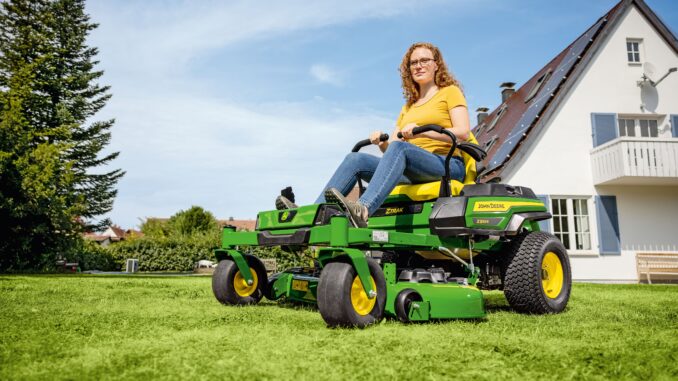
The John Deere Z920M is a commercial ZTrak zero-turn mower aimed at owners who need faster mowing, stronger deck options, and a more durable platform than a typical residential lawn tractor. Deere’s owner information pages and replacement-parts guides place it in the Commercial ZTrak M Series, with maintenance and parts details varying by serial number and deck configuration.
For DIY owners in the USA and Canada, the practical value of a John Deere Z920M repair guide is knowing what you can safely handle at home, what parts you need before you start, and when the smarter move is to use a Deere dealer. This guide covers troubleshooting, maintenance schedules, common service parts, diagrams, manuals, and realistic repair boundaries for the John Deere Z920M.
John Deere Z920M model overview
The John Deere Z920M is a gas-powered zero-turn mower in the Z900 M Series, and published model information lists it with a 23.5 hp Kawasaki gasoline engine. Deere’s replacement-parts guide also shows that the machine was offered with 48-inch, 54-inch, and 60-inch mower deck configurations, which matters when ordering belts and blades.
In practical use, the John Deere Z920M suits larger home properties, estates, and demanding mowing conditions where cut speed and maneuverability matter more than towing or ground-engaging work. Owners usually focus on engine service, deck drive components, traction drive components, and electrical safety circuits because those are the systems most tied to starting, cutting quality, and drive performance.
General overview of the John Deere Z920M
Within the Deere lineup, the John Deere Z920M sits above homeowner zero-turns and inside Deere’s commercial ZTrak range, which is why parts support is heavily organized around serial number breaks and deck versions. Deere explicitly tells owners to use the operator’s manual that matches the machine serial number because maintenance schedules can vary by machine number.
The key systems on the John Deere Z920M are straightforward once you break them down by function:
-
Engine and fuel system: air filters, inline fuel filter, spark plugs, engine oil, and oil filter.
-
Mower system: deck belt, deck wheels, blades, and deck leveling gauge references.
-
Drive system: traction drive belt and transmission oil/filter service points.
-
Electrical system: battery, key switch, brake switch, rotary switch, and some serial-number-based lighting parts.
Common service parts owners regularly buy for the John Deere Z920M include:
-
Engine oil filter: AM125424.
-
Spark plug: M805853.
-
Primary air filter: M131802.
-
Secondary air filter: M131803.
-
Inline fuel filter: UC21217 or AM116304 depending on configuration.
-
Battery for USA and Canada: TY25221B.
-
Traction drive belt: TCU34299.
Troubleshooting the John Deere Z920M by symptom
The best way to diagnose a John Deere Z920M is to start with the symptom the owner can see, hear, or feel, then work backward to the system involved. That symptom-first method helps avoid replacing good parts when the real issue is a dirty filter, weak battery, worn belt, bad switch, or wrong deck part for the machine’s serial number and deck width.
The main symptom groups on the John Deere Z920M are:
-
Starting issues.
-
Running or power-loss issues.
-
Cut-quality problems.
-
Vibration and abnormal noise.
-
Overheating, burning smells, or fluid leaks.
-
Transmission or drive complaints.
-
Electrical and safety-switch faults.
Immediate John Deere Z920M repair needs
Some faults on the John Deere Z920M need attention immediately because they affect safe operation or can quickly damage expensive parts. The biggest examples are severe blade vibration, drive loss, fuel leaks, overheated belt systems, and safety-switch problems that let the machine behave unpredictably.
1. John Deere Z920M starting issues
When a John Deere Z920M will not crank or starts inconsistently, the problem often sits in the battery, ignition-switch circuit, brake switch, fuel delivery, or routine tune-up items. Ignoring hard starting usually turns a simple maintenance issue into a no-start situation at the worst time.
Common causes:
-
Weak or failed battery TY25221B on USA/Canada machines.
-
Dirty or overdue air filters M131802 or M131803.
-
Restricted inline fuel filter UC21217 or AM116304.
-
Worn spark plug M805853.
-
Faulty brake switch TCA15398 or key/rotary switch issue on the applicable serial-number range.
Basic owner checks:
-
Confirm the battery connections are clean and tight, then test battery voltage.
-
Verify the parking brake and operator controls are fully in the required start position.
-
Inspect the air and fuel filters for service history and visible restriction.
-
Remove and inspect the spark plugs for fouling, damage, or incorrect gap.
-
If it still will not crank, inspect safety-switch operation before buying starter or ignition parts.
2. John Deere Z920M cut-quality problems
Poor cut quality on a John Deere Z920M usually shows up as streaks, ragged grass tips, scalping, or uneven height from side to side. These problems matter because owners often blame the deck belt first, when dull blades, the wrong blade style, or poor deck leveling are just as common.
Common causes:
-
Dull, bent, or incorrect blade set for the deck size.
-
Loose, glazed, or worn mower deck belt such as TCU30510, UC25996, or TCU35604 depending on deck and serial range.
-
Worn gauge wheels UC28193 or deck wheel issues.
-
Deck out of level.
-
Grass buildup under the deck.
Basic owner checks:
-
Match the installed blade part numbers to the actual deck width and mowing conditions.
-
Clean the underside of the deck and inspect spindle/blade mounting hardware.
-
Check belt condition for cracking, glazing, or obvious width loss.
-
Level the deck using the correct procedure and a deck leveling gauge such as AM130907 if available.
-
Test mow a small area before returning the machine to full service.
3. John Deere Z920M vibration and noise
Strong vibration on a John Deere Z920M is a stop-now issue because it can damage spindle assemblies, deck hardware, belt systems, and even the engine mounting area if the machine keeps running. Noise and shake are usually tied to blade damage, belt damage, loose hardware, or rotating parts that are out of balance.
Common causes:
-
Bent or unbalanced blades.
-
Blade bolt or spindle hardware looseness.
-
Damaged deck belt.
-
Debris wrapped around spindles or pulleys.
-
Tire or caster-wheel damage, including caster wheel TCA19309 concerns.
Basic owner checks:
-
Shut the machine down immediately and remove the key.
-
Inspect blades for bends, cracks, and mismatched part numbers.
-
Spin pulleys and visible rotating parts by hand with the engine off.
-
Check deck belt tracking and pulley alignment.
-
Do not continue mowing until the vibration source is identified.
4. John Deere Z920M overheating and leaks
Heat, smoke, fuel smell, or oil leakage on a John Deere Z920M should be handled quickly because engine and hydraulic repairs get expensive fast. The most common owner-side causes are clogged cooling areas, old engine oil, restricted filters, belt drag, and fuel-system seepage.
Common causes:
-
Low or overdue engine oil TY22029 service interval.
-
Dirty air filter restricting combustion air.
-
Fuel filter or line issues near the inline filter assembly.
-
Debris packed around engine cooling areas or muffler TCA21568.
-
Transmission oil overdue after first 300 hours and then every 500 hours.
Basic owner checks:
-
Check engine-oil level and change history.
-
Clean external debris from engine screens, cooling fins, and muffler area.
-
Inspect for wet spots around the fuel filter, lines, and engine.
-
Check for belt drag or deck bind that could overload the engine.
-
Stop using the mower if there is active fuel leakage or persistent overheating.
5. John Deere Z920M transmission and drive problems
A John Deere Z920M that loses speed, tracks unevenly, or will not drive smoothly may have a worn traction drive belt, overdue transmission service, or a deeper hydro problem. Early diagnosis matters because drive complaints often start with belt or fluid issues before owners assume the transmissions are failing.
Common causes:
-
Worn traction drive belt TCU34299.
-
Low, old, or incorrect transmission oil; Deere specifies Hy-Gard TY26975 in the parts guide.
-
Filter MIA881446 due for service.
-
Linkage adjustment issues.
-
Internal hydro wear.
Basic owner checks:
-
Inspect the traction drive belt for wear, heat damage, and tension loss.
-
Review whether the transmission service interval has been met.
-
Look for fluid leakage around hydro components.
-
Confirm both control levers and linkages move freely and return correctly.
-
Move to dealer diagnosis if the machine still lacks drive after belt and service checks.
6. John Deere Z920M electrical problems
Electrical faults on the John Deere Z920M often show up as no-crank issues, intermittent shutdown, dead lights, or safety-circuit problems. These can be frustrating because multiple switches use serial-number-based parts, so matching the right component to the correct machine number is important.
Common causes:
-
Weak battery TY25221B.
-
Brake switch TCA15398 failure.
-
Key switch TCA24616 or AUC12681 depending on serial range.
-
Rotary switch TCA22740 or AUC18708 depending on serial range.
-
Corroded terminals or damaged wiring.
Basic owner checks:
-
Test the battery before replacing switches.
-
Inspect visible connectors for corrosion, looseness, or heat damage.
-
Match any replacement electrical part to the mower serial range.
-
Confirm the brake switch works consistently.
-
Use dealer diagnosis for intermittent wiring faults or repeated blown fuses.
DIY or dealer on the John Deere Z920M
The John Deere Z920M is DIY-friendly for routine service and many deck-related jobs, but once the repair involves hydrostatic drive internals, complex electrical diagnosis, or safety systems you cannot verify confidently, dealer help is usually the safer and cheaper choice in the long run. The dividing line is less about the mower being “commercial” and more about whether the repair needs special test equipment, lifting methods, torque procedures, or serial-number-sensitive setup.
Good DIY jobs
-
Engine oil and filter changes with AM125424 and TY22029.
-
Air-filter and fuel-filter replacement.
-
Spark-plug replacement with M805853.
-
Blade replacement and deck cleaning.
-
Deck belt replacement when routing is confirmed from the parts diagram/manual.
-
Battery replacement.
Advanced DIY or dealer jobs
-
Traction drive belt replacement if access is tight or routing is unclear.
-
Transmission oil and filter service if the owner is not equipped to work cleanly and safely.
-
Safety-switch tracing and intermittent electrical faults.
-
Spindle replacement or major deck rebuilds.
-
Hydro drive diagnosis and internal repair.
Skill level guide
-
Beginner: air filter, oil service, spark plugs, battery, blade inspection.
-
Intermediate: deck belt replacement, blade changes, deck leveling, fuel filter replacement.
-
Advanced: traction drive belt service, electrical troubleshooting, hydro service, spindle or switch diagnosis.
Parts for the John Deere Z920M: OEM numbers and buying info
Before ordering John Deere Z920M parts, gather the full model name, mower serial number or PIN, engine model details, and deck width. Deere specifically warns that maintenance schedules and some parts vary by serial number, and the replacement-parts guide clearly shows serial-number breaks for several electrical and deck-drive parts.
OEM parts are usually the safest choice for belts, electrical switches, safety-related parts, and any fit-sensitive item where serial-number changes matter. Aftermarket parts can make sense for batteries, blades, and some filters, but only when the cross-reference is exact for the John Deere Z920M and its specific deck width and serial range.
John Deere Z920M diagrams and manuals
For the John Deere Z920M, owners should use a mix of Deere manual pages, the replacement-parts guide, and a model-specific parts source. Each source solves a different problem, so using all of them together usually prevents wrong-part orders.
-
John Deere Z920M owner information page — best starting point for owner information, maintenance access, and links tied to the model.
-
John Deere Z920M replacement parts guide PDF — best for quick OEM part numbers, deck-specific belts and blades, and serial-number notes.
-
John Deere Technical Information Store — useful when a user needs deeper official manual coverage beyond quick-reference parts pages.
-
Green Farm Parts Z920M maintenance guide — helpful for service-part lookups and cross-checking commonly replaced items, though official Deere sources should take priority when numbers conflict.
How to find John Deere Z920M serial and engine numbers
These numbers matter because the John Deere Z920M uses serial-number breaks for several parts, including switches, headlights, filler cap versions, and some deck belt listings. Using the wrong serial range is one of the easiest ways to buy the wrong part online.
-
Locate the machine Product Identification Number plate on the mower frame and record it exactly as shown.
-
Record the full model name as Z920M, not just “ZTrak.”
-
Check the deck tag so you know whether the mower has a 48-inch, 54-inch, or 60-inch deck.
-
Record the engine model and serial from the engine label before ordering tune-up parts.
-
Keep a photo of all tags on your phone so you can compare numbers while ordering parts online or at the dealer counter.
Buying John Deere Z920M parts online or in-store
The smartest buying strategy for John Deere Z920M parts is to use official Deere information to confirm the OEM number first, then compare pricing and availability across dealer and aftermarket sources. That approach is especially important for serial-sensitive electrical parts and deck-drive components.
-
Online: verify the OEM part number, serial range, and deck width before checkout; Deere owner pages and the replacement guide are the best first check.
-
Dealer counter: usually the best option for switches, serial-break parts, and anything unclear from the diagram alone.
-
Retail stores: acceptable for oil, spark plugs, batteries, and some filters only if the packaging clearly cross-references the exact Z920M application.
Useful sources:
Step-by-step John Deere Z920M fitting guide
These are the most practical owner-level jobs on the John Deere Z920M because they directly affect starting, power, and cut quality. Always use the serial-number-correct operator information before starting service.
Change the John Deere Z920M engine oil and filter
This service protects starting, lubrication, and engine life, and Deere lists AM125424 and TY22029 as the core service items.
-
Park on level ground, set the brake, stop the engine, and let it cool.
-
Drain the old oil into a suitable container.
-
Remove the old AM125424 oil filter and lightly oil the gasket on the new one.
-
Install the new filter hand-tight, then refill with the correct amount of TY22029 oil listed for the machine.
-
Start the engine, check for leaks, then recheck the oil level after shutdown.
Replace the John Deere Z920M air filters
Fresh air filters help cure power loss and dirty running, and Deere lists M131802 as the primary and M131803 as the secondary element.
-
Open the air-cleaner housing carefully.
-
Remove the old outer and inner filters without knocking dirt into the intake.
-
Wipe the housing clean with a lint-free cloth.
-
Install the new secondary filter first, then the primary element.
-
Close the housing securely and inspect for any gaps or damaged seals.
Replace the John Deere Z920M spark plugs
Spark-plug service often helps hard starting and rough running, and Deere lists plug M805853 for the model.
-
Let the engine cool completely.
-
Pull the plug caps carefully and remove each old plug.
-
Compare the old plugs for fouling, oiling, or heavy carbon deposits.
-
Install the correct new plugs and tighten to specification from the correct manual.
-
Refit the plug wires firmly and test start the mower.
Replace John Deere Z920M blades or deck belt
Blade and deck-belt service is one of the most effective ways to restore cut quality on the John Deere Z920M. The exact blade and belt numbers depend on whether the mower has a 48-inch, 54-inch, or 60-inch deck.
-
Disable the mower safely and support access according to the operator manual.
-
Remove the belt guards or blade hardware as needed.
-
Match the replacement belt or blades to the actual deck width and serial range.
-
Route the new belt exactly as shown in the diagram, or torque the blades correctly after replacement.
-
Rotate the deck components by hand before restarting and test the deck at low throttle first.
Maintenance to prevent repeat John Deere Z920M problems
Regular maintenance on the John Deere Z920M does more than extend part life; it also reduces false troubleshooting by keeping filters, belts, blades, and fluids in known condition. Deere’s own owner information stresses using the correct manual for the machine serial number because service intervals can differ.
Focus areas:
-
Starting reliability: keep the battery charged, replace spark plugs at interval, and change air and fuel filters on time.
-
Cut quality: keep the deck clean, blades sharp, and the deck level and correctly belted.
-
Fire and overheating prevention: remove dry grass buildup and keep the engine and muffler area clean.
-
Drive performance: inspect the traction drive belt and keep transmission service current.
-
Electrical reliability: protect terminals from corrosion and match replacement switches to the serial number.
John Deere Z920M maintenance schedule
The published quick-reference guide gives clear intervals for the most important routine items on the John Deere Z920M, while Deere’s owner page notes that maintenance schedules may vary by serial number. That means the schedule below is a practical baseline, but owners should always confirm it against the operator’s manual that matches their mower.
Daily or before each use
-
Check engine-oil level.
-
Inspect for fuel, oil, or transmission leaks.
-
Check blades, deck area, and belt guards for visible damage.
-
Clean grass buildup from the mower and engine area.
Every 100 hours
-
Change engine oil and replace engine oil filter AM125424.
-
Review belt condition and deck hardware while the machine is being serviced.
Every 200 hours
-
Change engine oil again where the applicable schedule calls for it.
-
Replace the oil filter again if following the 100/200/300-hour listed interval.
Every 300 hours
-
Replace the primary air filter M131802.
-
Replace the inline fuel filter UC21217 or AM116304 depending on configuration.
-
Replace the oil filter if following the 300-hour cycle in the guide.
-
Change transmission oil the first time at 300 hours.
Every 500 hours
-
Replace the secondary air filter M131803.
-
Change transmission oil and filter after the initial 300-hour service, then every 500 hours.
Every 1000 hours
-
Replace spark plugs M805853.
Seasonal checklist
-
Spring or start of season: change overdue oil and filters, inspect blades and belts, and test the battery.
-
Mid-season: clean cooling areas, check cut quality, and inspect traction and deck belts for wear.
-
End of season: wash and dry the mower, note all worn parts, and complete overdue service before storage.
Repair, upgrade, or replace the John Deere Z920M?
For most owners, a John Deere Z920M is worth repairing when the engine, frame, and hydro system are still fundamentally sound because many of the most common issues are filters, blades, belts, switches, and scheduled-service items. Replacement becomes a more realistic discussion when major hydro, engine, or repeated structural deck failures stack up at the same time.
-
Repair if: the issue is maintenance-related, limited to belts/blades/filters/switches, or tied to neglected service intervals.
-
Upgrade if: your current deck setup or blade style no longer suits your mowing conditions, or you want better cut performance using the correct Deere blade option for your deck.
-
Replace if: the mower needs major hydro and engine work together, has recurring structural problems, or downtime is costing more than a newer machine would justify.
John Deere Z920M troubleshooting FAQ
1. Why will my John Deere Z920M not start?
Most no-start complaints on a John Deere Z920M come from a weak battery, dirty fuel delivery parts, fouled spark plugs, or a safety-switch issue rather than a catastrophic engine problem. Start with battery condition, brake-switch function, fuel-filter age, and spark-plug inspection before replacing expensive electrical parts.
2. Why does my John Deere Z920M crank but not fire?
If the engine cranks but will not fire, focus on fuel, spark, and air. A restricted inline fuel filter, fouled M805853 spark plugs, or badly overdue air filters can all create this exact symptom.
3. Why is my John Deere Z920M hard to start when hot?
Hot-start issues often point to weakening ignition parts, marginal battery condition, or fuel-delivery restriction that becomes more obvious after the mower is fully warmed up. Check tune-up history first, especially spark plugs and fuel filter condition.
4. Why does my John Deere Z920M start and then die?
A mower that starts and stalls soon after can have a failing fuel supply, contaminated fuel, or an intermittent safety/electrical fault. Begin with the simple checks: filter condition, fuel freshness, and visible wiring or switch problems.
5. Why is my John Deere Z920M losing power while mowing?
Power loss under load often means the engine cannot breathe properly or the deck is overloading it. Dirty air filters, overdue oil service, a dragging deck belt, or heavy deck buildup are all practical first checks.
6. Why is the John Deere Z920M running rough?
Rough running usually comes from tune-up items before anything more serious. Inspect the air filters, fuel filter, spark plugs, and fuel quality, then look for loose plug wires or intake-side dirt leaks.
7. Why does my John Deere Z920M backfire?
Backfiring can be linked to fuel mixture issues, ignition problems, or operating habits such as abrupt shutdown after heavy load. Check plug condition, filter condition, and whether the engine is generally running rich or unevenly.
8. Why is my John Deere Z920M smoking?
Smoke should never be ignored because it may point to oil overfill, oil burning, severe overheating, or fuel-related problems. Verify oil level first, then inspect the muffler area and the engine for active leaks or debris buildup.
9. Why will the John Deere Z920M battery not stay charged?
A battery that repeatedly goes flat may simply be old, but loose terminals, dirty connections, and charging-system problems can create the same symptom. Deere lists TY25221B for USA and Canada, so start by confirming the battery itself is correct and healthy.
10. Why does my John Deere Z920M click but not crank?
A clicking sound usually points to low battery voltage, poor cable connections, or starter-circuit resistance. Clean and tighten the battery connections first, then move on to switch and starter-circuit checks.
11. Why is the John Deere Z920M cutting unevenly?
Uneven cutting is commonly caused by blade wear, wrong blade style, incorrect tire pressure, or a deck that is no longer level. Deere lists specific blade options by deck size, so confirming the correct blade set is important before deeper diagnosis.
12. Why does the John Deere Z920M leave streaks of uncut grass?
Streaking normally means one or more blades are dull, bent, installed wrong, or not matching the deck setup. It can also happen when buildup under the deck disrupts airflow and clipping lift.
13. Why is the John Deere Z920M tearing grass instead of cutting cleanly?
Torn grass tips usually mean dull blades or the wrong blade style for conditions. Sharpening or replacing the blades with the correct deck-specific parts is often the fastest fix.
14. Why is my John Deere Z920M scalping the lawn?
Scalping happens when the deck is set too low, the deck is out of level, or the gauge wheels are not helping the deck follow uneven ground correctly. Inspect deck level and gauge-wheel condition before changing more parts.
15. Why does the John Deere Z920M deck belt keep slipping?
A slipping deck belt may be worn, glazed, contaminated, or simply the wrong belt for the mower’s deck width or serial range. Check the part number carefully because Deere lists different deck belts by deck size and, on some versions, by serial break.
16. Why does the John Deere Z920M deck belt keep coming off?
Belts usually come off because of pulley misalignment, damaged belt guides, incorrect routing, or a belt that has stretched beyond usable tension. Always compare routing with the correct diagram before assuming the spindle system is bad.
17. Why are the blades on my John Deere Z920M vibrating?
Blade vibration is often caused by bent blades, loose blade hardware, or damaged spindle components. Stop mowing immediately because continued use can turn a simple blade issue into a spindle or deck repair.
18. Why is my John Deere Z920M shaking at full throttle?
Full-throttle vibration can come from the deck, blades, pulleys, or even a damaged tire or caster assembly. Remove debris, inspect the blades, and do not continue operating until the cause is found.
19. Why is the John Deere Z920M making a squealing noise?
Squealing usually points to belt slip, dry rotating components, or a pulley problem. Check both the mower deck belt system and the traction drive belt system for wear, heat glazing, and alignment issues.
20. Why is my John Deere Z920M overheating?
Overheating often starts with packed grass debris around cooling areas, old oil, restricted airflow, or excess deck load. Cleaning and routine service are the first things to correct before assuming internal engine trouble.
21. Why does my John Deere Z920M smell like burning rubber?
A burning-rubber smell usually means a belt is slipping or binding against a pulley or guide. Shut the mower down and inspect the deck and traction belt areas before more heat damages surrounding parts.
22. Why is there fuel leaking on my John Deere Z920M?
Fuel leakage should be treated as an immediate safety issue because of fire risk. Inspect the inline fuel filter area, hoses, and fittings, and do not use the mower again until the source is corrected.
23. Why is oil leaking from my John Deere Z920M?
Oil leaks may come from the filter, drain point, engine gaskets, or overfilling after service. Check whether the leak appeared right after an oil change, then inspect around the filter and drain area first.
24. Why does my John Deere Z920M move slowly?
Slow travel often points to a worn traction drive belt, overdue hydro service, linkage problems, or hydro wear. The practical first step is to inspect belt condition and review transmission oil and filter service history.
25. Why does my John Deere Z920M pull to one side?
Pulling to one side can be caused by tire-condition differences, linkage adjustment issues, or unequal hydro response. Rule out simple rolling and control issues before assuming transmission failure.
26. Why will my John Deere Z920M not drive at all?
A complete no-drive condition may come from a failed traction drive belt, severe hydro issue, or a control/linkage problem. Start with visible belt inspection because Deere identifies the main traction drive belt as TCU34299 in the parts guide.
27. Why is the John Deere Z920M traction drive belt failing early?
Early belt failure usually points to misalignment, contamination, overheating, or a machine that is being run with neglected pulleys or guards. Using the exact OEM-size belt is also important on drive systems.
28. Why do I need the serial number for John Deere Z920M parts?
You need the serial number because Deere uses serial breaks for multiple Z920M parts, including switches, lights, filler-cap versions, and some deck-related items. Ordering by model alone can be enough for some consumables, but not for every repair part.
29. Can I use aftermarket parts on a John Deere Z920M?
Yes, but use caution. Aftermarket parts are most reasonable for common consumables and some blade or battery replacements, while OEM parts remain the safer choice for belts, electrical parts, and anything with serial-sensitive fitment.
30. Which deck sizes were available on the John Deere Z920M?
Deere’s replacement guide lists 48-inch, 54-inch, and 60-inch deck sections for the Z920M. That is why owners must verify deck width before ordering blades, gauge wheels, and deck belts.
31. What oil does a John Deere Z920M use?
The replacement guide lists John Deere Turf-Gard 10W30 engine oil under part number TY22029, with 2.0 liters or 2.1 quarts shown with filter. Always verify the exact manual for your mower serial number before filling.
32. What spark plug does a John Deere Z920M use?
Deere lists spark plug M805853 for the Z920M in the replacement-parts guide. Replacing worn plugs is one of the easiest ways to improve hard starting and rough running if the rest of the tune-up is overdue.
33. What battery fits a John Deere Z920M in the USA and Canada?
The Deere guide lists TY25221B as the 12V battery for USA and Canada machines. That makes it a strong first-reference number when your existing battery label is unreadable.
34. Where can I find a John Deere Z920M manual or parts diagram?
The easiest starting point is Deere’s Z920M owner information page, followed by the official replacement-parts guide PDF and the Deere Technical Information Store. Using those together gives you both service references and quick OEM part lookups.
35. Is the John Deere Z920M a realistic DIY mower to maintain?
Yes, for routine service and many deck repairs it is a very realistic DIY machine, especially for owners comfortable with filters, plugs, blades, and belts. The work becomes dealer territory once you move into hydro internals, complex electrical tracing, or repairs that depend heavily on serial-number-specific setup.