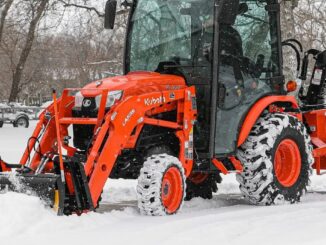
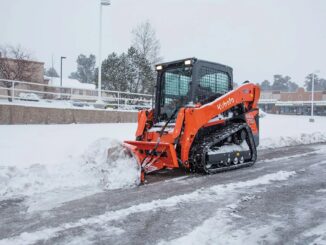
Kubota Compact Wheel Loader Snow Removal: Models, Parts, and Repairs
Kubota compact wheel loaders can clear snow with suitable buckets, pushers, blades, and other approved attachments. A hydraulic snowblower or rotary broom is also a possibility only when its mounting, hydraulic requirements, controls, and weight match the individual loader.
For owners, compatibility begins with the complete machine identification—not just the R-Series name. Kubota’s US wheel loader range includes several generations, different attachment couplers, and separately cataloged production configurations. The current US lineup consists of the R430, R540, and R640.kubotausa+1
This guide covers current and legacy US-market compact wheel loaders, winter attachments, replacement-parts identification, routine maintenance, troubleshooting, and repairs. It also explains why articulated steering, attachment weight, hydraulic supply, and tire selection deserve particular attention during snow removal.
Kubota Compact Wheel Loader Models: Current and Legacy US Machines
Kubota’s compact wheel loaders use the R designation. They are separate from SSV skid steers and SVL compact track loaders, even where a loader is equipped with a skid-steer-style attachment coupler.
A matching coupler does not make the machines mechanically identical or give them the same hydraulic capability.
Current Kubota R-Series wheel loaders
| Base model | US catalog designations owners may encounter | Main ownership checks |
|---|---|---|
| R430 | R430, R430R1, R430R3 | Full model, serial number, operator station, coupler, and hydraulic equipment |
| R540 | R540, R540R41, R540R43 | Exact configuration, attachment interface, engine and hydraulic parts |
| R640 | R640, R640R41, R640R43 | Configuration-specific parts, attachment weight, hydraulic requirements |
Kubota lists the R430, R540, and R640 as its current US wheel loaders. Its model-selection system also identifies the additional configuration designations shown above.kubotausa+1
Do not assign a meaning to an unfamiliar suffix by guesswork. Have the parts catalog or dealer establish which configuration applies to the actual machine.
Legacy Kubota wheel loaders
| Model family | Principal US catalog identifications | Parts and repair priority |
|---|---|---|
| Earlier smaller loaders | R310 | Exact production configuration and original attachment equipment |
| Earlier R400 family | R400 | Complete identification and parts availability |
| Earlier compact loader | R410 | Production version, driveline, hydraulic and steering components |
| Following compact loader | R420 | Correct catalog and installed equipment |
| Updated R420 family | R420S | Preserve S and production designations |
| Earlier larger loader | R510 Old Type, R510 New Type | Establish which catalog applies before ordering |
| Following larger loader | R520 | Complete model and production identification |
| Updated R520 family | R520S | Correct generation and configuration |
| Previous-generation smaller loader | R530 | Coupler, hydraulics, cab, and serial-specific parts |
| Previous-generation larger loader | R630 | Exact configuration and attachment application |
These model families appear in Kubota’s US wheel-loader resources. The R510 is explicitly divided into Old Type and New Type entries, illustrating why a base model number alone may be insufficient.kubotausa
Additional legacy catalog designations
Kubota’s expanded model-selection resources include entries such as:
-
R310BU-1, R310BU-2, and R310BU-3.
-
R400B and R400BU.
-
R410BU-1, R410BU-1A, R410BU-2, and R410BU-3.
-
R420BU-1A.
-
R420S1 and R420S2.
-
R420S1T3, R420S2T3, and R420S1T3NT.
-
R520S1T3 and R520S2T3.
-
R530R41 and R530R43.
-
R630R41 and R630R43.kubotausa
These are parts-lookup distinctions, not an invitation to identify the loader from appearance alone.
This guide covers the established US catalog families. A machine imported independently may require different documentation and parts support even if its model resembles a US-market loader.
Identify the Loader and Attachment Before Ordering Parts
A snow-removal setup usually involves separate catalogs for the loader and attachment.
The loader catalog identifies its hydraulic system, coupler, steering, axles, cab, and engine components. The attachment catalog identifies items such as a pusher’s cutting edge or a snowblower’s hydraulic motor.
Create a permanent equipment record
Record:
-
Complete loader model and serial number.
-
Engine identification.
-
Cab or canopy configuration.
-
Coupler type.
-
Auxiliary hydraulic equipment.
-
Attachment model and serial number.
-
Attachment motor identification, where fitted.
-
Electrical control-kit identification.
-
Tire size and specification.
-
Approved counterweight equipment.
Photograph identification plates, hydraulic connections, mounting points, and wiring before disassembly.
Keep the appropriate manuals together
| Document | Main purpose |
|---|---|
| Loader operator’s manual | Safe operation, routine maintenance, fluids, and normal checks |
| Loader workshop manual | Diagnosis, measurements, and repair procedures |
| Loader parts catalog | Machine components and production applicability |
| Attachment operator’s manual | Operating limits, adjustments, lubrication, and safety |
| Attachment parts catalog | Wear parts, motors, valves, bearings, and control components |
| Accessory installation instructions | Couplers, wiring, hydraulic options, and approved weights |
Kubota provides wheel-loader-specific frequently used parts resources. Nevertheless, filters and service components should still be selected against the exact machine application.kubotausa
An exploded diagram is not a complete repair procedure. It may not explain bearing fits, pressure release, pin removal, torque, or safe component support.
Choosing Snow Attachments for a Kubota Wheel Loader
Choose the attachment around the property, snow conditions, and available storage space.
| Attachment | Useful application | Main compatibility and repair checks |
|---|---|---|
| Snow bucket | Loading and relocating snow | Coupler, weight, edge, welds, capacity |
| Snow pusher | Clearing open areas with space for piles | Width, weight, shoes, edge, mounting |
| Angle blade | Moving snow to one side of a route | Hydraulic controls, pivots, trip system, balance |
| Snowblower | Throwing snow beyond the cleared area | Flow, pressure, return, case drain, controls |
| Rotary broom | Light snow and cleanup | Hydraulic requirements, brush wear, debris control |
| Pallet forks | Handling bagged salt, grit, and supplies | Load chart, fork condition, load center |
| Spreader | Applying approved de-icing material | Mounting, loaded weight, controls, corrosion |
Kubota’s implement listings identify a Land Pride SSP25 snow-pusher application for an R640 configuration. That is a specific listing—not approval for every pusher on every R loader.kubotausa
Snow buckets and wet snow
A large bucket can become heavily loaded before it looks full.
Use the loader’s actual operating limits for its tires, coupler, attachment, and steering position. Do not treat breakout force or lifting force as an allowable payload.
Pushers and blades
Inspect cutting edges, shoes, side plates, pivots, cylinders, hoses, and any trip mechanism.
Do not ram frozen banks. A hidden curb or solid ice ridge can transmit substantial impact into the attachment and loader.
Snowblowers require additional verification
Do not assume that a hydraulic blower advertised for a skid steer will work correctly on a wheel loader.
A common mounting plate establishes only one part of the installation. The motor, controls, hydraulic supply, attachment weight, and visibility must also be suitable.
Auxiliary Hydraulics: Flow, Pressure, and Return Requirements
Wheel loaders can have substantially different auxiliary capability from high-flow skid steers.
Kubota’s current R-Series page publishes an auxiliary-flow range of 11.1–17.8 US gpm across the family. The correct individual-machine specification is essential when selecting a motor-driven attachment.kubotausa
Verified R540 and R640 specifications
| Loader | Published auxiliary flow | Published auxiliary pressure |
|---|---|---|
| R540 | 14.2 US gpm, approximately 54 L/min | 2,683 psi |
| R640 | 17.8 US gpm, approximately 67.2 L/min | 2,973 psi |
These figures come from Kubota’s US R540/R640 brochure. Confirm the applicable machine specification and attachment requirements rather than treating the figures as universal across all years and configurations.kubotausa
Flow and pressure are different
Flow influences motor speed and available hydraulic power. Pressure relates to the force or torque the circuit can develop within its design.
Too little flow can produce weak attachment performance. Excessive flow can damage an incorrectly matched motor.
Do not alter relief settings to compensate for an unsuitable attachment.
Return flow and case drain
Where the attachment requires a separate case drain or low-restriction return, use the approved connection.
Do not substitute another port merely because the fittings match. Incorrect return arrangements can cause overheating or motor-seal damage.
Have a dealer or attachment specialist verify the circuit when the requirements are unclear.
Quick Couplers and Attachment Mount Repairs
Current R540/R640 literature lists hydraulic Euro-type, hydraulic SSL-type, and mechanical SSL-type coupler options. The installed interface must be identified before purchasing attachments.kubotausa
Daily coupler inspection
Check:
-
Locking pins or wedges.
-
Retainers.
-
Linkage.
-
Cylinders, where fitted.
-
Hydraulic hoses.
-
Attachment mating surfaces.
-
Worn holes.
-
Cracked welds.
-
Bent components.
Clear snow and ice before coupling. Verify engagement by the procedure in the loader and attachment manuals.
A switch position does not prove the attachment is securely locked.
Wear and distortion
A coupler may still pick up an attachment despite worn locks or distorted mating surfaces.
Excess movement, incomplete engagement, or damaged mounting plates requires repair before use.
Structural cracks and improvised welding need qualified assessment.
Hose routing
Check hose clearance throughout the attachment’s permitted movement and the loader’s steering range.
Hoses must not stretch, rub tires, become trapped at the coupler, or enter the articulation area.
Never search for a hydraulic leak with bare hands.
Articulation Joint and Steering Repairs
An articulated wheel loader steers by changing the angle between its front and rear sections.
Kubota’s current R-Series uses an articulated frame with oscillation. This provides maneuverability but creates maintenance and safety requirements that differ from a conventional tractor.kubotausa
Inspect the center joint
Check accessible:
-
Articulation pins and bushings.
-
Retainers.
-
Grease points.
-
Steering-cylinder mounts.
-
Hoses crossing the joint.
-
Wiring.
-
Oscillation components.
-
Evidence of abnormal movement.
Follow the specified lubrication schedule. Do not assume every joint uses the same grease or service interval.
Warning signs
Investigate:
-
Clunking during steering or travel.
-
Visible movement beyond specification.
-
Uneven steering response.
-
Damaged hoses.
-
Steering-cylinder leakage.
-
Loose mounting hardware.
-
Cracked frame areas.
Wear measurements and pin or bushing replacement require the correct service procedure and suitable support.
Use the articulation lock correctly
Install the manufacturer’s articulation lock when required for servicing, lifting, or transport.
Never enter the articulation pinch zone while the machine can steer. Do not rely on a parked steering wheel or an inactive engine as a substitute for the prescribed lock and isolation procedure.
Loader Pins, Bushings, and Cylinders
Snow work repeatedly loads the lift and tilt linkage, particularly when pushing against dense snow.
Pin and bushing inspection
Look for:
-
Missing retainers.
-
Loose hardware.
-
Damaged grease fittings.
-
Uneven wear.
-
Abnormal movement.
-
Cracked bosses or brackets.
Do not tighten components arbitrarily to remove movement. Establish whether the wear is in the pin, bushing, mount, or another part.
Cylinder inspection
Check rods for pitting, scoring, corrosion, and damage. Inspect hoses, mounts, and seals.
A leaking cylinder may require more than a seal kit if the rod or internal surfaces are damaged.
Seal replacement, rod repair, and pressure testing should be completed using the correct tools and cleanliness procedures.
Raised equipment
Never work beneath raised loader arms without the manufacturer’s approved support device installed according to instructions.
Do not rely on hydraulic pressure, a bucket, or an unstable jack.
Tires, Wheels, Axles, and Brakes
Tire inspection
Check:
-
Installed size.
-
Load rating.
-
Tread and sidewalls.
-
Pressure.
-
Matching configuration.
-
Wheel condition.
-
Fasteners.
Use the approved pressure for the tire and machine—not a generic winter setting.
Different tire sizes can affect clearance, stability, gearing relationships, and published capacities.
Chains and winter tires
Verify chain approval, sizing, and clearance around tires, fenders, hoses, and bodywork throughout articulation and oscillation.
Stop immediately if chains contact the machine.
Winter-oriented tires or approved traction equipment may improve grip, but four-wheel drive does not prevent sliding.
Axle and final-drive service
Use the correct lubricant and service procedure for each assembly.
Noise, leakage, abnormal heat, or metal contamination requires diagnosis. Do not continue operating to see whether a drivetrain noise “clears up.”
Braking and inching
The R540/R640 brochure identifies hydrostatic drive, wet service brakes, a spring-applied hydraulically released parking brake, and inching/brake controls.kubotausa
Do not apply those details universally to every legacy R loader.
A loader that creeps, will not hold, or brakes unpredictably needs service. Do not use snow piles or a lowered bucket as a substitute for working brakes.
Snowblower, Broom, and Blade Repair Priorities
Snowblower wear components
Inspect shoes, cutting edge, auger, impeller, bearings, shafts, and mounting hardware.
With power isolated, look for bent flights, cracked welds, debris, housing contact, and abnormal shaft movement.
Never reach into a chute or auger. Stored mechanical energy can move components after shutdown.
Hydraulic motors
Before replacing a slow or leaking motor, verify:
-
Correct supply flow.
-
Correct direction.
-
Return arrangement.
-
Case drain, where required.
-
Mechanical freedom.
-
Oil condition.
Motor symptoms can originate in the carrier circuit or attachment mechanism.
Chute and deflector controls
Check for ice, binding, damaged linkage, coupler issues, and electrical faults.
Do not force a frozen mechanism or increase fuse size to overcome repeated failures.
Brooms and blades
Inspect brush wear, bearings, guards, cutting edges, trip mechanisms, pivots, and cylinders.
Service loaded springs only according to the attachment instructions.
Engine, Cooling, and Emissions Repairs
Cooling-system access
Keep cooling screens, radiators, and air passages clear. A loader can overheat in freezing weather if packed snow blocks airflow.
Check coolant condition and freeze protection when safe. Never open a hot cooling system.
Fuel-system maintenance
Use clean winter-suitable diesel and drain accumulated water as instructed.
No. 2 diesel generally offers greater energy content, while approved winter blends and No. 1 diesel can improve severe-cold flow.
Use approved anti-gel before cold-flow problems develop. Never add gasoline, alcohol, or unapproved solvents.
Common-rail engines and DPF
Kubota’s R540/R640 brochure identifies common-rail engines and DPF equipment. These systems require model-specific diagnosis.kubotausa
Never loosen high-pressure injection lines to diagnose a running engine.
Follow the exact regeneration and warning instructions. Repeated warnings, power reduction, or unsuccessful regeneration require qualified service—not bypasses or emissions modifications.
Batteries, Electrical Faults, and Cab Equipment
Starting and charging
Inspect terminals, grounds, cables, hold-downs, and accessible connectors.
A repeatedly discharged battery may indicate a charging fault, parasitic drain, poor connection, or excessive accessory demand.
Use a compatible maintainer. Never charge a frozen, cracked, swollen, or leaking battery.
Cab heat and defrost
Inspect heater airflow, wipers, washers, seals, lights, mirrors, and cameras.
Kubota’s R540/R640 cab literature describes heating, cooling, and defrosting equipment, but older and canopy machines differ.kubotausa
Weak heat can involve coolant, airflow, controls, or a heater fault. Refrigerant work and serious coolant contamination require qualified service.
Record fault information
Before clearing a warning or disconnecting a battery, record the displayed code, operating conditions, and symptoms.
Do not assume a warning identifies the failed component directly. Wiring, power supply, sensors, and mechanical faults can produce related symptoms.
Ballast and Articulated-Loader Stability
Use the loader’s approved configuration and capacity information.
Turning changes the geometry of an articulated loader. Kubota’s R540/R640 specifications distinguish straight and full-turn tipping loads, as well as bucket and pallet-fork applications.kubotausa
Safe winter loading
-
Keep loads low during travel.
-
Avoid abrupt steering.
-
Reduce speed on ice.
-
Avoid turning with a raised load.
-
Follow slope limits.
-
Keep clear of hidden drop-offs.
-
Do not exceed the actual configuration’s limits.
Do not add improvised counterweights to increase lifting capacity. Extra weight can overload tires, axles, brakes, or transport equipment.
Daily Winter Operating Checklist
Before starting
-
Inspect leaks, hoses, wiring, and fluid levels.
-
Check tires and wheel fasteners.
-
Clear steps, windows, lights, and cooling areas.
-
Inspect articulation and steering areas.
-
Confirm attachment locks.
-
Check couplers and hose routing.
-
Test lights, alarms, and safety systems.
Warm-up
-
Follow the cold-start procedure.
-
Use approved heaters and starting aids only as designed.
-
Allow engine and hydraulic warm-up according to the manual.
-
Operate permitted functions slowly.
-
Confirm steering, braking, travel, and attachment response.
Do not use one warm-up time for every R loader.
Shutdown
Park on firm, level ground, lower the attachment, and follow the parking procedure.
Remove packed snow and salt, inspect for damage, and connect approved heaters or maintainers only after safe shutdown.
Troubleshooting Kubota Wheel Loader Snow Problems
| Symptom | Likely causes | Safe first checks | Professional service needed |
|---|---|---|---|
| Attachment will not operate | Coupler, control, hydraulic, or mechanical fault | Isolate power and check approved connections | Pressure, motor, valve, or internal fault |
| Blower discharge is weak | Wrong flow, excess feed, blockage, drive problem | Reduce travel speed and confirm setup | Persistent weakness or abnormal noise |
| Hydraulic motor leaks | Seal damage, return restriction, case-drain issue | Stop and inspect visible routing | Motor and circuit diagnosis |
| Coupler will not lock | Ice, wear, distortion, linkage fault | Clean and inspect safely | Damaged locks, cylinders, or structure |
| Steering clunks | Pin, bushing, mount, or cylinder wear | Stop and inspect accessible areas | Joint measurement and repair |
| Steering is slow or uneven | Cold fluid, supply issue, mechanical fault | Warm correctly and check routine items | Persistent or unpredictable response |
| Loader lifts slowly | Cold fluid, low level, restriction, hydraulic fault | Check approved routine items | Pressure or internal hydraulic diagnosis |
| Loader creeps or will not hold | Control, transmission, or brake fault | Stop use and park safely | Qualified diagnosis |
| Engine loses power | Fuel restriction, load, engine or emissions fault | Check approved routine items | Repeated warnings or power loss |
| Windows fog or heater is weak | Moisture, airflow, controls, coolant issue | Clear vents and use controls correctly | Leakage or persistent HVAC fault |
Buying Used and Storing Correctly
Before purchasing, inspect identification plates, service history, articulation wear, steering, brakes, coupler engagement, tires, leaks, cooling condition, and warning indicators.
For powered attachments, obtain a complete inventory of hoses, controls, wiring, and mounting components.
Confirm major-parts availability before dismantling an older loader. A catalog listing does not guarantee immediate stock.
For storage:
-
Remove salt, dirt, and debris.
-
Let equipment dry.
-
Lubricate specified points.
-
Protect exposed metal.
-
Cap couplers.
-
Label detached components.
-
Lower attachments or use approved supports.
-
Record outstanding repairs.
Routine owner work includes cleaning, inspection, lubrication, and manual-listed maintenance. Structural repairs, articulation rebuilds, high-pressure hydraulics, internal transmissions, brakes, common-rail injection, and complex electrical faults require appropriate skills and equipment.
Frequently Asked Questions
What are the current Kubota wheel loader models?
Kubota currently lists the R430, R540, and R640 in its US R-Series range.kubotausa
Will a skid-steer snowblower work on an R-Series loader?
Only if mounting, hydraulics, controls, attachment weight, and operating requirements are approved. A skid-steer-style coupler alone does not establish compatibility.
Are R530 and R540 parts interchangeable?
Only where the correct catalog confirms it. Treat them as separate models and preserve the full configuration and serial number.
Why is my hydraulic snowblower slow?
Possible causes include insufficient flow, incorrect settings, restricted connections, excessive feed rate, mechanical resistance, or a motor fault.
Can I install a larger hydraulic pump?
Do not make an unverified conversion. Pump changes can affect cooling, controls, pressure limits, engine loading, and component compatibility.
Can I repair articulation pins myself?
This requires correct support, isolation, measurements, tools, and service procedures. It is not a routine grease-and-adjustment task.
Should I add rear weight for a larger snow attachment?
Only use approved ballast and capacity information. Improvised weight does not authorize a heavier attachment or higher payload.
Why does capacity change when the loader turns?
Articulation changes the machine’s stability geometry. Kubota therefore publishes separate straight and full-turn tipping figures.kubotausa
Repair the Whole Winter Setup Before Severe Weather
Keep one parts record for the loader, coupler, attachment, hydraulic arrangement, and controls.
Resolve worn locks, steering play, brake faults, recurring leaks, vibration, and warning indicators before winter service. Use the loader and attachment manuals together, and establish the cause before replacing expensive pumps, motors, or drive assemblies.