
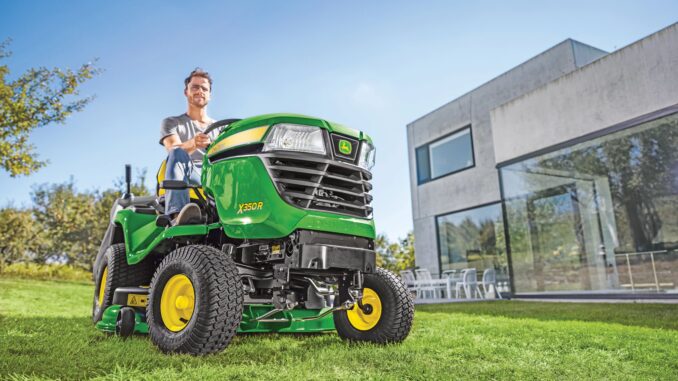
The John Deere X580 is a heavy-duty lawn tractor in Deere’s X500 Select Series, built for homeowners who want more capability than an entry-level lawn tractor and need strong mowing, towing, and hill-friendly performance from a liquid-cooled V-twin and shaft-driven hydrostatic transmission. This guide is written for USA and Canada owners who want a practical, symptom-first reference covering common repairs, troubleshooting steps, maintenance tasks, parts planning, and realistic DIY limits before a small problem turns into a bigger one.
For most owners, the X580 is used for larger residential properties, repeated mowing in hot weather, towing lawn carts or sweepers, and handling more demanding terrain than lighter lawn tractors are comfortable with. That means the most important ownership topics are usually starting reliability, mower deck performance, belt and blade wear, cooling system cleanliness, hydraulic drive service, and electrical or safety-switch faults that stop the tractor from cranking or mowing properly.
General overview of the John Deere X580
The John Deere X580 sits in the X500 Select Series, above basic lawn tractors and aimed at owners who want a more durable chassis, better steering and traction manners, and longer-life components for regular residential work. Deere groups it with the X570, X584, and X590 in the same operator manual family, which helps because many service procedures and maintenance intervals overlap across those models.
On the John Deere X580, the main systems an owner needs to understand are the engine and fuel system, the mower deck and belt drive, the hydrostatic transaxle, and the electrical and operator-presence safety system. Owners commonly buy service parts such as the fuel filter AM116304, oil filter AM125424, spark plug M805853, transaxle filter MIA881446, foam precleaner MIU12554, paper air filter MIU12555, 54-inch blade options such as UC22010 or related 54-inch blade references depending on blade style, and common U1-size battery options sold by Deere such as TY25221B.
Troubleshooting approach for the John Deere X580
The best way to diagnose a John Deere X580 is to start with the symptom the owner actually sees rather than guessing at parts. A tractor that will not crank needs a different path from one that cranks but will not fire, and both are different again from a tractor that runs well but cuts poorly, vibrates, overheats, or will not drive correctly.
Main John Deere X580 symptom groups usually include:
-
Starting issues, including no crank, slow crank, or cranks-but-will-not-start faults.
-
Running issues, including surging, stalling, loss of power, and rough operation under load.
-
Cut-quality problems, including scalping, streaking, uncut strips, and poor discharge.
-
Vibration and noise, often linked to blades, deck hardware, pulleys, bearings, or loose components.
-
Overheating and leaks, especially when cooling fins or screens are dirty or fluid levels are ignored.
-
Transmission and drive complaints, such as weak hill performance, sluggish travel, or fluid service neglect.
-
Electrical and safety-switch faults, including PTO issues, dead lights, blown fuses, or no-crank safety interlock problems.
Emergency and immediate John Deere X580 repair needs
Some John Deere X580 problems should be dealt with immediately because they affect safe operation or can rapidly damage expensive parts. If the tractor is leaking fuel, making heavy driveline noise, overheating badly, losing steering or braking confidence, or shaking hard enough to suggest blade or spindle trouble, stop using it until the cause is found.
John Deere X580 starting issues
When the X580 will not crank, only clicks, or cranks without starting, the immediate concern is whether the problem is a simple battery or interlock issue or something that could leave you stranded and lead to repeated starter abuse. Repeatedly cranking a weak system can overheat cables, flatten the battery, and mask the real fault.
Common causes:
-
Weak, discharged, or failing battery.
-
Dirty or loose battery terminals and grounds.
-
Brake, PTO, or seat safety interlock not satisfied.
-
Blown fuse, faulty ignition switch, or starter circuit fault.
-
Fuel delivery issue, stale fuel, clogged filter, or ignition issue on a cranks-but-no-start complaint.
Basic checks:
-
Confirm the PTO is off, the brake is fully applied, and the operator controls are in the correct start position.
-
Inspect battery terminals for corrosion and make sure connections are tight.
-
Charge-test or substitute a known-good battery if cranking is slow.
-
If it cranks but does not start, inspect the fuel filter, fuel freshness, air filter, and spark plugs.
-
Stop and investigate further if there is a fuel smell, repeated fuse failure, or signs of melted wiring.
John Deere X580 cut-quality problems
Poor cut quality on the John Deere X580 usually shows up as ragged tips, strips of missed grass, clumping, scalping, or uneven height side to side. It matters because many owners first suspect the deck belt, but the real cause is often blade condition, deck buildup, incorrect tire pressure, or deck-level errors.
Common causes:
-
Dull, bent, or mismatched blades.
-
Deck packed with wet grass underneath.
-
Mower not level or tire pressures uneven.
-
Belt wear or poor belt tension.
-
Ground speed too high for conditions.
Basic checks:
-
Check tire pressures before judging deck level.
-
Inspect blade edges and confirm the correct 54-inch blade set is installed for the deck setup.
-
Clean the underside of the deck and inspect for packed debris.
-
Check the mower belt for glazing, cracking, or heat damage.
-
Re-level the deck if the cut is consistently uneven after blade inspection.
John Deere X580 vibration and noise
A vibrating John Deere X580 should never be ignored because severe vibration can damage spindle bearings, deck housings, belts, and engine mounts. The most common causes are blade damage from impact, loose hardware, pulley or spindle wear, or debris wound around rotating parts.
Common causes:
-
Bent or unbalanced blades.
-
Loose blade hardware or deck hardware.
-
Worn spindle bearings or pulleys.
-
Debris wrapped around spindles or shafts.
-
Belt slap from a damaged or stretched belt.
Basic checks:
-
Shut the tractor down immediately if vibration starts suddenly after striking an object.
-
Inspect blades for bends, cracks, and loose bolts.
-
Spin pulleys and spindles by hand with the engine off to feel for roughness or play.
-
Remove wrapped grass, wire, or string from shafts and spindles.
-
Replace damaged blades or bearings before mowing again.
John Deere X580 overheating and leaks
Overheating on the X580 often starts with restricted airflow rather than a catastrophic engine fault, but ignoring it can shorten engine life fast. Fuel, oil, or hydraulic leaks also need quick attention because they create fire risk, belt contamination, and secondary component damage.
Common causes:
-
Dirty cooling fins, screens, or engine compartment buildup.
-
Low engine oil or overdue oil service.
-
Fuel seepage from lines or filter connections.
-
Hydraulic seepage or neglected transaxle service.
-
Grass accumulation around hot engine parts.
Basic checks:
-
Clean the screen, cooling areas, and visible debris around the engine.
-
Check engine oil level and correct overdue oil/filter service.
-
Inspect around the fuel filter and fuel lines for wetness or smell.
-
Look for oil or hydraulic fluid traces around filters, housings, and lines.
-
Do not keep mowing if the engine is clearly overheating or smoking.
John Deere X580 transmission and drive problems
Drive complaints on the John Deere X580 usually show up as weak movement on hills, sluggish response, noise from the rear end, or poor traction feel after fluid service has been skipped. Because the X580 uses a shaft-driven hydrostatic setup rather than a simple belt-only lawn tractor arrangement, transmission service quality matters more than many owners expect.
Common causes:
-
Low or degraded transaxle fluid.
-
Restricted or overdue transaxle filter.
-
Rear wheel hardware or related drivetrain looseness after service intervals are ignored.
-
Tire condition or inflation issues affecting traction.
-
Internal hydrostatic wear needing dealer-level diagnosis.
Basic checks:
-
Confirm whether the 50-hour break-in and later hydro service intervals have been done.
-
Inspect for leaks around the transaxle and filter area.
-
Check tire pressure and tire condition before blaming the hydro unit.
-
Verify rear wheel hardware torque status if the machine has recently been serviced.
-
Escalate persistent loss of drive or abnormal hydro noise to a dealer.
John Deere X580 electrical problems
Electrical faults on the John Deere X580 often appear as no-crank conditions, intermittent PTO engagement, dead lights, or repeated fuse failures. The tricky part is that many electrical complaints are actually safety-switch or connector problems, so random parts replacement usually wastes time.
Common causes:
-
Seat, brake, or PTO switch faults.
-
Corroded connectors or grounds.
-
Battery condition or charging weakness.
-
Ignition switch or starter relay trouble.
-
Harness damage from vibration or rubbing.
Basic checks:
-
Inspect obvious connectors, grounds, and fuse condition first.
-
Verify battery health before chasing the rest of the system.
-
Check whether the fault changes when the PTO or brake pedal is moved.
-
Inspect harness routing in high-vibration or pinch areas.
-
Use a meter for confirmation before replacing switches or modules.
DIY or dealer? John Deere X580 repair decision guide
The normal line on a John Deere X580 is this: routine service, blades, filters, spark plugs, deck cleaning, basic belt work, and visual electrical checks are realistic owner jobs, but engine internal work, hydrostatic diagnosis, repeated electrical faults, and valve-clearance service are usually better left to a dealer or an experienced independent shop. The X580 is more serviceable than many modern machines, but it is also valuable enough that guessing on complex repairs can get expensive quickly.
Good DIY jobs on the John Deere X580
-
Engine oil and filter changes.
-
Air filter and foam precleaner replacement.
-
Fuel filter replacement.
-
Spark plug replacement.
-
Blade sharpening or blade replacement.
-
Deck cleaning, leveling checks, and grease-point service.
-
Basic battery replacement and terminal cleaning.
Advanced DIY or dealer jobs
-
Deck spindle replacement or deck shell repair.
-
Hydrostatic transaxle oil and filter service if access or cleanliness is a concern.
-
Electrical diagnosis involving intermittent switches, relays, or harness faults.
-
Steering, axle, or driveline repairs beyond simple lubrication.
-
Valve-clearance inspection and adjustment, which Deere specifically directs to dealer service at the 200-hour interval.
Skill level guide
-
Beginner: Air filter, foam precleaner, spark plugs, battery, blade inspection, deck cleaning.
-
Intermediate: Oil and filter service, fuel filter replacement, blade replacement, deck leveling, basic belt inspection.
-
Advanced: Hydro service, spindle or pulley work, electrical diagnosis with a meter, steering/driveline repairs.
Parts needed for the John Deere X580: OEM vs aftermarket
Before ordering John Deere X580 parts, gather the full model name, the tractor Product Identification Number, the engine model and serial number, and the deck size or attachment version because Deere changes parts by serial break, deck option, and component supplier. This matters most for blades, belts, filters, electrical parts, and any repair where two similar-looking parts may fit differently or have different update numbers.
For the John Deere X580, OEM parts are the safest choice for belts, safety switches, fit-sensitive deck parts, hydro filters, and anything tied to operator safety or exact routing. Aftermarket parts can be acceptable for blades, batteries, and some filters when the cross-reference is exact and the seller clearly states X580 compatibility by deck and serial range rather than just saying “fits many John Deere models”.
Where to find John Deere X580 parts diagrams and manuals
The best places to research the John Deere X580 are Deere’s owner-information page, the operator manual family for the X570/X580/X584/X590 tractors, Deere’s official parts catalog tools, and a Deere-focused parts retailer with model-specific maintenance references. Used together, these sources help owners confirm intervals, identify likely part numbers, and avoid ordering mistakes.
-
John Deere X580 owner information for official owner support, manual access, and model-specific starting points.
-
X570/X580/X584/X590 operator manual family for operating procedures, control descriptions, and troubleshooting guidance.
-
John Deere parts catalog reference for 54-inch blade UC22010 as a useful example of Deere’s official catalog structure for verifying deck-related parts.
-
Green Farm Parts X580 maintenance guide for a practical service-parts summary and common maintenance part references used by X580 owners.
How to locate John Deere X580 model, serial, and engine numbers
These numbers matter because John Deere X580 parts can vary by machine identification and by engine supplier details, especially once you move beyond routine consumables. Getting the exact numbers first usually saves more time than any amount of guessing from photos.
-
Find the tractor Product Identification Number on the right side of the tractor frame above the front axle area, which is where TractorData notes the X580 serial identification is located.
-
Write down the full model designation exactly as shown on the machine before searching parts.
-
Record the engine model and serial numbers from the engine identification label so engine-related parts can be matched correctly.
-
Confirm the mower deck size and deck type, such as the 54-inch Accel Deep deck, before ordering blades or belts.
-
Take clear photos of all tags and labels so you can compare them when ordering online or visiting a dealer counter.
Buying John Deere X580 parts online and in stores
The safest buying strategy for John Deere X580 parts is to identify the OEM number first, then cross-check it against your PIN, deck size, and engine details before buying from the cheapest source. That approach reduces returns and is especially important for deck parts, hydro service parts, and electrical components.
-
Online: Best for routine filters, blades, plugs, manuals, and price comparison, but always verify exact OEM numbers and serial-sensitive notes first; strong starting points include Deere owner support, Deere Shop, and Green Farm Parts.
-
Dealer counter: Best for serial-specific parts, updated part substitutions, safety-switch questions, and anything unclear from diagrams alone.
-
Retail stores: Fine for consumables like equivalent batteries, oil, and some spark plugs if the packaging clearly lists the correct John Deere cross-reference and specifications.
Useful sources:
Step-by-step fitting guide for common John Deere X580 parts
These are the highest-value DIY jobs on a John Deere X580 because they directly affect starting, mowing quality, and long-term reliability. Always work on a cool machine, remove the key, and follow the operator manual’s safety practices before beginning.
Replacing the John Deere X580 air filter and foam precleaner
This job helps cure rich running, restricted power, and dirty-air ingestion that shortens engine life.
-
Park on level ground, shut the engine off, remove the key, and open the engine cover or access area as directed in the manual.
-
Remove the air-cleaner cover carefully so dirt does not fall into the intake.
-
Remove the foam precleaner MIU12554 and paper element MIU12555, then inspect the housing for dust or debris.
-
Wipe the housing clean with a lint-free rag and install the new elements in the correct order.
-
Refit the cover securely and confirm it seals evenly all the way around.
Changing the John Deere X580 spark plugs
Fresh spark plugs help with hard starting, misfire complaints, and rough running under load.
-
Let the engine cool fully so the plug threads are not removed from a hot cylinder head.
-
Pull the plug boots straight off and clean around each plug before removal.
-
Remove the old plugs and confirm they match the correct replacement part number M805853 or the current Deere substitute for your engine specification.
-
Install the new plugs by hand first to avoid cross-threading, then tighten to the manual specification.
-
Refit the plug boots firmly and test-start the tractor.
Replacing John Deere X580 mower blades
Blade replacement fixes poor cut quality, vibration from damaged blades, and ragged grass tips.
-
Disable the tractor safely, remove the key, and raise or access the deck using safe support methods.
-
Mark blade orientation before removal so the replacement goes back in the correct direction.
-
Remove the blade hardware and inspect the spindle area for cracks, wrapped debris, or worn mating surfaces.
-
Install the correct replacement blade set for the 54-inch deck, such as UC22010 where applicable, and tighten hardware to Deere specification.
-
Spin blades by hand to confirm clearance, then test for smooth operation before mowing at full speed.
Replacing the John Deere X580 fuel filter
A fresh fuel filter helps with hesitation, lean running, power loss, and intermittent stalling caused by restricted fuel flow.
-
Work in a ventilated area away from ignition sources and clamp or manage fuel flow as needed.
-
Identify the old inline filter and note the flow direction before removal.
-
Remove the clamps, slide out the old filter, and inspect the hose ends for cracks or looseness.
-
Install the new AM116304 filter in the correct direction and secure the clamps.
-
Start the tractor, check for leaks immediately, and shut down at once if any seepage appears.
Maintenance to prevent John Deere X580 problems reoccurring
Most recurring John Deere X580 problems are preventable because the tractor responds well to routine service, deck cleaning, lubrication, and timely fluid changes. Owners who keep up with filters, cooling cleanup, blade condition, and hydro service usually avoid the most expensive failures.
Focus areas:
-
Starting reliability: Keep the battery healthy, replace spark plugs and filters on schedule, and avoid stale fuel sitting too long.
-
Cut quality: Keep blades sharp, the deck underside clean, tire pressures correct, and the mower level checked periodically.
-
Fire and overheating prevention: Clean grass buildup from engine cooling areas and check for leaks before they soak hot surfaces.
-
Drive performance: Do the hydro break-in and later transaxle services on time instead of treating the unit as sealed forever.
-
Electrical reliability: Keep terminals clean, inspect harness routing, and address intermittent switch issues before they strand the machine.
John Deere X580 maintenance schedule and year-round checklist
The official John Deere service-interval guidance for this tractor family includes an 8-hour engine oil break-in service, a 50-hour transaxle break-in service on the X580, regular 50-hour lubrication points, 100-hour or annual engine and deck service, and 200-hour hydro and valve-clearance attention. The exact official chart should always be checked against the operator manual for your serial range, but the following is a practical owner version based on Deere’s interval summary for the X580.
Daily / before each use on the John Deere X580
-
Check engine oil level.
-
Inspect for fuel, oil, or hydraulic leaks.
-
Check mower area for buildup, loose parts, or visible blade damage.
-
Confirm tire condition and general safety-interlock operation before mowing.
After 8 hours
-
Change engine oil and filter as the break-in service.
Every 25 hours
-
Use this as a practical inspection point for cleaning, fastener checks, and general condition review, even where the formal Deere chart focuses more heavily on 50-hour and 100-hour intervals.
-
Recheck deck cleanliness, blade condition, and battery terminals if the tractor works in dusty or heavy-growth conditions.
Every 50 hours or yearly on the John Deere X580
-
Lubricate front axle pivot and axle spindles.
-
Lubricate mower deck spindles.
-
Lubricate idler arm pivot.
-
Lubricate lift pedal if equipped.
-
At the 50-hour break-in point on the X580, change transaxle oil and the transaxle filter, and check rear wheel bolt torque.
Every 100 hours or yearly
-
Change engine oil and filter.
-
Replace spark plugs.
-
Replace both foam and paper air filter elements.
-
Replace fuel filter.
-
Clean engine cooling fins.
-
Check mower belt, sharpen or replace blades, clean underside of deck, and check tire pressure.
Every 200 hours
-
Change transaxle oil.
-
Change transaxle oil filter on the X580.
-
Have valve clearance checked and adjusted by a John Deere dealer.
Seasonal checklist for the John Deere X580
-
Spring: Install sharp blades, check tire pressures, inspect the battery, and make sure the air and fuel systems are fresh before heavy mowing begins.
-
Mid-season: Clean cooling areas more often, inspect the mower belt, and monitor cut quality as grass loads increase.
-
Fall or end of season: Clean the deck thoroughly, address any fuel storage plan, and record hours so the next oil, filter, and hydro services are not missed.
Repair, upgrade, or replace a John Deere X580?
For a John Deere X580, repair usually makes sense when the tractor is structurally sound, the engine and hydro are fundamentally healthy, and the problems are confined to service items, deck wear, switches, blades, belts, or normal age-related consumables. Upgrade makes more sense when your work has outgrown the tractor’s deck or traction setup, while replacement becomes the better choice when the machine needs major engine, hydro, and deck work at the same time.
Repair if…
-
The fault is limited to filters, plugs, blades, belts, battery, switches, or deck service parts.
-
The engine starts and runs well once routine maintenance is brought up to date.
-
The transmission performs normally after correct hydro service.
Upgrade if…
-
You need different deck capability, more traction features, or a machine better suited to steeper or more specialized work.
-
You are repeatedly pushing the tractor beyond routine residential mowing and light towing duties.
Replace if…
-
The tractor has major hydro, engine, and deck problems at the same time.
-
Structural wear, recurring electrical faults, and poor maintenance history make the repair path uncertain.
-
Parts and labor estimates approach the value of a sound used or newer replacement machine.
John Deere X580 troubleshooting FAQ
1. Why will my John Deere X580 not start?
On the John Deere X580, a no-start begins with separating no-crank from cranks-but-will-not-fire. A no-crank problem often points to battery condition, cable corrosion, fuse issues, or a brake/PTO/seat safety interlock problem, while a cranks-but-no-start complaint pushes you toward fuel, spark, and air checks. Start with the simple items first so you do not replace parts at random.
2. Why does my John Deere X580 click but not crank?
A clicking X580 usually means the starter circuit is trying to engage but does not have enough current or clean connection quality to turn the engine. The most common suspects are a weak battery, dirty battery posts, poor ground, or a failing starter solenoid connection. Charge and test the battery before moving on.
3. Why does my John Deere X580 crank but not fire?
If the engine cranks normally but does not start, look at fuel freshness, fuel delivery through the inline filter, spark plug condition, and air filter restriction. A clogged AM116304 fuel filter, stale gasoline, or fouled M805853 plugs can all create the same basic symptom. Check for simple fuel and ignition faults before assuming a major engine issue.
4. Why is my John Deere X580 hard to start when cold?
Cold-start trouble often comes from weak ignition, marginal battery performance, or fuel that has degraded during storage. Dirty air filters and overdue spark plugs can also make a good engine act tired on startup. If the issue is seasonal, inspect tune-up parts and battery health first.
5. Why does my John Deere X580 start and then stall?
When an X580 fires and then dies, the first things to suspect are restricted fuel flow, stale fuel, or an intermittent safety/electrical issue. A partially clogged filter can allow enough fuel for startup but not enough for continued running. It is also worth checking whether moving off the seat or engaging the PTO changes the symptom, because that can point toward an interlock fault.
6. Why is my John Deere X580 running rough?
Rough running usually comes from fuel quality, spark plug wear, dirty air filters, or debris affecting the engine’s ability to breathe and cool properly. Because the same symptom can also appear with ignition or carburetion-related issues, start with the scheduled maintenance parts first. Many rough-running complaints improve after a basic tune-up.
7. Why is my John Deere X580 losing power while mowing?
Power loss under load usually means the engine cannot get enough clean air, enough fuel, or enough cooling, or the deck is demanding too much because blades are dull and the underside is packed with grass. High ground speed in thick grass can make the same complaint look worse. Service the filters, sharpen the blades, and clean the deck before chasing deeper faults.
8. Why does my John Deere X580 backfire or pop?
Backfiring or popping can be linked to fuel issues, ignition weakness, or operating shutdown habits that allow unburned fuel into the exhaust. While occasional popping is not always catastrophic, repeated backfire along with rough running means the tune-up and fuel system should be checked promptly. Persistent ignition-related symptoms deserve closer diagnosis.
9. Why is my John Deere X580 smoking?
Smoke color matters on the X580 because it helps separate oil burning, over-fueling, and overheating-related complaints. Grass-packed cooling areas and overdue maintenance can contribute, especially in hot-weather mowing. Stop and inspect the tractor if the smoke is heavy, persistent, or accompanied by loss of power.
10. Why does my John Deere X580 cut unevenly?
Uneven cutting is commonly caused by incorrect tire pressures, deck-level issues, dull blades, or deck buildup rather than a major deck failure. The X580 can only cut as level as the tractor sits, so tire pressure should always be checked before adjusting the deck. Then inspect blades and deck cleanliness.
11. Why does my John Deere X580 leave strips of uncut grass?
Uncut strips usually point to worn blade edges, wrong blade overlap from incorrect parts, deck buildup, or mowing too fast for grass conditions. Verify the correct 54-inch blade specification for your deck and replace any bent or heavily worn blades. A clean deck and a slower pass often improve the result immediately.
12. Why is my John Deere X580 scalping the lawn?
Scalping means the deck is cutting too low in spots or the tractor/deck attitude is wrong for the ground contour. Tire-pressure imbalance, deck mislevel, and aggressive mowing height choices are more common than actual deck damage. Correct setup before assuming bent hardware.
13. Why does my John Deere X580 clump grass?
Clumping usually happens when wet or heavy grass overwhelms airflow through the deck, especially if the underside is dirty or the blades are no longer lifting material cleanly. Slow down, mow in drier conditions when possible, and keep the blade and deck surfaces maintained. The problem is often operating condition plus maintenance, not only one or the other.
14. Why does my John Deere X580 vibrate when the mower is engaged?
If vibration appears mainly with the PTO on, focus on the cutting system first: blades, spindle bearings, pulleys, and deck debris. A bent blade after impact is a very common trigger. Shut the machine down quickly and inspect before more damage spreads through the deck.
15. Why is my John Deere X580 noisy underneath?
Noise under the tractor often comes from spindle bearings, pulleys, belt slap, wrapped debris, or loose deck hardware. The exact sound matters: a chirp can suggest a belt or pulley issue, while a growl or rumble points more toward bearings. Do not keep mowing until the source is confirmed.
16. Why did my John Deere X580 blade bend?
Blades bend most often after striking roots, rocks, branches, or hidden objects at mowing speed. Once bent, a blade can create severe vibration and should be replaced rather than straightened for normal homeowner use. Also inspect the spindle and deck around the impact area.
17. Why does my John Deere X580 throw the belt off?
A thrown belt usually means misalignment, a damaged pulley, a seized spindle, belt wear, or debris that forced the belt out of its normal path. Installing the wrong belt length or profile can create the same issue. Inspect all rotating parts before fitting another belt.
18. Why does my John Deere X580 mower belt keep wearing out?
Repeated belt failure normally points to an underlying problem such as pulley damage, bad bearings, heat, contamination from leaks, or wrong belt specification rather than bad luck alone. OEM belts are worth the extra cost on the X580 because fit and routing sensitivity matter. Fix the root cause before fitting another belt.
19. Why are my John Deere X580 blades coming loose?
Loose blades can come from incorrect installation torque, damaged hardware, or debris and wear at the blade mounting surfaces. This is a safety-critical issue, so the tractor should not be used until the hardware and spindle interfaces are inspected carefully. Replace questionable hardware rather than reusing it repeatedly.
20. Why does my John Deere X580 overheat?
Overheating usually starts with restricted airflow, dirty cooling fins, grass packed around the engine, or neglected oil service. These are preventable causes, which is why cleaning and maintenance matter so much on a hard-working X580. Stop mowing and clean the cooling system before the engine is stressed further.
21. Why is my John Deere X580 leaking fuel?
Fuel leaks often appear at hose connections, around the inline filter, or from aged fuel-line material. Because fuel leakage creates a fire risk, it should be treated as an immediate repair rather than a watch-and-wait issue. Replace damaged hoses and filters promptly and verify there is no seepage after restart.
22. Why is my John Deere X580 leaking oil?
Oil leaks can come from filter sealing surfaces, drain points, gaskets, or oil spread by airflow from an earlier spill during service. Clean the area first so you can tell whether the leak is active or just leftover residue. Persistent fresh oil needs tracing before it reaches belts or hot surfaces.
23. Why does my John Deere X580 move slowly?
Slow travel on the X580 can be caused by overdue hydro service, low hydraulic efficiency, dragging conditions, or tires that are affecting traction and response. Owners sometimes expect a worn hydro to fix itself with fresh fluid, but the service only helps if the core unit is still sound. Check maintenance history before assuming the worst.
24. Why won’t my John Deere X580 pull hills like it used to?
Hill performance loss often points to hydro wear, neglected transaxle fluid and filter service, or traction-related issues such as tires and surface conditions. Because the X580 is designed for more demanding lawn work than lighter tractors, a clear drop in hill ability is worth taking seriously. Start with fluid, filter, and tire checks.
25. Why is my John Deere X580 transmission noisy?
Hydro or rear-end noise can indicate fluid condition problems, filter restriction, or internal wear that needs more than owner-level inspection. If noise changes with travel direction, load, or temperature, note that before seeking service because it can help narrow the diagnosis. Persistent driveline noise is a dealer-level warning sign.
26. Why won’t the PTO engage on my John Deere X580?
A PTO engagement problem can be electrical, switch-related, interlock-related, or mechanical at the deck end. Start by confirming the safety system is satisfied and the battery/electrical system is strong enough to support proper engagement. Then inspect the PTO circuit and deck condition.
27. Why does my John Deere X580 keep blowing fuses?
Repeated fuse failure usually means a short to ground, a rubbing harness, water intrusion, or a component drawing more current than it should. Replacing the fuse without finding the cause only delays the next failure. Harness inspection in pinch and vibration areas is a smart first step.
28. Why are the lights not working on my John Deere X580?
Lighting faults are often simple, such as bulb failure, fuse issues, weak battery condition, or connector corrosion. If the lights fail along with starting or PTO behavior, treat it as a broader electrical-system problem rather than a bulb-only issue. Confirm battery and fuse condition first.
29. How often should I service my John Deere X580?
Deere’s service summary for the X580 family calls for engine oil and filter at 8 hours for break-in, hydro oil and filter at 50 hours for X580 break-in, lubrication every 50 hours or annually, engine tune-up items every 100 hours or annually, and hydro plus valve-clearance attention at 200 hours. Usage in heat, dust, and heavy mowing may justify shorter practical intervals for cleaning and inspection. The official manual should always be the final authority for your machine.
30. What maintenance matters most on a John Deere X580?
If an owner only focuses on a few things, the biggest payoffs come from clean cooling areas, timely oil and filter service, sharp blades, clean deck undersides, healthy batteries, and on-time transaxle service. Those jobs affect the problems X580 owners complain about most: hard starting, rough running, poor cut quality, overheating, and weakening drive performance. Staying ahead of those basics is cheaper than any major repair.
31. Should I buy OEM or aftermarket parts for my John Deere X580?
For the X580, OEM is the safer default for belts, hydro filters, switches, and fit-sensitive deck parts because routing, safety, and exact dimensions matter. Aftermarket can be acceptable for some blades, filters, and batteries if the cross-reference is exact and the seller clearly lists the right deck and model fitment. Avoid vague “universal fit” listings.
32. Where is the serial number on a John Deere X580?
TractorData states that the John Deere X580 serial number is located on the right side of the tractor frame above the front axle. That is the number to record before ordering anything more specific than basic consumables. Pair it with the engine ID and deck information for the best accuracy.
33. Can I do my own John Deere X580 hydro service?
Many capable owners can do X580 hydro service, but it sits closer to advanced DIY than beginner maintenance because cleanliness, correct fluid, correct filter, and proper handling of service access all matter. If you are not confident working cleanly around hydraulic components, dealer service is safer. A poor hydro service is worse than a careful delay.
34. When should I replace my John Deere X580 instead of repairing it?
Replacement becomes easier to justify when an X580 needs major hydro work, major engine work, and significant deck repairs at the same time, especially if the tractor also has a poor maintenance history. In contrast, a solid machine with normal wear items is usually worth repairing because many routine parts remain available. The decision depends on combined repair cost, not just one bad part