Kubota Snowblowers: Complete Snow Removal and Winter Equipment Guide
Kubota snowblowers include front-mounted tractor attachments, rear three-point implements, hydraulic loader attachments, and specialized systems for selected front mowers and RTV utility vehicles. The right setup depends on the exact machine, attachment drive, mounting system, available power, and conditions you need to clear—not simply the Kubota name on the hood.kubotausa+3
A compact tractor clearing an acreage driveway needs a different arrangement from a skid steer working a parking lot or an RTV maintaining paths. Kubota equipment can also use snow blades, pushers, brooms, buckets, and spreaders, but compatibility must be established for the individual machine and attachment combination.kubotausa+1
This guide covers the main equipment families, snowblower selection, traction and ballast, winter preparation, safe operation, troubleshooting, and seasonal storage. It is written primarily for owners in the United States and Canada; attachment availability and specifications can differ between markets.
Kubota Snowblowers and Snow Removal Equipment by Machine Type
Start by identifying the complete machine model and production details. Then identify the attachment model separately. A snowblower’s width or orange paint does not establish whether it will fit or operate safely.
Kubota’s tractor snow-implement literature separates BX, B01, and LX applications and specifies different hitches, driveline components, and installation requirements. Some installations require removal of the mid-mount mower and associated bracing.kubotausa
| Kubota equipment family | Snow-removal options to investigate | Main compatibility checks |
|---|---|---|
| BX subcompact tractors | Matched front snowblowers, front blades, rear implements, loader-mounted pushers | Exact tractor generation, front hitch, PTO kit, loader interface, ballast |
| B and B01 compact tractors | Matched front snowblowers and blades; suitable rear-mounted equipment | Model-specific subframe, driveline, PTO equipment, hydraulic controls |
| LX compact tractors | Front snowblowers and blades; suitable rear snowblowers, pushers, and spreaders | Tractor generation, loader configuration, subframe, hitch, PTO equipment |
| Standard L, Grand L, and larger tractors | Suitable rear snowblowers, pull-type blowers, loader blades, pushers, buckets, and spreaders | PTO power, hitch category, implement weight, loader capacity, hydraulic requirements |
| F-Series front mowers | Matched front snowblower, blade, or rotary sweeper | Exact mower model, front hitch, drive arrangement, lift capacity |
| Selected RTV utility vehicles | Approved plows, spreaders, and model-specific powered front attachments | Vehicle model, mounting kit, payload, electrical demand, required power system |
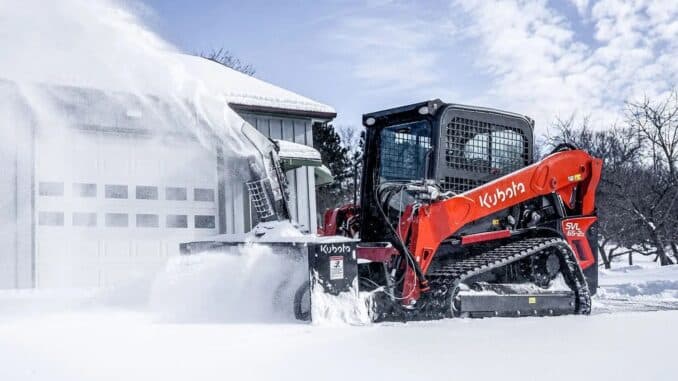
| Skid-steer and compact track loaders | Hydraulic snowblowers, pushers, blades, snow buckets, and brooms | Coupler, hydraulic flow and pressure, electrical controls, attachment weight |
| Compact wheel loaders | Suitable snow buckets, pushers, blades, and other approved attachments | Coupler, tipping and load limits, hydraulics, visibility, counterweight |
Kubota lists snowblower and blade options for its F-Series front mowers, while Kubota by Land Pride offers hydraulic loader snowblowers and other snow tools. These are separate attachment systems, not interchangeable versions of one universal mounting arrangement.kubotausa+1
Mowers, excavators, and tractor-loader-backhoes
Do not assume a Kubota zero-turn mower, lawn tractor, or older garden tractor accepts a snowblower because another Kubota mower does. For older or discontinued equipment, obtain the original attachment application information and verify that all mounting and drive components remain available.
Kubota excavators and tractor-loader-backhoes are not substitutes for a matched snowblower carrier. They may remain useful for approved bucket work, drainage maintenance, and winter material handling, but snow attachments require their own verified mounting, hydraulic, structural, and operating approvals.
Choosing the Right Kubota Snowblower
Choose the mounting and drive arrangement before choosing clearing width. A wider blower is only useful if the power unit can drive, lift, balance, and maneuver it safely.
Front-mounted tractor snowblowers
A front snowblower lets the operator face the clearing direction. This can be useful for repeated driveway work, confined areas, and properties where reversing with a rear implement would be awkward.
However, the purchase must include more than the blower itself. Depending on the tractor, the installation may require:
-
A model-specific front hitch or subframe.
-
A PTO drive kit and connecting shafts.
-
Hydraulic lift and chute controls.
-
Electrical controls for an optional deflector.
-
Removal of the mower deck or other conflicting equipment.
-
Prescribed rear ballast.
Kubota’s published BX, B01, and LX packages illustrate why a used blower without its matching hitch and drive components may be an incomplete purchase.kubotausa
Conventional rear-mounted snowblowers
A conventional rear three-point snowblower normally clears while the tractor reverses into the snow. It can suit rural lanes, farmyards, and properties where a front loader needs to remain available.
Check the tractor’s PTO specification, usable PTO power, hitch category, lift capacity, driveline geometry, and ballast requirements. Do not select solely by engine horsepower.
Rear operation also requires a clear view behind the tractor. Consider operator mobility, mirrors, lighting, cab visibility, and the amount of reversing the job requires.
Pull-type rear snowblowers
A pull-type or inverted blower mounts behind the tractor but clears while traveling forward. Land Pride lists three-point pull-behind snowblowers among the equipment presented for Kubota tractor applications.kubotausa
The tractor must travel through the snow before the blower reaches it. That makes snow depth, drifting, ground clearance, and traction important selection factors. A pull-type blower should not automatically be treated as the best option for opening deep, untouched drifts.
Hydraulic loader snowblowers
Kubota by Land Pride hydraulic snowblowers use the loader’s auxiliary hydraulic system rather than a tractor PTO shaft. The SBL product families include different machines and configurations, so their operating requirements must be checked individually.landpride+2
Verify:
-
Required hydraulic flow and operating pressure.
-
Standard-flow or high-flow configuration.
-
Any case-drain requirement.
-
Coupler type and hose routing.
-
Electrical connector and control compatibility.
-
Attachment weight and the carrier’s operating limits.
A matching quick-attach plate establishes only the mechanical connection. It does not confirm that the carrier can power the blower correctly.
Snowblowers for Kubota F-Series mowers and RTVs
Selected F-Series front mowers can change from mowing to snow work with a matched front attachment. Kubota lists a snowblower, front blade, and sweeper capability for the family, but the exact mower and installation package still need verification.kubotausa+1
Selected RTV configurations also support powered snow equipment. Kubota’s RTV-X1100C literature documents a dedicated PTO K-Connect system with a two-stage snowblower and sweeper. This is not evidence that every RTV accepts those attachments.kubotausa
Match the Attachment to the Property
Consider the entire clearing route rather than just driveway length.
| Property or operating condition | Equipment approach to consider | Important limitation |
|---|---|---|
| Narrow paths and short residential drives | Compact matched attachment or a separate walk-behind machine | Access width, turning space, storage, operator effort |
| Long rural driveway | Front, conventional rear, or pull-type tractor blower | Drifting, available power, traction, discharge space |
| Open parking lot | Loader pusher or blade, with a blower where snow must be relocated | Pile locations, parked vehicles, repeated accumulation |
| Gravel lane | Blower or blade with correctly adjusted shoes and cutting edge | Loose stones can become projectiles |
| Light snow on hard surfaces | Approved rotary broom | Depth, ice, debris, and discharge limitations |
| Paths maintained by an RTV | Matched plow or verified powered attachment | Payload, mounting limits, traction, braking |
Single-stage, two-stage, and walk-behind machines
A two-stage blower uses an auger to feed snow to a separate impeller that discharges it through the chute. Kubota’s tractor and RTV literature includes two-stage attachments.kubotausa+1
Standalone walk-behind snowblowers are a different equipment category. They can be more practical around steps, narrow gates, and short paths than fitting a larger Kubota power unit with an attachment. Do not assume a walk-behind machine powered by a Kubota engine is a Kubota-branded product or part of a tractor attachment system.
“Three-stage” terminology used in the walk-behind market does not establish any compatibility with Kubota machinery.
Kubota Snow Plows, Pushers, Brooms, and Spreaders
A snowblower is valuable when snow must be thrown beyond the clearing route. A blade or pusher may be more practical where there is adequate room to move and store snow.
Front blades and rear blades
Front blades can clear routes without continuously throwing snow through a chute. Hydraulic angling allows the operator to change discharge direction from the seat where the installation supports it.
Rear blades offer another option for suitable tractors. Check blade orientation, permitted working direction, hitch limits, and obstacle protection in the implement manual.
Neither a loader-mounted blade nor a rear blade should be used to strike frozen banks at speed. Attachment weight and side loads must remain within the carrier’s limits.
Loader buckets and snow pushers
A bucket remains useful for loading and relocating snow piles. A pusher contains snow between side plates and can reduce the windrows left by an angled blade.
Land Pride offers different loader-mount pusher families, including BX-specific arrangements and universal quick-attach products. Those distinctions matter when selecting a pusher for a Kubota loader.landpride
A box blade may help redistribute loose snow on an appropriate surface, but it is not automatically a replacement for a purpose-built snow blade. Avoid catching scarifiers on hidden pavement, utilities, or frozen obstacles.
Rotary brooms and spreaders
A matched rotary broom can handle light snow and cleanup work, but it should not be treated as a deep-drift machine. Kubota documents sweeper applications for selected F-Series and RTV equipment.kubotausa+1
For spreaders, check both the mounting arrangement and the loaded weight. Salt, sand, and blended materials differ in density and flow characteristics.
Confirm:
-
Hitch, receiver, or cargo-bed approval.
-
Payload and axle limits.
-
Electrical load and circuit protection.
-
Material compatibility.
-
Spinner clearance and discharge pattern.
-
Local restrictions on de-icing products.
After use, remove corrosive residue, dry the equipment, and lubricate it as instructed.
Tire Chains, Winter Tires, and Ballast
Traction and ballast solve related but different problems. Chains can improve grip; ballast establishes the weight distribution required for steering, braking, stability, and attachment operation.
Four-wheel drive does not eliminate either requirement.
Selecting traction equipment
| Traction option | Potential advantage | Checks and limitations |
|---|---|---|
| Two-link ladder chains | More frequent cross-chain contact than a comparable four-link arrangement | Correct fit, clearance, ride quality, surface damage |
| Four-link ladder chains | Suitable for some lower-speed applications | Less frequent cross-chain contact; suitability varies |
| Diamond-pattern chains | More continuous contact across the tread | Approval, clearance, installation, cost |
| Rubber traction belts | An option where protecting surfaces is important | Verify permitted use and expected ice performance |
| Winter-oriented tires | Tread and compound selected for winter work | Size, load rating, wheel compatibility |
| Studded tires | Potential additional grip on ice | Manufacturer approval, pavement damage, local law |
Check clearance around fenders, steering parts, brake components, hydraulic hoses, and bodywork through the permitted range of movement. Stop immediately if chains strike the machine.
On compact track loaders, inspect the actual track specification rather than assuming tracks always outperform tires on ice. Avoid unapproved chain, stud, or over-track modifications.
Ballast placement
Depending on the machine and attachment, approved ballast may include wheel weights, suitcase weights, a ballast box, liquid tire ballast, or a suitable rear implement.
Follow the prescribed arrangement. Rear tire ballast does not necessarily replace a specified rear counterweight, and a backhoe should not be assumed to provide the required balance.
Excess weight can overload tires, axles, bearings, the frame, or the transport trailer. Include the attachment and ballast when calculating transport weight.
Preparing Kubota Equipment for Winter Service
Kubota recommends inspecting hoses, belts, connections, fluids, tires or tracks, and corrosion before winter. It also emphasizes correct cold-weather fluids, battery condition, and adequate warm-up.kubotausa
Diesel fuel and cold-weather gelling
Diesel-powered tractors, loaders, front mowers, and utility vehicles need fuel suitable for expected temperatures.
-
No. 2 diesel generally provides higher energy content but can develop wax-related flow restrictions in severe cold.
-
No. 1 diesel has different cold-flow characteristics and may be used in approved winter blends.
-
Cloud point describes when wax crystals begin to appear.
-
Pour point describes bulk fuel flow under a test condition; it does not guarantee that a fuel filter will remain clear.
-
Cold-filter-plugging behavior concerns the fuel’s ability to pass through a filter as temperature falls.
Purchase winterized fuel from a reliable supplier and confirm suitability for the engine and any biodiesel content. Fuel bought during warmer weather may not be appropriate for a sudden cold spell, a concern Kubota specifically highlights.kubotausa
Use only approved additives at the specified treatment rate. Anti-gel is normally preventive, so add it before the fuel becomes too cold and circulate treated fuel as directed.
If fuel has already gelled, stop repeated starting attempts. Use the manufacturer-approved recovery procedure, which may require moving the machine into a safely heated space and servicing restricted filters.
Never add gasoline, alcohol, or unapproved solvents to diesel. Drain accumulated water from the separator as instructed and investigate repeated contamination rather than continually replacing filters.
Gasoline-powered equipment
Some Kubota utility vehicles and mowing equipment use gasoline. Diesel additives and diesel storage procedures do not apply to them.
Follow the engine’s storage instructions for fresh stabilized fuel or proper draining. Do not universally fill or empty every gasoline system.
Battery maintenance
Clean the battery case and terminals, inspect grounds and cable connections, and check the hold-down hardware. Test a weak battery before relying on it during freezing weather.
For storage:
-
Charge the battery using a compatible charger.
-
Check electrolyte only on serviceable flooded batteries.
-
Disconnect the battery where the manual permits.
-
Use an appropriate automatic maintainer.
-
Inspect charge periodically.
-
Keep a removed battery upright in a dry, ventilated, protected location.
Do not charge a frozen, swollen, cracked, or leaking battery. Battery chemistry determines the correct charging method.
Oils, hydraulics, and coolant
Cold fluids flow more slowly. Use the approved engine oil, transmission fluid, hydraulic fluid, and grease for the machine and temperature range; Kubota warns that viscosity selection affects cold-weather performance.kubotausa
Do not replace a specified transmission-hydraulic fluid with an unverified “arctic” hydraulic oil. Avoid mixing incompatible products.
For liquid-cooled engines, check the radiator, reservoir, hoses, clamps, cap, and heater circuit when safe. Test freeze protection and use the specified coolant type and concentration rather than assuming one mixture suits every model.
Inspect approved block heaters and cords before the first cold snap. Do not apply coolant procedures to an air-cooled engine.
Daily Kubota Snow Removal Checklist
Before starting
-
Walk around the machine and check for leaks or damage.
-
Inspect applicable oil, coolant, hydraulic, and fuel levels.
-
Service the water separator when required.
-
Check tires, chains, tracks, fasteners, and ballast.
-
Clear steps, lights, cameras, windows, intakes, and cooling screens.
-
Confirm attachment locks, driveline guards, and hydraulic connections.
-
Inspect the auger, impeller, skid shoes, cutting edge, and discharge chute with power isolated.
-
Test lights, alarms, and safety systems.
Starting and warm-up
-
Follow the machine’s cold-start procedure.
-
Use glow plugs, intake heaters, or approved engine heaters only as designed.
-
Allow the engine and hydraulic system to warm according to the manual.
-
Operate permitted hydraulic functions slowly and without load.
-
Check steering, brakes, and attachment response in a clear area.
Do not use starting fluid unless expressly permitted. Kubota recommends warming equipment before work and consulting the manual for the appropriate procedure.kubotausa
During operation and shutdown
Watch warning indicators, hydraulic response, unusual noise, chain clearance, and visibility. Reduce travel speed when the blower is overloaded rather than forcing it into more snow.
At shutdown, park on firm, level ground, lower attachments, isolate power, and remove packed snow and salt. Clean track undercarriages before trapped material freezes around rollers, sprockets, and attachment mechanisms.
Operating Safely in Snow and Ice
Mark driveway edges, drains, rocks, curbs, and drop-offs before snowfall. Snow can hide hazards that were obvious during summer.
-
Travel slowly and allow more stopping distance.
-
Avoid abrupt steering, braking, and hydrostatic direction changes.
-
Follow the manual’s slope limits and braking instructions.
-
Keep loads and attachments as low as practical during transport.
-
Do not travel with a raised loader obstructing visibility or compromising stability.
-
Keep people clear of the working area and discharge path.
-
Never direct snow toward people, roads, buildings, or vehicles.
-
Carry passengers only in approved passenger seats.
-
Use the seat belt with the protective structure as instructed.
-
Check lighting, marking, and legal requirements before road travel.
Clearing a blocked snowblower
-
Stop travel and disengage the attachment drive.
-
Lower the attachment safely.
-
Stop the engine, remove the key, and isolate power as instructed.
-
Wait for all moving components to stop.
-
Use the specified clean-out tool.
Never reach into an auger, impeller, or chute. Stored mechanical energy can move components after power has been disconnected.
Replace shear bolts only with the specified type. Stronger substitute bolts can defeat the attachment’s protection system.
Loader, excavator, and backhoe precautions
Frozen banks may contain gravel, ice, and buried objects. Do not ram them with a bucket or use a snowblower to process frozen material beyond its design limits.
For winter drainage or excavation, locate utilities and use only approved ground-engaging tools. Stabilizers need secure support; ice or frozen surface crust is not automatically a stable foundation.
Never search for a high-pressure hydraulic leak with bare hands.
Kubota Cabs, Heaters, and Winter Visibility
A factory cab or approved enclosure can improve comfort, but visibility and control access remain the priorities. Selected Kubota RTV equipment includes factory heating and defrost features; these are not universal across the range.kubotausa
Inspect:
-
Heater performance and coolant level where applicable.
-
Wipers, washers, seals, and defroster outlets.
-
Mirrors and cameras.
-
Front and rear work lights.
-
Beacon and reflective markings where required.
-
Enclosure clearance around controls and moving equipment.
Use ventilation to manage condensation. Keep wet clothing and accumulated snow from adding unnecessary moisture inside the cab.
Wear close-fitting insulated clothing, waterproof gloves with adequate control feel, and slip-resistant boots. Keep loose garments away from PTO shafts, belts, fans, and rotating attachments.
Never idle equipment in an enclosed building, even if the machine has a cab.
Troubleshooting Kubota Snowblowers and Winter Equipment
| Symptom | Likely causes | Safe first checks | When professional service is needed |
|---|---|---|---|
| Engine cranks slowly | Weak battery, poor connections, unsuitable oil, starter fault | Charge and test battery; inspect cables; confirm approved oil | Persistent starting-system or electrical problems |
| Diesel starts, then loses power | Restricted filter, waxed fuel, water contamination | Check fuel suitability and separator; follow approved recovery procedure | Recurring contamination or injection-system faults |
| Hydraulics are unusually slow | Cold fluid, low level, unsuitable fluid, restriction | Warm up correctly; check level and specification | Persistent noise, pressure loss, or overheating |
| Snowblower repeatedly clogs | Excessive feed rate, sticky snow, restriction, drive problem | Isolate power; clear with tool; check approved operating settings | Repeated plugging despite correct operation |
| Auger or impeller stops | Shear protection operated, obstruction, driveline fault | Isolate power and inspect as the manual permits | Bearing, gearbox, shaft, or repeated failure |
| Chains strike the machine | Wrong size, loose fit, inadequate clearance | Stop and inspect fitment | Required clearance cannot be achieved |
| Tractor spins in four-wheel drive | Ice, unsuitable tires, incorrect balance, excessive load | Review traction, ballast, and feed rate | Drivetrain malfunction or unresolved fitment issue |
| Plow pushes the carrier sideways | Poor grip, excessive bite, blade angle, incorrect balance | Reduce load and review approved setup | Suspected mounting or steering damage |
| Track undercarriage freezes | Packed wet snow and ice | Park safely; thaw and clean using an approved method | Track, roller, seal, or tension-system damage |
| Heater is weak or windows fog | Airflow restriction, moisture, coolant or heater fault | Check safe routine items and ventilation | Coolant leakage, electrical faults, persistent poor heat |
Routine owner work includes cleaning, inspection, approved lubrication, and manual-listed maintenance. Fuel-injection repairs, hydraulic-pressure diagnosis, internal transmission faults, structural cracks, ROPS changes, emissions faults, and complex electrical repairs belong with a qualified technician.
Winter Storage for Kubota Machinery and Attachments
Decide which machines will remain in service and which will be stored. A snow-working tractor needs daily inspections; a stored mower needs protection against deterioration without unnecessary periodic cold starts.
Kubota recommends cleaning before storage, protecting exposed metal, maintaining batteries, and following model-specific fuel-storage instructions.kubotausa
| Equipment | Storage priorities |
|---|---|
| Tractors and front mowers | Clean screens and bodywork; inspect fluids, battery, tires, and attachment connections |
| Gasoline mowing equipment | Remove grass and debris; follow the engine’s fuel-storage procedure |
| RTVs | Clean the bed and chassis; remove corrosive material; inspect plow mounts and electrical accessories |
| Skid-steer and track loaders | Clean coupler and undercarriage; lower attachment; inspect hoses and tracks |
| Wheel loaders and tractor-loader-backhoes | Lower equipment, follow parking procedures, inspect articulation or stabilizer areas as applicable |
| Snowblowers | Remove packed snow and debris; dry; inspect cutting parts, guards, gearbox, drive, and shear protection |
| Blades, pushers, and brooms | Clean and dry; inspect edges, shoes, springs, pivots, and brush components |
| Spreaders | Empty completely; remove salt; dry and protect drive and electrical components |
Cleaning, lubrication, and corrosion protection
Remove mud, grass, salt, and trapped debris before enclosed storage. Allow the machine to dry.
Lubricate the fittings, pivots, PTO joints, and mechanisms listed in the attachment manual. Protect exposed metal and cylinder rods with an approved product, retract cylinders where the design permits, and cap disconnected hydraulic couplers.
Release belt, chain, or spring tension only where instructed. Do not alter adjustments simply because the machine is being stored.
Safe support and rodent prevention
Store on a dry, level, well-drained surface. Use sound stands or blocking where needed to keep an implement off damp ground.
Raising an attachment for storage means placing it on approved supports—not leaving it suspended by hydraulic pressure. Never work beneath equipment supported only by hydraulics or an unstable jack.
Remove nesting material and food sources. Inspect wiring and intake areas, and tag any safely fitted exhaust or intake covers so they are removed before restarting.
Use a suitable breathable cover rather than trapping condensation beneath an unsuitable sheet.
Fuel during storage
For diesel equipment, follow the manual on tank filling, approved conditioner, water drainage, and fuel circulation. Kubota’s general guidance favors minimizing unnecessary tank airspace, but model-specific instructions still govern.kubotausa
For gasoline equipment, use the prescribed stabilized-fuel or draining procedure. Record repairs and order missing attachment components before the next season.
Returning Stored Equipment to Service
-
Remove covers and every tagged intake or exhaust protection.
-
Inspect for rodents, damaged wiring, leaks, and loose components.
-
Check applicable fluids and fuel condition.
-
Reconnect the battery correctly.
-
Check tire pressures, wheel fasteners, tracks, and ballast.
-
Inspect couplers, hoses, shafts, guards, and attachment locks.
-
Test lights and safety interlocks.
-
Start according to the manual and warm up under low load.
-
Test steering, braking, and attachment functions in a clear area.
-
Recheck for leaks after warm-up.
Stop if warning indicators remain active or the machine responds abnormally.
Kubota Snowblower FAQs
Are all Kubota snowblowers interchangeable?
No. Tractor front hitches, PTO kits, three-point arrangements, loader hydraulic systems, and RTV attachment systems differ. Even equipment within the same family may require different components.kubotausa+1
Can a Kubota BX operate a front snowblower?
Kubota offers matched BX front snowblower packages. Confirm the exact tractor generation, hitch, drive kit, installation requirements, and ballast before purchasing.kubotausa
Can I keep the front loader when using a rear snowblower?
A suitable rear snowblower can leave the front of the tractor available, but loader installation, balance, operating clearance, and total weight still require verification. Follow both manuals rather than assuming the loader provides correct ballast.
Can every Kubota RTV run a snowblower?
No. Kubota documents a dedicated snowblower system for selected RTV equipment, including an RTV-X1100C PTO K-Connect arrangement. Do not extend that application to another RTV without written compatibility confirmation.kubotausa
Can a Kubota F-Series mower clear snow?
Selected F-Series machines accept matched snowblowers, blades, and sweepers. Verify the mower model and complete installation package.kubotausa+1
How much ballast does a Kubota snowblower need?
There is no universal figure. Required ballast depends on the carrier, mounting position, attachment weight, tires, loader configuration, and manufacturer instructions.
When should I add anti-gel?
Use an approved treatment before fuel reaches problematic cold conditions, at the specified rate. Anti-gel does not replace winter-suitable fuel or removal of water contamination.
How long should the machine warm up?
Use the operator’s manual rather than a fixed time for every Kubota. Temperature, oil specification, transmission, and hydraulic system affect the procedure. Normal engine operation alone does not prove the entire hydraulic system is ready for full load.kubotausa
Complete the Setup Before the First Storm
Verify the carrier, blower, hitch, drive equipment, controls, and ballast as one complete system. Inspect wear parts, obtain the correct shear bolts, test cold-start equipment, and resolve weak batteries or hydraulic problems before the machine is needed.
Keep the power-unit and attachment manuals together. Complete structural, electrical, fuel-system, and hydraulic repairs before severe weather rather than improvising modifications during a storm.