
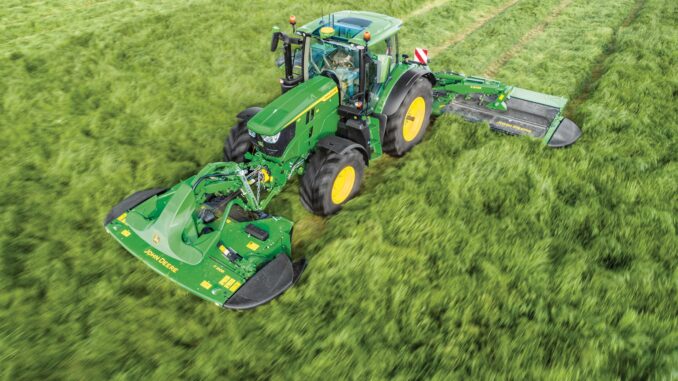
John Deere 7000 Series Tractor Models and Maintenance Guide
The John Deere 7000 Series is a legacy North American row-crop and livestock tractor family, not a compact-tractor range. It was sold during the 1990s and includes the 7200, 7400, 7600, 7700, and 7800. These are full-size agricultural tractors intended for broad-acre field work, forage harvesting, loader work, hay production, transport, and demanding livestock-farm duties rather than the small-property tasks normally associated with John Deere compact tractors.
This page serves as a practical directory for model-specific guides, servicing information, fault-finding articles, and buying guidance for the original John Deere 7000 Series tractors. For smaller machines, readers should use the General John Deere Compact Tractor Guide, which covers the 1, 2, 3, and 4 Series compact-tractor families. The 7000 Series belongs instead within a wider John Deere agricultural tractor hub covering legacy row-crop and utility machines.
About the John Deere 7000 Series Tractor Family
John Deere introduced the original North American 7000 Series in the early 1990s as a successor generation to several established Sound-Gard-era tractor models. The family was built around five principal models: the 7200, 7400, 7600, 7700, and 7800. While Deere’s current “7 Series” designation applies to modern high-horsepower 7R row-crop tractors, the machines covered here are the earlier 7000 Series, generally associated with the 1992–1997 period.tractorzoom+1
The range spans roughly 95 to 170 engine horsepower, depending on model and rating convention. The lower-power 7200 and 7400 were suited to mixed farms, livestock operations, baling, mowing, feeding, loader work, and general utility field duties. The 7600, 7700, and 7800 moved further into primary tillage, large balers, forage equipment, manure handling, planting, drilling, and heavier transport work.
These are full-size agricultural tractors with a substantial chassis, large rear tires, Category II or heavier implement capability depending on configuration, and an enclosed cab as the normal working environment. They were offered in two-wheel drive and mechanical front-wheel drive configurations. Buyers could also select transmissions according to model and application, including SyncroPlus, PowrQuad, and PowerShift options.tractorzoom
Common features and operating systems found across the range include:
-
John Deere turbocharged six-cylinder diesel engines.
-
Sound-Gard-style operator environments with a focus on visibility and long-day comfort.
-
Two-wheel drive or MFWD front-axle configurations.
-
Mechanical rear three-point hitch and remote hydraulic systems for mounted and trailed implements.
-
PowrQuad powershift-range transmission systems on many models.
-
PowerShift transmission availability on the higher-output models.
-
Hydraulic remote outlets for trailers, balers, drills, loaders, and other hydraulic implements.
-
Front-loader capability on appropriate models and configurations.
-
Independent rear PTO options for powered implements.
The original 7000 Series should not be confused with compact tractor families such as the 1 Series, 2 Series, 3E Series, 3R Series, or 4R Series. John Deere currently categorizes compact tractors separately, with the modern 1–4 Series compact range covering approximately 22.4 to 65.9 hp. A 7000 Series tractor is considerably larger, heavier, and more capable of sustained agricultural field work than a compact machine.deere+1
John Deere 7000 Series Tractor Models
The following table is an across-time index of the primary North American John Deere tractors marketed in the original 7000 Series. Horsepower figures are approximate because published ratings can vary between engine horsepower, PTO horsepower, tested drawbar horsepower, and market-specific specification sheets.
| Repair Guide | Serial Number Lookup | Winter Maintenance |
| John Deere 7000 Planter | ||
| John Deere 7810 |
The 7200 and 7400 used smaller engine and drivetrain combinations than the upper models, while the 7600, 7700, and 7800 were aimed at progressively heavier row-crop and field applications. Contemporary reporting identifies the 7200 and 7400 as the smaller pair in the lineup, with SyncroPlus available as standard equipment and PowrQuad offered as an option; the larger 7600, 7700, and 7800 were commonly associated with PowrQuad and optional PowerShift configurations.tractorzoom
The 7600, 7700, and 7800 were also commonly specified with Deere 6.8 L or 7.6 L turbocharged six-cylinder engines, depending on the model. Published legacy specifications place the 7600 near 130 hp, the 7700 near 150 hp, and the 7800 near 170 hp in the original 1992–1997 lineup.agrovik
7000 Series Maintenance Guides
A well-maintained John Deere 7000 Series tractor can remain highly useful decades after production ended. However, age changes the maintenance approach: service should include normal scheduled work, plus closer inspection of rubber components, wiring, cab systems, hydraulic hoses, seals, cooling-system condition, and wear in hitch, axle, steering, and drivetrain components.
Routine Service and Checks
Routine servicing begins with the operator’s manual and the correct technical manual for the exact tractor and transmission configuration. The 7200 through 7800 may share broad design principles, but filter specifications, oil capacities, electronic features, transmission details, and hydraulic arrangements can differ between models and serial-number ranges.
A practical service routine should include:
-
Check engine-oil level before daily operation, especially on tractors used for loader work, prolonged PTO work, or heavy draft loads.
-
Change engine oil and the engine-oil filter at the interval specified for the tractor, oil type, operating temperature, and duty cycle.
-
Inspect the air cleaner restriction indicator and service the primary and secondary elements correctly rather than over-cleaning or damaging the filter.
-
Drain water from the fuel system and inspect fuel filters regularly, particularly after storage or when operating with seasonal diesel fuel.
-
Inspect coolant concentration, coolant level, radiator condition, fan belt condition, and the cleanliness of the grille, screens, radiator core, and oil cooler.
-
Check transmission-hydraulic oil at the correct level and only under the conditions specified in the operator’s manual.
-
Replace hydraulic and transmission filters on schedule and investigate any metal debris, unusual contamination, or repeated filter plugging.
-
Grease front axle, steering joints, loader pivots, three-point hitch points, PTO driveline joints, and implement connection points at the correct intervals.
-
Inspect batteries, cables, grounds, starter terminals, fuses, and alternator charging performance before winter use.
Useful internal maintenance targets for a tractor site include:
-
“John Deere 7000 Series tractor service interval checklist.”
-
“DIY maintenance for John Deere 7000 Series tractors.”
-
“John Deere 7200, 7400, 7600, 7700, and 7800 fluid capacities and filters.”
-
“Cooling-system maintenance on John Deere 7000 Series tractors.”
-
“John Deere 7000 Series engine oil, hydraulic oil, and filter guide.”
-
“Pre-season inspection checklist for legacy John Deere row-crop tractors.”
When compiling model-specific maintenance pages, separate confirmed information from broad series guidance. A 7800 PowerShift machine, for example, should not automatically be assumed to use the identical procedures or parts as a 7200 fitted with a different transmission.
Hydraulics, Loader, and Three-Point Hitch
Hydraulic condition is central to the usefulness of an older 7000 Series tractor. The hydraulic system supports remote cylinders, steering, braking functions, the rear hitch, available front loaders, and hydraulic equipment such as balers, drills, trailers, cultivators, and manure-handling machinery.
Start with fluid level, fluid condition, approved oil specification, filter history, and external leaks. Then inspect remote couplers, hoses, loader lines, steel pipes, cylinders, seals, quick-coupler tips, and hitch-lift linkage. A slow loader, weak hydraulic cylinder, hitch that will not lift, or remote valve that will not hold pressure may be caused by anything from low oil or a plugged filter to a worn pump, leaking cylinder, faulty coupler, internal valve leakage, or a problem within the selective-control valve circuit.
Older tractors deserve special attention around:
-
Loader mounting brackets and frame hardware.
-
Cracked or chafed hydraulic hoses.
-
Loader pivot-pin wear and dry bushings.
-
Remote-coupler leakage or difficult implement hookup.
-
Three-point-hitch draft and position-control operation.
-
Lift-arm wear, stabilizer adjustment, and sway-control components.
-
Hydraulic oil overheating during continuous high-demand work.
A 725 loader is commonly associated with the 7200, 7400, and 7600, while some references list the 726 loader with the 7400, 7600, and 7700. Loader compatibility must always be checked against the exact tractor configuration, mounting frame, axle arrangement, hydraulic equipment, and serial-number details before purchase.mowersweb
Useful internal-link targets include “Hydraulic maintenance and leak diagnosis on John Deere 7000 Series tractors,” “Loader and three-point hitch maintenance for John Deere 7000 Series,” and “John Deere remote hydraulic coupler problems and repairs.”
Transmission and Drivetrain
Transmission and driveline servicing differs significantly depending on whether the tractor has SyncroPlus, PowrQuad, or PowerShift equipment. Before diagnosing a shifting complaint, confirm the transmission type, the tractor’s serial number, the hydraulic-fluid condition, the clutch and linkage condition where applicable, and whether the problem is present cold, hot, under load, or in every range.
Common maintenance checks include:
-
Inspect transmission-hydraulic fluid level and condition.
-
Replace filters on schedule using approved parts.
-
Check for leaks at axle seals, driveshaft areas, transmission cases, remote hydraulic circuits, and front-axle components.
-
Inspect MFWD driveshafts, universal joints, seals, and front-axle pivot points.
-
Check tire size, tire condition, and correct front-to-rear tire relationship on MFWD tractors.
-
Inspect brakes, differential-lock linkage, and parking-brake adjustment.
-
Confirm clutch adjustment and operation on transmissions that use a conventional clutch arrangement.
-
Test PTO engagement, PTO brake operation, and PTO output under a safe rated load.
On MFWD tractors, incorrect tire combinations, severe tire wear differences, or poor front-axle maintenance can increase drivetrain stress. Operators should also avoid treating shift problems as purely mechanical until fluid pressure, electrical connections, switches, sensors, and control-linkage faults have been considered.
A useful technical cluster is “Transmission and driveline maintenance across John Deere 7000 Series tractors,” supported by individual 7200, 7400, 7600, 7700, and 7800 transmission guides.
7000 Series Troubleshooting Guides
A series-level troubleshooting hub should help owners identify the system involved before directing them to a model-specific guide. The 7000 Series shares common age-related issues, but an accurate diagnosis still requires the exact model, transmission type, engine specification, fault symptoms, service history, and operating conditions.
For example, a 7200 that cranks but does not start after winter storage may have a fuel-supply, battery, glow-assist, shutoff-solenoid, or air-in-fuel-system problem. A 7800 that loses pulling power only after reaching operating temperature may instead require a closer hydraulic, transmission-pressure, fuel-restriction, cooling, or electronic-control diagnosis.
Starting, Engine, and Fuel Problems
Common engine and starting complaints include slow cranking, no-crank conditions, cranking without starting, hard cold starts, intermittent stalling, smoke, rough running, high operating temperature, and power loss under load.
Start with the simplest checks:
-
Confirm the battery is fully charged and cables, grounds, terminals, and starter connections are clean and secure.
-
Confirm safety switches, neutral-start circuits, clutch or park-switch requirements, and PTO safety interlocks are satisfied.
-
Check the fuel level, fuel shutoff position, sediment bowl or water separator, fuel filters, and fuel-line condition.
-
Inspect for air leaks on the suction side of the fuel system, particularly after filter changes or long storage.
-
Confirm the air-intake system is not restricted and that the exhaust path is unobstructed.
-
Check coolant level, radiator cleanliness, fan-belt condition, and thermostat or water-pump performance if overheating is involved.
-
Compare engine response at idle and under load, noting smoke color, engine temperature, and whether the fault appears cold or only after warm-up.
Useful article targets include “John Deere 7000 Series tractor starting problems – diagnostics and fixes,” “Engine and fuel system issues across John Deere 7000 Series models,” and individual guides such as “John Deere 7600 no-start and hard-start troubleshooting.”
Hydraulic and Loader Performance Issues
Weak loader lift, slow remote cylinders, jerky operation, three-point hitch problems, poor steering response, or hydraulic noise can result from low fluid, contaminated oil, clogged filters, a blocked suction screen, air entering the system, worn pump components, leaking cylinders, faulty couplers, or internal valve leakage.
A safe diagnostic order is important:
-
Park on level ground, lower implements, engage the parking brake, and relieve hydraulic pressure before disconnecting hoses.
-
Check fluid level and approved fluid type first.
-
Inspect the filter-change history and look for external leaks.
-
Check that quick couplers are fully seated and that implement hoses are not crossed, kinked, or damaged.
-
Compare hydraulic speed and power when cold versus fully warm.
-
Test one function at a time where possible to isolate a loader, remote valve, hitch, steering, or implement issue.
-
Inspect loader cylinders for external leakage, bent rods, damaged seals, or drift.
-
Avoid placing hands near pressurized hydraulic leaks; high-pressure oil injection injuries require urgent medical attention.
Good hub pages include “Hydraulic performance problems on John Deere 7000 Series tractors,” “Loader will not lift or is slow on John Deere 7000 Series models,” and “Three-point hitch will not raise, lower, or hold position on John Deere tractors.”
Transmission, Drive, and PTO Problems
Drive and PTO concerns may show up as poor pulling power, no movement in a selected range, delayed engagement, slipping under load, harsh shifting, loss of MFWD, a differential-lock fault, PTO engagement failure, PTO disengagement, or a PTO that drops out while operating.
Before assuming a major transmission failure, establish whether the tractor:
-
Has the correct transmission-hydraulic oil level.
-
Uses the correct specification of oil and filters.
-
Shows warning lamps, electrical faults, or intermittent control problems.
-
Has a clutch, linkage, selector, or park-brake issue.
-
Loses drive only in certain gears, ranges, directions, or temperature conditions.
-
Has a front-wheel-drive problem rather than a main transmission problem.
-
Suffers from implement-related overload, PTO shaft binding, or an incorrectly matched implement.
A PowerShift or PowrQuad complaint should be diagnosed with the correct service information and pressure-testing procedures rather than by adjustment guesswork. Misdiagnosis can be expensive, particularly where hydraulic control pressures, solenoids, clutch packs, or electronic controls are involved.
Conceptual internal-link targets include “Drive and transmission problems on John Deere 7000 Series tractors,” “PTO will not engage or drops out across John Deere 7000 Series models,” and model-specific pages such as “John Deere 7800 PowerShift troubleshooting guide.”
Attachments and Implements for the 7000 Series
John Deere 7000 Series tractors were built to operate a wide range of field, forage, livestock, and transport equipment. Correct matching depends on available PTO horsepower, tractor weight, rear lift capacity, hydraulic output, number of remote valves, tire equipment, front axle configuration, ballast, and the work being performed.
Typical implements and attachments include:
-
Front-end loaders and material buckets.
-
Bale spears, bale grapples, and bale handlers.
-
Hay rakes, mower-conditioners, balers, and forage wagons.
-
Rotary cutters and larger pasture-management equipment.
-
Box blades, rear blades, scraper blades, and land-leveling tools.
-
Cultivators, discs, field cultivators, and other tillage equipment.
-
Seed drills, planters, and fertilizer equipment.
-
Manure spreaders, slurry equipment, and feed-handling implements.
-
Grain carts, silage trailers, and general farm trailers.
-
Snow blades and snow-moving equipment where the tractor is suitably equipped.
-
PTO-driven generators, augers, wood processors, and stationary farm machinery.
For loader work, ballast is not optional. Correct rear ballast, wheel weights, liquid ballast where appropriate, suitable rear implements, tire condition, and axle-loading limits all affect stability and safety. A larger loader bucket is not automatically an improvement if it overloads the front axle, reduces stability, or exceeds the tractor’s safe lifting capability.
For PTO equipment, confirm PTO speed, horsepower requirement, driveline length, safety shielding, implement condition, and whether the tractor has enough hydraulic remotes for the job. For heavy draft tools, tractor weight, tire condition, ballast, traction, and soil type can matter as much as rated engine horsepower.