
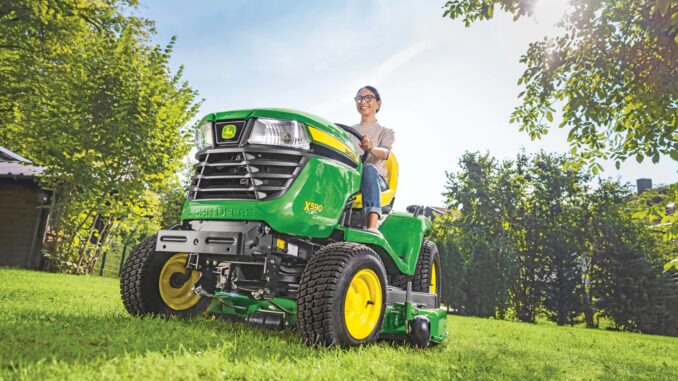
The John Deere 345 is a heavy-duty lawn and garden tractor built for homeowners who want more than a basic lawn tractor. It uses a liquid-cooled Kawasaki FD590V V-twin gasoline engine, hydrostatic drive, and was commonly paired with 48-inch or 54-inch mower decks, making it well suited to larger residential properties and owners who also tow light yard equipment.
This guide is written for DIY owners in the USA and Canada who are comfortable with normal service and some intermediate repairs. It focuses on symptom-first troubleshooting, realistic repair decisions, model-specific maintenance points, common service parts, and a large FAQ section based on the systems that most often give John Deere 345 owners trouble.
And See:
John Deere 345 model overview
The John Deere 345 sits in Deere’s older premium lawn and garden tractor range rather than the lighter-duty D100-style lawn tractor class. Compared with basic residential riders, it adds a liquid-cooled engine, stronger chassis components, power steering/brake systems in the service literature, and a more serviceable hydrostatic drivetrain aimed at heavier homeowner use.
For most owners, the key systems are the engine and fuel system, the cooling system, the mower deck and belt drive, the hydrostatic transmission and its filters, and the electrical/safety interlock system. Those are also the systems that tend to explain most no-start, poor mowing, overheating, weak-drive, and intermittent shutoff complaints on this model.
Several common service parts owners regularly buy for the John Deere 345 include the AM107423 engine oil filter, AM116304 fuel filter, AM120916 transaxle oil filter, M76076 foam air filter element, MIU10778 paper air filter element, M802138 or M71939 spark plugs depending on engine spec, M143019 primary belt, M118685 secondary belt, and M115496 standard mower blades for the 54-inch deck.
John Deere 345 troubleshooting approach
The best way to diagnose a John Deere 345 is to start with the symptom the owner can actually see or hear, then narrow the fault to a specific system. That matters because the same machine can show similar symptoms for very different reasons, such as a weak battery, clogged fuel filter, dirty air intake screen, damaged deck belt, or failing safety switch.
Main symptom groups for this model include:
-
Starting issues, such as no crank, slow crank, or cranks-but-won’t-start.
-
Running issues, such as rough running, surging, stalling, smoke, or loss of power.
-
Cut-quality problems, such as uneven cut, strips of uncut grass, weak discharge, or scalping.
-
Vibration and noise, including blade vibration, deck noise, engine-area rattles, or hydro whine.
-
Overheating and leaks, especially around the radiator, hoses, coolant tank, engine oil, or fuel lines.
-
Transmission and drive problems, such as weak hill climbing, poor response, or oil/filter service neglect.
-
Electrical and safety-switch issues, including dead dash, no-crank with PTO engaged, seat-switch shutdowns, or ignition faults.
John Deere 345 immediate repair needs
Some faults on the John Deere 345 should not be ignored because they can quickly damage expensive parts or make the tractor unsafe to use. The big red-flag areas are overheating, major vibration, fuel leaks, oil leaks, brake/steering issues, and anything that defeats the safety interlock system.
4.1 Starting issues
A starting problem matters most when owners keep cranking and accidentally flatten the battery, overheat wiring, or ignore a fuel delivery problem that later turns into carburetor contamination. On the 345, starting complaints usually trace back to battery condition, safety interlocks, ignition parts, spark plugs, or fuel flow restrictions.
Common causes:
-
Weak or failed battery.
-
Dirty or loose battery cable connections.
-
Faulty seat, brake, or PTO safety switch/interlock issue.
-
Restricted fuel filter or stale fuel.
-
Fouled or worn spark plugs.
-
Ignition module or key switch fault.
Basic owner checks:
-
Confirm the PTO is off, brake is fully applied, and the operator seat switch is being satisfied.
-
Check battery voltage and inspect both terminals for corrosion or looseness.
-
Make sure fuel is fresh and flowing through the inline filter in the correct direction.
-
Inspect spark plugs for fouling, damage, and incorrect gap.
-
If it still will not start, move on to switch testing or dealer diagnosis rather than repeated cranking.
4.2 John Deere 345 cut-quality problems
Poor cut quality on a John Deere 345 often shows up as ragged grass tips, scalping, streaks, or grass clumps left behind the deck. These problems matter because many owners first blame blades, when deck level, blade condition, belt condition, deck cleanliness, and ground speed are often just as important.
Common causes:
-
Dull, bent, or mismatched blades.
-
Worn primary or secondary mower belt.
-
Deck out of level.
-
Packed grass under the deck shell.
-
Damaged gage wheels or deck rollers.
-
Mowing too fast or in overly wet grass.
Basic owner checks:
-
Inspect the blades for sharpness, straightness, and correct installation.
-
Check the deck belt system for glazing, cracking, or poor tension.
-
Verify deck level side-to-side and front-to-rear using a deck leveling gauge if available.
-
Clean built-up grass from the underside of the deck.
-
Test mow at a slower ground speed before assuming a major deck fault.
4.3 Vibration and noise on the John Deere 345
New vibration or unusual noise should be treated seriously because it can point to blade damage, spindle trouble, belt failure, loose hardware, or engine-driven component issues. Continued use can turn a cheap fix into a deck spindle, pulley, or engine mounting repair.
Common causes:
-
Bent or badly unbalanced blade.
-
Loose blade hardware or spindle hardware.
-
Failing spindle bearings or idler bearings.
-
Damaged deck belt or pulley.
-
Debris wrapped around shafts or pulleys.
Basic owner checks:
-
Shut the tractor down immediately and inspect the blades after any impact.
-
Check for missing hardware, cracked pulleys, or belt fragments.
-
Spin deck pulleys by hand with the engine off and key removed, listening for roughness.
-
Do not continue mowing if vibration starts suddenly after hitting an obstacle.
4.4 John Deere 345 overheating and leaks
Overheating is one of the most important John Deere 345 issues because this model uses a liquid-cooled engine. Running hot can damage hoses, coolant seals, and the engine itself, while oil or fuel leaks create fire risk and contamination problems.
Common causes:
-
Dirty radiator or air intake screens.
-
Low coolant level in the recovery tank or radiator system.
-
Loose or aging radiator hoses and clamps.
-
Incorrect coolant mixture or overdue coolant change.
-
Engine oil leak, fuel line leak, or loose filter connection.
Basic owner checks:
-
Let the engine cool fully before opening the cooling system.
-
Check the recovery tank level against the hot and cold marks.
-
Clean debris from the engine screen, radiator screen, and surrounding intake area.
-
Inspect hoses, clamps, filter seals, and the area beneath the tractor for fresh leaks.
-
Stop using the tractor if coolant loss or active fuel leakage is present.
4.5 John Deere 345 transmission and drive problems
Drive complaints usually show up as slow response, weak hill climbing, whining, or poor movement after the tractor warms up. On this model, neglected hydrostatic oil and filter service can contribute to weak performance, and serial-specific belt differences mean owners need the correct parts before ordering.
Common causes:
-
Old or contaminated hydrostatic oil.
-
Restricted transaxle oil filter.
-
Incorrect traction drive belt for the tractor serial number.
-
Belt wear or slippage.
-
Internal hydrostatic wear requiring advanced diagnosis.
Basic owner checks:
-
Confirm which traction belt part number fits your serial number range before replacing anything.
-
Review whether the transaxle oil and filter have actually been serviced at the listed intervals.
-
Inspect for belt glazing, contamination, and obvious slack.
-
If the tractor still has weak drive after correct service, dealer-level hydro testing is usually the next step.
4.6 John Deere 345 electrical problems
Electrical faults can appear as no-crank, intermittent shutoff, dead lights, or a tractor that starts only in certain control positions. Because the machine uses interlocks and ignition components tied to safe operation, random bypassing is a bad idea.
Common causes:
-
Corroded battery terminals or weak battery.
-
Failed ignition module or key issue.
-
Seat, brake, or PTO safety switch problems.
-
Bad bulb or lighting circuit fault.
-
Chafed wiring around the engine, seat, or frame.
Basic owner checks:
-
Clean and tighten battery terminals first.
-
Confirm whether lights, starter, and PTO symptoms happen together or separately.
-
Inspect visible wiring and switch connectors under the seat and around the dash.
-
Replace obvious bulbs, but use a meter for deeper electrical diagnosis.
-
Avoid defeating safety switches as a permanent repair.
DIY or dealer?
For the John Deere 345, the line is usually clear: routine service, deck work, filters, plugs, blades, and basic belt replacement are reasonable DIY jobs, but hydrostatic internal repairs, electrical diagnosis beyond simple continuity checks, and cooling-system faults that are not solved by normal inspection are better left to an experienced technician.
Good DIY jobs
-
Engine oil and filter service.
-
Fuel filter replacement.
-
Air filter and precleaner service.
-
Spark plug inspection and replacement.
-
Blade removal, sharpening, balancing, and replacement.
-
Basic mower belt replacement.
-
Cleaning radiator screens and deck underside.
Advanced DIY or dealer jobs
-
Hydrostatic oil and filter service if access is awkward or contamination is suspected.
-
Troubleshooting safety interlocks with a meter and wiring diagrams.
-
Cooling-system flushing, hose replacement, and leak tracing.
-
Spindle, pulley, or steering/brake system repairs.
-
Internal hydrostatic or engine work.
Skill level guide
-
Beginner: oil, air filter, fuel filter, spark plugs, deck cleaning, blade inspection.
-
Intermediate: deck belt replacement, blade changes, deck leveling, coolant checks, battery and switch testing.
-
Advanced: hydro service, electrical tracing, spindle rebuilds, cooling-system flushes, and major engine or transmission work.
Parts for the John Deere 345
Before ordering parts, gather the full model name, the tractor Product Identification Number, the engine model/spec information, and the mower deck size. That matters on the John Deere 345 because certain parts, including the traction drive belt and home maintenance kit, change by serial-number range.
OEM parts are usually the safer choice for belts, safety switches, ignition parts, and fit-sensitive deck components because Deere serial-number splits and deck variations can catch owners out. Aftermarket parts can be fine for filters, blades, batteries, and tune-up parts, but only if the seller clearly cross-references to the correct John Deere 345 application and deck size.
Manuals and diagrams
The best places to verify service data and part numbers are Deere’s operator information pages, JDParts, Deere technical publications, and a Deere-focused parts dealer with illustrated diagrams. Using at least two sources helps confirm that the part matches the tractor serial number, engine spec, and deck version.
Useful links:
-
John Deere operator information for Model 345 – useful for engine service procedures, cooling system checks, spark plugs, and fuel filter steps.
-
John Deere 345 with 54-inch deck maintenance sheet PDF – quick reference for service parts, capacities, and intervals.
-
JDParts online catalog – illustrated diagrams and official part lookup.
-
Green Farm Parts John Deere parts lookup – useful Deere-focused aftermarket/OEM lookup source once the correct OEM number is known.
John Deere 345 serial and engine numbers
These numbers matter because Deere used serial-number breaks on parts for the John Deere 345, and engine tune-up parts can vary by engine specification. Ordering by model name alone is often not precise enough.
Use this approach:
-
Find the tractor Product Identification Number tag on the tractor frame area specified in the Deere identification section for the machine.
-
Record the full model and full serial number exactly as shown, including leading zeros if present.
-
Check the mower deck for its own serial/model tag, because deck-specific belts, blades, rollers, and wheel kits may differ by deck size.
-
Locate the Kawasaki engine model/spec/serial information on the engine shroud or engine identification label.
-
Use all of that information together when ordering engine, deck, or traction-drive parts.
Buying John Deere 345 parts
A good buying strategy is to identify the OEM number first, then compare prices and availability. For serial-sensitive or deck-specific items, the dealer counter or JDParts route is usually safer than guessing from a generic marketplace listing.
-
Online: verify the OEM number, serial range, and deck fitment before checkout, especially for belts, blades, and ignition parts.
-
Dealer counter: best for serial-number-sensitive items, cooling-system parts, unusual electrical pieces, and anything where the parts diagram matters.
-
Retail stores: acceptable for oil, grease, some batteries, and tune-up consumables if the packaging clearly lists the John Deere 345 or the correct Kawasaki engine spec.
Useful sources include JDParts, Green Farm Parts, and Deere manuals online.
John Deere 345 fitting guide
Change the engine oil and oil filter
This job protects the liquid-cooled Kawasaki engine and is one of the most important services on the 345.
-
Park on level ground, shut the engine off, and warm the oil first so it drains more completely.
-
Place a drain pan under the drain valve and open the valve to drain the oil fully.
-
Remove the old AM107423 oil filter, wipe the filter base clean, and oil the gasket on the new filter lightly.
-
Install the new filter until the gasket contacts, then tighten it an additional one-half turn.
-
Refill with the correct oil, tighten the dipstick, start the engine, and check carefully for leaks before rechecking the level.
Replace the John Deere 345 fuel filter
A fresh inline fuel filter helps solve lean running, power loss, and some hard-start complaints.
-
Work with the fuel level low if possible and park the tractor safely with the hood raised.
-
Put a drain pan under the filter and move the hose clamps away from the filter body.
-
Remove the old AM116304 filter and note the fuel-flow direction arrow.
-
Install the new filter with the arrow pointed in the direction of fuel flow.
-
Refit the clamps securely and inspect for leaks before operating.
Service the John Deere 345 air filter
Air filter service helps prevent rich running, smoke, and power loss while protecting the engine internally.
-
Remove the filter housing and inspect both the foam precleaner and paper element.
-
Replace the paper element if it is excessively dirty; do not wash the paper element.
-
Wash the foam precleaner in warm water with detergent, let it dry, then add about 30 ml of clean oil and squeeze it evenly through the foam.
-
Reinstall the precleaner on the paper element and refit the housing.
-
Clean the surrounding intake area before closing everything up.
Replace blades on the John Deere 345 54-inch deck
Blade replacement restores cut quality and can eliminate vibration caused by bent or damaged blades.
-
Park safely, remove the key, and secure the mower deck for safe access.
-
Inspect each blade for bends, edge damage, or heavy wear before removal.
-
Replace with the correct M115496 standard blade or M113518 mulching blade set for the 54-inch deck as needed.
-
Tighten hardware to the correct specification from the operator or technical manual, not by guesswork.
-
After installation, verify that all blades match and rotate freely with no contact issues.
Maintenance to prevent repeat problems
Regular service prevents most recurring John Deere 345 complaints because the tractor’s common trouble spots are predictable: dirty cooling screens, overdue hydro service, clogged fuel filters, worn belts, neglected blades, and old plugs or air filters. Owners who stay ahead of those areas usually avoid the most common no-start, poor-cut, and weak-drive problems.
Focus areas:
-
Starting reliability: keep the battery charged, replace worn plugs, and change the fuel filter on schedule.
-
Cut quality: sharpen or replace blades, keep the deck clean, and replace worn deck belts before they fail outright.
-
Fire and overheating prevention: clean the radiator and intake screens regularly, and stop immediately if fuel or oil leakage appears.
-
Drive performance: service hydro oil and filters at the listed intervals and use the correct oil.
-
Electrical reliability: keep terminals clean and avoid moisture and debris buildup around switches and connectors.
John Deere 345 maintenance schedule
The most useful official reference points for this model are the 50-hour, 100-hour, 200-hour, 250-hour, and multi-year cooling-system intervals shown in Deere service information. The exact cooling interval can vary with coolant type, but the routine service pattern below follows Deere’s published maintenance sheets and service-interval guidance.
Daily / before each use
-
Check engine oil level with the engine cold.
-
Check coolant level in the recovery tank.
-
Inspect for fuel, coolant, or oil leaks.
-
Clean debris from engine and radiator intake screens when conditions are dirty.
-
Look over blades, tires, and visible hardware before mowing.
After first 50 hours
-
Change transmission oil and filter.
-
Change hydraulic oil filter.
-
Change engine oil and filter on model 345.
Every 50 hours
-
Check transmission oil level.
-
Lubricate front wheel spindles and axle pivot.
-
Lubricate mower gage wheels.
-
Lubricate mower blade spindles.
-
Check and clean the air cleaner element.
Every 100 hours or yearly
-
Check and tighten loose hardware.
-
Check battery electrolyte level.
-
Check radiator hoses and clamps on model 345.
-
Check and clean the air cleaner element.
-
Inspect spark plugs and check gap.
Every 200 hours or yearly
-
Change engine oil and filter.
-
Replace the fuel filter.
Every 200 to 250 hours or two years
-
Change radiator coolant based on Deere’s interval guidance and coolant type.
-
Check radiator hoses and clamps again.
-
Change transmission oil and filter at 250 hours.
-
Change hydraulic oil filter at 250 hours.
Seasonal checklist
-
Spring: change oil and filter if due, inspect blades and belts, check battery condition, and clean all cooling screens.
-
Mid-season: recheck blade condition, clean deck underside often, and inspect coolant level and hydro response.
-
Fall or storage prep: clean the machine thoroughly, address leaks, and perform overdue fuel or coolant service before storage.
Repair, upgrade, or replace?
For most owners, a John Deere 345 is worth repairing when the machine is structurally sound and the problem is limited to service items, deck work, cooling-system upkeep, or normal hydro maintenance. Upgrade thinking starts to make sense when repeated electrical, hydrostatic, or engine issues stack up and the owner needs features or attachments the current setup does not handle well.
Repair if…
-
The issue is a filter, belt, blade, battery, switch, hose, or normal service item.
-
The tractor still has good compression, strong hydro response after service, and a solid deck shell/frame.
-
Parts are available at sensible cost using confirmed OEM numbers.
Upgrade if…
-
You want a different deck setup, mulch kit, or more capability than the current tractor configuration gives you.
-
The machine is usable but needs multiple medium-cost repairs at once, such as deck, hydro service, and electrical cleanup.
Replace if…
-
The engine and hydro both need major work at the same time.
-
The frame, deck shell, or major driveline components are heavily worn and parts cost exceeds the tractor’s practical value.
-
Safety-critical faults cannot be repaired economically.
John Deere 345 FAQ
1. Why will my John Deere 345 not start?
Most no-start complaints on the John Deere 345 come down to battery condition, safety interlocks, stale fuel, clogged fuel filter, or ignition problems. Start by confirming the PTO is off, the brake is set, the battery terminals are clean, and fuel is actually reaching the engine. Then inspect the spark plugs and basic wiring before assuming a major fault.
2. Why does my John Deere 345 crank but not fire?
If the engine cranks but does not fire, think fuel, spark, or interlock-related ignition loss. The inline fuel filter can restrict flow, old plugs can foul, and stale gasoline can cause hard starting even when the starter sounds normal. Check for clean spark, fresh fuel, and correct filter installation direction first.
3. Why is my John Deere 345 slow to crank?
Slow cranking usually points to a weak battery, dirty terminals, poor cable connections, or a starter circuit issue. Repeated short trips and seasonal storage often leave these tractors undercharged. Clean the terminals, charge and test the battery, and only then move on to starter or cable diagnosis.
4. Can a bad seat switch stop a John Deere 345 from starting?
Yes, a faulty seat or safety interlock can contribute to no-start or shutdown complaints depending on operating conditions. Because these systems are part of the machine’s safe-operation design, they should be tested properly rather than bypassed permanently. Intermittent switch behavior is common enough to keep on the checklist.
5. Why does my John Deere 345 start and then stall?
A start-then-stall pattern often suggests fuel starvation, dirty filters, stale gas, or an electrical interlock issue. It can also happen if the tractor is running hot or if debris is affecting air intake and cooling. Check the fuel filter, plug condition, wiring connections, and engine cooling screens in that order.
6. Why is my John Deere 345 running rough?
Rough running usually comes from old spark plugs, dirty air filtration, restricted fuel flow, or fuel quality problems. Deere’s service information also notes that some surging conditions at high throttle in neutral can be normal because of the emission-control setup. Distinguish between a normal light surge and a true miss or bog under load.
7. Why does my John Deere 345 lose power when mowing?
Loss of power under load usually points to poor fuel delivery, dirty air filtration, dull blades, packed grass under the deck, or mowing too fast in heavy grass. A partially restricted fuel filter can show up more under mowing load than at idle. Clean the deck, inspect blades, and make sure the engine can breathe and get fuel properly.
8. Why is my John Deere 345 overheating?
Because the 345 uses a liquid-cooled engine, overheating often starts with debris packed into the air intake or radiator screen, low coolant, or aging hoses and clamps. Stop mowing and let the engine cool before checking anything. Continued operation while hot can cause much more expensive engine damage.
9. How do I check coolant on a John Deere 345?
With the engine cool, inspect the recovery tank and compare the level with the low and high marks referenced in Deere’s service instructions. Also look for hose condition, leaks, and debris in the cooling area. Do not treat a low tank as normal if coolant keeps disappearing.
10. What coolant does a John Deere 345 use?
Deere lists its own coolant products as preferred and also allows an ethylene-glycol-based coolant meeting the proper specification. When using concentrate, Deere says to mix about 50 percent antifreeze with 50 percent distilled or deionized water. The published cooling-system capacity is 3.1 L, or 3.3 qt.
11. Why is my John Deere 345 leaking coolant?
Coolant leaks often come from hoses, clamps, fittings, or neglected cooling-system service. Once a 345 begins losing coolant, inspect the hose connections and surrounding engine area carefully before using it again. Running low on coolant is not a harmless nuisance on this model.
12. Why does my John Deere 345 cut unevenly?
Uneven cut complaints usually trace to a deck that is out of level, blades that are dull or bent, or mismatched blade condition across the deck. Gage wheel condition and deck cleanliness also matter. Check the simple mechanical items before assuming spindle damage.
13. Why does my John Deere 345 leave strips of uncut grass?
This often happens when blades are dull, deck airflow is poor, or ground speed is too high for the grass conditions. A worn belt can also reduce blade speed enough to hurt cut quality. Inspect the blades and belts together rather than checking only one item.
14. Why is my John Deere 345 scalping the lawn?
Scalping is usually caused by deck height choice, incorrect deck pitch or level, bad gage wheel setup, or uneven ground taken too quickly. Owners sometimes mistake this for a blade problem when the deck setup is the real issue. Verify deck level and wheel condition first.
15. Why does my John Deere 345 clump grass?
Grass clumping normally points to wet mowing conditions, buildup under the deck, worn blades, or travel speed that is too fast for the volume of grass being cut. The fix is often operational plus maintenance-based rather than a single failed part. Clean the deck and reduce speed before buying parts.
16. Why are the blades on my John Deere 345 vibrating?
Blade vibration usually means a blade is bent, badly worn, out of balance, or loose from impact damage. Shut the tractor down right away and inspect the blade set. Continued mowing can damage spindle bearings and pulleys.
17. Can a bent blade damage a John Deere 345 deck?
Yes, a bent or unbalanced blade can overload spindle bearings, shake pulleys and belt guides, and create cracks or loose hardware over time. What starts as a cheap blade issue can turn into a deck rebuild if ignored. That is why sudden vibration should always be treated as urgent.
18. Why is my John Deere 345 deck belt slipping?
A slipping belt usually shows glazing, cracking, contamination, or age-related stretch. Incorrect routing or the wrong belt for the deck can cause the same symptom. Verify the exact belt number and inspect pulleys while the belt is off.
19. What belts fit a John Deere 345?
That depends on which system you are servicing and, for the traction belt, the tractor serial number. Deere’s maintenance sheet lists M143019 as the 54-inch deck primary belt, M118685 as the secondary belt, M118048 as the traction drive belt up to serial 070000, and M131808 from serial 070001 onward.
20. Why does my John Deere 345 have poor traction or weak drive?
Weak drive can come from an overdue hydro service, a restricted transaxle filter, the wrong oil, a worn traction belt, or internal hydro wear. Start with service history because neglected oil and filter changes are common on older garden tractors. If proper service does not improve it, deeper transmission diagnosis is usually needed.
21. How often should I service the hydro on a John Deere 345?
Deere’s service-interval information shows transmission oil and filter service after the first 50 hours and again every 250 hours. The maintenance reminder sheet also lists the transaxle filter and Low Viscosity Hy-Gard as key service items. That makes hydro service an important routine job, not a once-in-a-lifetime repair.
22. What hydro oil does a John Deere 345 use?
The Deere maintenance sheet lists Low Viscosity Hy-Gard, part number TY22000, and shows a 4.7 qt capacity. Using the specified oil matters because hydro performance can be sensitive to the wrong fluid. Generic substitution is not a good idea unless it clearly matches the Deere specification.
23. Why is my John Deere 345 whining during operation?
Some hydro noise can be normal, but a noticeable increase in whine along with weak movement suggests service neglect, low efficiency, or internal wear. Check whether the hydro oil and filter service is overdue before assuming the transaxle is bad. Noise plus poor drive is more concerning than noise alone.
24. Why does my John Deere 345 backfire or surge?
Surging can come from fuel and air issues, but Deere also notes that some surge at high throttle in neutral with the mower disengaged is normal due to the emission-control system. The important question is whether it surges only unloaded or also under mowing load. True under-load surging deserves normal fuel, spark, and air checks.
25. How often should I change oil in a John Deere 345?
Deere’s service guidance shows an initial 50-hour oil and filter change for the 345, then engine oil and filter changes every 200 hours or annually depending on the service schedule source. Many homeowners effectively treat that as a yearly service item. The key point is not to let it go multiple seasons without a change.
26. What oil filter does a John Deere 345 use?
The maintenance reminder sheet lists AM107423 as the engine oil filter for the 345. It is one of the most commonly ordered service parts for this model. Using the correct filter helps avoid fitment and sealing issues.
27. What air filter does a John Deere 345 use?
For the 345 shown on Deere’s maintenance sheet, the foam air filter element is M76076 and the paper element is MIU10778. The service procedure also explains that the paper element should be replaced when excessively dirty, while the foam precleaner can be washed and lightly re-oiled. That combination service is important for engine protection.
28. What spark plugs does a John Deere 345 use?
Deere lists two plug numbers on the maintenance sheet depending on engine specification: M802138 for engine code AS01-DS01 and M71939 for engine code ES01. That is why checking engine spec matters before ordering tune-up parts. Deere’s service instructions also specify a 20 N·m, or 15 lb-ft, tightening torque.
29. What battery fits a John Deere 345?
The maintenance sheet lists TY25881 as the battery for this model. Battery fit is straightforward, but owners should still confirm terminal layout and physical dimensions before buying aftermarket replacements. A correct fit matters because cable routing and tray space are limited.
30. Is the John Deere 345 worth repairing?
It often is, especially when the tractor only needs normal service parts, belts, blades, hoses, or hydro maintenance. The 345 belongs to Deere’s heavier-duty garden tractor family rather than the lightest residential class, so a sound machine can still justify repair. The decision changes when both engine and hydro problems appear together.
31. Should I buy OEM belts for a John Deere 345?
OEM is usually the safest choice for traction and deck belts on this tractor because Deere used serial-number splits and specific belt applications. Aftermarket can work, but only when the cross-reference is exact and the seller is clear about deck and serial compatibility. Belt fit errors can create poor cut quality or weak drive symptoms that look like bigger problems.
32. Where can I find a John Deere 345 manual?
Useful sources include Deere’s online operator information pages, JDParts for diagrams, and Deere technical publications for deeper service information. The operator information pages are the best place to start for routine service steps, while JDParts helps confirm part numbers. Use both whenever possible.
33. How do I know which parts fit my John Deere 345?
Use the full model, tractor PIN, engine specification, and deck size together. That is especially important for items like traction belts, spark plugs by engine code, and deck-specific components. Ordering by “John Deere 345” alone is not always accurate enough.
34. Why does my John Deere 345 keep blowing through service items faster than expected?
Frequent belt, blade, or filter issues usually point to operating conditions and maintenance habits rather than poor parts alone. Wet grass, dirty mowing conditions, infrequent deck cleaning, and skipped hydro or cooling checks all shorten component life. The 345 rewards regular service more than neglect-and-run use.
35. What maintenance matters most on a John Deere 345?
If only a few tasks get done consistently, make them engine oil service, cooling-system cleanliness, hydro oil and filter service, fuel and air filtration, and blade/deck upkeep. Those areas connect directly to the most common 345 problems: no-starts, overheating, weak drive, and poor mowing results. They also prevent small issues from becoming expensive repairs.
Common engine issues with the John Deere FD590V engine
Common issues with the Kawasaki FD590V (as used in the John Deere 345) include plastic cam gear failure, fuel-delivery and carb problems, intake valve/guide issues, and recurring ignition/“no spark” faults tied to the time delay module and related electrical components. Owners also see recurring backfire/sputter complaints from a mix of fuel, ignition, and shutdown-control problems.
FD590V design background
The FD590V is a liquid‑cooled, 20 hp Kawasaki V‑twin used on higher‑end garden tractors like the John Deere 345. Its liquid cooling, overhead‑valve design, and electrical ignition system give good performance, but also add more parts that can fail compared with simpler air‑cooled engines.
Because the same basic engine shows up on many Deere 345s, known weak points (like the plastic cam gear and valve/guide issues) are well-documented in owner and mechanic communities.
Plastic cam gear failure
One of the most widely reported FD590V problems is failure of the plastic cam gear and related valvetrain parts.
Typical pattern:
-
Engine suddenly loses compression or stops running with a “free‑spinning” feel when cranking.
-
Sometimes it happens without much warning, even on engines that otherwise ran well.
Why it matters:
-
When the cam gear strips or fails, valve timing is lost and the engine cannot run, and repair requires major teardown (cam, lifters, timing gear set, and often more).
-
On older engines this often triggers a “repair vs. replace” decision because of labor cost.
Red flags for owners:
-
Sudden no‑start with normal cranking speed but no real attempt to fire.
-
Noticeable change in engine sound (no normal compression pulses) compared with earlier starts.
Fuel delivery and carburetor issues
FD590V engines on Deere 345s see a lot of fuel‑system complaints: dying under load, needing choke to restart, and persistent sputtering/backfire issues.
Common symptoms:
-
Engine runs for a while, then sputters and dies, especially while mowing, then needs heavy choke to restart.
-
Engine restarts, runs a few minutes, dies again, as if it is “running out of fuel” in the carb bowl.
-
Persistent popping/backfire on shutdown or when throttling down.
Frequent causes:
-
Weak or failing fuel pump that cannot keep up under mowing load.
-
Partially restricted fuel filter or debris in the tank and lines.
-
Carburetor contamination/varnish causing lean running and intermittent fuel shut‑off behaviour.
-
Misbehaving fuel shutoff solenoid or incorrect shutdown technique contributing to backfire.
Practical owner checks:
-
Confirm clean, fresh fuel and a clear filter; test or replace the fuel pump if symptoms happen only under load.
-
Inspect and, if necessary, properly clean or rebuild the carburetior rather than only spraying cleaner through it.
-
Verify correct operation of the fuel shutoff solenoid and avoid immediate “hot” shutdowns which can promote backfire.
Intake valve, guide, and seat problems
Some owners and mechanics report intake‑side failures on FD‑series engines, including the FD590V, such as valves sticking or seats coming loose.
Typical failure modes mentioned:
-
Intake valve sticking due to varnish on the valve stem.
-
Valve guide migration (moving out of its bore) which can hold the valve off its seat.
-
Dislodged or loosened valve seat, requiring cylinder‑head work.
What owners might see:
-
Sudden loss of power or a dead cylinder.
-
Backfiring through the intake or exhaust.
-
Noticeable mechanical noise and very uneven running.
Because these issues require head removal and machine work, they usually fall into “advanced DIY or shop job” territory.
Ignition, time delay module, and “no spark” issues
On Deere 345s with FD590V engines, ignition problems are very often traced to the time delay module and its wiring, not just the ignition coils themselves.
Common symptoms:
-
Engine cranks but has no spark.
-
Intermittent “runs then dies” issues tied to safety‑switch or shutdown behaviour.
-
Persistent backfire on shutdown when components are not working as intended.
Key points from field experience:
-
The time delay module sits in the ignition power circuit and is a very common failure point on these tractors.
-
Its job is to briefly keep spark going after shutdown so remaining fuel is burned, reducing hot‑muffler backfires, and to smooth brief seat‑switch interruptions.
-
Bad connections, corroded exposed terminals, failing ignition switches, and voltage regulators are also frequently cited issues.
Owner‑level guidance:
-
Inspect and clean ignition and module connections, and protect them against corrosion.
-
Consider testing or substituting the time delay module when there is a crank‑no‑spark scenario, after confirming coils and basic wiring are good.
General reliability considerations
Taken together, the main FD590V trouble spots show up in these clusters:
-
Mechanical: plastic cam gear/valve train failures.
-
Fuel system: pump, filter, carb, and solenoid issues that cause surging, dying, and backfire.
-
Ignition/electrical: time delay module, ignition switch, regulator, and wiring faults causing no‑spark or shutdown problems.
For a John Deere 345 owner, regular fuel‑system maintenance, careful electrical/ignition inspection, and an awareness of the cam gear reputation helps catch many issues earlier, before they become catastrophic or misdiagnosed.