
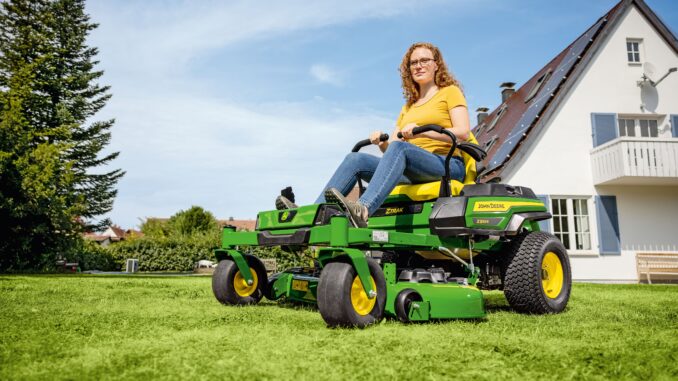
The John Deere Z355E is a residential Z300 Series zero-turn mower built for homeowners who want faster mowing and tighter maneuvering than a lawn tractor usually offers. It uses the same core owner-service pattern as other Deere homeowner machines: routine checks, scheduled engine and deck maintenance, symptom-first troubleshooting, and a clear dividing line between practical DIY work and dealer-level repairs.
For most owners in the USA and Canada, the John Deere Z355E suits medium to fairly large home lawns where speed, trimming around obstacles, and an even cut matter more than towing or ground-engaging work. This guide covers model overview, common repairs, troubleshooting, maintenance intervals, parts ordering, fitting advice, and a detailed FAQ so owners can decide what to inspect themselves and when to involve a Deere dealer.
General overview of the John Deere Z355E
The John Deere Z355E sits in the Z300 Series ZTrak lineup, alongside models such as the Z335E, Z345M, Z345R, Z355R, Z365R, and Z375R covered in the same operator literature family. In practical terms, it is a homeowner-focused zero-turn mower rather than a heavy commercial machine, so it rewards regular servicing and clean operating habits more than neglect-and-abuse use patterns.
The main systems owners deal with on the John Deere Z355E are:
-
Engine and fuel system: air filter, fuel filter, spark plugs, oil, oil filter, cooling fins, and fuel lines.
-
Mower system: deck shell, blades, deck belt, spindle lubrication points, idler arm, deck level adjustment, and washout/cleanout areas.
-
Drive system: dual transaxles, motion control levers, park brake, drive belt areas, and transmission oil level checks.
-
Electrical and safety system: ignition switch, battery, hour meter, PTO switch, brake and interlock logic, and wiring under the seat.
Common service parts that owners actually buy for the John Deere Z355E include 48-inch mower blades GY20852 or GY22621 depending on PIN range, 48-inch mower deck belt GX21833 or GX26422 depending on PIN range, oil filter GY20577, fuel filter GY20709, air filter GY21435, John Deere engine oil TY22029, and the MulchControl kit BM24993 or mulch cover GY20417 depending on setup.
John Deere Z355E troubleshooting approach
Troubleshooting works best when it starts with the symptom the owner can see, hear, smell, or feel. On the John Deere Z355E, most problems fall into a handful of repeating categories that match the machine’s main systems and official troubleshooting layout.
The main symptom groups are:
-
Starting issues
-
Running issues
-
Poor cut quality
-
Vibration and unusual noise
-
Overheating, smoke, or leaks
-
Transmission and drive complaints
-
Electrical and safety interlock faults
A good rule is to begin with simple external checks before removing parts: fuel condition, battery charge, obvious loose wiring, clogged cooling fins, damaged blades, belt condition, deck debris, and safety-control position. Many homeowner complaints on this model come from maintenance drift rather than a major failed component, so clean, inspect, and confirm adjustment before ordering parts.
John Deere Z355E emergency and immediate repair needs
Some faults should not wait because they create a direct safety risk or can quickly damage expensive parts. If the John Deere Z355E has strong vibration, fuel leakage, belt smoke, a failed safety interlock, or severe overheating from debris buildup, stop using it until the cause is found.
4.1 Starting issues on a John Deere Z355E
A no-start problem matters immediately when the starter only clicks, the engine cranks slowly, or the machine repeatedly blows fuses or loses power to the ignition circuit, because repeated attempts can overheat wiring, drain the battery, and hide the original fault.
Common causes:
-
Weak or discharged battery.
-
Loose or corroded battery terminals under the seat area.
-
PTO switch left engaged.
-
Park brake not set or motion levers not in the required start position.
-
Fault in seat/brake/PTO safety interlock logic.
-
Fouled spark plugs or restricted fuel delivery.
Basic checks:
-
Confirm the PTO is off, the park brake is applied, and the control levers are in the correct start position.
-
Inspect battery terminals and cables for looseness or corrosion before trying again.
-
Check for fresh fuel and inspect the inline fuel filter for obvious blockage or age.
-
Inspect spark plug leads and look for disconnected or damaged safety-switch wiring under the seat.
-
If the engine cranks but will not fire, move on to fuel, spark, and air-filter checks rather than repeated cranking.
4.2 John Deere Z355E cut-quality problems
Cut-quality faults show up as stragglers, scalping, uneven cut height, clumping, or discharge that looks weak on one side. These problems matter because a mower used in poor adjustment can overload belts, wear blades faster, and leave the owner chasing a problem that is really about setup rather than broken parts.
Common causes:
-
Dull, bent, or mismatched blades.
-
Deck out of level side-to-side or front-to-rear.
-
Grass packed under the deck.
-
Incorrect tire pressure affecting deck attitude.
-
Worn or slipping deck belt.
-
Mowing too fast in heavy or wet grass.
Basic checks:
-
Clean the underside of the deck and remove packed grass before adjusting anything.
-
Check blade condition and replace blades in matched sets if damaged or badly worn.
-
Verify tire pressure first, then measure deck level side-to-side and front-to-rear.
-
Inspect the mower belt for glazing, cracking, frayed edges, or signs of slipping.
-
Test again in dry grass at a moderate ground speed with full cutting rpm.
4.3 Vibration and noise from the John Deere Z355E
Strong vibration is one of the most important stop-now symptoms because it often points to blade damage, loose hardware, spindle trouble, or debris wrapped around rotating parts. Continuing to mow can damage spindle bearings, deck housings, belts, and engine mounts.
Common causes:
-
Bent, cracked, or badly unbalanced blade.
-
Blade hardware loose after previous service.
-
Debris wound around spindle areas or pulleys.
-
Worn spindle bearings or idler components.
-
Belt slap caused by a damaged belt or pulley issue.
Basic checks:
-
Shut off, remove the key, and wait for all movement to stop before going near the deck.
-
Inspect blades carefully and replace any damaged blade rather than trying to straighten it.
-
Clear wrapped debris from spindle and pulley areas.
-
Spin pulleys and spindle assemblies by hand only when the machine is safely disabled and check for roughness or play.
-
If vibration remains after blade and debris checks, treat it as an advanced repair and inspect spindle, pulley, or shaft-related causes more deeply.
4.4 Overheating and leaks on a John Deere Z355E
Heat-related issues often show up as hot-smelling operation, smoking debris around the muffler area, loss of power, or visible oil or fuel leakage. These matter quickly because the operator’s manual specifically warns that grass and leaf buildup around hot or moving parts can cause fire, and leaks create ideal debris collection points.
Common causes:
-
Cooling fins or intake screens packed with debris.
-
Dry grass accumulation around muffler, engine, or transaxles.
-
Low engine oil.
-
Fuel line, cap, or filter seepage.
-
Oil filter loose or leaking after service.
Basic checks:
-
Inspect and clean the muffler area, engine cooling fins, intake screens, top of deck, and transaxle areas.
-
Check for oil level, fuel seepage, and fresh drips under the machine.
-
Confirm the oil filter is snug and the drain point is fully closed after an oil service.
-
Replace cracked fuel lines or a suspect fuel filter promptly.
-
Do not continue mowing if smoke or strong burning smell persists after cleaning.
4.5 John Deere Z355E transmission and drive problems
Drive complaints on the John Deere Z355E usually feel like weak hill performance, one side slower than the other, jerky response, or poor tracking with the levers centered. These issues matter because zero-turn drivability problems can become a safety problem on slopes or near drop-offs, where the manual already stresses extra caution and strict slope limits.
Common causes:
-
Low transmission oil level in one or both units.
-
Debris around transaxle cooling fins reducing heat dissipation.
-
Brake drag or control lever linkage needing inspection.
-
Tire pressure mismatch affecting straight tracking.
-
Internal transaxle wear beyond normal homeowner DIY scope.
Basic checks:
-
Check tire pressure first because mismatched pressure can mimic steering or tracking faults.
-
Inspect both transaxle areas for grass buildup and clean the cooling fins.
-
Check transmission oil level in both units as part of the daily checklist.
-
Confirm the park brake is fully releasing and control levers return evenly.
-
If one side remains weak or noisy, plan for dealer diagnosis before continued heavy use.
4.6 Electrical problems on the John Deere Z355E
Electrical faults usually show up as no crank, intermittent starting, dead hour meter, PTO not engaging, or nuisance shutdowns linked to the interlock system. These problems matter because owners sometimes bypass switches to keep mowing, but the manual is explicit that safety devices must remain in place and working.
Common causes:
-
Weak battery or poor terminal contact.
-
Seat-area wiring damage or corrosion.
-
Faulty PTO, brake, or seat interlock switch.
-
Ignition switch issues.
-
Blown fuse or harness damage after rubbing/chafing.
Basic checks:
-
Inspect the battery, cables, and visible under-seat harness routing.
-
Confirm all starting and PTO engagement conditions are being met exactly.
-
Wiggle-test only visible connectors with the machine off and key removed.
-
Check for obvious pinched wires near the seat platform and battery access area.
-
Avoid bypassing switches for diagnosis unless you fully understand the circuit and the safety implications; dealer help is usually smarter once the fault moves beyond simple connector and battery checks.
DIY or dealer?
The normal line on the John Deere Z355E is simple: routine service, deck care, blade work, and straightforward parts replacement are realistic DIY jobs, while transaxle internals, complex electrical diagnosis, valve clearance work, and structural deck or spindle repairs often belong with an experienced shop.
Good DIY jobs
-
Engine oil and oil filter changes.
-
Air filter replacement.
-
Fuel filter replacement.
-
Spark plug replacement.
-
Blade sharpening or replacement.
-
Deck cleanout and deck leveling checks.
-
Battery service and terminal cleaning.
-
Belt inspection and some belt replacements if the routing is understood.
Advanced DIY or dealer jobs
-
Spindle replacement or deck pulley diagnosis.
-
Electrical troubleshooting beyond battery, visible fuses, and connectors.
-
Transaxle performance faults or oil-related drive problems that do not clear with basic checks.
-
Engine valve clearance inspection/adjustment, which Deere lists at 200 hours and directs to the dealer.
-
Repeated belt failure caused by alignment, bent brackets, or hidden pulley damage.
Skill guide
-
Beginner: oil, filter, fuel filter, air filter, deck cleaning, tire pressure, battery checks.
-
Intermediate: blades, deck leveling, deck belt replacement, basic switch and connector inspection.
-
Advanced: spindle repair, electrical tracing with a meter, transaxle-related diagnosis, valve clearance service.
Parts for the John Deere Z355E
Before ordering parts for a John Deere Z355E, gather the full model name, the product identification number, the engine serial number, and the deck configuration or PIN range information that affects fitment. This matters because Deere lists more than one blade and deck-belt part number for the Z355E depending on serial/PIN range, and owners who order from a generic listing can easily end up with the wrong belt length or blade pattern.
OEM parts are the safest choice for belts, safety-switch items, and fit-sensitive deck components because exact length, profile, and mounting details matter more than owners often expect. Aftermarket parts can be reasonable for items such as oil, batteries, some filters, and some blades, but only when the cross-reference clearly matches the Z355E and its PIN range.
Manuals and diagrams for John Deere Z355E owners
The most useful sources are the official operator’s manual, Deere technical publications, Deere parts ordering resources, and a Deere-focused parts site with model pages. Each source helps with a different stage of ownership, from routine servicing to exact part identification.
Recommended sources:
-
Official operator’s manual: useful for safe operation, troubleshooting logic, and servicing procedures in Deere format for this model family.
-
Z300 Series operator manual PDF: useful for current Z300 service intervals, cleanout points, safety system checks, deck leveling, and identification-number locations.
-
John Deere Technical Information Store: useful for buying the parts catalog or technical manual when the operator’s manual is not detailed enough.
-
Green Farm Parts Z355E page: useful as a model-focused aftermarket/OEM shopping reference, though part numbers should still be verified against Deere data.
How to locate John Deere Z355E numbers
These numbers matter because the dealer and most serious parts suppliers will ask for them before confirming fitment. On a mower like the John Deere Z355E, the PIN, engine serial, and sometimes transaxle serial numbers can all matter when repair parts change across production ranges.
-
Find the tractor product identification number on the machine and record it exactly as shown.
-
Find the engine serial number on the engine blower housing.
-
Find the transaxle serial numbers on the forward side of each transaxle housing if a drive-system problem needs parts-level diagnosis.
-
Compare the PIN range to the blade and belt listings before ordering.
-
Keep a photo of each tag on your phone so the number is available when ordering online or at the dealer counter.
Buying John Deere Z355E parts
The best buying strategy is to identify the exact OEM number first, then compare sources instead of shopping by model name alone. That reduces bad orders on serial-sensitive items such as blades and deck belts.
-
Online: verify OEM numbers, confirm the PIN range, and use a Deere-backed or Deere-specialist catalog first, such as JDParts/Deere parts resources, Deere.com, or Green Farm Parts.
-
Dealer counter: best for serial-sensitive parts, switch gear, deck hardware, spindle pieces, and any problem where the old part has changed supersession numbers.
-
Retail stores: acceptable for common consumables such as oil, batteries, and some filters only if the packaging clearly lists the Z355E or the matching OEM cross-reference.
John Deere Z355E fitting guide for common parts
These are the high-impact service jobs most homeowners actually perform because they directly affect starting, reliability, and cut quality. Always park safely, remove the key, and disable accidental starting before service.
Replacing the air filter on a John Deere Z355E
A fresh air filter helps starting, throttle response, and fuel efficiency, especially in dusty mowing conditions.
-
Park on level ground, switch off, and allow hot engine parts to cool.
-
Open the air-cleaner housing and remove the old element carefully so dirt does not fall into the intake.
-
Wipe out loose dust from the housing with a clean rag.
-
Install the new air filter GY21435 in the correct orientation and close the housing securely.
-
Inspect the intake area for loose debris before restarting.
Changing engine oil and oil filter on the John Deere Z355E
Fresh oil and a new filter protect the engine and are part of the official 50-hour or annual routine.
-
Warm the engine briefly, then park safely and remove the key.
-
Drain the engine oil into a suitable container and reinstall or close the drain properly.
-
Remove the old oil filter and install new filter GY20577, lightly oiling the gasket first.
-
Refill with the correct engine oil, check the dipstick, and inspect carefully for leaks.
-
Run the engine, shut it off, recheck the level, and top up if needed.
Replacing John Deere Z355E blades
Blade replacement fixes poor cut, vibration caused by damaged edges, and ragged grass tips.
-
Park safely, remove the key, and disconnect spark plug wires or the battery negative cable before working near blades.
-
Raise access safely and wear gloves before handling the blades.
-
Remove the old blades and compare them to the new correct set for your PIN range, such as GY20852 or GY22621.
-
Clean the mounting surfaces and inspect blade hardware for wear or damage.
-
Install the new blades in the correct orientation and torque them to specification from the service literature before mowing.
Replacing the John Deere Z355E deck belt
A deck belt replacement can cure weak blade drive, squeal, or intermittent blade slowdown when the PTO is engaged.
-
Park safely, lower the deck as needed for access, and study the belt routing before removal.
-
Remove guards as required and relieve tension from the idler according to the deck layout.
-
Remove the old belt and inspect pulleys, spindle tops, and idler bearings for damage or roughness.
-
Install the correct belt, GX21833 or GX26422 depending on PIN range, and confirm that it sits fully in every pulley groove.
-
Refit guards, engage the PTO briefly at low risk conditions, and recheck tracking before full mowing use.
Maintenance to prevent repeat John Deere Z355E problems
Regular maintenance prevents most repeat complaints on this model because the official service schedule targets the exact areas that tend to cause homeowner downtime: filtration, oil, belt condition, blade condition, deck cleanliness, cooling, and level adjustments. In plain terms, a clean deck, clean cooling fins, fresh filters, and sharp blades solve far more problems than many owners expect.
Focus areas:
-
Starting reliability: maintain battery connections, fresh fuel, air filter, fuel filter, spark plugs, and correct control positions.
-
Cut quality: keep blades sharp, keep the deck clean, check belt condition, and confirm deck level after impacts or seasonal setup.
-
Fire and overheating prevention: clean muffler area, intake screens, cooling fins, top of deck, and transaxle areas regularly.
-
Drive performance: check both transmission oil levels and keep debris off transaxle cooling areas.
-
Electrical reliability: inspect under-seat wiring, battery terminals, and interlock-related controls rather than forcing the machine to operate with an intermittent fault.
John Deere Z355E maintenance schedule
The official quick-reference chart for the John Deere Z355E is concise and useful, and it should be treated as the baseline schedule rather than guesswork. The operator’s manual also adds a daily operating checklist that owners should use before each mowing session.
Daily / before each use
-
Check engine oil.
-
Clean muffler area, air intake screens, and mower deck.
-
Check brake system.
-
Check fuel level.
-
Check under the machine for leaks.
-
Check safety interlock system, tire pressures, transmission oil level, and clean the deck after use.
After 8 hours
-
Check mower deck level.
Every 50 hours or yearly
-
Replace fuel filter.
-
Change engine oil.
-
Check mower belt.
-
Change engine oil filter.
-
Sharpen or replace mower blades.
-
Lubricate mower deck spindles, clean underside of deck, lubricate mower idler arm, check tire pressure, check mower deck level, and clean engine cooling fins.
Every 100 hours or yearly
-
Replace air filter element or elements.
Every 200 hours
-
Check and adjust engine valve clearance; Deere directs owners to the dealer for this service.
Seasonal checklist
-
Spring: change oil if due, replace filters as required, inspect blades, check belt condition, and confirm deck level before the mowing season gets busy.
-
Mid-season: clean cooling areas more often in dusty conditions, recheck blades and belt, and inspect for leaks or loose hardware.
-
Fall or end of season: clean the machine thoroughly, remove debris from fire-risk zones, inspect wear parts, and prepare for storage following the operator’s manual.
Repair, upgrade, or replace?
For a homeowner machine like the John Deere Z355E, repair usually makes sense when the engine, frame, and transaxles are fundamentally sound and the faults are limited to normal wear parts or a few isolated components. Upgrade makes sense when the mower still runs well but your property or expectations have outgrown the machine, while replacement becomes more sensible when multiple expensive systems are failing at once.
Repair if…
-
The issue is a normal wear item such as blades, belts, filters, battery, or minor switch-related service.
-
The deck shell, frame, and drive system are still in good condition.
-
The machine has been maintained and the fault is clearly limited.
Upgrade if…
-
You need more comfort, a heavier deck, more traction, or more acreage capacity than the Z355E was really intended for.
-
You want features such as a different seat, stronger residential trim level, or different attachment capability within Deere’s broader lineup.
-
The mower works, but recurring workload frustration matters more than repair cost.
Replace if…
-
The machine has major drive, engine, and deck problems at the same time.
-
Structural corrosion, repeated unsafe failures, or chronic neglected maintenance have made reliability poor.
-
The total repair estimate approaches the value of a sound replacement mower in your market.
John Deere Z355E troubleshooting FAQ
1. Why will my John Deere Z355E not start?
On this model, start with the simple interlock checks before assuming a major failure. Make sure the PTO is off, the park brake is applied, and the motion control levers are in the required start position, then check battery charge and cable condition. If it cranks but will not fire, move next to fuel flow, spark plugs, and air-filter restriction.
2. Why does my John Deere Z355E click but not crank?
A click with no real crank usually points to low battery voltage, poor cable contact, or high resistance at a connection. Inspect both battery terminals under the seat area and look for corrosion or looseness before replacing parts. Repeated clicking can also happen when the starter circuit sees low voltage from a weak battery.
3. Why does my John Deere Z355E crank but not fire?
When the engine turns over but does not start, focus on fuel, spark, and air. Old fuel, a restricted fuel filter, fouled spark plugs, or a badly restricted air filter are common homeowner-level causes. Check the easy service items first before chasing uncommon failures.
4. Why does my John Deere Z355E start and then die?
This can happen if the seat or other interlock input is dropping out, if fuel delivery is restricted, or if the choke/throttle setup is incorrect. It can also happen when debris and heat affect engine running quality over time. Inspect the visible under-seat wiring and the fuel filter before assuming a carburetion problem.
5. Why is my John Deere Z355E battery always dead?
Many repeat dead-battery complaints come from loose terminals, corrosion, or a mower that sits for long periods between uses. Start by cleaning and tightening connections and checking whether the machine is actually charging during operation. If the battery is old, replacement may be more sensible than repeated jump-starting.
6. Why does the PTO on my John Deere Z355E not engage?
First confirm the machine is satisfying the safety-interlock conditions and that the PTO switch is operating properly. If the PTO does not engage and there is no obvious wiring issue, inspect the deck belt and blade area for something jammed or seized. Electrical diagnosis beyond that often becomes an intermediate-to-advanced job.
7. Why does my John Deere Z355E cut unevenly?
Uneven cutting is often caused by tire pressure differences, a deck that is out of level, dull blades, or grass buildup under the deck. Deere specifically includes deck-level checks in the maintenance schedule because level affects cut quality directly. Inflate the tires correctly before making deck adjustments.
8. Why is my John Deere Z355E leaving strips of uncut grass?
This usually means the blades are dull, damaged, installed incorrectly, or the ground speed is too high for the conditions. A slipping or worn deck belt can also reduce blade tip speed enough to leave stragglers. Clean the deck, inspect the blades, and check the belt before changing more expensive parts.
9. Why does my John Deere Z355E scalp the lawn?
Scalping often comes from deck setup rather than a failed part. Check tire pressures, confirm deck level, and make sure the anti-scalp wheels are adjusted correctly for your chosen cutting height. Very uneven ground and mowing too low also make scalping much more likely.
10. Why does the John Deere Z355E clump grass badly?
Clumping usually means the grass is too wet, too tall, or the deck underside is packed with debris. Blade condition matters too, because weak airflow from dull blades reduces discharge performance. Slow down, mow in drier conditions, and keep the underside clean.
11. Why are there ragged tips after mowing with my John Deere Z355E?
Ragged grass tips usually point to dull blades rather than a deeper machine problem. Sharpen or replace the blades in matched sets and inspect for bends or chips while they are off the machine. Running with damaged blades can also increase vibration.
12. Why does my John Deere Z355E vibrate when the blades are on?
Vibration that appears only with the deck engaged usually points toward the blade system or deck drive components. Check for bent blades, missing chunks of blade material, wrapped debris, worn spindle bearings, or a belt tracking issue. Stop mowing until the cause is identified because secondary damage can build quickly.
13. Why does my John Deere Z355E shake all the time?
If the vibration is present even with the deck off, look beyond the blades to tires, engine mounting, or drive-related rotating parts. Debris on pulleys and loose hardware can also mimic larger faults. A constant heavy shake is not a symptom to ignore.
14. Why is the John Deere Z355E mower belt squealing?
A squeal often means the belt is worn, glazed, contaminated, or not tracking correctly on a pulley. It can also happen when debris or a failing idler or spindle bearing changes belt tension or alignment. Inspect the whole belt path before fitting a new belt so the replacement does not fail for the same reason.
15. How often should I replace the John Deere Z355E mower belt?
There is no single universal replacement hour because belt life depends heavily on conditions, storage, and deck cleanliness. Deere’s schedule says to check the mower belt every 50 hours or annually, which is the right time to look for cracks, glazing, fraying, or stretched behavior. Replace it when condition or performance shows it is due rather than waiting for a total failure.
16. Why does my John Deere Z355E throw a belt?
Thrown belts usually happen because the belt is worn, routed incorrectly, or forced out by a pulley, idler, or spindle issue. Debris buildup on top of the deck can also interfere with belt tracking. If a new belt comes off quickly, inspect alignment and pulley condition rather than blaming the belt alone.
17. Which blades fit a John Deere Z355E?
The answer depends on the PIN range of the machine. Deere lists GY20852 for one PIN range and GY22621 for a later range on the 48-inch setup, so owners should confirm the machine identification before ordering. Do not assume any Z300 blade listing is automatically correct.
18. Which deck belt fits a John Deere Z355E?
Again, the correct part number depends on PIN range. Deere lists GX21833 for earlier Z355E units and GX26422 for later units in the quick-reference guide. This is exactly why the PIN should be checked before ordering online.
19. Why does my John Deere Z355E run rough?
Rough running often comes from dirty air filtration, fuel delivery restriction, stale fuel, or spark-plug condition. Start with the air filter, fuel filter, and plugs because those are normal service items on the machine. Debris blocking cooling airflow can also make the engine feel weak or unhappy once hot.
20. Why does my John Deere Z355E lose power in thick grass?
Heavy grass naturally increases load, but poor blade condition, a dirty deck, and a weak belt can make the problem much worse. The engine also needs clean cooling fins and a clear air intake to maintain performance under load. Slow down and check the basic service condition before assuming engine trouble.
21. Why is my John Deere Z355E overheating?
The most common owner-related cause is debris blocking cooling fins, intake screens, muffler zones, and other cleanout areas the manual specifically highlights. Low oil or an external oil leak can make heat management worse. Stop mowing, clean the machine thoroughly, and inspect for leaks before resuming.
22. Why does my John Deere Z355E smell hot after mowing?
A hot smell often means dry grass and dust have collected on hot engine or exhaust areas. The manual explicitly warns that combustible buildup near hot parts can lead to fire. Clean the machine once it cools and pay special attention to muffler and cooling-fin areas.
23. Why is my John Deere Z355E leaking fuel?
Fuel leaks should be treated as immediate repair items. Inspect the fuel cap, lines, filter connections, and hose condition, then replace cracked or loose components before using the mower again. Fuel leaks also trap dust and grass, increasing fire risk.
24. Why is my John Deere Z355E leaking oil?
Oil leakage after service often comes from the filter, drain point, or a spill that was not cleaned up and later looks worse than it is. Clean the area first, then recheck to see whether the leak is fresh and active. Do not keep mowing until you know whether the engine is losing oil.
25. Why does my John Deere Z355E not drive evenly?
Uneven drive or tracking often starts with mismatched tire pressures, not a failed transaxle. Check pressures, brake release, and basic lever behavior before concluding that one hydro unit is failing. If one side stays weak after those checks, deeper drive diagnosis is justified.
26. Why is one side of my John Deere Z355E weaker than the other?
One weak side can come from low transmission oil level, heat and debris around a transaxle, linkage issues, or internal wear. Start with the easy checks Deere already places in the daily checklist, including transmission oil and cleanout inspection. Persistent one-side weakness usually moves into dealer territory.
27. Can I mow slopes with a John Deere Z355E?
Yes, but only within Deere’s stated limits and with real caution. The manual says never to mow or operate the machine on slopes greater than 13 degrees in basic configuration, and attachments reduce the limit to 10 degrees. It also says to mow across slopes, not up and down.
28. Why does my John Deere Z355E feel unsafe on hills?
Zero-turn mowers can lose confidence quickly on slopes because traction and control change faster than on flat ground. Wet grass, sudden steering inputs, excess speed, and working near terrain hazards all increase risk. If the slope feels questionable, the manual’s advice is simple: do not mow it.
29. How often should I change oil in a John Deere Z355E?
The quick-reference chart says to change engine oil every 50 hours or annually, whichever comes first. Owners who mow in dusty or hot conditions should still watch oil condition and level between changes. Always pair the schedule with regular pre-use oil checks.
30. How often should I replace the fuel filter on a John Deere Z355E?
Deere lists the fuel filter replacement interval at every 50 hours or annually, whichever comes first. If the mower has sat with stale fuel or shows obvious restriction symptoms, replacement sooner is reasonable. Use the correct filter orientation when installing the new one.
31. How often should I replace the air filter on a John Deere Z355E?
The official interval is every 100 hours or annually, whichever comes first. In very dusty mowing conditions, inspection should happen more often because restriction can affect starting and power before the full interval arrives. A dirty housing should be cleaned when the filter is changed.
32. Does the John Deere Z355E need deck spindle lubrication?
Yes, Deere’s maintenance guide includes lubricating the mower deck spindles at the 50-hour or annual interval. Skipping this can shorten spindle life, especially if the mower works in dusty conditions. Use the service schedule rather than waiting for noise to remind you.
33. When should a John Deere Z355E valve clearance be checked?
The quick-reference chart lists valve-clearance inspection or adjustment at 200 hours. Deere specifically says to see your dealer for this service. For most homeowners, that is the right call because the work is not a casual beginner task.
34. Should I use OEM or aftermarket parts on my John Deere Z355E?
OEM is usually the smarter choice for belts, safety-related parts, and fit-sensitive deck parts where exact dimensions matter. Aftermarket can be fine for some filters, batteries, and blades if the cross-reference is accurate for the Z355E and the correct PIN range. The main mistake is buying by appearance instead of verified part number.
35. Is a John Deere Z355E worth repairing?
Usually yes, if the machine mainly needs normal service parts and the engine, frame, and drive system are still fundamentally sound. A Z355E with isolated deck or maintenance issues is very different from one with major simultaneous engine, transaxle, and structural problems. The smarter decision depends on whether you are fixing wear items or stacking major systems repairs together.
John Deere Z355E common engine starting issues and solutions
The most common John Deere Z355E starting issues are weak batteries, safety‑switch interlock problems, stale or restricted fuel supply, and dirty ignition/air‑intake components, and most have straightforward owner‑level checks before you need a dealer. The right approach is to start with simple “does it crank or click?” checks, confirm safety controls and choke use, then move step‑by‑step through battery, fuel, and spark rather than randomly replacing parts.
Understand the type of no‑start problem
A clear description of what the mower does when you turn the key helps narrow the fault quickly. The first question is whether you get no response, just a click, or normal cranking with no fire.
-
No response at all: often power, fuse, ignition‑switch, or major interlock issues.
-
Click but no crank: often low battery voltage, bad cable connections, or starter‑circuit resistance.
-
Cranks but will not start: usually fuel, spark, choke/throttle use, or air‑intake problems.
Once you know which pattern you have, you can target the right checks instead of guessing.
No‑crank / dead key issues
If the Z355E does nothing when you turn the key (no dash activity, no click, no crank), think power feed and safety circuit first.
Common causes:
-
Flat or failed battery after storage.
-
Corroded or loose battery terminals and ground connections.
-
Blown or corroded main fuse or fuse holder.
-
Faulty ignition switch or incorrect replacement switch.
-
Safety interlock not made (seat, brake, PTO, or control‑lever positions).
Owner checks and solutions:
-
Inspect the battery and terminals
-
Make sure the battery is actually charged; a battery can show lights but still drop voltage under load.
-
Clean corrosion from posts and clamps and tighten them firmly.
-
-
Check fuses and their condition
-
Remove the fuse(s), inspect for blown elements and for corrosion on the blades and in the holder.
-
Clean light corrosion or replace a badly oxidized fuse rather than reusing it.
-
-
Confirm safety‑switch conditions
-
Sit firmly in the seat, set the park brake as required, move the motion levers to the start position, and ensure the PTO switch is fully off.
-
If the mower starts only when you bounce in the seat, a weak seat switch or wiring issue may be present and needs attention, not bypassing.
-
-
Evaluate the ignition switch
-
An internal‑contact fault in the key switch can cause intermittent “dead key” symptoms even if it looks fine externally.
-
If you replace the switch, match it exactly to the Z355E model because similar‑looking switches can be wired differently.
-
If you still have no response after these checks, more advanced electrical diagnosis (with a meter) is usually best left to a dealer or an experienced DIYer.
Click but no crank on a Z355E
A single click or rapid clicking when you turn the key usually means the starter circuit is trying to engage but cannot turn the engine.
Common causes:
-
Low or weak battery that shows voltage but collapses under load.
-
Loose, dirty, or damaged battery cables and grounds.
-
High resistance across solenoid or starter connections.
-
Internal starter or solenoid wear (less common than basic connection/battery issues).
Owner checks and solutions:
-
Charge and test the battery
-
Fully charge the battery and, if possible, test it under load or have it tested; many “mystery clicks” simply need a new battery.
-
Avoid jump‑starting from large automotive sources; over‑current can damage electronic components on some machines.
-
-
Recheck terminals and grounds
-
Remove, clean, and reinstall both positive and negative cables, including the frame ground point.
-
Look for green or white corrosion and broken strands under the insulation.
-
-
Inspect the starter cable and solenoid area
-
Check that the cables on the starter and solenoid are tight and clean.
-
If a light tap on the starter or solenoid temporarily restores operation, internal wear is likely and the unit may need replacement.
-
If the mower repeatedly clicks after a fully charged known‑good battery and cleaned connections, diagnosis moves toward starter or solenoid replacement and is often a mid‑level DIY or dealer job.
Cranks but will not start
When the engine spins at normal speed but never fires, the problem is almost always fuel, spark, choke use, or air intake.
Common causes:
-
Stale fuel or an empty tank.
-
Clogged fuel filter or non‑venting fuel cap.
-
Fuel pump or carburetor issues after long storage.
-
Dirty or restricted air filter.
-
Fouled spark plugs or coil/kill‑wire issues.
-
Incorrect choke or throttle use, especially after sitting.
Owner checks and solutions:
-
Verify fuel basics
-
Confirm the tank actually has fresh fuel; old fuel from last season is a frequent cause of no‑start complaints.
-
Check the fuel filter; if it is dry or obviously dirty, replace it with the correct part.
-
-
Check fuel cap vent and flow
-
Loosen the fuel cap slightly and try to start; a blocked vent can cause vacuum in the tank and starve the engine.
-
Watch for fuel moving through the filter or lines when cranking; if no fuel moves, the pump or a blockage may be at fault.
-
-
Use choke correctly
-
Engage full choke for a cold start by pushing/pulling the choke or using the combined throttle/choke control as the manual describes.
-
Once the engine fires, reduce choke to prevent flooding and rough running.
-
-
Inspect and, if needed, replace the air filter
-
A heavily clogged filter restricts air and makes starting difficult or impossible.
-
Remove the element; if it is visibly dirty or clogged, fit a new filter rather than trying to blow it out.
-
-
Check spark plug condition
-
Remove the plug, inspect for heavy carbon, oil, or damage, and replace if necessary.
-
If you have the skills and tools, checking for spark at the plug can confirm whether the ignition system is working.
-
If fresh fuel, a new filter, proper choke use, a clean air filter, and a good plug still do not restore starting, the fault may lie in carburetor internals, an electronic module, or deeper ignition faults that typically justify dealer involvement.
Starts, then stalls right away
Some Z355E owners see the engine fire briefly and then stall repeatedly, which points to fuel or safety‑interlock issues.
Common causes:
-
Partially blocked fuel system allowing only a brief shot of fuel.
-
Misused choke (left fully on or never used at all).
-
Seat or other safety switch opening as soon as you move, shutting the engine off.
Owner checks and solutions:
-
Refresh fuel and filter
-
Replace aged fuel with fresh fuel and install a new fuel filter if there are any doubts about restriction.
-
-
Re‑train choke and throttle habits
-
Use full choke only for the initial start, then reduce once the engine catches; running at full choke will make it run poorly and can stall it.
-
-
Watch for safety‑switch triggers
-
Note whether the engine stalls when you shift weight in the seat or move the control levers, which can implicate a weak seat switch or misadjusted interlock.
-
If the mower only runs briefly on starting fluid or when the fuel solenoid is bypassed, more advanced carburetor or control‑module work is indicated and is usually beyond basic DIY.
Practical starting checklist for Z355E owners
Keeping a simple checklist on hand makes it easier to avoid repeat no‑start issues.
-
Before each start:
-
Check fuel level and that the fuel is not last season’s.
-
Confirm PTO off, brake set, levers in correct start positions, and correct choke use.
-
-
Monthly or per 25–50 hours:
-
Inspect and clean battery terminals and check state of charge if the mower sits.
-
Inspect fuel filter and replace on schedule or when restriction is suspected.
-
Check and, if needed, replace air and spark‑plug components according to the maintenance chart.
-
-
Storage and offseason:
-
Either drain or stabilize fuel before long storage to reduce varnish and clogging issues at the next season’s start.
-
Following these steps prevents many Z355E starting issues and gives you a structured way to decide when it is time to hand the problem to a dealer rather than keep guessing.