
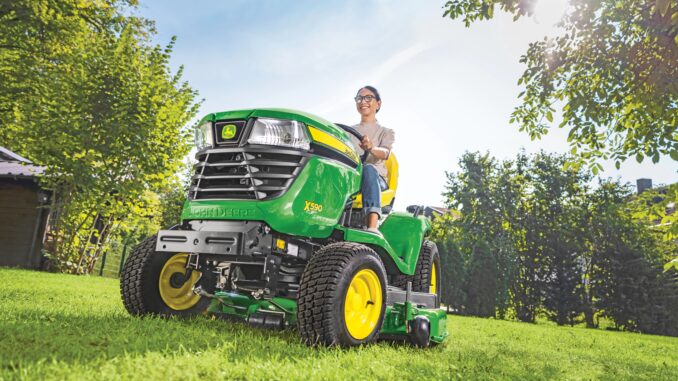
John Deere LT155 Serial Number Lookup, PIN Location, Parts & Year Guide
The John Deere LT155 is a hydrostatic lawn tractor from the LT Series. It was sold primarily in North America and is commonly associated with late-1990s and early-2000s production. The machine is equipped with a 15 hp Kohler Command single-cylinder petrol engine and was offered with mid-mount mower-deck options.
Finding and recording the correct John Deere LT155 serial number, more accurately called the Product Identification Number or PIN, is important before ordering parts, buying a mower deck or snow attachment, checking service information, or assessing a used tractor. The model decal alone is not always enough: parts catalogues can separate components by serial range, engine number, deck type, or attachment configuration.
This guide covers the North American John Deere LT155 lawn tractor fitted with the Kohler Command CV15S engine. Do not confuse it with the later LTR155 rear-engine lawn tractor, which is a different machine with different identification details, parts information, and attachment arrangements.
And See:
The machine PIN, engine serial number, transaxle number, and mower-deck or attachment identification number are separate records. Keep all of them together when maintaining, buying, selling, or insuring an LT155.
In this guide
-
Main John Deere LT155 PIN and serial-number location
-
Engine serial-number identification
-
PIN structure and decoding limits
-
Serial-number year identification
-
Parts lookup and serial-range changes
-
Maintenance implications by production range
-
Mower-deck, snowblower, and blade compatibility checks
-
Safety checks, used-machine inspection, and missing-plate advice
Quick Guide: Where to Find the Serial Number on a John Deere LT155
On the John Deere LT155, the main Product Identification Number (PIN) is located below and in front of the operator’s seat on the tractor body.
If you are in a hurry:
Park the machine safely on level ground, stop the engine, set the parking brake, and remove the key.
Raise or move the seat only as needed to inspect the area below and ahead of it.
Look for “PIN,” “Product Identification Number,” “Product ID,” or “Serial Number.”
Use a torch and gently remove loose dirt with a soft brush and cloth.
Photograph the identification area before cleaning and again after the number is visible.
Main Product Identification Number Location on the John Deere LT155
Exact position on the machine
The John Deere LT155 machine PIN is located on the tractor body below and in front of the operator’s seat. Inspect the fixed body and chassis area rather than removable mower-deck components, engine shrouds, or attachment brackets.
The identification plate may be hard to see on an older machine because of:
-
Accumulated grass, dust, oil residue, or dried mud
-
Seat movement or restricted access around the operator platform
-
Faded printing or corrosion
-
Overspray from cosmetic repainting
-
Physical damage caused by long-term outdoor storage
-
A replacement seat or modified seat mounting arrangement
Earlier and later production ranges may be covered by different service literature. If the plate position or plate style appears different from expected, use the complete PIN with a John Deere dealer to confirm the correct production version.
What the PIN plate looks like
The machine identification area should show the John Deere model designation and Product Identification Number or serial-number information. Plate appearance can vary with age, production range, and replacement bodywork, so do not rely on colour, plate shape, rivet style, or decal design alone to establish authenticity.
A legitimate identification record should be clear enough to connect the machine to its paperwork and parts information. The full number should be recorded exactly as displayed, including letters, numbers, spaces where shown, and leading zeroes.
Tips for old, dirty, or painted machines
Use a careful approach when inspecting an LT155 identification plate:
-
Brush away loose debris with a soft brush.
-
Wipe the surrounding area with a clean cloth.
-
Use a mild degreaser sparingly if oily residue obscures the plate.
-
Photograph the plate before and after cleaning.
-
Use angled light from a torch to reveal faint markings.
-
Write down every visible character exactly.
-
Keep a digital copy of the photographs with service records.
Do not use grinders, wire wheels, aggressive abrasives, paint stripper, or scraping tools on the identification plate. Do not restamp, alter, manufacture, or fit a replacement identification plate yourself.
A missing, unreadable, or suspicious machine PIN should be resolved through a John Deere dealer. If ownership, theft, registration, or insurance is relevant, also contact the appropriate local authority or insurer before proceeding.
Engine Serial Number on the John Deere LT155
The engine serial number is separate from the tractor PIN. A John Deere LT155 is commonly associated with a Kohler Command CV15S, a vertical-shaft, air-cooled, single-cylinder petrol engine. The tractor PIN identifies the lawn tractor; the Kohler engine number identifies the engine production version.
You may need the engine model and engine serial number when ordering or repairing:
-
Carburettor and fuel-system components
-
Ignition parts
-
Starter and charging-system components
-
Engine cooling and shroud parts
-
Internal overhaul components
-
Oil-system parts
-
Engine-specific belts or pulleys
-
Electrical components fitted directly to the engine
Engine serial-number location
The Kohler engine identification information is normally found on an engine-mounted label or identification area. The exact position can vary with engine version, shroud arrangement, replacement parts, and production range.
Check the Kohler engine identification label carefully and record both the engine model and specification details, not just the tractor model. For engine-specific work, use the engine documentation that matches the complete Kohler identification information or ask a John Deere dealer or Kohler engine specialist to confirm the correct parts listing.
Why engine identification matters
A listing for “John Deere LT155 engine parts” can be too broad if it does not distinguish between the actual engine model, specification number, and serial number. Engine components can change during production even when the tractor model decal remains LT155.
Always compare:
-
The tractor PIN
-
The Kohler engine model
-
The Kohler specification number, where shown
-
The Kohler engine serial number
-
The old part and its visible configuration
How to Read a John Deere LT155 Serial Number
Copy the complete John Deere LT155 PIN exactly as it appears on the machine. Avoid relying on handwritten notes from a previous owner, auction listing, service sticker, or online advert until the number has been checked directly against the tractor.
A machine PIN can help identify the individual tractor and allow a dealer or parts system to select the appropriate production range. However, individual characters should not be decoded from generic internet charts unless the chart clearly applies to the exact LT155 production version and market.
PIN structure
The full John Deere LT155 PIN should be treated as a complete identifier rather than a collection of characters to decode individually.
[MODEL CODE]-[PRODUCTION CODE]-[SEQUENCE NUMBER]Illustrative format only — this is not a real John Deere LT155 serial number and should not be used to identify a machine.
Some character meanings can be internal to John Deere manufacturing and dealer systems. Do not guess factory, build date, configuration, or option information from a partial number.
What the PIN can tell you
The complete PIN can help with:
-
Identifying the individual LT155 lawn tractor
-
Selecting the correct parts-catalogue serial range
-
Confirming the correct service literature
-
Helping a John Deere dealer identify production information
-
Checking possible safety campaigns or service actions
-
Comparing the tractor with sales paperwork and ownership records
-
Confirming whether an attachment should be checked against a particular tractor version
What the PIN cannot prove on its own
The PIN does not independently prove:
-
The exact calendar date of manufacture
-
The full original equipment specification
-
The original selling dealer
-
The number of previous owners
-
The tractor’s complete service history
-
Whether the engine, transaxle, mower deck, or other components are original
-
Whether the tractor is stolen
-
Whether finance is outstanding
-
Whether the machine has been modified or repaired correctly
Finding the Year of Your John Deere LT155 from the Serial Number
The John Deere LT155 is generally associated with 1998 through 2001 production. Serial-number reference material commonly identifies starting serial numbers for each production year, but a serial number should be used carefully. A dealer PIN lookup remains the best method for confirming an individual machine’s production information.
These figures should be treated as production-year starting points, not as proof of a precise build date. A machine built near a production transition, sold later than its manufacture year, or fitted with replaced components may not match assumptions based only on decals or paperwork.
How to verify the year
-
Copy the complete PIN exactly from the tractor.
-
Compare it with a verified LT155 serial-year reference.
-
Check the correct operator’s manual and parts information for the PIN range.
-
Ask a John Deere dealer to search the complete PIN.
-
Compare the result with original sales documents, labels, decals, and machine configuration.
-
Treat generic online serial-number year charts cautiously if they do not specifically identify the North American LT155 lawn tractor.
The production year is not necessarily the same as the year in which the tractor was first sold, registered, or entered into service.
Using Your John Deere LT155 Serial Number to Order the Right Parts
The LT155 model decal is a useful starting point, but it is not always enough to identify a replacement part. The machine PIN, engine identification, mower-deck number, and old part details may all be needed.
This matters particularly when ordering parts for the Kohler engine, hydrostatic drive system, electrical system, steering components, mower deck, belts, blades, pulleys, spindles, snowblower equipment, or front blade hardware.
Understanding serial breaks
A serial break is a point during production at which John Deere changed a component, system, design, supplier, or assembly arrangement. Parts catalogues may use serial-break wording to distinguish early and late tractors.
Common parts-catalogue terms include:
-
Serial number below: The part applies before the stated serial number.
-
Serial number and above: The part applies from the stated serial number onward.
-
Before PIN: The part applies to earlier production.
-
After PIN: The part applies to later production.
-
Early production: A component arrangement used on earlier tractors.
-
Late production: A revised arrangement used on later tractors.
-
With or without option: The correct part depends on the original equipment configuration.
Known serial breaks on the John Deere LT155
Publicly available model-specific information does not provide a single complete serial-break table for every LT155 component. That does not mean all LT155 tractors use identical parts.
Read every serial-range note in the applicable official parts catalogue. Pay particular attention when buying engine-related parts, mower-deck components, drive belts, electrical parts, transaxle components, and attachment hardware.
Ordering parts correctly
-
Photograph and record the complete machine PIN.
-
Confirm that the plate identifies the tractor as a John Deere LT155.
-
Record the Kohler engine model, specification number, and engine serial number for engine-related parts.
-
Identify the mower-deck or attachment model separately.
-
Use the official John Deere parts catalogue where possible.
-
Read every “before,” “after,” “below,” and “and above” note.
-
Compare the old part number, mounting arrangement, and visible component with the relevant diagram.
-
Ask a John Deere dealer or knowledgeable supplier to confirm uncertain parts before ordering.
Aftermarket catalogues sometimes group several production versions under one model name. Never assume that a part listed simply as “fits LT155” is correct without comparing serial-range notes and the existing component.
Maintenance and Service Differences by Serial Range
Basic maintenance needs remain similar across LT155 production, but individual service parts, procedures, and component arrangements can vary by serial range, engine specification, mower deck, or replacement component history.
The correct operator’s manual and parts catalogue should match the tractor’s PIN range. Engine maintenance should also match the complete Kohler engine identification details.
Before ordering routine service items, confirm:
-
Engine oil and filter information for the exact Kohler engine
-
Air-filter arrangement
-
Spark plug and ignition components
-
Fuel-system components
-
Drive-belt and mower-deck-belt arrangement
-
Mower-deck blade and spindle configuration
-
Battery size and terminal layout
-
Transaxle and drive-system parts
-
Electrical switches, relays, and safety-system components
Do not select filters, belts, blades, or electrical parts only by tractor model. Use the tractor PIN, engine identification, deck identification, and the old part whenever possible.
Attachment Compatibility for the John Deere LT155 by Serial Number
The John Deere LT155 was offered with mid-mount mower-deck options and may also be found with seasonal attachments such as a snowblower or front blade. Compatibility depends on more than the tractor model decal.
Check the tractor PIN and the attachment’s own identification details before buying used equipment. A mower deck, snowblower, or blade from a related LT Series tractor may look similar but require different mounting hardware, lift linkage, drive belts, pulleys, guards, or brackets.
Attachment checks before purchase
Why attachment identification matters
A used attachment may be incomplete even if its main housing is present. Check for the correct:
-
Mounting frame
-
Lift linkage
-
Belt or driveshaft arrangement
-
Pulleys and guards
-
Attachment-specific brackets
-
Pins, clips, and fasteners
-
Electrical components where applicable
-
Front weight or traction requirements
-
Tyre chains or other seasonal equipment where required
Provide both the LT155 machine PIN and the attachment serial number to a John Deere dealer before purchasing a used mower deck, snowblower, blade, or mounting kit.
Checking Recalls and Safety Notices Using Your LT155 PIN
Safety campaigns, recalls, and service actions can apply to particular production ranges, component suppliers, or configurations. The most reliable way to check an individual LT155 is to provide the complete machine PIN to a John Deere dealer.
Use this process:
-
Record the full machine PIN exactly.
-
Photograph the identification plate for your records.
-
Contact a John Deere dealer and ask for a check of open safety campaigns or recall actions.
-
Check official John Deere safety information for the applicable market.
-
Keep the dealer’s response with the tractor’s service and ownership records.
Do not assume that a recall affecting a different John Deere lawn tractor, a later model, or a similarly named machine applies to the LT155.
Using the John Deere LT155 Serial Number When Buying or Selling
Checks for buyers
A used LT155 can be a practical lawn tractor, but identification checks should happen before money changes hands.
-
Check that the machine PIN plate matches available paperwork.
-
Confirm that the tractor is actually an LT155, not an LT133, LT166, LTR155, or another related machine.
-
Inspect the area around the PIN plate for unusual rivets, disturbed paint, damage, removal marks, or altered characters.
-
Check whether the seller is quoting the machine PIN, engine number, mower-deck number, or transaxle number.
-
Use the PIN to confirm applicable parts information and attachment suitability.
-
Inspect the mower deck and attachment separately; they may not be original to the tractor.
-
Ask for service history, operating hours, and receipts where available.
-
Pause the purchase if there is a serious mismatch between the plate, paperwork, and seller’s description.
Advice for sellers
A clear listing can make a genuine LT155 easier to sell and easier for a buyer to assess. State the correct model, disclose the mower-deck size and attachment details, provide an honest hours reading, and include service history where available.
Avoid publishing a close, high-resolution photograph of the full PIN plate in a public advert. Share the complete number privately with a serious buyer, John Deere dealer, insurer, or parts supplier when appropriate.
What If You Cannot Find or Read the Serial Number?
Plate is dirty, painted over, or faded
Use strong angled lighting, a soft brush, a clean cloth, and mild degreaser where appropriate. Photograph the area before and after cleaning, then record every visible character.
Do not scrape aggressively, sand the plate, use a wire wheel, or apply chemicals that can destroy printed information.
Plate is corroded or damaged
Record every readable character and preserve clear photographs. Check original sales paperwork, service invoices, insurance records, and dealer records for matching information.
A John Deere dealer may be able to help interpret a partial number, but a partial number should not be treated as conclusive proof of identity.
Plate is missing
Check legitimate alternative identification points such as engine, transaxle, mower-deck, or attachment labels, but remember that these numbers do not automatically replace the tractor PIN.
Review historical paperwork, dealer service records, ownership documents, and insurance records. Do not manufacture, restamp, alter, or install an identification plate yourself.
PIN does not match paperwork
A mismatch can result from:
-
A transcription or data-entry error
-
Paperwork belonging to a different machine
-
An engine number being mistaken for the tractor PIN
-
A mower-deck or attachment number being mistaken for the tractor PIN
-
Replacement components
-
A more serious ownership or identity issue
Resolve the discrepancy through a John Deere dealer and, where necessary, the relevant local authority before buying, selling, registering, or insuring the tractor.
John Deere LT155 Serial Number FAQ
Where is the serial number on a John Deere LT155?
The main John Deere LT155 Product Identification Number is located on the tractor body below and in front of the operator’s seat. Park safely, remove the key, inspect the area with a torch, and clean loose debris gently. Do not confuse the machine PIN with the Kohler engine number, mower-deck number, or transaxle identification.
What does the serial number on my John Deere LT155 identify?
The machine serial number, often called the Product Identification Number or PIN, identifies the individual LT155 tractor. It helps a dealer or parts system select the proper production range and can support parts lookup, service-information matching, safety enquiries, and ownership-record checks. It does not prove complete original specification or ownership history by itself.
Is the John Deere LT155 serial number the same as a VIN?
The LT155 PIN serves a similar identification purpose to a vehicle identification number, but it should not automatically be treated as a road-vehicle VIN. The tractor is a lawn tractor, and registration or legal identification requirements can vary by location. Use the full PIN when dealing with a dealer, insurer, lender, or authority.
Is the Product Identification Number the same as the serial number?
In everyday use, owners often use “PIN” and “serial number” interchangeably for the main tractor identification number. John Deere commonly uses Product Identification Number for the machine record. The LT155 also has separate identification numbers for major components such as the engine, transaxle, and mower deck.
Can I find the year of my John Deere LT155 from the serial number?
A serial-number reference can help identify the likely production year for an LT155, which is generally associated with 1998 through 2001 production. However, the complete PIN should be checked by a John Deere dealer for the best confirmation. Production year is not necessarily the same as first-sale year or the date shown on later paperwork.
Are official serial-number year charts available for the LT155?
Serial-number starting points are commonly used to identify LT155 production years, but they should be applied only to the correct North American LT155 lawn tractor. For a definitive check, provide the complete PIN to a John Deere dealer and compare the result with the correct model-specific parts and operator information.
How accurate are online LT155 serial-number year charts?
Online charts can be useful when they clearly identify the John Deere LT155 lawn tractor and show production-year starting points. They can still be incomplete, copied incorrectly, or confused with another John Deere model. Use them as a preliminary guide, then verify the full PIN through a dealer and compare it with original documentation.
What is the difference between the machine PIN and engine serial number?
The machine PIN identifies the complete John Deere LT155 lawn tractor. The engine serial number identifies the Kohler engine fitted to it. Use the tractor PIN for chassis, steering, drive, electrical, and tractor-level parts; use the engine identification details for engine-specific repair parts, carburettor information, ignition items, and internal engine service.
Where is the engine serial number on a John Deere LT155?
The engine number is normally found on the Kohler engine identification label or an engine-mounted identification area. The exact location can vary by engine configuration and replacement shrouds or components. Record the full Kohler model, specification, and serial information before ordering engine-related parts.
Do I need the engine number or machine PIN to order parts?
It depends on the part. Use the machine PIN for tractor, chassis, mower-drive, electrical, and attachment-related parts. Use the Kohler engine model and serial details for engine-specific components. For mower-deck parts, you may also need the deck’s own identification number. Providing all available identification details avoids costly ordering errors.
Why does the parts catalogue ask for a serial-number range?
A parts catalogue asks for a serial-number range because John Deere can change components during production. These changes are called serial breaks. A belt, switch, bracket, pulley, wiring component, or drive-system part may differ between early and late LT155 production even when the tractors look nearly identical.
What is a serial break on a John Deere LT155?
A serial break is the production point where John Deere changed a part or assembly. Catalogue wording such as “serial number below” or “serial number and above” tells you which version applies. Always read those notes before ordering, particularly for mower-deck, drive, engine-related, and electrical parts.
Which LT155 parts are most likely to change by serial range?
Parts that commonly require careful serial-range checking include mower-deck belts, blades, pulleys, spindles, electrical switches, wiring-related components, engine service parts, and drive-system items. The exact changes must be confirmed in the parts catalogue matching your LT155 PIN, engine identification, and mower-deck number.
Does maintenance differ by serial number on a John Deere LT155?
Basic maintenance tasks remain broadly similar, but the correct filters, belts, electrical components, mower-deck parts, and engine procedures can depend on production range and engine specification. Use the operator’s manual and official parts information that matches the machine PIN, and use Kohler documentation that matches the full engine identification.
Can filters change by serial number or engine version?
Yes. Engine-related filters and service components should be selected by the Kohler engine model, specification information, and serial number rather than the LT155 decal alone. If the engine or its equipment has been replaced during the tractor’s life, the original tractor build information may no longer identify every engine-service part correctly.
How do I use a John Deere parts catalogue with my LT155 PIN?
Start by confirming the tractor is an LT155 and recording the full machine PIN. Select the parts section for the correct production range, then read all serial-number notes. For engine parts, use the Kohler engine identification. For mower parts, identify the deck model separately and compare the old component with the diagram before placing an order.
Can a John Deere dealer identify build details from the PIN?
A John Deere dealer can use the complete PIN to help identify the correct machine record, production range, and applicable parts information. The dealer may also be able to help check safety actions. Ask specifically what information can be confirmed for your individual tractor rather than assuming every original option or component is still present.
Can I check recalls or safety notices using my LT155 PIN?
Yes. Record the complete machine PIN and ask a John Deere dealer to check for applicable open safety campaigns or recall actions. Actions can depend on production range, components, and market. Do not rely on a recall notice for another John Deere lawn tractor unless a dealer confirms that it applies to your LT155.
Is it safe to share a John Deere LT155 serial number online?
It is usually better not to publish a high-resolution image of the complete PIN plate in a public advert or social-media post. A partial number can be sufficient for general discussion. Share the full PIN privately with a serious buyer, dealer, insurer, finance provider, or parts supplier when there is a legitimate reason.
What should I do if the LT155 serial plate is missing?
Do not create or restamp a replacement plate. Record any legitimate engine, transaxle, mower-deck, and attachment numbers, then gather original paperwork, service records, and ownership documents. Contact a John Deere dealer for guidance. If the tractor’s identity or ownership is in question, involve the appropriate authority before completing a sale.
How can I tell whether a serial plate has been tampered with?
Warning signs can include altered characters, disturbed rivets, mismatched paint around the plate, damage inconsistent with the rest of the tractor, unusually fresh fasteners, or paperwork that does not match the plate. None of these signs proves wrongdoing on its own, but a serious discrepancy should be investigated before purchase or sale.
Can I legally replace a damaged identification plate?
Do not replace, manufacture, stamp, or alter an LT155 identification plate yourself. Legal requirements differ by location, and self-made identification labels can create ownership and resale problems. Contact a John Deere dealer and, where applicable, the relevant authority or insurer for the correct process.
Why does the serial number not match my paperwork?
The paperwork may contain a typing error, an engine number, a mower-deck number, or an identification number from another machine. It may also reflect a previous owner’s mistake or a more serious identity issue. Compare the number directly with the plate below and in front of the seat, then ask a dealer to help resolve discrepancies.
Do attachments for a John Deere LT155 depend on serial number?
Yes. Attachment fitment can depend on the tractor PIN, mower-deck configuration, mounting brackets, lift linkage, belt arrangement, and the attachment’s own identification number. A used attachment may also be incomplete. Confirm the complete tractor PIN and attachment number before buying a mower deck, snowblower, blade, or mounting kit.
Which mower decks fit a John Deere LT155?
The LT155 was offered with 38-inch and 42-inch mid-mount mower-deck options. Before buying a deck, verify the deck identification number, mounting hardware, belt arrangement, lift components, pulleys, guards, and serial-range notes. A deck from another LT Series tractor may look similar but should not be assumed compatible without confirmation.
Will a snowblower or blade from another John Deere model fit my LT155?
Do not assume it will fit. Snowblowers and blades can require model-specific mounting frames, lift parts, belts, brackets, guards, and traction equipment. Ask a John Deere dealer to check both the LT155 PIN and the attachment identification number before purchase, especially when buying used seasonal equipment.
Can I decode every character in my LT155 serial number?
Not reliably from a generic online chart. The complete PIN can be used by a John Deere dealer to identify the correct production information and parts range, but not every character should be interpreted independently. Avoid guessing factory, build date, options, or configuration details from partial or copied serial-number information.
Does the serial number show where my John Deere LT155 was built?
The LT155 is associated with John Deere lawn-tractor production in Horicon, Wisconsin, USA. However, use the complete PIN and dealer information if you need confirmation for a specific tractor. Do not infer the identity or origin of a machine solely from decals, engine tags, or partial serial-number characters.
How should I record and store my LT155 PIN?
Photograph the machine PIN plate clearly, write the full number exactly as shown, and keep the record with service receipts, insurance documents, and sales paperwork. Also record the Kohler engine details, transaxle number where relevant, mower-deck number, and attachment identification numbers. Store a backup copy separately from the tractor.
Can I still get parts for an early John Deere LT155?
Many routine and repair parts may still be available, but availability varies by component and supplier. Begin with the complete tractor PIN, Kohler engine identification, and mower-deck number. A John Deere dealer can help identify current part availability, superseded numbers, and the correct serial-range listing.
How can I identify my machine if the LT155 decals are missing?
Start with the machine PIN below and in front of the operator’s seat. Compare the PIN with dealer information and the correct John Deere parts catalogue. Then record the engine, transaxle, mower-deck, and attachment numbers. Do not identify a tractor only by colour, styling, engine size, or parts fitted by a previous owner.
Does the serial number affect LT155 resale value?
The serial number itself does not set the tractor’s value, but a clear and matching PIN can increase buyer confidence. A machine with consistent paperwork, a documented service history, identified attachments, and no unresolved identification concerns is generally easier to assess and sell than one with a missing or questionable plate.
Are there known serial-number-related service bulletins for the LT155?
Service actions and technical information can apply to particular machine ranges or components. The correct method is to provide the complete LT155 PIN to a John Deere dealer and ask whether any applicable safety or service action remains open. Do not rely on general internet claims about unrelated models or unverified production ranges.
Who should I contact if I am still unsure about my LT155 serial number?
Contact an authorised John Deere dealer with clear photographs of the tractor PIN area, the engine identification label, any mower-deck or attachment labels, and available paperwork. For suspected theft, altered identification, or a serious paperwork mismatch, contact the appropriate local authority before buying, selling, insuring, or transporting the tractor.