
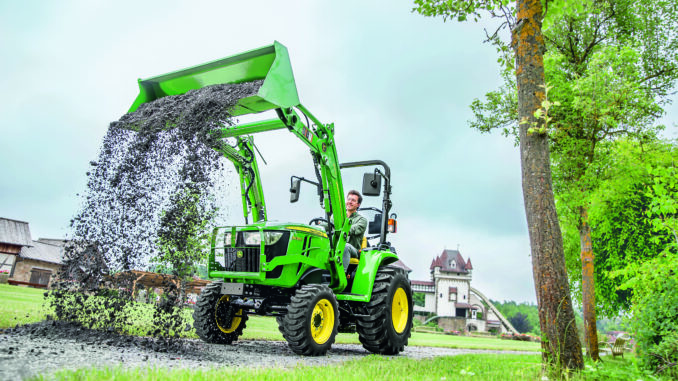
The John Deere 2305 is a compact utility tractor sold in North American specification, and Deere’s operator manual identifies it as the 2305 for PIN 120001 and up. Deere’s official manual structure also shows that the tractor combines engine, electrical, transmission, steering, brake, PTO, and scheduled maintenance systems, which makes it more capable and more complex than a basic lawn tractor.
For homeowners and acreage owners in the USA and Canada, the John Deere 2305 is often used as a do-it-all machine for mowing, loader work, light grading, snow work, and general property maintenance. This guide follows a symptom-first format and covers realistic DIY repairs, common parts, maintenance planning, and a large FAQ so owners can decide what to check themselves and when dealer help makes more sense.
And See
John Deere 2305 overview
The John Deere 2305 sits in Deere’s compact utility tractor range rather than the D100 or S100 lawn tractor families. The operator information for the model includes controls and service sections for hydrostatic drive, MFWD use, PTO operation, three-point hitch functions, storage, and scheduled maintenance, which reflects the machine’s wider job range.
In practical terms, that means the John Deere 2305 has several systems owners need to understand before diagnosing faults:
-
Engine and fuel system, including diesel starting procedure, filtration, cooling, and basic fuel-delivery checks.
-
Mower and PTO system, including mid-PTO use and deck driveline setup on mower-equipped tractors.
-
Drive and hydraulic system, including hydrostatic transmission service, hydraulic oil and filter maintenance, and range selection.
-
Electrical and safety system, including battery, fuses, warning lights, PTO switch, neutral start switch, and other interlocks.
Several common service parts for the John Deere 2305 appear repeatedly in model-specific maintenance listings, including engine oil filter M806418, fuel filter M801101, transmission/hydraulic oil filter LVA12812, primary air filter M131802, secondary air filter M131803, fan belt MIU800108, and battery TY26498. Frequently purchased switch and electrical parts listed for the model also include PTO switch AM118802, neutral start switch AM37643, oil pressure switch M809526, key AM879480, and headlight bulb 57M7166.
John Deere 2305 troubleshooting approach
The best way to troubleshoot a John Deere 2305 is to begin with what the owner sees rather than the part they suspect. Deere’s own manual structure supports that method because it breaks diagnosis into engine, machine, brakes, steering, and electrical troubleshooting sections rather than telling owners to replace random components first.
The main symptom groups for the John Deere 2305 are:
-
Starting issues, such as no crank, slow crank, hard cold start, or cranks but will not fire.
-
Running issues, such as low power, smoke, rough running, or stalling.
-
PTO and mower issues, such as weak cutting, deck not turning, or driveline connection problems.
-
Vibration and noise, including blade imbalance, loose hardware, or belt noise.
-
Overheating and leaks, especially cooling-screen blockage, hose leaks, or belt-related cooling faults.
-
Transmission and drive complaints, such as weak travel, hill-performance complaints, or hydrostatic concerns.
-
Electrical and safety-switch faults, including dead dash, intermittent start problems, blown fuses, or PTO interlock issues.
Emergency and immediate repair needs
Some John Deere 2305 problems need immediate attention because they can make the tractor unsafe or damage other parts quickly. Stop using the machine if you find fuel leaks, hydraulic leaks under pressure, overheating, severe vibration, brake or steering faults, or a PTO or driveline issue that could damage shafts, bearings, or shields.
4.1 John Deere 2305 starting issues
When a John Deere 2305 will not crank or cranks slowly, owners should first treat it as a setup or power-supply problem until proven otherwise. The model’s operating guidance makes clear that PTO position, neutral position, and proper key-on/glow-plug timing all matter during starting.
Common causes:
-
PTO left engaged.
-
Range selector not fully in neutral.
-
Weak battery or dirty terminals.
-
Faulty neutral, seat, or PTO switch.
-
Fuel restriction or air introduced after running the tank too low.
-
Blown fuse or switch fault.
Basic owner checks:
-
Confirm the PTO is off and the range selector is in neutral.
-
Turn the key on and allow the glow-plug cycle to complete before cranking.
-
Inspect battery terminals for corrosion and confirm the battery is charged.
-
Check main fuses and look for obvious wiring issues.
-
If the engine cranks but will not start, inspect the fuel filter area and air filter condition.
4.2 John Deere 2305 cut-quality problems
If the John Deere 2305 is mowing poorly, the issue is not always the blades. Engine speed, deck level, deck cleanliness, driveline engagement, and belt condition all affect cut quality on a mower-equipped tractor.
Common causes:
-
Dull, bent, or unbalanced blades.
-
Improper deck level or height setup.
-
Low engine speed during mowing.
-
Deck driveline not fully connected.
-
Belt slip or spindle wear on the mower deck.
Basic owner checks:
-
Confirm the mower driveline is connected correctly.
-
Run the engine at the correct rpm for PTO mowing work.
-
Inspect blades for wear, bends, and heavy buildup.
-
Check deck level and height settings.
-
Inspect the deck belt and pulleys if cut quality suddenly changes.
4.3 John Deere 2305 vibration and noise
A John Deere 2305 that suddenly vibrates should be shut down quickly so the problem does not spread into bearings, shafts, pulleys, or deck hardware. On this type of tractor, vibration can come from the implement as easily as from the tractor itself.
Common causes:
-
Bent or unbalanced mower blades.
-
Loose deck, wheel, or chassis hardware.
-
PTO driveline wear or poor attachment fit.
-
Failing alternator or fan belt.
-
Tire pressure mismatch or tire damage.
Basic owner checks:
-
Shut the tractor down and inspect blades, deck shell, and driveline areas.
-
Check wheel fasteners and visible hardware.
-
Inspect the fan belt for fraying or cracking.
-
Verify tire pressures match side to side.
-
If vibration remains with the PTO off, inspect engine, wheels, and driveline more broadly.
4.4 Overheating and leaks on the John Deere 2305
Overheating on the John Deere 2305 is important because blocked cooling passages or low coolant can quickly lead to major engine damage. Small leaks also matter on a compact tractor because the machine depends on several fluid systems working together in a tight chassis layout.
Common causes:
-
Dirty grille screen or clogged radiator fins.
-
Low coolant or aging hoses and clamps.
-
Worn or slipping fan belt.
-
Engine oil, fuel, or hydraulic seepage.
-
Heavy debris accumulation around the engine bay.
Basic owner checks:
-
Clean the front grille screen and cooling fins.
-
Inspect coolant level, hoses, and clamps for seepage.
-
Check the fan belt condition.
-
Verify engine and hydraulic oil levels before working the tractor again.
-
Do not continue operating with an over-temperature warning or active leak.
4.5 John Deere 2305 transmission and drive problems
A John Deere 2305 that feels weak in travel is not automatically suffering from hydrostatic failure. The model’s operating guidance emphasizes that low range is preferred for heavier work, while high range is mainly for transport and gives less pulling power.
Common causes:
-
High range being used for hills or heavy work.
-
Low transmission or hydraulic oil.
-
Overdue hydraulic filter service.
-
Parking brake dragging.
-
Linkage or pedal movement issues.
Basic owner checks:
-
Shift to low range for hills, heavy mowing, or ground-engaging work.
-
Confirm the parking brake is fully released.
-
Check transmission and hydraulic fluid level.
-
Review whether hydraulic filter service is overdue.
-
If weak travel continues after those checks, dealer diagnosis is usually the sensible next step.
4.6 Electrical problems
Electrical problems on the John Deere 2305 often come down to battery condition, fuse status, corroded connections, or worn safety switches. Because the model uses several interlocks, an intermittent switch can create symptoms that feel random to the owner.
Common causes:
-
Weak battery or dirty battery terminals.
-
Blown fuse.
-
Faulty PTO switch or neutral switch.
-
Worn key switch.
-
Warning-lamp or pressure-switch faults.
Basic owner checks:
-
Clean and tighten battery terminals.
-
Inspect and replace fuses only with the correct rating.
-
Retry starting with PTO off and range selector in neutral.
-
Inspect switch connectors for looseness or corrosion.
-
Avoid bypassing safety switches and move to dealer-level testing if the fault is intermittent and safety-related.
DIY or dealer? Repair decision guide
The John Deere 2305 is realistic for owner maintenance, but it is still a diesel compact tractor with hydraulics, electrical interlocks, and multiple attachment systems. Routine service and straightforward repairs are good DIY territory, while internal hydraulic, fuel-injection, and complex electrical diagnosis are usually better left to a dealer or an experienced compact-tractor technician.
Good DIY jobs
-
Engine oil and filter service.
-
Air and fuel filter replacement.
-
Battery replacement or terminal cleaning.
-
Cooling-screen cleaning and hose inspection.
-
Fan belt replacement.
-
Deck blade service and basic deck setup on mower-equipped tractors.
Advanced DIY or dealer jobs
-
Transmission and hydraulic oil service if the owner is comfortable handling the fluid volume and keeping the system clean.
-
Repeated no-start diagnosis involving multiple switches or harness checks.
-
Cooling-system repair beyond simple hose replacement.
-
Fuel-system or injector-related diagnosis.
-
Hydrostatic performance complaints after fluid and linkage checks.
Skill level guide
-
Beginner: battery, fuses, fluid checks, cooling-screen cleaning, and visual inspections.
-
Intermediate: engine oil and filter, fuel filter, air filter, fan belt, and mower blade service.
-
Advanced: hydraulic service, electrical tracing, cooling-system repairs, and drivetrain diagnosis.
Parts for the John Deere 2305, OEM vs aftermarket, and what information you need
Before ordering parts for a John Deere 2305, gather the full model name, the tractor Product Identification Number, the engine identification, and the exact deck or attachment model if one is fitted. Deere’s official manual includes a record-identification section because serial and configuration differences matter when ordering service parts.
OEM parts are usually the best choice for belts, safety-related switches, and parts where fit is sensitive. Aftermarket parts can be fine for selected filters, batteries, bulbs, and some wear items as long as the cross-reference clearly lists the John Deere 2305 and the correct OEM number.
John Deere 2305 manuals and parts diagrams
A few sources are especially useful when researching or buying parts for the John Deere 2305:
-
Official John Deere operator manual entry: confirms the correct North American operator’s manual and the PIN range it covers.
-
John Deere operator manual index: useful for locating the maintenance chart, storage procedures, and troubleshooting categories.
-
Green Farm Parts maintenance guide: handy for quick service-part references and common maintenance intervals.
-
Jensales operator manual listing: useful if you want a retail source that summarizes the manual’s scope before purchase.
How to locate John Deere 2305 model, serial, and engine numbers
These numbers matter because parts can vary by serial range and by the exact engine or attachment fitted to the tractor. Owners should record all identification before ordering anything beyond the most basic consumables.
-
Locate the tractor Product Identification Number using the identification guidance in the operator’s manual.
-
Record the full model as John Deere 2305 and copy the entire PIN exactly.
-
Find and photograph the engine model and serial identification on the engine itself before ordering engine-side parts.
-
Record the model and serial for any deck, loader, blade, or other attachment separately.
-
Keep those photos on your phone so you can verify fitment at the dealer counter or while shopping online.
Buying John Deere 2305 parts online and in physical stores
The best buying strategy is to identify the OEM number first and then shop by part number, not just by model name. That is especially important for filters, switches, and attachment-related items where broad “fits 2305” listings can still be incomplete or misleading.
-
Online: start with Deere manual and parts resources, then compare with Deere-focused sellers such as Green Farm Parts and Jensales.
-
Dealer counter: best for serial-sensitive parts, hydraulic items, and anything involving switches, wiring, or attachment fitment.
-
Retail stores: acceptable for common consumables like batteries, bulbs, grease, and some filters when the packaging clearly cross-references the correct Deere number.
Step-by-step fitting guide for common John Deere 2305 parts
These are high-impact DIY jobs because they solve a large share of real-world starting, running, cooling, and reliability complaints before owners move into more complex repairs.
John Deere 2305 engine oil and filter replacement
Engine oil and filter service protects the diesel engine and is one of the most important repeat jobs on the John Deere 2305.
-
Park safely on level ground, lower attachments, shut the engine down, and allow it to cool slightly.
-
Drain the old oil using the procedure in the operator’s manual.
-
Remove the old oil filter and install a new M806418 filter after lightly oiling the gasket.
-
Refill with the correct oil type and quantity specified in the manual.
-
Run the engine briefly, then shut down and recheck the oil level and for leaks.
John Deere 2305 air filter replacement
Air-filter service is a smart first step when the John Deere 2305 feels down on power or starts smoking under load.
-
Open the filter housing carefully so dirt does not enter the intake path.
-
Remove the primary element and inspect the secondary element behind it.
-
Replace dirty or damaged elements with the correct M131802 primary and M131803 secondary filters.
-
Inspect intake hoses and clamps before reassembly.
-
Refit the housing securely so unfiltered air cannot bypass the elements.
John Deere 2305 fuel filter service
Fuel filter service is often one of the first useful jobs when the tractor cranks but starts poorly, stalls, or loses power after sitting.
-
Clean the area around the fuel filter and bowl before opening anything.
-
Remove the old filter and inspect for contamination or water.
-
Install the correct M801101 fuel filter.
-
Reassemble carefully and follow the manual’s restart procedure rather than excessive dry cranking.
-
Check for leaks after restarting.
John Deere 2305 fan belt replacement
A worn fan belt can show up as charging trouble, squeal, or rising temperatures on the John Deere 2305.
-
Let the engine cool fully and gain safe access to the belt area.
-
Inspect the old belt routing before removal.
-
Replace the old belt with MIU800108 if the belt is cracked, glazed, or stretched.
-
Set belt tension according to the official procedure.
-
Recheck for noise or slip after a short test run.
Maintenance to prevent John Deere 2305 problems returning
Regular maintenance prevents most repeat problems on the John Deere 2305 by controlling contamination, heat, wear, and poor electrical connections. The official maintenance structure for the model includes daily checks, early first-service intervals, recurring 50-, 200-, 400-, and 600-hour jobs, and long-interval coolant-related service.
Focus areas:
-
Starting reliability, by keeping the battery healthy and the fuel and air systems clean.
-
Cut quality and PTO reliability, by maintaining blades, deck setup, and driveline connection.
-
Fire and overheating prevention, by cleaning screens and inspecting the cooling system often.
-
Drive performance, by keeping hydraulic and transmission service current and using the proper range.
-
Electrical reliability, by dealing with weak connections and failing switches before they become intermittent no-start faults.
John Deere 2305 maintenance schedule and year-round checklist
Deere’s operator manual index lists service checkpoints at daily, first 10 hours, first 50 hours, every 50 hours, every 200 hours, every 400 hours, every 600 hours, yearly, every 1200 hours, and every two years or 2000 hours. The model-specific maintenance listing adds part-level detail for the oil filter, hydraulic filter, fuel filter, air filters, and common fluids.
Daily / before each use
-
Check engine oil level.
-
Check transmission and hydraulic oil level.
-
Inspect tires and visible hardware.
-
Clean front grille screens and remove debris.
-
Watch for warning lights or obvious leaks.
After first 10 hours
-
Carry out the initial inspection items listed in the official maintenance chart.
-
Recheck fasteners and recently installed attachments.
After first 50 hours
-
Replace the transmission and hydraulic oil filter.
-
Complete the initial 50-hour hydraulic service tasks listed in the manual.
-
Inspect for leaks or loose hardware after the break-in period.
Every 50 hours
-
Replace engine oil where the service plan calls for the 50-hour oil interval.
-
Lubricate fittings and linkages specified in the manual.
-
Inspect the cooling system and belt condition.
Every 200 hours or yearly
-
Replace engine oil filter M806418.
-
Replace transmission/hydraulic oil filter LVA12812.
-
Replace engine oil according to the service schedule.
-
Replace air filters as due or sooner in dusty conditions.
Every 400 hours
-
Replace fuel filter M801101.
-
Continue hose, clamp, and cooling-system inspection.
Every 600 hours
-
Complete the 600-hour maintenance items listed in the official chart.
Every 1200 hours
-
Carry out the 1200-hour service items from Deere’s maintenance schedule.
Every two years or 2000 hours
-
Complete the long-interval cooling-system service shown in the operator information.
Seasonal checklist
-
Spring: replace overdue filters, clean the cooling pack, and inspect mower or work attachments before heavy use.
-
Mid-season: recheck filters, tire pressure, belts, and loose hardware.
-
Fall: clean the tractor thoroughly, inspect lights, and prepare for winter attachment work or storage.
-
Storage period: follow Deere’s storage and return-to-service procedures in the operator manual.
Repair, upgrade, or replace the John Deere 2305?
Repair usually makes sense when the John Deere 2305 is fundamentally sound and the issue is limited to normal wear parts, maintenance items, hoses, switches, or attachment setup. Upgrade or replacement becomes more reasonable when the tractor no longer fits the workload or when several major systems are failing at once.
Repair if…
-
The fault is in filters, belts, switches, hoses, battery, or attachment wear parts.
-
The tractor still starts, drives, and operates normally after basic service is brought up to date.
-
The issue is clearly isolated to one system.
Upgrade if…
-
Your property or tasks now need more lift, more hydraulic capacity, or more PTO capability than the 2305 provides.
-
The tractor still works well, but your attachment needs have moved beyond its original role.
Replace if…
-
Engine, hydrostatic, electrical, and cooling problems are stacking up together.
-
There is clear evidence of poor maintenance history and repeated overheating or contamination.
-
Repair cost is approaching the real value of a better replacement tractor.
Expanded troubleshooting FAQ
1. Why will my John Deere 2305 not start?
Start with the basic interlocks because the John Deere 2305 requires the PTO to be off and the range selector to be in neutral before normal starting. If those are correct, check battery condition, cable cleanliness, fuses, and fuel delivery next. Many no-start complaints on this model begin as setup or maintenance issues rather than major failures.
2. Why does my John Deere 2305 crank but not fire?
A crank-no-start usually points to fuel restriction, air in the fuel side, poor fuel quality, or restricted intake airflow. Check the fuel filter, inspect for signs of contamination, and verify the air filter is not badly restricted. If the tractor was run very low on fuel, air in the system is also possible.
3. Why is my John Deere 2305 hard to start when cold?
Cold starts depend on correct glow-plug timing, battery strength, and good fuel condition. Allow the preheat cycle to complete and make sure the battery is strong enough to spin the diesel engine properly. Weak batteries often show up first in colder weather.
4. Why does my John Deere 2305 click but not crank?
That symptom often means the battery is weak or the connections have high resistance from corrosion or looseness. Clean and tighten the terminals first because that is faster and more common than starter replacement on homeowner machines. A safety-switch problem can also create misleading start symptoms.
5. Why does my John Deere 2305 start and then die?
If the engine starts briefly and quits, suspect fuel starvation, contamination, or air in the fuel path. A partly clogged fuel filter can allow the engine to fire and then starve moments later. This is especially common on tractors that sit for long periods between jobs.
6. Why is my John Deere 2305 losing power?
Loss of power often comes from restricted air or fuel flow, operating in the wrong range, or heat buildup from poor cooling airflow. Check filters, cooling screens, and whether the tractor is being asked to do heavy work in high range. Persistent power loss after service checks points toward deeper diagnosis.
7. Why does the John Deere 2305 smoke under load?
Smoke under load can indicate air restriction, overload, or fuel-related issues. Check the air filters, clean the cooling package, and make sure the tractor is not bogging in the wrong range. Continued heavy smoke after those checks deserves dealer-level diagnosis.
8. Why is my John Deere 2305 overheating?
The first things to inspect are the grille screen, radiator fins, coolant level, and fan belt condition. Deere’s maintenance structure specifically includes cooling-system cleaning and inspection because blockage and seepage are common enough to matter. Running the tractor hot can turn a minor issue into an expensive repair quickly.
9. Why is coolant leaking on my John Deere 2305?
Check the hoses, clamps, radiator connections, and thermostat-related areas first. Small leaks often show dried residue before they show active dripping, so a clean, cool inspection helps. Repeated coolant loss should be fixed before the tractor goes back to hard work.
10. Why is the John Deere 2305 battery not charging?
Charging complaints often trace back to the fan belt, battery condition, or cable connection quality. Inspect the belt for wear and make sure the battery terminals are clean and tight. If warning lights are involved, broaden the inspection to switches and the charging circuit.
11. Why does my John Deere 2305 keep blowing fuses?
Blown fuses usually point to a short, moisture intrusion, or a failing component on that circuit. Always replace with the correct fuse rating and inspect the affected circuit rather than installing a larger fuse. Because the 2305 uses multiple electrical and safety circuits, repeated fuse failure needs proper diagnosis.
12. Why will the PTO not engage on my John Deere 2305?
Start with PTO switch function, operating setup, and any interlock condition that may prevent engagement. On mower-equipped machines, also make sure the deck driveline is physically connected and locked properly. PTO complaints can be electrical, mechanical, or attachment-related.
13. Why is my John Deere 2305 mower deck not spinning?
If the deck is not spinning, confirm the PTO is engaged correctly and the driveline connection is complete. Then inspect the deck belt and pulleys for breakage, slip, or visible damage. Many “tractor” PTO complaints are really deck-side problems.
14. Why does my John Deere 2305 cut unevenly?
Uneven cutting usually comes from deck level, blade condition, or mismatched tire pressure. Check setup before replacing parts because many poor-cut complaints are adjustment issues. A properly leveled deck with sharp blades solves a large share of them.
15. Why is my John Deere 2305 leaving stragglers?
Stragglers usually mean dull blades, low engine speed, heavy buildup under the deck, or ground speed that is too fast for conditions. Make sure the PTO is being run at proper speed and that the blade edges and deck airflow are in good condition. Poor airflow can hurt cut quality as much as blade wear.
16. Why does my John Deere 2305 vibrate when mowing?
The most common causes are bent blades, blade imbalance, loose deck parts, or spindle issues. Stop mowing and inspect before running again because vibration can damage more expensive parts quickly. If vibration remains with the PTO off, look beyond the deck to wheels or drivetrain.
17. Why is there belt squeal on my John Deere 2305?
Belt squeal usually means slip, glazing, wear, or misalignment. On the tractor, check the fan belt, and on mower-equipped machines inspect the deck belt and pulley condition. Squeal should be treated early because it may be a warning sign for cooling or deck-drive problems.
18. Why is my John Deere 2305 weak on hills?
This is often caused by using high range where low range is more appropriate. The model’s operating guidance specifically notes that low range is preferred for heavier work and hill performance. Check hydraulic fluid level too, but start with operating range and technique.
19. Why does my John Deere 2305 barely move in high range?
High range is mainly for transport, not heavy pulling or steep climbing. If the tractor behaves normally in low range, the issue may be expectations rather than a transmission fault. If it is weak in both ranges, then check fluid, service history, and brake drag.
20. Why is the John Deere 2305 hydrostatic transmission noisy?
Hydrostatic noise can increase when fluid is low, filters are overdue, or the tractor is worked hard in the wrong range. Start with service history and fluid condition before assuming internal damage. Persistent noise after proper service is a strong reason to get dealer input.
21. Why will my John Deere 2305 not shift into range easily?
Hydrostatic tractors often need pedal load relieved before the range selector moves easily. Guidance associated with this model notes that tapping the pedal slightly can help the selector engage. If the selector remains difficult, inspect the linkage and make sure the machine is fully stopped.
22. Why does the parking brake on my John Deere 2305 seem to drag?
A dragging parking brake can make the tractor feel weak and reluctant to move. Confirm the brake is fully released and inspect linkage movement if the problem remains. This is a simple but easy-to-miss cause of poor drive performance.
23. Why is steering heavy on my John Deere 2305?
Heavy steering can come from tire condition, front-end loading, axle issues, or steering-system faults. Start with tire pressures and a visible inspection before assuming a deeper hydraulic problem. Deere’s troubleshooting structure treats steering as its own diagnosis category, which is a clue that targeted checks matter here.
24. Why is hydraulic oil leaking from my John Deere 2305?
Hydraulic leaks matter because they can be hazardous and because low oil can damage the system. Clean the area, identify the source, and never use bare hands to search for pinhole leaks under pressure. Hose, fitting, and filter-area leaks are the first areas most owners can inspect safely.
25. Why does my John Deere 2305 stall when I engage the PTO?
That usually points to low engine speed, excess attachment load, or a mechanical problem in the deck or implement. Bring the engine up to the proper working rpm and make sure the implement turns freely before engaging. A jammed or dragging implement can overload the tractor quickly.
26. Why do the safety switches keep causing problems on my John Deere 2305?
The tractor relies on several interlocks, so a slightly worn or misadjusted switch can create intermittent symptoms. That is why setup checks and switch inspection should come before random parts replacement. Safety switches should not be bypassed as a repair strategy.
27. How often should I service a John Deere 2305?
The official schedule includes daily checks, early 10- and 50-hour service points, then recurring 50-, 200-, 400-, and 600-hour work, plus yearly and longer-interval items. The maintenance listing adds model-specific part numbers and intervals for major filters. Dusty or severe-use conditions justify more frequent inspection.
28. What oil filter does a John Deere 2305 use?
A commonly listed engine oil filter for the John Deere 2305 is M806418. That number appears in the model-specific maintenance guide as the standard engine oil filter part. Always verify fitment against your machine identification before ordering.
29. What fuel filter does a John Deere 2305 use?
A commonly listed fuel filter for the John Deere 2305 is M801101. The same maintenance source lists it as a regular 400-hour or annual replacement item. It is one of the first service parts to consider on a machine with poor starting or stalling complaints.
30. What hydraulic filter does a John Deere 2305 use?
The common transmission and hydraulic filter listing for the John Deere 2305 is LVA12812. The model-specific maintenance guide states it is replaced initially after 50 hours and then every 200 hours. That makes it a high-priority check on tractors with uncertain service history.
31. What air filters fit a John Deere 2305?
The maintenance guide lists primary air filter M131802 and secondary air filter M131803 for this model. These filters are especially important on tractors used for mowing and other dusty property work. Air restriction can easily look like a larger engine fault if it is ignored.
32. Can I use aftermarket parts on a John Deere 2305?
Yes, but use them selectively. Aftermarket can work well for some filters, batteries, bulbs, and wear parts when the cross-reference is exact, while OEM remains the safer choice for belts, switches, and fit-sensitive parts. The more serial-specific the part is, the more cautious you should be.
33. Is the John Deere 2305 a good DIY tractor to maintain?
For many owners, yes. The machine is practical for fluid checks, filters, battery work, cooling cleanup, and basic mower maintenance, but hydraulic diagnosis, injection work, and complex electrical tracing move beyond casual DIY quickly. It rewards a careful owner, but not every repair is realistically a home-garage job.
34. When should I take my John Deere 2305 to a dealer?
Dealer help is the smart choice when you have repeated no-start faults after basic checks, persistent overheating, hydraulic leaks, unresolved interlock problems, or weak hydrostatic performance after correct service. Those jobs often need pressure testing, deeper electrical diagnosis, or procedures beyond normal homeowner tools. The goal is to stop a manageable problem from becoming a much larger one.
35. Is the John Deere 2305 worth repairing?
In many cases, yes, especially when the problem is confined to wear parts, maintenance parts, hoses, switches, or attachment setup. It becomes a harder case when multiple major systems are failing together or the tractor shows signs of long-term neglect. The right decision depends on total machine condition rather than on one repair bill alone.