
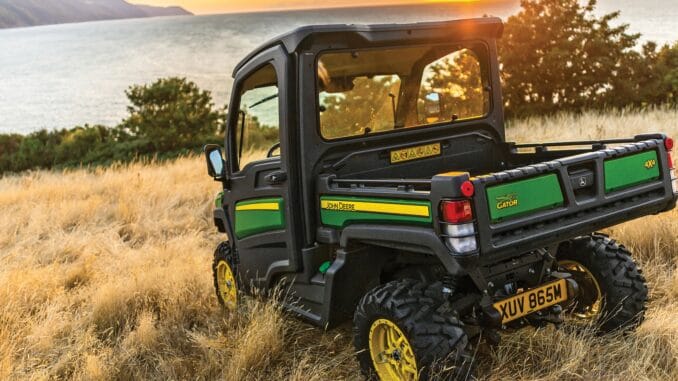
John Deere RSX Gator Models, Maintenance, and Troubleshooting Guide
The John Deere RSX Gator family was Deere’s high-performance recreational crossover utility vehicle range: a two-seat, gasoline-powered side-by-side designed to combine trail speed and independent suspension with the practical hauling, towing, and all-weather utility expected of a Gator. It suited acreage owners, hunters, rural property managers, trail users, and landowners who wanted a more sporting machine than a conventional work-focused Gator.
This page is a directory for RSX ownership information, including model-specific specifications, routine maintenance, common-problem diagnosis, used-machine inspections, and accessory setup. Use it alongside the General John Deere Gator Guide for broader information on the complete Gator lineup. The RSX range is discontinued, so it is especially important for used buyers and owners to identify the exact machine, trim, year, and installed options before ordering parts or following a repair procedure.
About the John Deere RSX Gator Series
John Deere introduced the RSX family as a high-performance, recreational-oriented Gator platform. Unlike traditional work Gators, which prioritized low-speed hauling, payload, turf-friendly operation, and commercial utility work, the RSX was built around substantially higher travel speed, sportier handling, and independent suspension while retaining a cargo box, receiver hitch, 4WD capability, and meaningful utility capacity.
North American RSX models used an 839 cc liquid-cooled gasoline V-twin with electronic fuel injection. John Deere rated the engine at 62 hp in RSX850i and RSX860i literature. The machines used a continuously variable transmission (CVT), with high, low, neutral, and reverse ranges, rather than a manual transmission. The belt-drive system, enclosed clutch housing, reduction gearing, and selectable 4WD made the RSX more suitable for varied terrain than a purely road-oriented recreational vehicle.deere+1
The original RSX850i was introduced for the 2013 model year. It was succeeded by the RSX860i for 2016; John Deere described the RSX860i as replacing the RSX850i and increased the advertised top speed to 60 mph. The RSX860i also offered electronic power steering as an option and received revised controls and driveline updates.utvguide+1
All principal North American RSX machines were side-by-side, two-passenger vehicles. They were not four-seat Gators, diesel work vehicles, electric utility carts, or conventional low-speed work machines. Their real strength was mixed use:
-
Accessing remote acreage, woodland, hunting land, and farm tracks.
-
Carrying hand tools, fencing supplies, feed, recovery gear, and field equipment.
-
Towing lighter utility trailers within the machine’s published limits.
-
Recreational trail riding where local laws, landowner permissions, and vehicle suitability allow.
-
Supporting estate, property-maintenance, and inspection work where rough-terrain mobility matters.
-
Moving people and equipment more quickly over larger rural properties.
The RSX platform used independent suspension and selectable four-wheel drive, with an electronically locking front differential on the RSX860i. Deere literature describes a CVT transmission, shaft drive, high/low/reverse ranges, and true locking 4WD on the RSX860i. Depending on model year and trim, buyers may encounter manual or power steering, standard shocks or upgraded FOX suspension components, winches, roofs, windshields, doors, lighting packages, brush guards, and other dealer-installed accessories.deere
Because RSX machines are now legacy vehicles, specifications and fitted equipment can vary materially between individual examples. Verify the serial number, operator’s manual, parts catalog, decals, wheel-and-tire size, drivetrain configuration, and aftermarket modifications before relying on any capacity, service interval, or replacement-part recommendation.
John Deere RSX Gator Models
The RSX850i and RSX860i are the core, clearly documented North American RSX machines. Deere’s technical-publication search also identifies RSX850i, RSX860E, RSX860i, and RSX860M models, supporting the inclusion of the E and M designations in an across-time index. Treat named Trail and Sport versions carefully when researching individual units: dealer literature, model year, installed accessories, and package names can differ, so the vehicle identification number and factory parts catalog should take precedence over a seller’s description.techpubs.deere
RSX Gator Maintenance Guides
Routine Service and Inspection
RSX ownership depends heavily on routine inspection because these machines combine a high-output gasoline engine, CVT drivetrain, independent suspension, four-wheel-drive components, and off-road use. Exact intervals, fluid types, capacities, and adjustment procedures vary by model year. Use the operator’s manual and technical manual that match the machine’s identification number.
A practical RSX service routine should include:
-
Check engine-oil level before extended use, especially after hard trail riding, towing, steep terrain, or hot-weather work.
-
Change engine oil and filter at the manufacturer-recommended interval using the specified oil grade and filter.
-
Inspect the air-filter element regularly, and service it more frequently in dust, crop residue, dry trails, construction areas, or livestock yards.
-
Check gasoline quality, fuel age, fuel-line condition, tank venting, and fuel-filter condition.
-
Inspect spark plugs, ignition coils, wiring connectors, battery terminals, and battery state of charge.
-
Clean the radiator, oil-cooler area where fitted, grille openings, and cooling fan area; packed mud, grass, seeds, and chaff can reduce cooling airflow.
-
Check coolant level only with the engine cool, inspect hoses and clamps, and investigate any recurring coolant loss.
-
Inspect tires for cuts, plug repairs, uneven wear, low pressure, bead leaks, and incorrect tire sizes.
-
Check wheel nuts, brake-system condition, steering joints, suspension fasteners, bushings, ball joints, and shock mounts.
-
Inspect cargo-box hinges, latch operation, tailgate hardware, bed mounts, and any fitted bed-lift components.
-
Look over the frame, skid plates, brush guards, receiver hitch, winch mount, and underbody for damage after rough-terrain use.
For a maintenance-content cluster, link naturally to:
-
“RSX Gator service interval checklist”
-
“DIY maintenance for John Deere RSX Gators”
-
“John Deere Gator fluids, filters, and grease-point guide”
-
“Pre-season inspection checklist for RSX Gator owners”
John Deere’s RSX860i quick-reference material identifies routine service categories including air filtration and battery-related parts, but owners should still confirm their particular year’s interval chart rather than applying one schedule to every RSX.deere
CVT, Drivetrain, and Suspension Care
The RSX uses a CVT system, so belt condition and clutch-area cleanliness directly affect takeoff quality, hill-climbing performance, towing behavior, and drive-belt life. A belt that has been overheated, contaminated with oil, glazed, cracked, or run through repeated water and mud exposure can cause slipping, squeal, shuddering, slow engagement, or reduced top speed.
Inspect the CVT system for:
-
Belt wear, glazing, frayed cords, abnormal width loss, heat damage, or contamination.
-
Excessive belt dust in the clutch enclosure.
-
Restricted clutch cooling or ventilation paths.
-
Water, oil, or mud intrusion around the belt and clutch housings.
-
Abnormal primary- or secondary-clutch movement, noise, or vibration.
-
Correct engagement behavior when shifting from neutral into forward or reverse.
Check drivetrain oils and components at the specified intervals. This includes gearcases, differentials, front and rear axles, driveshafts, U-joints, CV boots, prop shafts, and seals. A torn CV boot should be dealt with promptly: once water, grit, and mud enter the joint, a relatively simple boot repair can turn into a complete axle replacement.
The RSX860i’s drivetrain incorporated selectable 4WD and an electronically locking front differential. If four-wheel drive does not engage correctly, begin with operator controls, wiring, connectors, fuses, actuators, fluid condition, and obvious driveline damage before assuming a major internal gear failure.deere
Useful supporting content includes:
-
“CVT belt and clutch maintenance for RSX Gators”
-
“4WD, differential, and axle service on RSX models”
-
“Suspension and steering maintenance for John Deere Gators”
-
“How to inspect a Gator drivetrain before costly repairs”
Cargo Box, Towing, and Work Equipment
Although the RSX is more recreational than a conventional work Gator, it still has a cargo box and towing capability. Treat both as practical utility features, not as permission to overload the machine or tow at speed over rough ground.
Use these habits:
-
Confirm the cargo box latches securely and hinges move freely.
-
Do not carry loads higher than the bed sides if they obstruct rear visibility or could shift on uneven terrain.
-
Inspect hitch pins, receiver hardware, safety-chain attachment points, trailer couplers, and trailer lighting before towing.
-
Match trailer weight, tongue weight, brake needs, and terrain to the Gator’s actual rated capacity and operating conditions.
-
Inspect winch rope or cable for kinks, fraying, crushed strands, abrasion, and corrosion.
-
Keep winch mounting bolts tight and confirm that electrical cables are insulated and routed safely.
-
Flush manure, mud, grass, sand, and trail debris from the underbody, radiator area, suspension pivots, and brake components.
-
Recheck wheel nuts, skid plates, suspension hardware, and steering components after heavy towing or unusually rough trail use.
The published RSX860i literature lists an 800 lb payload and 1,200 lb towing capacity, but those figures should be treated as model-specific reference points, not as a substitute for checking the exact machine’s manual, hitch equipment, trailer setup, terrain, and legal requirements.crossimplement+1
RSX Gator Troubleshooting Guides
The following sections are intended as symptom-based navigation. An individual guide—such as “RSX860i common problems and fixes” or “RSX850i maintenance and troubleshooting guide”—should provide the model-specific wiring diagrams, test values, parts breakdowns, and repair sequences.
Starting, Battery, and Electrical Problems
A no-crank or no-start complaint is often caused by a basic electrical, safety-interlock, or fuel-delivery issue rather than an internal engine failure. Start with the simplest tests: battery voltage, battery-terminal condition, ground-cable integrity, fuses, relay operation, ignition-switch function, and whether the vehicle is in the correct shift and brake-pedal condition for starting.
Common RSX starting and electrical symptoms include:
-
Battery is weak, repeatedly discharged, or does not hold charge.
-
Battery terminals are corroded, loose, or damaged.
-
Ground cables have high resistance or poor frame/engine contact.
-
A fuse, relay, ignition switch, starter solenoid, or starter motor has failed.
-
A brake-pedal, neutral, park, gear-position, or other safety interlock is preventing cranking.
-
Accessory wiring for winches, lights, audio equipment, beacons, or battery chargers is drawing power when the machine is parked.
-
Charging-system output is insufficient, intermittent, or absent.
-
Dash instruments, warning lamps, accessory switches, or lights have poor connections.
Before replacing major parts, use a multimeter and inspect connectors for moisture, green corrosion, melted terminals, rubbed-through insulation, and previous owner modifications. RSX machines are old enough that accessory wiring and improvised repairs are common on used examples.
Potential internal content links include:
-
“RSX Gator won’t start: diagnostic steps and fixes”
-
“John Deere Gator battery and charging-system problems”
-
“Electrical troubleshooting for RSX Gator models”
-
“Safety-switch and no-crank problems on John Deere Gators”
Engine, Fuel, and Performance Problems
The RSX platform used gasoline EFI rather than a diesel or electric powertrain. Common running issues therefore tend to involve fuel quality, air supply, ignition, EFI-related components, cooling, battery voltage, sensor inputs, or mechanical wear.
Investigate hard starting, rough idle, stalling, hesitation, misfiring, or poor throttle response in a logical order:
-
Confirm that fuel is fresh and free of water or contamination.
-
Check fuel lines, fuel filter, tank venting, and fuel-pump operation.
-
Inspect the air filter and intake tract for restriction, loose clamps, water intrusion, or rodent damage.
-
Check spark plugs, ignition components, battery voltage, electrical grounds, and wiring connectors.
-
Look for cooling-system problems, blocked radiator fins, fan failure, coolant loss, or overheating after low-speed work.
-
Consider injector, throttle-body, sensor, or electronic-control issues when basic fuel, air, spark, and compression checks are satisfactory.
-
Check for signs of clutch slip or drivetrain drag before diagnosing every loss-of-power complaint as an engine problem.
A machine that loses power only when climbing, towing, or carrying a full box may have an engine issue, but it can also have a worn CVT belt, clutch problem, brake drag, incorrect tire size, 4WD driveline resistance, low gearcase fluid, or an overloaded trailer.
Useful hub links include:
-
“Engine and fuel-system problems on RSX Gators”
-
“John Deere Gator overheating causes and fixes”
-
“Loss of power under load on RSX utility vehicles”
-
“RSX850i EFI and ignition troubleshooting guide”
Drive, CVT, 4WD, and Steering Problems
Driveability faults may feel dramatic but often begin with inspection of the CVT belt, clutch housing, shifter linkage, brake system, drivetrain fluid, axle condition, and electrical controls for 4WD.
Symptoms that warrant focused diagnosis include:
-
The Gator starts but will not move in forward or reverse.
-
Engagement is delayed, abrupt, jerky, or accompanied by harsh clunking.
-
The CVT belt squeals, smells hot, slips, or produces excessive dust.
-
Hill-climbing performance has deteriorated.
-
The machine seems stuck in 2WD, will not enter 4WD, or will not disengage from 4WD.
-
A front differential-lock function does not operate correctly.
-
There is clicking during turns, grinding under load, driveline vibration, or noise from a wheel area.
-
Steering has excessive play, wanders, binds, or becomes unusually heavy.
-
The machine pulls under braking, brake pedals feel abnormal, or brakes drag after a ride.
-
A power-steering-equipped RSX860i develops intermittent assist or warning symptoms.
Do not continue hard riding with a damaged CV boot, failing wheel bearing, loose steering joint, overheated belt, grinding differential, or suspected brake drag. Small driveline defects can quickly damage expensive transmission, clutch, axle, and differential components.
Build this cluster around:
-
“RSX Gator drive and CVT problems”
-
“4WD and differential-lock troubleshooting for John Deere Gators”
-
“Steering and suspension problems on RSX models”
-
“Why a John Deere Gator loses drive under load”
-
“RSX860i power-steering troubleshooting guide”
Attachments, Accessories, and Work Setups
The RSX was designed for mixed recreation and utility use, so accessory choices should match the job rather than simply add weight. An RSX used primarily for property work may benefit from protection, lighting, storage, a receiver hitch, and a properly sized winch. A trail-oriented machine may need tire selection, skid protection, a spare-tire solution, recovery equipment, and secure tool storage.
Common RSX accessories and work setups include:
-
Cargo-bed mats, bed extenders, cargo dividers, tailgate organizers, and tool boxes.
-
Front or rear receiver-hitch equipment and correctly matched utility trailers.
-
Winches, recovery points, brush guards, skid plates, and tow straps.
-
Roofs, windshields, rear panels, doors, soft enclosures, mirrors, and weather-protection systems.
-
Work lights, flood lights, beacon lights, wiring harnesses, switches, and warning equipment.
-
Gun holders, chainsaw mounts, field-service tool racks, fuel-can mounts, and secure storage boxes.
-
Sprayers, spreaders, and property-maintenance equipment, subject to payload and electrical limits.
-
Snow blades or light snow-management equipment where an approved mounting system is available.
-
Turf, all-terrain, mud, snow, or work-oriented tires selected for the terrain and intended task.
Compatibility needs careful consideration. A bigger tire may improve ground clearance or traction in some conditions, but it can alter gearing, add rotating mass, increase steering effort, change suspension clearance, and place extra load on CV joints, belts, brakes, and drivetrain components. A winch must be mounted to an appropriate structure, use suitable wiring and circuit protection, and be matched to realistic recovery loads. Heavier cab enclosures, toolboxes, sprayers, and passenger loads all reduce remaining payload capacity.
Avoid treating an RSX as a dedicated heavy-haul work Gator. Its performance suspension and recreational character make it highly useful on large properties, but loading and towing decisions must remain within the ratings for the exact model and account for slope, ground condition, trailer brakes, speed, and passenger load.
Helpful related articles include:
-
“Attachments and accessory options for RSX Gators”
-
“How to set up a John Deere Gator for property maintenance”
-
“Choosing tires for RSX Gator work and trail use”
-
“Towing and cargo safety for John Deere Gator utility vehicles”
-
“Winch, recovery, and trail-preparation guide for John Deere RSX owners”
Related Guides and Hubs
Use the following related pages to make the RSX directory part of a broader John Deere Gator content structure:
-
General John Deere Gator Guide
-
John Deere Gator Maintenance Hub
-
John Deere Gator Troubleshooting Hub
-
John Deere Gator Buyer’s Guide and Used UTV Inspection Hub
-
John Deere Gator Attachments and Accessories Guide
-
John Deere Work Series Gator index
-
John Deere XUV Gator index
-
John Deere Diesel Gator index
-
John Deere Electric Gator index
-
John Deere HPX Gator index
-
John Deere Traditional, TS, and TH Gator index
For used buyers, the RSX850i and RSX860 family deserve a thorough pre-purchase inspection: check the CVT system, axle boots, wheel bearings, steering joints, suspension bushings, cooling system, drivetrain engagement, brake condition, accessory wiring, and evidence of rollover, water, or severe trail damage. The RSX860i replaced the RSX850i for the 2016 model year and brought a 60 mph claimed top speed plus an available power-steering option, so an exact identification and equipment check should always come before comparing parts or writing a repair guide.