
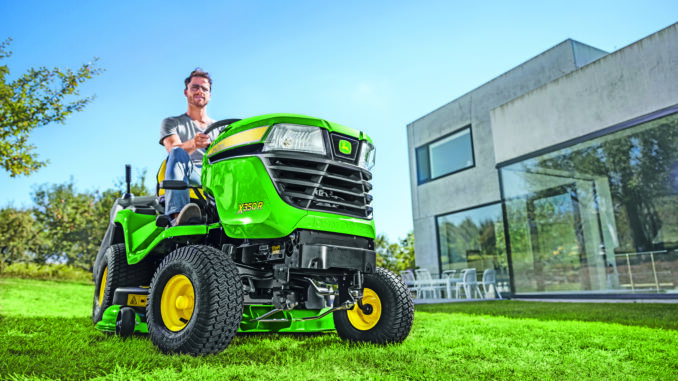
The John Deere S100 is a residential lawn tractor from John Deere’s 100 Series, sold primarily in North America. It uses a 42-inch Edge™ mower deck and a hydrostatic, two-wheel-drive transmission. The machine PIN, commonly described as the serial number, is the key number to record before ordering parts, arranging repairs, checking attachment fitment or assessing a used machine.
And See:
A complete Product Identification Number helps distinguish one S100 from another when parts, equipment specifications or service information changed during production. The model decal alone is useful, but it may not be enough to identify the correct component, belt, electrical part, engine part or mower-deck item.
This guide covers the John Deere S100 100 Series lawn tractor with a 42-inch Edge mower deck. Do not assume that identification information, parts, service procedures or attachment fitment for an S100 applies to older John Deere 100 Series tractors with different model prefixes, including D100, E100, LA100 or X100-series machines.
In this guide:
-
Main machine PIN and serial-number location
-
Engine serial-number location
-
PIN format and decoding limits
-
Year identification
-
Parts lookup and serial breaks
-
Maintenance differences by production range
-
Attachment compatibility
-
Safety checks, used-machine checks and missing-plate advice
Quick Guide: Where to Find the Serial Number on a John Deere S100
On the John Deere S100, the main Product Identification Number (PIN) is located on the left side of the frame, above the left rear tyre and below the fender deck. It is separate from the engine serial number and from any identification label fitted to the mower deck or other attachment.
If you are in a hurry:
Park the machine safely on level ground, stop the engine and remove the key.
Check the left side of the frame above the left rear tyre, below the fender deck.
Look for “PIN,” “Product Identification Number,” “Product ID” or “Serial Number.”
Use a torch and clean the surrounding dirt gently with a brush and cloth if needed.
Main Product Identification Number (PIN) Location on the John Deere S100
Exact position on the machine
The John Deere S100 serial number is located on the tractor’s left-side frame area. Look above the left rear tyre and below the fender deck. This is the main machine identification point used for the lawn tractor itself.
The number is easiest to inspect with the machine parked on a flat surface, the engine switched off and the ignition key removed. A torch is useful because the plate or decal can be shaded by the fender structure, dirt, grass residue or accumulated debris.
Do not confuse the machine PIN with:
-
The engine serial number
-
A mower-deck identification number
-
A transaxle manufacturer label
-
A battery date code
-
A retailer inventory sticker
-
A number moulded into a plastic body panel
What the PIN plate looks like
The exact appearance of the identification label can vary by production range, market and replacement history. The important point is that it identifies the lawn tractor and contains the complete Product Identification Number or serial number.
A readable identification label may also show the S100 model designation and other manufacturing or compliance information. Record every character exactly as shown, including letters, leading zeroes and punctuation where present.
Dirt, fading, paint overspray, corrosion, sun exposure and physical damage can make an older label difficult to read. Avoid assuming unclear characters; a single incorrect letter or number can place the tractor in the wrong parts range.
Tips for old, dirty or painted machines
Use careful cleaning methods that preserve the original identification marking:
-
Brush away loose grass, soil and debris first
-
Use a soft cloth and mild degreaser where suitable
-
Take photographs before and after cleaning
-
Use a torch or angled light to improve contrast
-
Record every letter and number, including leading zeroes
-
Compare uncertain characters against the original plate rather than relying on memory
-
Do not use grinders, wire wheels, strong abrasives or aggressive scraping tools
-
Do not restamp, alter, create or fit a replacement identification plate yourself
[Image suggestion: Wide, clearly annotated photograph showing the main PIN plate location on a John Deere S100, on the left side of the frame above the left rear tyre and beneath the fender deck.]
[Image suggestion: Close-up photograph of the John Deere S100 PIN plate, with sensitive digits obscured if appropriate.]
Engine Serial Number on the John Deere S100
The engine serial number is separate from the lawn tractor PIN. The current S100 specification identifies a single-cylinder, air-cooled gasoline engine listed as 31R977 (M31), with 500 cc displacement and full-pressure lubrication with an oil filter.
For ordinary mower-deck, chassis and steering parts, the machine PIN is normally the starting point. For engine-specific items, the engine model and engine serial number may be essential.
Engine identification can be important when ordering or servicing:
-
Ignition components
-
Spark plug and engine electrical items
-
Carburettor or fuel-system components
-
Fuel pump parts
-
Air-cleaner components
-
Cooling-system shrouds and engine hardware
-
Internal engine repair parts
-
Engine gaskets and seals
-
Replacement engine assemblies
Engine serial-number location
The engine serial number is normally found on an engine-mounted identification label or marking. The exact location can vary by engine version and production range, so confirm the position using the applicable engine documentation, official John Deere parts catalogue or a John Deere dealer before ordering engine-specific parts.
Do not rely on the S100 machine PIN as a substitute for the engine number when an engine supplier, dealer or repair shop specifically requests engine identification.
Engine variants
Current John Deere S100 specifications identify the engine as a 31R977 (M31) single-cylinder engine. However, owners should still record the engine model and engine serial number from the engine itself before buying engine-specific parts.
A lawn tractor may have had an engine replaced during its working life. In that situation, the machine PIN identifies the S100 chassis, while the engine identification determines the correct engine-service parts.
[Image suggestion: Close-up of the engine identification label or serial-number stamp on a John Deere S100 engine.]
How to Read a John Deere S100 Serial Number
Copy the complete PIN exactly as it appears on the tractor. A Product Identification Number may contain information used by John Deere systems to identify the machine, production range or configuration, but individual characters should not be decoded from generic online charts unless the chart clearly applies to the S100 and its market.
A missing character, an incorrect zero or an incorrectly copied letter can lead to the wrong parts diagram, the wrong maintenance item or a failed dealer lookup.
PIN structure
John Deere’s publicly available documentation does not clearly confirm a universal character-by-character decoding guide for every S100 production version. Some character meanings may be internal to John Deere and dealer systems and should not be guessed.
[MODEL CODE]-[PRODUCTION CODE]-[SEQUENCE NUMBER]Illustrative format only — this is not a real John Deere S100 serial number and should not be used to identify a machine.
What the PIN can tell you
A complete S100 PIN can help with the following:
-
Identifying the individual lawn tractor
-
Selecting the correct official parts-catalogue range
-
Helping a John Deere dealer identify the applicable production information
-
Confirming model and configuration details
-
Checking machine-specific safety campaigns or recall actions
-
Supporting insurance, ownership and service records
-
Confirming whether a mower deck or accessory is suitable for the tractor
What the PIN cannot tell you on its own
The PIN is valuable, but it does not independently prove:
-
The exact calendar year of manufacture
-
The complete original equipment specification
-
The original selling dealer
-
Full service history
-
Current legal ownership
-
Whether major components have been changed
-
Whether the machine is stolen
-
Whether finance is outstanding
Use the PIN alongside paperwork, service records, photographs, component identification numbers and dealer confirmation.
Finding the Year of Your John Deere S100 from the Serial Number
A single public serial-number year chart should not be treated as definitive for every John Deere S100. The safest way to establish the production period is to ask a John Deere dealer to check the complete PIN and compare the result with original sales documentation, operator’s-manual information, labels and machine configuration.
The S100 was introduced as part of the 100 Series range and is a modern residential lawn tractor, but owners should avoid assigning an exact year solely from a generic online serial-number list.
Use this process:
-
Copy the full PIN exactly.
-
Check the official model-specific operator’s manual or parts catalogue that applies to the machine’s PIN range.
-
Ask a John Deere dealer to search the complete PIN.
-
Compare the result with original records, labels, decals and configuration features.
-
Be cautious with generic online serial-year charts that do not clearly match the exact S100 and market.
An hour-meter reading can help assess use, but it is not proof of machine age and should not replace a PIN-based identification check.
Using Your John Deere S100 Serial Number to Order the Right Parts
The S100 model name is a useful starting point, but the model decal alone is not always enough to order the correct part. A parts catalogue may separate components by serial number, engine specification, mower-deck configuration or equipment option.
The official replacement-parts guide for the S100 with 42-inch convertible deck identifies common maintenance and deck-related items, but owners should still confirm every part against the complete machine PIN and the specific diagram for the machine.
Understanding serial breaks
A serial break is a point during production where a part, assembly, system or design changed. A parts catalogue may use serial-range wording to identify which version applies.
Common parts-catalogue terms include:
-
Serial number below
-
Serial number and above
-
Before PIN
-
After PIN
-
Early production
-
Late production
-
With a specified option
-
Without a specified option
A part that looks almost identical may still differ in dimensions, connectors, belt length, mounting method or compatibility.
Known serial breaks on the John Deere S100
Read all official parts-catalogue notes carefully because component differences can exist even when a simple public serial-break table is not available. Use the full PIN whenever a diagram refers to an early, late, before or after production range.
Do not select a part solely because an aftermarket listing says it fits “all John Deere S100 models.” Aftermarket catalogues can group different production versions, deck arrangements or engine applications under one model name.
Ordering parts correctly
-
Photograph and record the complete machine PIN.
-
Confirm the exact John Deere S100 designation on the machine.
-
Identify the engine model and engine serial number for engine-related parts.
-
Use the official John Deere parts catalogue where possible.
-
Read every “before” and “after” serial-range note.
-
Compare the old part number and visible component with the diagram.
-
Ask a John Deere dealer or knowledgeable supplier to confirm uncertain parts before ordering.
For routine servicing, the S100 replacement-parts guide identifies items such as the engine oil filter, fuel filter, spark plug, air-filter cartridge, traction belt and mower-deck belt. Confirm the applicable part against the machine’s PIN and the current official catalogue before purchase.
Maintenance and Service Differences by Serial Range on the John Deere S100
The John Deere S100 uses a replaceable engine oil filter and a no-tools oil-drain arrangement. Current S100 information identifies a hydrostatic two-wheel-drive transaxle, a 42-inch Edge mower deck and a manual PTO mower-drive system.
Even where basic maintenance intervals appear similar, service parts and procedures can change by production range, engine version or equipment configuration. Use the operator’s manual and official parts information that match the exact machine PIN.
Items worth checking by PIN or engine identification include:
-
Engine oil filter
-
Fuel filter
-
Air-filter cartridge
-
Spark plug
-
Traction-drive belt
-
Mower-deck drive belt
-
Mower blades
-
Battery specification
-
Deck wheels
-
Ignition-switch components
-
Electrical connectors and safety switches
-
Engine-service parts
The published S100 replacement-parts guide lists engine oil change intervals of 50 hours for the referenced configuration and specifies 1.41 L (1.5 qt) of Turf-Gard™ 10W-30 engine oil. Always check the operator’s manual applicable to the individual tractor before servicing, especially where the machine has been modified, repaired or fitted with a replacement engine.
Attachment Compatibility for the John Deere S100 by Serial Number
The S100 is designed as a residential lawn tractor and can be used with approved John Deere accessories for property-care work. John Deere describes compatible attachment categories including baggers, carts, snow blowers and weather enclosures.
Attachment fitment depends on more than the S100 decal. Check the tractor PIN, the attachment identification number, the mounting hardware, belt or drive arrangement and any required safety equipment before purchase.
Verified compatible attachment categories
Do not assume a mower deck, snow blower, bagger or accessory from another John Deere lawn tractor will fit an S100. A different frame, deck-lift arrangement, belt route, attachment bracket or production range can prevent safe installation.
Before buying an attachment, provide both the machine PIN and the attachment serial number to a John Deere dealer.
Checking Recalls and Safety Notices Using Your John Deere S100 PIN
Recalls, safety campaigns and service actions can apply only to certain machine PIN ranges, components or configurations. The correct way to check is through an authorised John Deere dealer and official John Deere safety information for the market where the tractor was sold.
Use this process:
-
Record the complete machine PIN.
-
Contact a John Deere dealer and request a check for open safety campaigns or recall actions.
-
Check official John Deere safety or recall information for the applicable market.
-
Keep a photograph and written record of the PIN with ownership and service records.
A dealer PIN check is more reliable than relying on internet discussion, resale listings or social-media posts about another machine.
Using the John Deere S100 Serial Number When Buying or Selling
Checks for buyers
A used John Deere S100 should be inspected as both a lawn tractor and an identifiable piece of equipment. The PIN is central to that process.
-
Check that the PIN plate matches available paperwork
-
Confirm that the machine is genuinely an S100 lawn tractor
-
Inspect the identification area for damage, removal, unusual rivets, mismatched paint or altered characters
-
Check whether the engine, deck or transaxle number is being incorrectly presented as the main tractor PIN
-
Use the PIN to verify parts ranges, attachment suitability and possible safety actions
-
Compare the seller’s stated year with dealer PIN information and available documentation
-
Inspect mower-deck condition, belt condition, tyre wear, steering operation, brakes and hydrostatic drive performance
-
Be cautious if the seller cannot explain missing or inconsistent identification information
-
Pause the purchase if there is a serious identity discrepancy
Advice for sellers
A clear and accurate listing makes a legitimate S100 easier to sell. State the model, mower-deck size, hour-meter reading, known accessories, service history and any faults honestly.
Photograph the machine from several angles, including the deck, engine area and controls. Avoid posting a high-resolution public image of the complete PIN plate. Share the full number privately with a serious buyer, dealer, insurer or parts supplier when appropriate.
What If You Cannot Find or Read the Serial Number on Your John Deere S100?
Plate is dirty, painted over or faded
Start with soft cleaning, bright lighting and close photographs. Record every visible character and avoid using force or abrasives that could damage the original marking.
If a character remains unclear, ask a John Deere dealer to help interpret the information using the machine and its available documentation. Do not guess an unclear digit when ordering a major part.
Plate is corroded or damaged
Record all readable characters, photograph the area and gather any original paperwork, dealer invoices, service records or insurance documents. The engine, mower deck and transaxle may carry their own identification information, but those numbers do not replace the machine PIN.
A dealer can advise on the correct next step for the tractor’s identity and parts support.
Plate is missing
Check for legitimate machine and component identification points, historical documentation, dealer service records and ownership records. Do not manufacture, restamp, alter or fit an identification plate yourself.
If ownership, theft, registration or insurance may be relevant, contact a John Deere dealer and the appropriate local authority before buying, selling or representing the machine as identified.
PIN does not match paperwork
A mismatch can result from:
-
A data-entry error
-
Incorrect paperwork
-
An engine, mower-deck or transaxle number being confused with the machine PIN
-
A replacement component
-
A machine assembled from parts
-
A more serious ownership or identity issue
Resolve the discrepancy before purchase, sale, registration or insurance. A John Deere dealer can help distinguish the correct machine PIN from component identification numbers.
John Deere S100 Serial Number FAQ
Where is the serial number on a John Deere S100?
The main John Deere S100 PIN or serial number is located on the left side of the tractor frame, above the left rear tyre and below the fender deck. Park safely, stop the engine, remove the key and use a torch if the area is shaded or dirty. Record the full number exactly as shown.
What does the serial number on my John Deere S100 identify?
The machine PIN identifies the individual S100 lawn tractor. It helps a dealer or parts supplier select the applicable parts catalogue, identify production-related information and check whether safety actions may apply. It does not replace the engine serial number when ordering engine-specific components.
Is the John Deere S100 serial number the same as a VIN?
The S100 identification number is generally referred to as a Product Identification Number, or PIN, rather than an automotive VIN. It serves a similar practical purpose by identifying the individual machine, but do not assume that vehicle VIN decoding rules apply to a John Deere lawn tractor.
Is the Product Identification Number, or PIN, the same as the serial number?
For practical parts, service and ownership discussions, the main machine PIN is commonly called the serial number. Use the complete number from the tractor identification label when contacting a dealer or searching the official parts catalogue.
Can I find the year of my John Deere S100 from the serial number?
A dealer PIN lookup is the most reliable way to establish the production information for a specific S100. Do not rely solely on generic serial-number year charts, because they may apply to different John Deere product lines, production periods or markets.
Are official serial-number year charts available for the John Deere S100?
Use an official S100 manual, parts catalogue or dealer PIN lookup rather than assuming that a general John Deere serial chart applies. Model-specific public year ranges are not always presented in a form that lets an owner safely assign an exact year without confirming the full PIN.
How accurate are online John Deere S100 serial-number year charts?
Accuracy depends entirely on whether the chart clearly applies to the exact S100, its market and the relevant production range. Many online charts combine unrelated equipment categories or older John Deere models. Treat a generic chart as a lead only, then verify the machine through an authorised dealer.
What is the difference between the machine PIN and engine serial number?
The machine PIN identifies the S100 lawn tractor chassis and original machine application. The engine serial number identifies the engine itself. Use the machine PIN for chassis, mower-deck and tractor parts; use engine identification for engine-specific repair parts, especially if the engine may have been replaced.
Where is the engine serial number on a John Deere S100?
The engine number is normally located on an engine-mounted identification label or marking. Its precise location can vary by engine version and production range. Check the engine documentation, official John Deere parts information or a dealer before ordering engine-specific parts.
Do I need the engine number or the machine PIN to order parts?
Use the machine PIN first for S100 chassis, deck, steering, electrical and attachment-related parts. Use the engine model and serial number for engine components. For a belt, blade or mower-deck part, identify the deck arrangement as well as the tractor PIN.
Why does the parts catalogue ask for a serial-number range?
The catalogue may separate earlier and later production versions because a part changed during manufacturing. A serial-range note prevents owners from ordering a component that looks similar but has different dimensions, mounting points, connectors or operating requirements.
What is a serial break on a John Deere S100?
A serial break is the point in production where John Deere changed a part, assembly or design. The catalogue may describe this with wording such as “before PIN,” “after PIN,” “serial number below” or “serial number and above.” Always read those notes before placing an order.
Which John Deere S100 parts are most likely to change by serial range?
Parts that may require close PIN confirmation include belts, electrical components, safety switches, deck hardware, engine-service items, ignition components and attachment mounting parts. The correct official diagram and any serial-range note should take priority over visual similarity or an aftermarket listing.
Does maintenance differ by serial number on a John Deere S100?
Basic service routines may be similar, but filters, belts, electrical parts and engine-related maintenance information can differ by production range or engine application. Use the operator’s manual and official parts information that match the machine’s complete PIN.
Can filters change by serial number or engine version?
Yes. Engine-service parts can depend on the engine model, engine serial number and production version. Even when an S100 uses the same stated engine family, confirm the specific component using the engine identification and the appropriate official parts information.
How do I use a John Deere parts catalogue with my S100 PIN?
Start by selecting the exact S100 model, then compare the complete PIN against every serial-range note in the catalogue. Check the relevant machine section, such as engine, electrical, traction drive or mower deck. For engine parts, also use the engine model and serial number.
Can a John Deere dealer identify build details from the PIN?
A John Deere dealer can use the complete PIN to check information available in John Deere systems for the individual machine. This can help confirm the model, applicable parts information and potential safety actions. The scope of information available can vary by market and machine record.
Can I check recalls or safety notices using my John Deere S100 PIN?
Yes. Record the complete PIN and ask an authorised John Deere dealer to check for open safety campaigns or recall actions. Safety actions can apply only to particular production ranges or configurations, so a PIN-based check is more useful than relying on general online claims.
Is it safe to share a John Deere S100 serial number online?
Avoid posting a clear, high-resolution public photograph of the complete PIN plate. A seller can state the model and general machine details publicly, then share the complete PIN privately with serious buyers, insurers, dealers or parts suppliers where appropriate.
What should I do if the serial plate is missing?
Do not create, restamp or replace the identification plate yourself. Gather paperwork, service records and photos, then speak with a John Deere dealer about legitimate identification options. If ownership, theft, registration or insurance is involved, contact the relevant authority as well.
How can I tell whether a serial plate has been tampered with?
Warning signs can include unusual rivets, mismatched paint, obvious damage around the plate, inconsistent characters, a label that appears newer than the surrounding machine or paperwork that does not match the number. These signs are not proof on their own, but they justify further checks before purchase.
Can I legally replace a damaged identification plate?
Do not independently replace, manufacture, stamp or alter an S100 identification plate. A damaged or missing PIN should be handled through a John Deere dealer and, where relevant, the appropriate authority. This protects the machine’s identity and reduces the risk of ownership disputes.
Why does the serial number not match my paperwork?
The issue may be a typing error, incorrect paperwork or confusion between the tractor PIN and a component number. It can also indicate a more serious identity problem. Stop and resolve the discrepancy with a John Deere dealer before buying, selling, registering or insuring the S100.
Do attachments for a John Deere S100 depend on serial number?
They can. Attachment fitment may depend on the tractor’s production range, mounting hardware, drive arrangement, deck configuration and safety equipment. Provide the S100 PIN and the attachment identification number to a John Deere dealer before buying a bagger, snow blower, cart or enclosure.
Which mower deck fits a John Deere S100?
The S100 is specified with a 42-inch Edge mower deck. Confirm the deck identification and the machine PIN before replacing a deck or buying used deck components. Do not assume that a 42-inch deck from another John Deere lawn tractor uses the same mounting, belt or lift arrangement.
Will an attachment from another John Deere model fit my S100?
Not necessarily. Similar-looking lawn tractors can use different frames, brackets, belt paths, deck-lift systems and attachment drives. Check the S100 PIN and the attachment identification number against official compatibility information before purchase or installation.
Can I decode every character in my John Deere S100 serial number?
Do not attempt to decode every character using an unverified online guide. Some PIN information may be intended for John Deere and dealer systems. Use the complete number for a dealer lookup rather than assigning your own meaning to individual characters.
Does the serial number show where my John Deere S100 was built?
The complete PIN may help John Deere identify production information through its systems, but owners should not assume that every character publicly identifies a factory or country. Ask a John Deere dealer to interpret the PIN if production-location information is required.
How should I record and store my John Deere S100 PIN?
Photograph the identification label, write the PIN exactly as shown and store the information with the operator’s manual, purchase invoice, service receipts and insurance documents. Keep a separate record of the engine serial number and mower-deck identification where available.
Can I still get parts for an early John Deere S100?
Parts availability varies by component and production range. Start with the official John Deere parts catalogue using the complete PIN, then ask a dealer to confirm current availability and any superseded part numbers. Do not substitute an unverified part simply because it is listed for a similar model.
How can I identify my machine if the John Deere S100 decals are missing?
Use the main PIN location on the left side of the frame, above the left rear tyre and below the fender deck. Combine that number with the machine’s frame, engine information, mower-deck details and dealer lookup. Missing decals alone do not prove the tractor is not an S100.
Does the serial number affect resale value?
A readable, consistent PIN can improve buyer confidence because it supports clear identification, parts research and ownership documentation. A missing, damaged or inconsistent number can reduce buyer confidence and may make a machine harder to insure, finance or resell.
Are there known serial-number-related service bulletins for the John Deere S100?
Ask an authorised John Deere dealer to check the complete S100 PIN for applicable service information, safety campaigns or recall actions. Do not assume that a bulletin discussed for another 100 Series lawn tractor applies to your specific machine.
Who should I contact if I am still unsure about my John Deere S100 serial number?
Contact an authorised John Deere dealer with clear photographs of the identification area, the complete PIN if readable, the engine identification and any available paperwork. For a missing or suspicious identification plate, also contact the appropriate local authority where ownership, theft, registration or insurance may be relevant.
John Deere S100 maintenance schedule and part numbers
For the John Deere S100 with the 42-inch deck, the official quick-reference guide lists a 50-hour service cycle for the main engine-service items during the first 250 hours. The current US home-maintenance kit is LG266. Confirm parts against your tractor PIN and engine identification before ordering, particularly if it has a replacement engine or non-standard deck components.
Maintenance schedule
The S100 quick-reference guide specifies 1.41 L (1.5 US qt) of John Deere Turf-Gard™ 10W-30 engine oil for each oil-and-filter service. It lists oil changes and the principal maintenance consumables at 50-hour intervals through the first 250 hours.
Important: Change oil with the engine warm enough for good drainage but cool enough to work around safely. Park on level ground, disengage the mower, set the parking brake, stop the engine and remove the key before servicing.
John Deere S100 part numbers
These numbers are from John Deere’s S100-with-42-inch-deck replacement-parts guide.
Practical service checklist
Engine oil and filter
Change the engine oil and replace filter every 50 hours or annually, following the applicable S100 operator’s manual.
-
Oil: John Deere Turf-Gard 10W-30, TY22029
-
Capacity: 1.41 L / 1.5 US qt
-
Filter: AM125424
-
Recheck the oil level after running the engine briefly and allowing oil to settle.
Do not overfill. Check the dipstick using the procedure in the operator’s manual because checking with an incorrectly positioned dipstick can give a false reading.
Air filter
Inspect the air-cleaner system regularly, especially when mowing dry, dusty lawns or dealing with leaf debris.
-
Air filter: MIU14395
-
Official guide interval: 50 hours or annually
-
Replace sooner if heavily contaminated, damaged or oil-soaked.
Avoid blowing high-pressure compressed air directly through the filter element, as this can damage the filtration media and allow abrasive dirt into the engine.
Fuel system and spark plug
The S100 guide lists both items on the 50-hour service schedule through the first 250 hours.
-
Inline fuel filter: AM116304
-
Spark plug: M78543
Replace the fuel filter with the engine cold, away from ignition sources, and clamp or manage the fuel line carefully to reduce spillage. For spark-plug work, remove the key and disconnect the spark-plug lead before working near the blade or deck.
Mower deck and blades
The S100 has a 42-inch Edge™ deck using two mower blades. Inspect the deck more frequently than the formal service interval if you mow rough ground, strike sticks or stones, or notice uneven cutting.
-
Standard 3-in-1 blade: GX22151
-
42-inch blade kit: AM141031
-
Bagging blade kit: AM141034
-
Mower-deck belt: GX20072
-
Gauge wheel: GX10168
Replace blades as a matched pair when possible. Bent, cracked, badly worn or excessively sharpened blades should be replaced rather than repaired. Balance blades after sharpening to reduce vibration and spindle wear.
Drive system
Inspect the traction belt at least every 25 hours and whenever the tractor shows poor drive response, belt squeal, slipping or unusual vibration.
-
Traction-drive belt: GX20006
Before replacing the belt, inspect pulleys, idlers, belt guides, springs and the underside of the tractor for packed grass or debris. A new belt will not correct a seized pulley, damaged guide or worn idler.
Before ordering parts
Use the part numbers above as a model-specific starting point, but verify the following before purchase:
-
Confirm the tractor is a John Deere S100 with a 42-inch deck.
-
Record the complete machine PIN from the frame identification label.
-
Confirm whether the engine is original; if not, use the engine model and serial number for engine parts.
-
Check whether your deck is the original 42-inch deck and record its identification information.
-
Read all official parts-catalogue serial-range notes.
-
Compare old belts, blades and filters with the applicable John Deere diagram.
John Deere provides an S100 owner-information page with access to model-specific operator manuals, maintenance information, parts diagrams and attachment information.