
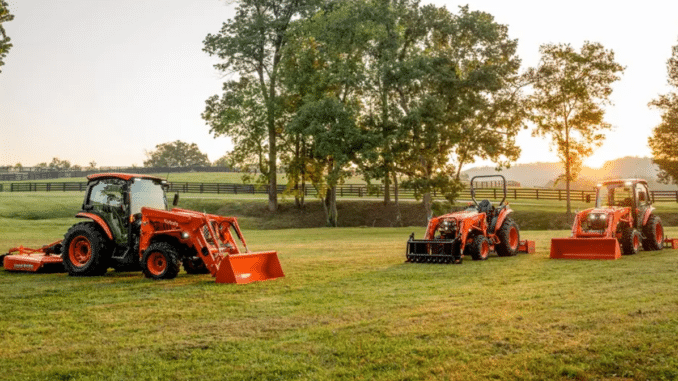
Kubota L and Grand L Serial Number Locations: A Complete Identification Guide
The Kubota L Series serial number location is generally on the left-hand side of the front axle or under the seat. For Grand L tractors, the general locations are the left-hand side of the front axle or the right-hand side of the transmission case.
These are starting points for finding the tractor identification. They are not a guarantee that every L or Grand L model has the same plate, stamping, or mounting arrangement.
The L and Grand L families include different generations, configurations, and market versions. Use your exact model’s operator’s manual to confirm the identification point if the general description does not match your tractor.
Once you find the number, record the complete model and serial number together. Keep the tractor’s identification separate from the engine number and any identification fitted to a loader, backhoe, mower, cab, or other attachment.
This guide explains where to begin, how to distinguish the correct number, what to do when identification is unreadable, and how to use the information for parts, servicing, manuals, and production-year enquiries.
Quick Guide to Kubota L and Grand L Serial Number Locations
Start with the location appropriate to your tractor family.
| Tractor family | General locations to inspect |
|---|---|
| Kubota L Series | Left-hand side of the front axle or under the seat |
| Kubota Grand L Series | Left-hand side of the front axle or right-hand side of the transmission case |
The word “or” matters. Do not assume that every tractor has a readable serial number in both listed positions.
If the first location does not reveal clear identification, check the alternative location and then consult the model-specific identification diagram.
Do not dismantle the tractor or scrape suspected markings simply because the number is not immediately visible.
Which Side Is Left or Right on a Kubota Tractor?
Establish the tractor’s sides from the operator’s seated position.
When you sit in the seat facing forward:
-
The tractor’s left-hand side is on your left.
-
The tractor’s right-hand side is on your right.
When you stand in front of the tractor looking toward the seat, the sides appear reversed.
For example, the left-hand front axle area will appear on your right when you face the tractor from the front.
This simple orientation check helps prevent wasted time, particularly when instructions mention the left-hand front axle but the right-hand transmission case.
Kubota L Series Serial Number Location
For an L Series tractor, begin by inspecting the left-hand side of the front axle area.
If the identification is not apparent there, check the under-seat location described in the general guidance.
Treat those positions as a search sequence, not as proof that any number found nearby identifies the complete tractor.
Checking the Left-Hand Front Axle Area
Park the tractor safely, then inspect the left-hand side of the front axle from a position where you do not need to reach beneath raised equipment.
Use a torch to illuminate shaded surfaces.
Look for identification that can be matched to the tractor, rather than copying the first visible marking.
Nearby numbers may belong to:
-
An axle component.
-
A wheel or tire.
-
A replacement part.
-
A loader bracket.
-
An engine component.
-
Another fitted assembly.
A number cast into a housing should not automatically be recorded as the tractor serial number.
If you are uncertain, photograph the marking and its location before asking a dealer to identify it.
Checking Under the Seat
For L Series models where identification is beneath the seat, inspect the area using the access method described in the operator’s manual.
If the seat is designed to tilt, follow the correct procedure. Do not remove the seat or disconnect wiring simply to investigate a general location description.
Check visible identification surfaces in the under-seat area carefully.
Avoid confusing tractor identification with a label belonging to:
-
The seat assembly.
-
A suspension mechanism.
-
An electrical switch.
-
A protective structure.
-
Another nearby component.
Record the wording on the label, not just its largest number.
If Neither Location Produces a Clear Result
Stop treating the general description as a precise model-specific instruction.
The next steps are:
-
Confirm the complete model designation.
-
Locate the identification illustration in its operator’s manual.
-
Compare the illustrated area with the tractor.
-
Photograph any remaining or suspected identification.
-
Request dealer assistance if necessary.
A failed search in a general location does not establish that the tractor has no serial number.
Kubota Grand L Serial Number Location
For a Grand L tractor, begin on the left-hand side of the front axle.
The alternative general location is the right-hand side of the transmission case.
Do not automatically transfer an under-seat instruction from the L Series to a Grand L without checking the exact model’s documentation.
Checking the Left-Hand Front Axle Area
Use the operator’s seated position to establish the left-hand side.
Inspect the area with a torch and take a wider photograph before attempting any cleaning.
Your aim is to locate tractor identification, not to interpret every number on the axle.
If a marking is unclear, retain a photograph showing both the characters and the surrounding component.
Checking the Right-Hand Transmission Case
The transmission-case location is distinct from the front axle location.
Use the model’s identification diagram to establish the exact surface to inspect. Do not assume that every raised number, casting mark, or component label on the transmission is the machine serial number.
If access is limited, try a torch, inspection mirror, or carefully positioned camera from a safe location.
Do not:
-
Crawl beneath unsupported equipment.
-
Raise the tractor solely to begin a serial-number search.
-
Remove hydraulic lines.
-
Disconnect controls.
-
Grind paint or corrosion away.
-
Dismantle components without model-specific instructions.
If the number cannot be viewed safely, ask a dealer to confirm the location and appropriate access method.
Cab and Open-Station Tractors
Record whether your Grand L has a cab or an open operator station when requesting assistance.
Photographs should show enough of the tractor to establish the configuration, not just a close-up of an unidentified number.
A useful enquiry includes:
Complete model:
Cab or open station:
Number found:
Location where it was found:
Identification photographs attached:
This gives the dealer context without assuming that the cab identification and tractor identification are the same.
How to Find and Record the Serial Number Safely
A careful inspection should preserve the identification and avoid creating unnecessary risk.
Step 1: Prepare the Tractor
Before inspecting the axle, under-seat area, or transmission case:
-
Park on firm, level ground.
-
Lower the loader and other implements fully.
-
Disengage the PTO.
-
Put the controls in the parked positions specified for the tractor.
-
Apply the parking brake.
-
Stop the engine and remove the key.
-
Allow hot components to cool.
Follow the parking instructions in your operator’s manual.
Do not place yourself beneath raised equipment to look for a number.
Step 2: Confirm the Tractor Family and Model
Check whether the tractor is an L Series or Grand L model.
Do not rely solely on a shortened sales description such as “Kubota L tractor.”
Record the complete designation from the machine and available documents.
If the bonnet markings, invoice, and other records disagree, keep the discrepancy visible rather than selecting whichever description seems most convenient.
Step 3: Inspect Before Cleaning
Look at the area carefully before touching it.
Take an initial photograph. This can help preserve evidence where a plate is deteriorated or a marking is partly obscured.
Identify whether you are looking at:
-
A printed label.
-
An identification plate.
-
A stamped marking.
-
A raised casting number.
-
A component label.
Do not assume these all serve the same purpose.
Step 4: Remove Loose Contamination Gently
Use a soft cloth or brush to remove loose dust, grass, and dirt.
Avoid aggressive methods that could erase the remaining information.
Do not use:
-
Wire wheels.
-
Sandpaper.
-
Grinding tools.
-
Paint stripper.
-
Strong solvents.
-
Heavy scraping.
-
Direct pressure-washing on a fragile label.
If corrosion or paint prevents reading the number, ask for advice before attempting restoration.
Step 5: Take Close-Up and Context Photographs
Keep two types of image:
-
A close-up showing the complete identification.
-
A wider image showing where it sits on the tractor.
Check the images for:
-
Focus.
-
Glare.
-
Shadows.
-
Hidden characters.
-
Cropped model information.
A different lighting angle may reveal characters that were difficult to see in the first photograph.
Step 6: Transcribe Without Guessing
Use separate fields:
Tractor model:
Tractor serial number:
Identification location:
Photograph date:
Uncertain characters:
Preserve letters and leading zeros.
If the number appears to be “48?21,” record it that way until the missing character is resolved.
Do not change uncertain characters repeatedly until a search system accepts the entry.
Model-Specific Checks for L and Grand L Tractors
A general series location should not be presented as a verified exact position for every individual model.
L2501, L3301 and L3901 Enquiries
If you are identifying a tractor described as an L2501, L3301, or L3901, keep the complete model available and follow its own identification illustration.
Begin with the L Series locations, but do not assume that a photograph from another model proves the precise position on yours.
If you cannot find the identification, send the dealer:
-
A complete tractor photograph.
-
The model markings.
-
The front axle area.
-
The under-seat area, where safely visible.
-
Available purchase documents.
Ask the dealer to identify the correct location for the exact machine.
Grand L Model Enquiries
Apply the same method to tractors described as L3560, L4060, L4760, L5060, L5460, or L6060 models.
These names are examples of model-specific enquiries, not a claim that every listed model has an identical identification layout.
Record the configuration and ask for the appropriate identification illustration.
Older L and Grand L Tractors
Older tractors may need more investigation when documents are incomplete or identification has deteriorated.
Use the available evidence in this order:
-
Readable machine identification.
-
Model-specific documentation.
-
Original purchase records.
-
Earlier service records.
-
Previous photographs.
-
Dealer confirmation.
Keep any unresolved uncertainty in the record.
Do not turn a visual resemblance to another tractor into a confirmed model or production year.
Tractor Serial Number Versus Engine Serial Number
The tractor serial number identifies the complete machine. The engine serial number identifies the installed engine.
Keep both, but do not use them interchangeably.
| Identification | Purpose |
|---|---|
| Tractor model and serial number | Identifying the complete tractor |
| Engine model and serial number | Identifying the engine |
| Loader model and identification | Identifying the loader |
| Backhoe model and identification | Identifying the backhoe |
| Mower identification | Identifying the mower or deck |
| Cab or ROPS identification | Identifying that structure where relevant |
When You Need the Tractor Number
Provide the tractor model and serial number when asking about the tractor itself.
Examples include enquiries concerning:
-
Transmission.
-
Steering.
-
Front axle.
-
Three-point linkage.
-
Tractor hydraulic assemblies.
-
Electrical equipment.
-
Bodywork.
-
Controls.
The supplier may request more information depending on the component.
When You Need the Engine Number
Add the engine identification when the enquiry concerns engine components or when the supplier requests it.
Prepare:
Tractor model:
Tractor serial number:
Engine model:
Engine serial number:
Component or problem:
Identification photographs attached:
Do not assume that an engine label gives the tractor’s production year.
If the engine has been replaced, retain the replacement invoice and current identification separately from the tractor record.
Loader, Backhoe and Mower Identification
Attachments should be identified separately whenever their own model or serial information is available.
Loader Parts
For a loader enquiry, record:
-
Complete loader model.
-
Loader serial number, where available.
-
Tractor model and serial number.
-
Component description.
-
Existing markings.
-
Photographs.
Make clear whether the repair concerns a cylinder, control valve, hose, linkage, or mounting assembly.
Do not assume that a number on a loader bracket identifies the complete tractor.
Backhoe Parts
For a backhoe repair, supply the backhoe identification alongside the tractor details.
Describe the affected assembly, such as:
-
Boom linkage.
-
Dipper assembly.
-
Stabilizer.
-
Hydraulic cylinder.
-
Control assembly.
-
Mounting equipment.
A photograph of the installed part can be more useful than a guessed catalog term.
Mower and Deck Parts
For mower components, record the implement’s complete model and available serial information.
Do not select blades, belts, spindles, or gearboxes solely because the mower is attached to an L Series tractor.
Keep uncertainty visible if the implement plate is missing.
Using the Serial Number to Select Parts
Finding the identification is the beginning of a parts enquiry, not the final compatibility check.
Select the Exact Model
Use the complete designation, including any suffix or configuration information.
Do not silently substitute a similar model because it appears in a search result.
Identify the Assembly
Establish whether the failed component belongs to:
-
The tractor.
-
The engine.
-
The loader.
-
The backhoe.
-
The mower.
-
Another implement.
Then choose the relevant catalog.
Distinguish Diagram Numbers from Part Numbers
A number beside a drawing may be a diagram reference rather than an orderable part number.
Record:
-
Catalog model.
-
Assembly heading.
-
Diagram reference.
-
Part description.
-
Candidate part number.
-
Application restrictions.
This makes it easier for a supplier to check your selection.
Read Serial Restrictions Carefully
Where a catalog distinguishes parts by serial range, follow its exact wording.
For illustration only:
| Hypothetical application | Hypothetical part |
|---|---|
| Up to serial 39999 | Earlier component |
| Serial 40000 and above | Later component |
These are invented examples, not actual Kubota L or Grand L application ranges.
Do not apply another machine’s serial break to your tractor.
Request Confirmation Before Ordering
For an uncertain application, ask:
Please confirm that this part applies to the supplied tractor model and serial number. Please also identify any additional seals, fittings, hardware, or associated components required.
Keep the quotation or confirmation with your equipment records.
Kubota L and Grand L Serial Number Year Lookup
Use the complete tractor model and serial number when investigating when the machine was produced or sold.
Make clear which date you need.
Keep the Dates Separate
| Date | What it describes |
|---|---|
| Tractor production date | When the complete machine was manufactured |
| First documented sale | The sale shown by the available record |
| Your purchase date | When you acquired the tractor |
| Engine production information | Information relating to the engine |
| Attachment purchase date | When a separate implement was acquired |
A purchase invoice dated 2018 does not automatically establish a 2018 production year.
Similarly, an engine date should not be relabelled as the tractor’s manufacturing date.
Do Not Assume a Universal Year Code
Before using any decoding method, confirm that it applies to:
-
The tractor rather than its engine.
-
The exact identifier format.
-
The model family.
-
The relevant market.
Do not apply a general automotive decoding rule to an unidentified tractor number.
What to Record When the Year Remains Unconfirmed
Use precise wording:
Production year not established. Purchase invoice dated [date] retained.
Or:
Seller describes the tractor as [year]. Supporting production documentation has not been supplied.
This prevents an estimate from becoming an apparently verified fact in later records or advertisements.
What If the Serial Number Is Unreadable?
Try the least intrusive methods first.
-
Improve the lighting.
-
Photograph from several angles.
-
Remove loose dirt gently.
-
Enlarge the image for inspection.
-
Compare with existing documents.
Do not grind, sand, restamp, or alter identification.
Partly Readable Number
Record what you can establish:
Readable transcription: 73?62
Uncertain character: Third position
Original photograph retained: Yes
Send the photograph rather than only the typed transcription.
Paint or Corrosion Obscuring the Number
Preserve the area and request advice before removing paint or corrosion.
A partially readable marking is useful evidence. An aggressively cleaned surface may contain less information afterward.
What If the Serial Number Is Missing?
First confirm the correct location for the exact model.
Then review:
-
Original purchase documents.
-
Delivery paperwork.
-
Warranty documents.
-
Service invoices.
-
Insurance records.
-
Earlier photographs.
-
Records available from the supplying dealer.
If no number can be recovered, explain that clearly.
Do not substitute:
-
An engine number.
-
A casting number.
-
A loader number.
-
A number copied from a similar tractor.
Ask what can still be established from the remaining evidence.
Imported L and Grand L Tractors
If the tractor was originally supplied in another market, tell the dealer at the beginning of the enquiry.
Provide:
-
Exact model.
-
Machine serial number.
-
Original market, if known.
-
Current country of operation.
-
Engine identification.
-
Import and purchase documents.
-
Identification photographs.
Do not assume that a locally sold tractor with a similar name uses the same catalog or parts.
The useful question is:
Does this documentation cover the exact model and market version shown on my tractor?
Keep market-specific support policies separate from the machine’s physical identification.
Buying a Used L or Grand L Tractor
Request a readable identification photograph before relying on a seller’s description.
Compare the Model with the Advertisement
Check whether the complete model matches what is being offered.
Ask for clarification where a listing uses an abbreviated description.
Compare the Number with the Documents
Check every character in any document that records a serial number.
Where records disagree, retain both and investigate.
Possible explanations include:
-
A transcription error.
-
Paperwork for another machine.
-
An engine or attachment number entered in the wrong field.
-
Another issue requiring supporting evidence.
Do not resolve the disagreement by simply choosing the more convenient number.
Ask What Supports the Advertised Year
Separate confirmed production information from purchase dates and previous-owner estimates.
Identify Included Attachments
Record each attachment independently.
Do not assume it was supplied with the tractor when new.
Keep Identity Separate from Condition
A readable serial number does not prove that the tractor is mechanically sound.
Assess service records, operation, repairs, hours, and overall condition separately from identification.
Common L and Grand L Identification Mistakes
Applying One Series Location to Every Tractor
Use the appropriate L or Grand L starting points, then confirm the exact model.
Treating Every Marking as a Serial Number
A casting or component reference may be genuine without identifying the machine.
Confusing Engine and Tractor Identification
Keep separate fields and photographs.
Omitting Model Details
Do not remove suffixes or configuration information from an enquiry.
Using an Attachment Number for Tractor Parts
Identify the item being repaired before selecting the catalog.
Guessing Unclear Characters
Mark uncertainty and preserve the original image.
Treating Purchase Date as Production Date
Record each date according to what the evidence actually establishes.
Treating a Parts Range as a Year Chart
A parts-application restriction should not automatically be interpreted as a manufacturing-date result.
Kubota L and Grand L Identification Record
Tractor Details
Complete model:
L or Grand L family:
Tractor serial number:
Identification location:
Cab or open station:
Identification photographs retained:
Original market, if known:
Current country of operation:
Unresolved questions:
Engine Details
Engine model:
Engine serial number:
Identification photographs retained:
Replacement history, if known:
Supporting documents:
Attachment Details
Loader model and identification:
Backhoe model and identification:
Mower model and identification:
Other implements:
Ownership and Service
Your purchase date:
Seller or supplying dealer:
Invoice reference:
Confirmed production information:
Latest documented service:
Recorded hours at service:
Major repairs:
Confirmed parts references:
Leave unknown information marked “not established.”
Dealer Enquiry Template
Subject: Kubota L or Grand L tractor identification assistance
I need help confirming the identification for the following tractor.
Model shown on the machine:
Tractor family, if known:
Cab or open station:
Number found:
Location where it was found:
Country of operation:
Original market, if known:I have attached photographs of the complete tractor, model markings, suspected identification, and relevant documents.
Please confirm whether the photographed number identifies the tractor and advise the correct location if it does not.
My enquiry concerns: [parts, manual selection, production information, or another purpose].
Any uncertain characters have been marked rather than guessed.
Kubota L and Grand L Serial Number FAQ
Where is the serial number on a Kubota L Series tractor?
The general locations are the left-hand side of the front axle or under the seat. Use the exact model’s operator’s manual if those descriptions do not lead to clear identification.
Where is the serial number on a Kubota Grand L?
The general locations are the left-hand side of the front axle or the right-hand side of the transmission case. Confirm the precise identification point for the particular model.
Does every tractor have a number in both locations?
Do not assume so. The alternative locations are search guidance, not a guarantee of duplicate identification at both points.
Is an axle casting number the tractor serial number?
Not automatically. Record the marking and its location, then confirm what it identifies.
Can I use the engine number instead?
Do not substitute it when tractor identification is required. Keep engine information in a separate record.
Can the serial number help establish the year?
Use the complete tractor model and serial number to request production or sale information. Specify which date you need.
What if the number is under the seat but difficult to reach?
Follow the access instructions in the operator’s manual. Do not remove components or disconnect wiring solely on the basis of a general location description.
What if the number cannot be read?
Photograph it, improve the lighting, clean gently where appropriate, and compare it with existing documents. Mark uncertain characters rather than guessing.
Should I record attachment numbers too?
Yes, wherever separate identification is available. That makes loader, backhoe, mower, and other implement enquiries clearer.
Conclusion
For an L Series tractor, begin on the left-hand side of the front axle or under the seat. For a Grand L, begin on the left-hand side of the front axle or the right-hand side of the transmission case.
Use those descriptions as starting points, then confirm the exact model’s identification arrangement where necessary. Photograph the number, retain the complete model designation, and keep engine and attachment records separate.
Accurate identification makes the next enquiry clearer. Where the number, model, or date remains uncertain, preserve that uncertainty and obtain confirmation before ordering parts or presenting the information as fact.