
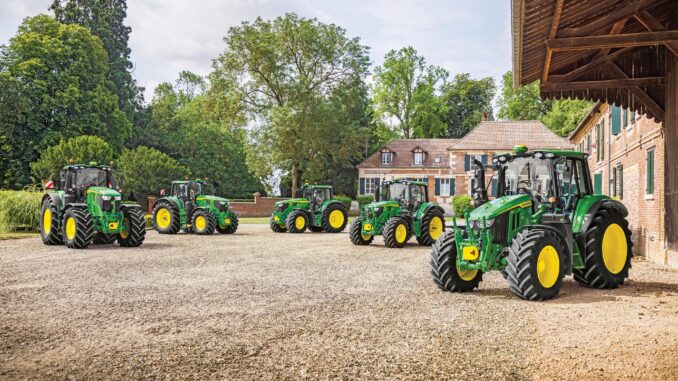
The John Deere 5100m is a utility tractor platform aimed at owners who need more capability than a lawn tractor but still want straightforward routine servicing and fault-finding at owner level. In Deere’s current online literature, the closest documented North American references are the 5100M and 5100E utility tractor lines, with official parts and manual support available through Deere’s parts portal, operator’s manuals, and replacement parts guides.
This guide is written for DIY-minded owners in the USA and Canada who want a practical, symptom-first repair article that covers troubleshooting, maintenance, parts lookup, diagrams, manuals, and realistic boundaries between home repair and dealer work. It is structured for WordPress publication and follows the same owner-focused approach used in established repair-content templates: start with what the operator notices, check the simple items first, then decide whether the repair stays in the shop at home or goes to a Deere dealer.
John Deere 5100m model overview
The John Deere 5100 sits in Deere’s utility tractor range rather than the residential mower category, and official Deere materials show 5100-branded variants in both 5M and 5E families depending on exact model suffix and market. The 5100M quick reference guide identifies a 5M Series tractor with engine, cab, and hydraulic service points, while Deere’s 5100E product page lists a 102 hp utility tractor with PowrReverser transmission options and hydraulic output suited to heavier property, livestock, loader, and field work.
For most owners, the systems that matter most are the engine and fuel system, cooling system, transmission and hydraulics, front axle and steering, PTO, and the electrical starting/charging system. Those are the systems most commonly tied to hard starting, weak running, overheating, hydraulic complaints, charging faults, and drivability issues on utility tractors in this size class.
Common service parts owners regularly look up for a John Deere 5100M include the engine oil filter RE530203, hydraulic filter SJ11784, primary air filter SU20768, secondary air filter RE253519, primary fuel filter RE544391, final fuel filter RE544394, and battery TY25879. Deere’s replacement parts guide also lists related cab air filters, alternator references, and belt references that are useful when planning routine service or a repair order.
Troubleshooting the John Deere 5100m by symptom
The best way to troubleshoot a John Deere 5100 is to begin with the symptom the owner can clearly observe, not with a guessed failed part. A no-start tractor, a tractor that cranks but smokes, a machine that overheats under PTO load, or a tractor that loses hydraulic response all point to different systems and should be diagnosed in that order.
Main symptom groups on this model include starting issues, poor running or low power, overheating and fluid leaks, transmission or hydraulic problems, steering or front axle issues, charging and electrical faults, and unusual vibration or belt noise. Organizing diagnosis this way helps owners avoid ordering parts too early and reduces the chance of missing a blocked filter, loose connection, or overdue maintenance item.
John Deere 5100m emergency repair needs
Some faults on a John Deere 5100 need immediate attention because they can quickly become expensive or unsafe. Stop using the tractor right away if you see a major fuel leak, hydraulic leak under pressure, charging failure combined with warning lights, overheating, steering looseness, brake problems, or a belt failure affecting cooling.
Starting issues
A starting fault usually shows up as no crank, slow crank, or normal cranking with no fire. This matters because repeated cranking can flatten the battery, overheat cables, and hide the real issue if fuel filtration or an electrical interlock is the true cause.
-
Weak or failed battery TY25879 or equivalent fitment issue
-
Dirty or loose battery terminals or ground cable
-
Plugged fuel filter such as RE544391 or RE544394 on a service-overdue tractor
-
Safety interlock, PTO, range, or neutral-start issue requiring manual-based checks
-
Starter or charging-system fault if the battery repeatedly goes flat
-
Confirm PTO is off, transmission/range is in the correct start position, and all start conditions in the operator’s manual are met.
-
Check battery voltage and inspect both terminals and frame grounds for corrosion or looseness.
-
Inspect fuel filter service history; if overdue, replace filters before deeper diagnosis.
-
If the tractor still will not crank or still cranks slowly after battery checks, move toward starter, solenoid, or dealer-level electrical testing.
John Deere 5100m running and low-power problems
When a John Deere 5100 starts but lacks power, surges, smokes, or struggles under load, the issue often points to restricted air or fuel flow, contaminated fuel, or maintenance neglect. Continued use in that condition can overheat the engine, raise soot loading, and make a small service issue feel like a major mechanical failure.
-
Plugged primary air filter SU20768 or secondary air filter RE253519
-
Restricted fuel supply from overdue fuel filters
-
Old fuel or water contamination in the tank
-
Belt or cooling-related drag if overheating accompanies low power
-
Sensor or engine-management faults that need dealer diagnostics
-
Check whether the problem appears only under PTO or drawbar load, which helps separate engine power loss from driveline load issues.
-
Inspect and replace air and fuel filters if service intervals have been missed.
-
Drain suspect fuel or inspect for contamination if the machine has sat for a long period.
-
If warning lamps or persistent derate symptoms remain, book dealer diagnostics rather than guessing at electronic parts.
John Deere 5100m vibration and belt noise
Vibration, squeal, or rattling on a John Deere 5100 should never be ignored because belts, steering components, and rotating assemblies can deteriorate quickly once noise begins. Deere’s 5100M guide specifically identifies belt references and front-end steering components that can be involved in these complaints.
-
Worn or slipping fan-drive belt such as SU22140 or SU23542 depending on configuration
-
Tensioner wear or belt misalignment
-
Loose tie-rod or steering component wear, including RE271437 or related tie-rod-end parts
-
Cab or operator-station hardware looseness
-
Shut the tractor down and inspect belts for glazing, fraying, or contamination.
-
Check visible steering joints and front axle hardware for looseness before further use.
-
Confirm whether the noise changes with engine speed, steering input, or PTO engagement.
-
Replace belts and obvious wear items promptly; unexplained driveline vibration is dealer territory.
Overheating and leaks on the John Deere 5100m
Overheating or visible fluid loss is one of the most urgent John Deere 5100 repair situations because it risks engine, hydraulic, and fire damage. Deere publishes coolant capacities and regular hose-clamp checks in its maintenance procedures, which shows how important the cooling and fluid systems are on this tractor platform.
-
Low coolant level or neglected cooling-system service
-
Loose hose clamps in cooling or hydraulic-related circuits
-
Fan belt problems reducing cooling airflow
-
Engine oil or hydraulic leaks from filters, hoses, or fittings
-
Stop the tractor and allow it to cool before opening the hood or checking coolant.
-
Inspect the fan belt, coolant hoses, and visible clamps for looseness or damage.
-
Check for leaks around the oil filter, hydraulic filter, and hose connections.
-
If overheating repeats after basic checks, do not continue working the tractor until the cause is confirmed.
John Deere 5100m transmission and hydraulic problems
Transmission hesitation, weak hydraulic response, or loader and hitch complaints usually point to fluid condition, filter restriction, or a more advanced hydraulic problem. The 5100M quick reference guide lists a 39.5 L transmission and hydraulic capacity and a hydraulic filter replacement interval, which makes fluid condition a key first check.
-
Low or incorrect transmission/hydraulic oil
-
Overdue hydraulic filter SJ11784
-
Internal hydraulic leak or pressure issue
-
MFWD axle or hub fluid neglect on front-drive units
-
Check hydraulic/transmission fluid level on level ground and confirm the correct oil type from the manual.
-
Replace the hydraulic filter if service history is unknown or overdue.
-
Note whether the problem affects steering, hitch, loader, or transmission equally, because that helps narrow the circuit involved.
-
Pressure-testing and internal transmission diagnosis are usually dealer jobs.
Electrical problems
Electrical faults on a John Deere 5100 often show up as low charging voltage, intermittent starting, dead lights, or repeated battery drain. Deere lists alternator options and battery references in the parts guide, but diagnosis still needs to begin with wiring condition and charging output rather than immediate parts replacement.
-
Failing battery TY25879
-
Alternator fault, with Deere listing DZ123153 and RE554568 options in the 5100M guide
-
Loose grounds, corroded terminals, or damaged wiring
-
Safety-switch or control-circuit issue
-
Test battery state first and inspect cable condition.
-
Check charging voltage with the engine running.
-
Inspect fuses, grounds, and harness plugs before ordering expensive components.
-
Use dealer diagnostics if the issue involves electronic control logic or repeated charging failures.
DIY vs dealer for the John Deere 5100m
The normal line on a John Deere 5100 is simple: owner DIY work makes sense for scheduled service, basic bolt-on parts, and visual diagnosis, while dealer or advanced independent repair is the safer route for electronic diagnostics, internal hydraulic work, clutch or transmission repairs, and anything requiring pressure tests or split-tractor procedures. That boundary matters because the 5100 is a utility tractor with higher system complexity than a lawn tractor, especially in hydraulics, drivetrain, and emissions-era engine controls.
Good DIY jobs
-
Engine oil and oil filter replacement using the correct service interval and filter reference
-
Primary and secondary air filter service
-
Fuel filter replacement and fuel-quality checks
-
Battery replacement, terminal cleaning, and basic charging checks
-
Cab fresh-air or recirculation filter replacement where fitted
-
Basic fan belt inspection and straightforward replacement where access is clear
Advanced DIY or dealer jobs
-
Starter, alternator, and wiring diagnostics when the fault is intermittent
-
Hydraulic pressure testing, valve diagnosis, and transmission issues
-
Front axle, steering cylinder, and brake repairs beyond simple inspection
-
Emissions-related or electronic engine derate problems
-
Cab HVAC repairs beyond filter service
Skill level guide
-
Beginner: Filters, battery, visual inspections, fluid-level checks, simple belt inspection
-
Intermediate: Oil service, fuel filter bleeding procedure from the manual, accessible belt replacement, cab filter service
-
Advanced: Charging-system diagnosis, steering-part replacement, cooling-system repairs, any repair that needs torque specs and service-manual procedures
John Deere 5100m parts, OEM numbers, and ordering details
Before ordering John Deere 5100 parts, gather the full model designation, Product Identification Number (PIN), engine model and serial number, and any configuration details such as cab versus open operator station, MFWD versus 2WD, and transmission type. Deere supports parts lookup through its official parts site and manuals, and those configuration details often determine the correct belt, filter, or electrical part.
OEM parts are the safer choice for belts, hydraulic filters, steering parts, brake parts, and any safety- or fit-sensitive item because Deere designs those around the tractor’s exact configuration. Aftermarket parts are usually more acceptable for consumables like some batteries and filters, but only when the seller clearly cross-references the Deere number and your exact John Deere 5100 variant.
John Deere 5100m diagrams and manuals
Owners looking for diagrams and manuals should begin with Deere’s own operator and parts resources, then use a reputable Deere-focused catalog for exploded views. Deere’s parts site, operator manual portal, and quick reference guides are the most useful first stops because they connect maintenance intervals, part references, and ordering paths in one system.
-
John Deere Parts portal – official Deere parts entry point for catalog lookup, shopping, and dealer-supported parts search
-
John Deere operator manuals portal – useful for operating instructions, service intervals, controls, and safety checks on 5100M-family tractors
-
5100M replacement parts guide PDF – quick service-reference sheet with commonly replaced part numbers and capacities
-
777parts John Deere 5100M catalog – aftermarket-friendly exploded parts navigation for model-specific assemblies
Use the operator’s manual for maintenance intervals, capacities, and control/safety information, and use the parts catalog when you need diagram-based confirmation of what physically fits your tractor. For major repairs, Deere technical publications or dealer service information are still the better option because quick guides do not replace full repair procedures.
How to identify your John Deere 5100m
Correct identification matters because Deere used 5100 branding across more than one utility tractor family, and even within a family the correct part can change by serial range, cab type, axle, and charging-system specification. Ordering by appearance alone is risky on utility tractors, especially for belts, alternators, steering parts, and filtration components.
-
Find the tractor’s Product Identification Number plate on the main frame area identified in your operator literature or by your dealer.
-
Write down the full model designation exactly as shown, such as 5100M or 5100E, rather than using only “5100”.
-
Record whether the tractor is cab or open station and whether it is 2WD or MFWD, because Deere lists different related parts by configuration.
-
Locate the engine model and serial number on the engine data label before ordering engine filters, belts, or charging parts.
-
Keep photos of the tags and your current part numbers, which helps when buying online or at the dealer counter.
Buying John Deere 5100m parts online and in stores
The smart strategy is to identify the Deere OEM number first, then compare price and availability. That avoids the common mistake of buying a part that matches the model name but not the tractor’s exact configuration or serial range.
-
Online: Best for comparing OEM numbers, checking guide references, and finding stock before ordering; start with Deere’s official parts site and then compare with model-specific catalog sellers such as John Deere Parts, 777parts, and Cross Implement manuals
-
Dealer counter: Best for serial-specific parts, steering or brake components, electrical parts, and any item where Deere supersessions may apply
-
Retail stores: Fine for common consumables such as batteries or some filters only if the packaging clearly cross-references the Deere OEM number and the exact 5100 variant
Fitting common John Deere 5100m service parts
These are the DIY jobs with the best payoff for reliability on a John Deere 5100. Exact access and procedure can vary by configuration, so always compare the steps below against the operator’s manual for your specific tractor.
Replacing the John Deere 5100m engine oil filter
This service helps protect the engine and is part of Deere’s regular maintenance schedule. Deere lists RE530203 as the engine oil filter in the 5100M replacement parts guide.
-
Warm the engine briefly, park on level ground, shut down, and remove the key.
-
Drain the engine oil into a suitable container according to the manual procedure.
-
Remove the old oil filter and confirm the old gasket is not stuck to the housing.
-
Lightly oil the gasket on the new filter and install it to the manual’s tightening guidance.
-
Refill with the correct oil, start the engine, and check for leaks.
John Deere 5100m air filter replacement
Replacing restricted air filters is one of the fastest ways to restore clean airflow and reduce smoke or power loss. Deere identifies SU20768 as the primary air filter and RE253519 as the secondary element in the 5100M guide.
-
Park safely, open the hood, and locate the air-cleaner housing.
-
Remove the outer filter first and inspect the housing for dust buildup.
-
Replace the inner safety element if dirty or if service history is unknown.
-
Clean the housing sealing surfaces carefully and install the new elements in the correct order.
-
Refit the cover securely and inspect the intake path for loose clamps.
Replacing John Deere 5100m fuel filters
Fresh fuel filters can solve hard starting, hesitation, and low-power complaints caused by restricted fuel flow. Deere lists several fuel filter references, including RE544391 for a primary filter and RE544394 for a final filter on the 5100M guide.
-
Shut the tractor down safely and clean around the filter housings before opening the system.
-
Remove the old filters and make sure the old seals come away with them.
-
Install the new filters with clean fuel or lubricant on the seals if specified in the manual.
-
Prime or bleed the fuel system using the approved manual procedure for your tractor.
-
Start the engine, check for leaks, and confirm the engine runs cleanly under load.
John Deere 5100m battery replacement and cable cleanup
Battery and cable condition are at the center of many no-start complaints. Deere lists TY25879 in the 5100M parts guide, but confirm physical size and terminal layout before ordering.
-
Shut the tractor off and remove the key before touching the battery.
-
Disconnect the negative cable first, then the positive cable.
-
Clean the cable ends and inspect the ground connection to the frame or engine.
-
Install the replacement battery, connect positive first and negative last, and secure the hold-down.
-
Test starting and charging voltage so you do not mistake a charging fault for a battery-only problem.
John Deere 5100m maintenance to prevent repeat problems
Good maintenance on a John Deere 5100 is mostly about staying ahead of filter restriction, fluid degradation, and cooling or belt issues. Deere’s published service intervals for the 5100M family emphasize oil, hydraulic, fuel, air, belt, and hose-clamp attention because those items directly affect reliability and operating cost.
-
Starting reliability: Keep battery terminals clean, replace overdue fuel filters, and do not ignore slow cranking
-
Engine performance: Service air and fuel filters on time and watch for contaminated fuel after storage
-
Overheating prevention: Inspect belts, hose clamps, and coolant condition regularly
-
Hydraulic performance: Check fluid level and change the hydraulic filter at Deere’s interval
-
Electrical reliability: Track charging behavior before the battery repeatedly goes flat
John Deere 5100m maintenance schedule
The exact schedule depends on the variant and year, but Deere’s 5100M maintenance references provide a practical baseline for routine owner care. The quick reference guide and maintenance excerpts point especially to first-100-hour service items, 250-hour cab-filter items, 500-hour engine oil, fuel, and hydraulic service, 600-hour hose-clamp and cab-air service, and longer-interval belt and tank-related tasks.
Daily or before each use
-
Check engine oil level and visible leaks before starting work
-
Check coolant level and inspect for hose or belt problems
-
Inspect tires, steering response, and brakes before road or field use
-
Watch instrument warnings and unusual noises on startup
First 100 hours
-
Change engine oil and oil filter at the first service point if specified for your variant
-
Change the hydraulic filter at the first 100-hour interval on the 5100M guide
-
Recheck for leaks, loose hardware, and belt condition after initial break-in use
Every 250 hours
-
Replace activated carbon cab filters where equipped
-
Inspect related cab air-filtration components for dirt or damage
-
Check operator-station intake areas for blockage
Every 500 hours or yearly
-
Change engine oil and oil filter
-
Replace primary and final fuel filters
-
Change the hydraulic filter
-
Review overall fluid condition and leaks before the next heavy-use season
Every 600 hours
-
Tighten air-intake and coolant-system hose clamps
-
Clean or service fresh-air and recirculation filters where fitted
-
Inspect surrounding cooling and intake components while access is open
Every 1200 hours
-
Replace fan belts and inspect tensioners as required
-
Clean the fuel tank vent filter
-
Carry out longer-interval fluid and chassis checks listed for the configuration
Seasonal checklist
-
Spring or preseason: Check battery condition, service filters, inspect belts, and confirm fluid levels before heavy work resumes
-
Mid-season: Inspect for dust-loaded air filters, hose-clamp looseness, and early hydraulic leaks
-
Fall or end-of-season: Replace overdue filters, address leaks, and stabilize storage fuel condition before long downtime
Repair, upgrade, or replace the John Deere 5100m?
For most owners, a John Deere 5100 is worth repairing when the tractor is structurally sound and the problem is confined to normal service parts, external hydraulics, charging components, or other bolt-on systems. Upgrade or replacement becomes more attractive when repairs move into repeated hydraulic, transmission, or engine-control faults and the machine no longer matches the work you need it to do.
Repair if…
-
The fault is a filter, battery, belt, hose, steering end, or other accessible service item
-
The tractor otherwise starts, drives, and hydraulically performs well
-
The machine fits your workload and parts support remains strong
Upgrade if…
-
You need more hydraulic flow, lift capacity, or modern features than your current configuration provides
-
Cab, axle, or charging-system specification limits the attachments or work pattern you now use
-
Repeated downtime is caused by under-specification rather than one failed part
Replace if…
-
Repair needs are stacking up across engine, transmission, hydraulics, and electrical systems at once
-
The tractor has major structural wear or neglected maintenance history
-
The cost of bringing it back to dependable use is too close to a newer, better-supported machine
John Deere 5100m troubleshooting FAQ
1. Why will my John Deere 5100m not start?
Start with the basics: battery condition, terminal corrosion, PTO disengagement, and correct transmission or neutral-start position. On a utility tractor like the John Deere 5100, an overdue fuel filter or weak charging system can also sit behind a no-start complaint, so battery and fuel-service history matter before deeper diagnosis.
2. Why does my John Deere 5100m crank but not fire?
A crank-no-start fault often points to restricted fuel flow, air in the fuel system after service, contaminated fuel, or a control-related problem. Replacing overdue fuel filters and following the manual’s priming procedure are the first realistic DIY steps before moving to dealer diagnostics.
3. Why is my John Deere 5100m cranking slowly?
Slow cranking usually means weak battery output, dirty cable connections, poor grounding, or a starter drawing too much current. If a freshly charged battery drops again quickly, check charging voltage because the alternator may be the real issue.
4. Why does the John Deere 5100m lose power under load?
Low power under load often comes from a restricted air filter, restricted fuel filters, or fuel contamination. If the tractor also shows warning lights or repeated derate behavior, that pushes the repair beyond normal owner service and toward proper electronic diagnosis.
5. Why is my John Deere 5100m smoking?
Smoke often follows poor airflow, poor fuel delivery, contaminated fuel, or an engine working too hard with another unresolved fault. Begin with air and fuel service items, then evaluate whether the problem happens at startup only or continues under load.
6. Why does my John Deere 5100m overheat?
Overheating can be caused by low coolant, loose hose clamps, poor airflow from belt problems, or general cooling-system neglect. Since Deere specifically calls out coolant capacity, belt service, and hose-clamp inspection in its literature, those are the right first checks.
7. Can I keep using a John Deere 5100m that is overheating?
No, not until the cause is found. Continued use risks engine damage and can turn a simple belt, coolant, or clamp problem into a major repair.
8. Why is there hydraulic oil under my John Deere 5100m?
Hydraulic leaks usually come from hoses, fittings, filters, or seals, and they should be treated seriously because high-pressure leaks are both messy and dangerous. Check the area around the hydraulic filter and visible lines first, but avoid placing hands near suspected pressurized leaks.
9. Why are the hydraulics weak on my John Deere 5100m?
Weak hydraulics often trace back to low oil level, a restricted hydraulic filter, overheated oil, or an internal hydraulic fault. The easiest owner-level step is to confirm fluid level and filter age before assuming a pump problem.
10. Why does my John Deere 5100m transmission feel weak or hesitant?
A hesitant transmission can be tied to low hydraulic/transmission fluid, filter restriction, or a more advanced internal issue. Since the transmission and hydraulics share service importance on this tractor, basic fluid and filter checks come first.
11. Why does my John Deere 5100m battery keep going flat?
Repeated battery discharge usually means the tractor has a charging problem, a poor cable connection, or a battery that has reached the end of its life. Deere lists both battery and alternator references in its 5100M guide, but testing should come before replacement.
12. What battery does a John Deere 5100m use?
Deere’s 5100M replacement parts guide lists TY25879 as a battery reference. You should still confirm fitment by PIN and tray/cable layout because 5100-branded tractors can differ by exact model and configuration.
13. Why is my John Deere 5100m not charging?
A no-charge complaint can be caused by alternator failure, belt slip, damaged wiring, or poor connections at the battery and ground points. The parts guide lists alternator references such as DZ123153 and RE554568, but diagnosis should confirm output before ordering parts.
14. Why is the belt squealing on my John Deere 5100m?
Squeal usually means belt wear, contamination, loss of tension, or pulley misalignment. Deere’s guide identifies separate fan-drive belt references for different configurations, which is why exact model details matter before replacement.
15. What fan belt does a John Deere 5100m use?
In Deere’s 5100M guide, SU22140 is listed for open operator station and SU23542 for cab configuration fan-drive applications. Verify against your exact tractor because not every John Deere 5100 shares the same station or accessory setup.
16. Why is my John Deere 5100m hard to steer?
Hard steering can point to low hydraulic oil, front-axle or steering-component wear, or a broader hydraulic problem. If the steering issue appears together with weak loader or hitch performance, the hydraulic system deserves priority in diagnosis.
17. What steering parts commonly wear on a John Deere 5100m?
Deere’s 5100M guide lists steering-related parts including tie rod RE271437 and tie rod end RE271440. Those references are useful starting points, but steering repairs should always be confirmed by exact axle configuration and PIN.
18. Why does my John Deere 5100m have excessive vibration?
Excess vibration can come from belt issues, loose steering or axle parts, operator-station hardware, or other rotating components. Any vibration that is getting worse should be investigated before further work because secondary damage can develop quickly.
19. Which oil filter fits the John Deere 5100m?
The Deere 5100M replacement parts guide lists RE530203 as the engine oil filter. Because Deere used 5100 branding across multiple variants, owners should still verify the exact tractor before ordering.
20. Which hydraulic filter fits the John Deere 5100m?
For the 5100M quick reference guide, Deere lists hydraulic filter SJ11784. That is a good reference point for many 5100M owners, but serial-number confirmation is still the safe move.
21. Which air filters fit the John Deere 5100m?
The 5100M replacement parts guide lists SU20768 as the primary air filter and RE253519 as the secondary air filter. Those are among the most commonly checked service parts when a tractor feels restricted or smoky.
22. Which fuel filters fit the John Deere 5100?
Deere lists RE544391 among the primary fuel filter references and RE544394 among the final fuel filter references in the 5100M guide. Use the tractor PIN and engine details to confirm the right combination before purchase.
23. Can I use aftermarket filters on a John Deere 5100?
Yes, many owners do, but only when the aftermarket brand clearly cross-references the Deere number and the exact tractor variant. OEM is still the safer choice for anything fit-sensitive or where service life and sealing quality are critical.
24. Should I buy OEM belts for a John Deere 5100?
Usually yes. Belts are fit-sensitive, and Deere’s own references differ by tractor configuration, so OEM reduces the risk of length, rib, or tension problems.
25. Where can I find John Deere 5100 parts diagrams?
The best sources are Deere’s official parts portal and model-specific parts catalogs such as 777parts. Use Deere first for OEM confirmation, then compare with aftermarket-friendly diagrams if needed.
26. Where can I get a John Deere 5100 operator’s manual?
Deere provides operator manual access through its manuals portal, and dealer-linked manual sellers also help locate the correct publication. Make sure you are searching the exact model suffix, such as 5100M or 5100E, rather than using only the base number.
27. Is there a service manual for the John Deere 5100?
Full repair information is usually handled through Deere technical publications or dealer service information rather than the quick replacement-parts sheets. For advanced repairs, that technical literature is far more useful than an operator’s manual alone.
28. How often should I change the John Deere 5100 engine oil?
In the Deere 5100M maintenance references, engine oil and filter service is identified at the first 100 hours and then every 500 hours. Always confirm the exact interval in the operator’s manual for your tractor year and variant.
29. How often should I change the hydraulic filter on a John Deere 5100?
The 5100M quick reference guide lists the hydraulic filter for change at the first 100 hours and every 500 hours after that. If service history is unknown, many owners use that as a prompt to inspect fluid condition immediately.
30. How often should I replace the fuel filters on a John Deere 5100?
Deere’s 5100M literature lists fuel-filter replacement every 500 hours. Tractors exposed to contaminated fuel or long storage may need earlier attention if symptoms appear.
31. How often should I clean or replace cab air filters on a John Deere 5100?
Deere lists fresh-air and recirculation filter attention around the 600-hour interval, and activated carbon filters are also listed in related service references. Cab-equipped tractors used in dusty work may need inspection earlier than the maximum interval suggests.
32. What transmission and hydraulic oil capacity does the John Deere 5100 have?
The Deere 5100M replacement parts guide lists approximately 39.5 L (10.4 gal) for the transmission and hydraulic system. Capacity can vary by exact model and configuration, so always confirm in the correct operator literature before filling.
33. What fuel tank capacity does a John Deere 5100 have?
In the 5100M replacement parts guide, Deere lists approximately 142.7 L for open operator station tractors and 165.4 L for cab tractors. Those figures show why exact configuration matters when ordering or planning long workdays.
34. What cooling-system capacity does the John Deere 5100 have?
The 5100M guide lists about 13.5 L for open operator station cooling capacity and 22 L for cab configuration. Those figures should be treated as model-guide references and verified against the specific manual for your tractor.
35. Is the John Deere 5100 a realistic DIY repair tractor?
Yes, for routine service and many external repairs, but not for everything. Filters, battery work, and many belt or inspection tasks are realistic DIY jobs, while internal hydraulic, transmission, and advanced electrical problems are usually better handled by a Deere dealer or experienced farm-equipment technician.
John Deere 5100M vs 5100E feature comparison
The John Deere 5100M is the more heavily built, higher‑spec utility tractor, while the 5100E is the “economy” 100 hp model aimed at lighter, less frequent work and mixed‑user operations. The key differences are in weight/frame size, hydraulics, transmission options, cab/feature level and intended workload.
Positioning and use case
-
5100E sits at the top of the 5E “economy” line (about 50–100 hp range) and targets small farms, ranches and property owners doing material handling, hay, light field and livestock chores.
-
5100M is in the mid‑spec 5M range (roughly 75–130 hp family) with a larger frame and heavier build, aimed at more demanding, often commercial‑grade field, loader and hay work.
-
5E is designed to be more straightforward to operate and is often chosen when multiple operators of mixed experience will use the tractor.
-
5M is closer to a “small row‑crop / heavy utility” spec: more capacity, more transmission choices, more hydraulic flow, and a higher trim level.
Spec and feature overview
Practical differences that matter day‑to‑day
Weight, traction and stability
The 5M frame is physically larger and heavier than the 5E, with up to about 1300 lb difference between series tops; even when comparing 5100E to the closest 5M equivalents, owners report a noticeable step up in mass and stability. That extra weight helps a 5100M keep traction with heavy rear implements and acts as “free ballast” under a loader, where the 5100E will more often need careful ballast management.
Hydraulics and rear lift
Hydraulic flow on the 5M (up to about 25.5 gpm) is higher than on the 5E (around 22.5 gpm), translating into faster loader cycle times and more authority on heavy hydraulic attachments. The rear‑lift contrast is more dramatic: a new‑generation 5100E is around 4600 lb at the 3‑pt, whereas the top 5M model pushes around 7800 lb; although the 5100M sits below the 5130M, the 5M family is clearly aimed at heavier rear implements.
Transmissions and drivability
On 5100E and the 5E line, Deere offers relatively simple gear and PowrReverser boxes that are easy for casual or family operators to grasp. The 5100M and 5M line add more ratios and higher‑spec transmissions such as 16/16 PowrReverser, PowrQuad and Powr8‑type packages, giving tighter ground‑speed selection for baling, mowing and fieldwork, plus more “big‑tractor” features for experienced operators.
Cab, comfort and operator experience
As of Model Year 2024, 5100E buyers can spec a Premium cab straight from Deere, adding features like a sunroof, Bluetooth radio with microphone, front and rear LED work lights, improved seat suspension and more. The 5M series has long been the more refined cab platform and is often praised by owners for better overall fit, finish and cab environment, particularly for full‑time commercial use. For a mixed‑user, “everyone hops on the tractor” scenario, the 5100E’s simpler control layout is often considered a plus.
Choosing between 5100M and 5100E
-
Pick 5100E if you mainly run loader work, hay, bush‑hogging and general farm/property chores, especially with multiple operators and a tighter equipment budget.
-
Pick 5100M if you routinely push heavy 3‑pt or loader implements, spend long days in the seat, or want higher hydraulic performance and more transmission/cab options closer to a row‑crop tractor.