
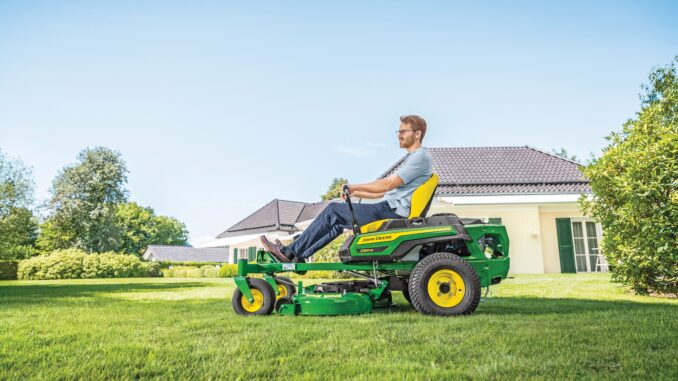
Deck size affects grass health indirectly but meaningfully through weight, ground pressure, deck design, clipping handling, and how often and how fast you mow, rather than simply “bigger cuts worse, smaller cuts better.”
Below is a detailed, practical look at how deck width interacts with turf health for real-world lawns and sports turf.
1. What “deck size” really changes
When you change deck size (say from 42″ to 60″), you are usually changing several other things at the same time, and those are what the grass “feels.”
Key things that scale with deck width:
-
Machine weight and ground pressure
Wider decks often come on heavier chassis, sometimes with larger engines and wider tires. That changes how much each square inch of soil is loaded, which matters for compaction and root health. -
Number and length of blades
A 60″ deck typically runs three longer blades vs two shorter blades on a 42″, which changes blade tip speed balance, airflow, and clipping distribution. -
Deck volume and depth
Larger decks tend to have more internal volume and sometimes deeper shells, which can improve or worsen airflow and clipping processing depending on design. -
Cutting width per pass
Wider decks remove more grass in each pass, so you finish faster and may mow less frequently in practice. That has big implications for stress on the plant. -
Maneuverability and scalping risk
Longer, wider decks bridge more of the ground. On flat ground that’s fine; on undulations, they can scalp high spots or leave low spots uncut.
Grass health is therefore affected by deck size mostly through: soil compaction, mowing height consistency, clipping management, and mowing frequency, not by deck width alone.
2. Soil compaction and turf roots
Heavier decks, wider footprints
Larger decks often ride on heavier machines, especially zero-turns and garden/compact tractors with >54″ decks. Weight itself is not automatically bad; what matters is how it’s distributed.
-
Wide tires or duals can spread load and reduce ground pressure.
-
However, repeated traffic in the same patterns with a heavy machine can compact the upper soil layer, even with wider tires.
Compacted soil leads to:
-
Shallower root systems and reduced rooting volume.
-
Less oxygen in the root zone, more anaerobic conditions.
-
More drought stress, because compacted soil holds water poorly yet can also stay saturated longer after rain.
Small walk-behind or residential riders with 30–42″ decks are typically lighter and put less load on soil, so they’re gentler on root systems—especially on wet or fine-textured soils.
Traffic pattern effects
Large decks on fast zero-turns often encourage operators to mow quickly on the same patterns.
This can:
-
Create worn, compacted tracks on turning areas.
-
Thin turf along the inside of tight zero-turn pivots where wheels scuff the sward.
Best practices with large decks for soil and root health:
-
Vary mowing patterns week to week to distribute traffic.
-
Avoid mowing when soil is saturated, regardless of deck size.
-
Use appropriate tire inflation and as wide a tire as practical for the machine.
On very soft or high-value turf, a smaller, lighter deck/mower is often kinder to the soil, even if it is less productive.
3. Scalping, contour following, and height consistency
Deck width vs ground contour
A wide, rigid deck effectively bridges over small dips and crests in the lawn. On flat ground this allows a very even cut; on uneven ground it can cause scalping of high spots and missed areas in low spots.
-
Large decks (>54″) excel on flat, open lawns with minimal micro-relief.
-
Smaller decks (<48″) tend to follow contours better and are easier to keep from scalping on rolling, bumpy, or heavily landscaped sites.
Scalping (cutting down into the crown of the plant) is harmful for grass health because:
-
It removes too much leaf tissue at once, reducing photosynthesis.
-
It exposes crown and soil, causing desiccation and temperature stress.
-
It weakens plants and opens space for weeds and disease.
Research-based turf recommendations emphasize maintaining an appropriate height-of-cut and avoiding “scalping events” to keep root growth and density high.
Deck size and anti-scalp features
Modern large decks often compensate with:
-
Multiple anti-scalp wheels or rollers along the leading edge and sides.
-
Floating suspension systems where the deck pivots from the tractor or ZTR frame.
When correctly adjusted:
-
A large deck with good anti-scalp rollers can run relatively low without frequent scalping on moderately uneven ground.
-
Poorly adjusted anti-scalp wheels (too high) will negate this advantage, no matter the deck size.
For pure grass health on uneven lawns, a smaller deck usually makes it easier to maintain a consistent height-of-cut across the surface, simply because it bridges less distance and is easier to set up and maneuver.
4. Clipping size, dispersion, and thatch
Deck width, airflow, and clippings
Deck design (baffling, depth, discharge design) drives how clippings are cut, recut, and distributed. Deck size interacts with design:
-
Wider decks generally move and process more biomass per second at a given ground speed.
-
If the deck and engine are sized appropriately, large decks can still mulch finely and spread clippings evenly.
Problems arise when:
-
The deck is too wide for the available horsepower and ground speed, leading to clumping and uncut stringers.
-
Wet or tall grass overloads the deck’s internal airflow, regardless of size, but large decks are more likely to be worked “too hard” to save time.
From a turf health standpoint:
-
Finely chopped clippings that filter into the canopy decompose quickly and recycle nitrogen and organic matter without adding to thatch.
-
Heavy clumps of clippings smother the leaf surface, block light, and can create localized areas of yellowing, disease, or thinning.
Deck size doesn’t directly determine clipping quality, but large decks demand more discipline:
-
Match ground speed to grass density and moisture so the deck can keep up.
-
Use high-lift or mulching blades that suit the deck and conditions.
Thatch and organic loading
Evenly distributed clippings rarely contribute significantly to thatch; thatch is primarily stem and rhizome tissue, not leaves. However:
-
Operators with large decks sometimes mow less often, take heavier cuts, and dump greater organic loads per pass.
-
This can slow decomposition in cool or wet periods, potentially contributing to surface organic buildup in poorly drained soils.
Smaller decks, particularly on autonomous or robotic mowers that cut very frequently at low removal rates, have been shown to improve turf density, uniformity, and green cover by consistently removing small amounts and returning very fine clippings.
5. Mowing frequency, speed, and plant stress
Deck size and mowing habits
The strongest link between deck width and grass health is behavioral: larger decks save time, which often changes mowing frequency and speed.
-
With a 30–42″ deck, homeowners often mow more regularly, because the machine feels “appropriately sized” and the time penalty of missing a week is smaller.
-
With 54–72″ decks on big ZTRs or tractors, operators commonly “stretch” intervals, relying on the large deck to knock down longer grass quickly.
Turf research and extension guidance consistently recommend:
-
Following the “one-third rule”: never remove more than one-third of the leaf blade at a single mowing.
-
Keeping a consistent, species-appropriate mowing height to promote dense, deep-rooted turf.
If a big deck tempts the operator to break the one-third rule regularly, turf health suffers regardless of deck size: more scalping, more stress, and shallower root systems.
Ground speed and cut quality
High forward speeds, which are more common with large commercial decks, can lower cut quality and increase stress if:
-
Blades start pushing grass over instead of cleanly cutting it.
-
Uncut or ragged blades increase evapotranspiration and susceptibility to disease.
Industry guidance suggests slowing down in dense or wet turf to maintain cut quality and reduce mechanical stress on the plant. This is independent of deck size but more critical as decks get wider and operators push for productivity.
6. Lawn size, obstacles, and the “right” deck for health
Deck size recommendations are usually framed in terms of productivity and maneuverability, but these also interact with turf health.
Typical deck width vs lawn size
Common guidelines:
-
Up to 0.5 acre: 30–42″ decks
-
0.5–2 or 3 acres: 42–54″ decks
-
Over 2–3 acres: 54–72″ decks
These ranges balance:
-
Time on turf (more time = more traffic and potential compaction).
-
Ability to mow often enough to keep within the one-third rule.
From a grass-health perspective:
-
On small, intricate lawns with trees and beds, a smaller deck that allows precise trimming and avoids repeated tight turns in the same spots will usually keep turf healthier.
-
On large, open properties, too small a deck may force long mowing times, encouraging infrequent mowing and fatigue-driven patterns that can damage turf.
The healthiest deck size is the smallest one that still lets you maintain your ideal mowing frequency and pattern without operator burnout, on the actual terrain and layout you have.
7. Terrain, thatch, and special cases
Flat, uniform turf
On golf fairways, sports fields, and very flat lawns, wide tri-decks and large gang units can produce extremely uniform height-of-cut when properly set up.
For these surfaces:
-
Deck size per se is not the limiting factor for turf health.
-
Height-of-cut, mowing frequency, and sharpness of blades are more important.
Hilly or highly contoured areas
On steep or rolling ground:
-
Smaller decks reduce scalping and allow safer operation on slopes.
-
Heavier, wide-deck machines may slide, rut, or compact wet slopes.
For grass health on challenging terrain, a smaller, lighter deck is often better, even if it takes more passes.
High-end turf and robotics
Recent studies on autonomous mowers (typically with small decks but high mowing frequency) show:
-
Greater turf quality, density, and green cover compared with conventional mowing at lower frequencies.
-
More uniform turf with fewer weed incursions.
This strongly suggests that mowing frequency and consistency matter more than deck width, and that small decks used very frequently can produce outstanding turf health.
8. Practical guidelines: choosing and using deck size for grass health
When a larger deck helps grass health
Use a larger deck if it allows you to:
-
Mow more often without dreading the time commitment, keeping within the one-third rule.
-
Finish before midday heat or before evening dew, reducing stress and disease pressure.
-
Reduce total traffic hours on the turf by finishing in fewer passes and trips.
Conditions where a large deck is turf-friendly:
-
Relatively flat, open lawns.
-
Firm, well-drained soils that resist compaction.
-
Careful operators who adjust speed to conditions and avoid scalping and clumping.
When a smaller deck is better for turf
Prefer a smaller deck where you need:
-
Better contour following on bumpy or hilly ground to avoid scalping.
-
Lower ground pressure and lighter machines on soft or fine-textured soils.
-
Tight maneuvering among trees, beds, and hardscape without repeated tight turns in the same spot.
Conditions where a small deck is clearly healthier:
-
Delicate, high-value lawns where any scalping or rutting is unacceptable.
-
Early spring or wet conditions where heavy machines would compact the soil.
Operator practices that matter more than width
Regardless of deck size, grass health depends heavily on:
-
Correct height-of-cut for the species and season, avoiding scalping.
-
Mowing frequency to respect the one-third rule.
-
Sharp blades for clean cuts and reduced leaf shredding.
-
Pattern rotation to spread traffic and reduce compaction lanes.
-
Proper clipping management, avoiding clumps and smothering.
Deck size shapes the context for these choices but does not override them.
9. Example scenarios
-
A 1-acre, moderately bumpy suburban lawn:
A 42–48″ deck on a light lawn tractor or walk-behind allows good contour following, manageable mowing time, and low compaction, supporting dense turf if you mow weekly at the right height. -
A 4-acre, open, flat rural lawn:
A 60″ or 72″ deck on a zero-turn reduces time dramatically, making it realistic to mow every 5–7 days within the one-third rule. If you vary your patterns and avoid mowing wet, turf can be very healthy. -
A small, intricate formal garden:
A 21–30″ mower or robot with high frequency, small clipping removal, and light weight will usually give the healthiest turf and best appearance, despite the tiny deck.
If you tell me your typical lawn size and how often you’re realistically willing to mow, I can suggest a specific deck width range and setup that will maximize grass health on your property.
How to maintain sports turf and need top cut quality
1. Reel vs rotary for top cut quality
-
Reel mowers give a scissor-like cut at the bedknife, producing a very clean leaf tip that heals quickly and is less prone to disease.
-
At low heights of cut (typical for elite football, rugby, cricket squares, and fine warm-season pitches), reels almost always out-perform rotaries in visual quality and ball roll.
-
Rotaries cope better with higher heights, weedier or slightly uneven turf, and “renovation” cuts, but they shred the leaf more at fine heights.
For “top” sports surfaces at low to medium heights, reel is usually the primary mowing solution, with rotary as a support tool for longer roughs, surrounds, and renovation passes.
2. Deck width on sports fields
-
Large sports complexes that do not need very low cutting heights (e.g., community multi-use fields) often use wider rotary or reel decks to improve work rate.
-
Where turf is cut low and must be very true (elite football, rugby, high-end cricket outfields), manufacturers recommend multi-deck reel or contour rotary mowers that follow undulations and minimize scalping.
A wide cutting width is helpful for productivity, but on undulating pitches you want multiple smaller floating heads (e.g., 5–7 gang reels or contour decks) rather than one huge rigid deck, so each unit follows the surface and keeps the height-of-cut truly uniform.
3. Height of cut and frequency (more important than width)
-
Sports-field BMPs stress that height-of-cut (HOC) and mowing frequency are the biggest drivers of turf density, recovery, and playability.
-
General sports-pitch guidance: follow the one-third rule (never remove more than one-third of the leaf at a time) and mow frequently enough to maintain a consistent HOC.
-
For football-type pitches, guidelines typically recommend around 20–35 mm depending on species and level of play, with 2× weekly in peak growth and at least weekly otherwise.
Whatever deck width you run, if it allows you to hit your target HOC and mowing frequency consistently, turf health and surface quality will be high; if it tempts you to leave too long between cuts, quality suffers.
4. Practical recommendations
-
For elite or high-standard natural grass pitches with low HOC targets, prioritize a reel-based triplex / 5‑gang / 7‑gang configuration rather than a single wide rotary deck; use width via multiple narrow heads, not one big shell.
-
For larger, multi-use fields kept at higher heights (e.g., 30–40+ mm), a wide contour rotary with floating decks can be acceptable and efficient, but you still need good contour-following and sharp blades.
-
Control quality primarily through: correct HOC for the sport/grass, frequent mowing within the one-third rule, pattern rotation, and blade/reel sharpness.