
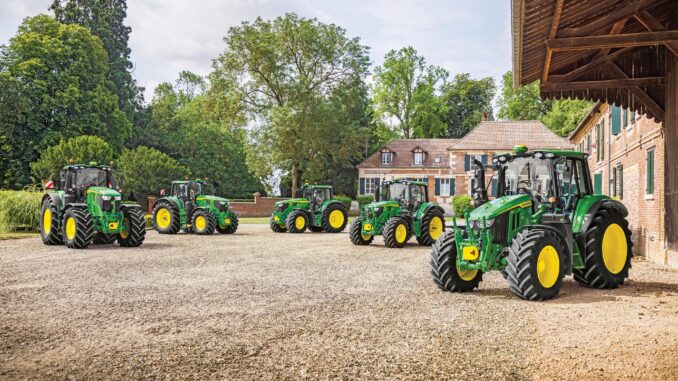
The John Deere 6410 is a utility tractor from Deere’s 6010 Series, aimed at owners who need a practical machine for loader work, mowing, hay, transport, and general property or farm tasks rather than a simple lawn tractor. Official Deere operator literature groups the 6410 with the 6010/6110/6210/6310 tractors, confirming its place in that lineup and making it clear that owners need tractor-focused maintenance habits rather than lawn-and-garden routines.
This guide is written for DIY-minded owners in the USA and Canada who are comfortable handling routine service and some intermediate repairs. It covers the John Deere 6410 parts owners commonly replace, where to find diagrams and manuals, how to troubleshoot by symptom, which jobs are realistic at home, and which repairs usually make more sense for a dealer or diesel tractor shop.
John Deere 6410 overview
The John Deere 6410 sits in the 6010 tractor family and shares its documentation platform with the 6010, 6110, 6210, and 6310. That matters because many service references, operator procedures, and maintenance intervals are published across the family rather than on a one-page model sheet.
For repair planning, the main systems to think about are the diesel engine and fuel system, the air intake and filtration system, the hydraulic and transmission filtration system, the PTO-related service points, the cab ventilation filters on cab-equipped tractors, and the basic electrical and starting circuits. Owners buying service parts most often look for engine oil filters, fuel filters, air filters, hydraulic filters, transmission filters, and cab filters rather than mower belts or lawn tractor blades because the 6410 is a true utility tractor platform.
Common service parts owners regularly buy for the John Deere 6410 include the engine oil filter RE59754, engine pre-fuel filter RE509208, engine fuel filter RE62419, engine main air filter AL78223, engine safety air element AL78224, hydraulic oil filter AL156625 or RE34958 depending on hydraulic pump specification, and front PTO oil filter L114404 where equipped.
John Deere 6410 troubleshooting approach
The smartest way to diagnose a John Deere 6410 is to start with the symptom the owner can actually see, hear, smell, or feel. A no-start, low power complaint, hydraulic weakness, warning light, unusual noise, or fluid leak gives a better repair path than changing parts at random.
Main symptom groups on this model usually include:
-
Starting issues, such as slow cranking, no crank, or crank-no-start.
-
Running issues, such as rough idle, smoke, stalling, weak power, or fuel starvation.
-
Hydraulic and transmission complaints, such as slow loader response, weak steering, poor shifting, or filter restriction concerns.
-
Electrical problems, such as battery drain, charging trouble, failed lights, and intermittent switches.
-
Overheating, leaks, and contamination problems involving engine oil, fuel, coolant, or hydraulics.
-
Cab-air and operator environment complaints on cab tractors, including poor airflow and restricted filters.
John Deere 6410 immediate repair needs
Some John Deere 6410 problems should not be put off because they can quickly damage major components or create a safety risk. Shut the tractor down and investigate immediately if you have low oil pressure, major hydraulic leakage, overheating, brake or steering loss, fuel leaks, or severe driveline noise.
Starting issues
When a John Deere 6410 will not crank or cranks slowly, the immediate concern is often battery condition, cable condition, or the starter circuit. Continued attempts to crank with weak voltage can overheat cables, stress the starter, and hide the real fault.
Common causes:
-
Weak or discharged battery.
-
Dirty or loose battery terminals or ground points.
-
Faulty starter, relay, or ignition-switch circuit.
-
Safety or neutral-start circuit problems, depending on equipment configuration.
Basic owner checklist:
-
Confirm battery voltage and inspect both terminals for corrosion.
-
Check the ground strap and main starter cable for heat damage or looseness.
-
Verify the tractor is in the correct start condition and all controls are in neutral or park as required.
-
If it clicks but does not crank, stop repeated attempts and test the battery and starter circuit properly.
John Deere 6410 running issues
A John Deere 6410 that starts but runs rough, loses power, or stalls under load often points to fuel delivery or air intake restriction before anything more exotic. On this model, the regular replacement schedule for pre-fuel, main fuel, and air filters is a strong clue that filtration is a high-impact maintenance area.
Common causes:
-
Restricted pre-fuel or main fuel filter.
-
Dirty main air filter or neglected safety element.
-
Contaminated diesel fuel.
-
Poor maintenance history leading to overdue oil and filter service.
Basic owner checklist:
-
Check service records and confirm when the fuel filters were last changed.
-
Inspect the air filter housing and service the primary element only within Deere guidance.
-
Drain or sample fuel if water or contamination is suspected.
-
If power loss continues under load, move on to proper fuel-pressure and injector diagnosis rather than guessing.
John Deere 6410 vibration and noise
New vibration, rattling, or driveline noise should be treated seriously because utility tractors can turn a small bearing or coupling fault into a larger failure quickly. Noise that changes with engine speed, PTO engagement, or movement helps narrow down whether the problem is engine-related, driveline-related, or hydraulic-related.
Common causes:
-
Loose shields, brackets, or mounting hardware.
-
PTO-related wear on equipped tractors.
-
Engine accessory or intake-related looseness.
-
Internal transmission, hydraulic, or driveline wear requiring deeper inspection.
Basic owner checklist:
-
Park safely and inspect visible shields, steps, brackets, and front-end attachments.
-
Check whether the noise appears at idle, under load, in motion, or only with PTO use.
-
Inspect fluid levels and look for metal contamination during scheduled filter changes.
-
Stop using the tractor if the noise is heavy, grinding, or accompanied by loss of function.
John Deere 6410 overheating and leaks
Overheating and fluid leaks are high-priority issues on the John Deere 6410 because the engine, hydraulics, and cooling system all depend on clean, stable fluid levels. A neglected leak can also contaminate belts, hoses, wiring, and nearby seals.
Common causes:
-
Low engine oil, coolant, or hydraulic fluid.
-
Dirty cooling package or restricted airflow.
-
Old filters causing added system restriction.
-
Damaged hoses, seals, or filter gaskets.
Basic owner checklist:
-
Check engine oil, coolant, and hydraulic levels before restarting.
-
Inspect around filters, hoses, and connections for fresh wetness.
-
Clean the radiator area and screens carefully if debris buildup is present.
-
Do not keep operating a hot tractor just to finish the job.
John Deere 6410 transmission and hydraulic problems
Many owners describe transmission or hydraulic trouble as weak steering, poor loader lift, jerky response, or shifting concerns. The 6410 maintenance references show hydraulic and transmission filters as critical service items, with first-change and repeated service intervals that should not be ignored.
Common causes:
-
Overdue hydraulic oil and filter service.
-
Wrong filter for the tractor’s hydraulic pump configuration.
-
Contaminated oil or low oil level.
-
Internal wear requiring pressure testing and dealer-level diagnosis.
Basic owner checklist:
-
Confirm which hydraulic pump setup the tractor has before ordering parts.
-
Check hydraulic oil level and inspect the condition of the oil.
-
Review whether the first 100-hour and later 750-hour filter intervals were followed.
-
If steering, brakes, hitch, or loader are weak together, stop and test system pressure rather than swapping random parts.
Electrical problems
Electrical faults on the John Deere 6410 usually show up as no-crank, weak charging, dead lights, bad gauges, or intermittent operation. Because tractors work in vibration, dust, and moisture, simple terminal, ground, and connector issues are often the first things worth checking.
Common causes:
-
Corroded battery terminals or grounds.
-
Weak battery or charging issue.
-
Damaged wiring near high-vibration areas.
-
Switch or relay faults that need meter testing.
Basic owner checklist:
-
Load-test the battery instead of relying only on a surface voltage reading.
-
Clean and tighten battery and ground connections.
-
Check fuses, relays, and obvious harness damage.
-
Move to wiring diagrams and meter-based diagnosis if the fault is intermittent.
DIY or dealer jobs on the John Deere 6410
The John Deere 6410 is very workable for routine service and basic repairs, but it is still a diesel utility tractor with hydraulic, driveline, and electrical systems that can become expensive quickly if guessed at. As a rule, routine filtration, fluid service, visual inspections, and straightforward component replacement are realistic DIY jobs, while internal transmission, hydraulic pressure diagnosis, injector work, and major electrical tracing are better handled by an experienced tractor technician.
Good DIY jobs
-
Engine oil and filter changes.
-
Fuel filter replacement and basic fuel-system bleeding if specified in the operator literature.
-
Main air filter service and safety element replacement at the correct interval.
-
Cab air and recirculation filter replacement on cab tractors.
-
Hydraulic and transmission filter replacement when the correct spec is confirmed first.
-
Battery, terminal, fuse, and basic lighting work.
Advanced DIY or dealer jobs
-
Starter-circuit diagnosis beyond basic voltage-drop checks.
-
Hydraulic pressure testing and low-flow diagnosis.
-
Internal transmission or PTO repairs.
-
Injector, pump, or deeper diesel fuel-system work.
-
Any repair that requires technical manual test procedures or special tools.
Skill level guide
-
Beginner: filters, battery service, visual inspections, fluid checks.
-
Intermediate: engine oil service, fuel filter changes, cab filter replacement, minor electrical checks.
-
Advanced: hydraulic filter service with spec verification, no-start diagnosis with a meter, PTO-related service, pressure testing prep.
John Deere 6410 parts you need before ordering
Before ordering John Deere 6410 parts, gather the full model name, the tractor Product Identification Number, the engine model and serial number, and details about any configuration that changes the part fit. That last point matters because even within the 6410 maintenance listings, Deere-related parts sellers separate hydraulic filters by pump specification and list cab versus non-cab filter options.
Use this basic checklist before buying:
-
Full model: John Deere 6410.
-
Product Identification Number or serial identification from the tractor.
-
Engine model and serial from the engine data plate.
-
Cab or non-cab configuration, plus any special hydraulic or PTO equipment.
OEM parts are usually the safest choice for filters tied to service intervals, hydraulic and transmission filtration, and any fit-sensitive or safety-related component because Deere’s schedules and cross-references are built around those specifications.
Aftermarket parts can make sense for some consumables, but only when the cross-reference is exact and the seller clearly states compatibility with the John Deere 6410 and the relevant engine or hydraulic configuration. On a utility tractor, saving a little money on the wrong hydraulic or fuel filter can cost far more later.
John Deere 6410 diagrams and manuals
Owners looking for John Deere 6410 diagrams and manuals should start with Deere’s official manual system and parts portal, then use a Deere-focused parts site for quick part-number lookups. Those sources serve different purposes, so using all of them together is usually faster than relying on just one.
Recommended sources:
-
John Deere operator manual portal for official operating and maintenance instructions covering the 6410 within the 6010 family.
-
John Deere parts page / catalog access for OEM parts lookup, diagrams, and dealer-connected part searches.
-
Green Farm Parts 6410 maintenance guide for a quick service-parts list and interval summary tied to the 6410.
-
Deere filter overview PDF for filter intervals and replacement guidance across the 6010 Series, including the 6410.
Use the operator manual for routine service, controls, capacities, and general maintenance intervals. Use the parts catalog when you need exploded diagrams, superseded part numbers, or serial-sensitive fit confirmation.
How to find John Deere 6410 serial and engine numbers
These numbers matter because tractors often change parts by serial break, engine version, cab equipment, or hydraulic specification. A John Deere 6410 owner who orders only by the hood decal is much more likely to get the wrong filter or configuration-specific part.
-
Park the tractor safely, shut it off, and clean any dirt from identification plates before reading them.
-
Locate the tractor Product Identification Number plate on the machine frame or identification area described in the operator manual.
-
Record the full model and serial information exactly as stamped, not from memory.
-
Find the engine serial and model information on the engine data plate and photograph it for future parts orders.
-
Confirm whether the tractor is cab or non-cab and whether it has front PTO or hydraulic options that affect filter selection.
Buying John Deere 6410 parts
The best buying strategy is to use official Deere information to confirm the correct OEM number first, then compare price and availability across trusted sellers. That approach is especially important on the 6410 because some maintenance items split by hydraulic pump or cab configuration.
-
Online: verify the OEM number, cross-check by PIN or serial if possible, and avoid listings that mention only a broad 6000-series fit with no details.
-
Dealer counter: best for hydraulic, transmission, electrical, and serial-sensitive parts where the parts advisor can confirm fit from the tractor record.
-
Retail stores: acceptable for generic consumables only when the packaging clearly cross-references the exact OEM number and the John Deere 6410 application.
Useful buying links:
John Deere 6410 fitting guide
These are four of the most useful DIY service jobs on a John Deere 6410 because they address the failures owners see most often: hard starting, poor running, restricted airflow, and overdue fluid service. Always confirm the exact part number against the tractor serial and configuration before fitting anything.
Changing the John Deere 6410 engine oil and filter
This job supports engine life and addresses one of the most basic overdue-service issues on the tractor. The 6410 maintenance guide lists the oil filter as a routine item, with the first change at 100 hours and then regular 250-hour replacement intervals.
-
Warm the engine briefly so the oil drains more completely, then park safely and shut the tractor off.
-
Drain the old engine oil into a suitable container and remove the old RE59754 oil filter.
-
Lightly oil the new filter gasket, install the new filter, and tighten it correctly.
-
Refill with the correct engine oil specified in the operator literature, then start and recheck for leaks.
-
Record the hours so the next interval is easy to track.
Replacing John Deere 6410 fuel filters
This is a high-value service job when the tractor has hard starting, weak power, or signs of fuel starvation. The 6410 service list identifies both a pre-fuel filter and a main fuel filter as regular 500-hour items.
-
Clean around the filter bases before loosening anything so dirt cannot enter the fuel system.
-
Remove the old pre-fuel filter RE509208 and main fuel filter RE62419 if both are due.
-
Install the new filters with clean seals and correct tightening.
-
Prime or bleed the fuel system using the approved procedure in the operator manual.
-
Start the tractor and check carefully for leaks or air-entry symptoms.
Servicing the John Deere 6410 air filters
A restricted intake can cause poor performance, smoke, and avoidable engine wear. Deere-related service references list the main air filter and safety element as long-interval items, but they should still be inspected whenever performance drops or dusty conditions are severe.
-
Open the air-cleaner housing carefully and inspect the main element AL78223.
-
Service or replace the primary element only within Deere’s guidelines; do not damage the sealing surfaces.
-
Replace the safety element AL78224 on schedule rather than trying to clean it.
-
Wipe the housing clean, reassemble correctly, and make sure all clamps seal fully.
-
Check the intake path for loose hoses or unfiltered air leaks.
Replacing John Deere 6410 hydraulic filters
This job matters when preserving steering, hitch, remote, and transmission performance. The maintenance listing shows a first hydraulic filter change at 100 hours, then 750-hour service, but the correct filter depends on pump specification.
-
Confirm whether the tractor uses the AL156625 or RE34958 hydraulic filter before ordering.
-
Lower implements, relieve hydraulic pressure as instructed, and clean the area around the filter base.
-
Remove the old hydraulic filter, inspect the gasket surface, and fit the new filter correctly.
-
Top up with the correct oil if needed and run the tractor long enough to circulate the system.
-
Recheck for leaks and verify steering and hydraulic response before returning to work.
Preventing John Deere 6410 repeat failures
Most repeat problems on a John Deere 6410 come back to missed service intervals, dirty fuel or air, ignored filter restrictions, and small leaks that were left too long. The official maintenance pattern around oil, fuel, air, hydraulic, transmission, and cab filtration makes it clear that this tractor rewards consistent routine service.
Focus areas:
-
Starting reliability: keep the battery, terminals, and fuel filters in good order.
-
Running quality: do not stretch air and fuel filter intervals once symptoms begin.
-
Overheating prevention: keep the cooling package clean and investigate leaks early.
-
Hydraulic performance: use the correct filter for the tractor specification and keep oil clean.
-
Cab and operator comfort: replace recirculation and fresh-air filters on schedule if cab-equipped.
John Deere 6410 maintenance schedule
The John Deere 6410 service pattern includes first-service items at 100 hours, repeated engine oil service at 250 hours in standard conditions, fuel filter service at 500 hours, hydraulic-related service at 750 hours, and long-interval air and cab filter replacement at 1500 hours or two years depending on the component. Exact procedures and capacities should always be checked against the official operator and technical literature for the tractor’s configuration.
Daily or before each use
-
Check engine oil level.
-
Check coolant and hydraulic fluid levels.
-
Look for fuel, oil, or hydraulic leaks around the tractor.
-
Check for dirty screens, obvious airflow restriction, or loose wiring.
After first 100 hours
-
Replace the engine oil filter and perform the initial engine oil service listed for the 6410.
-
Replace the initial hydraulic oil filter according to the service listing.
-
Replace the transmission oil filter at the first-change interval shown in the 6010 filter overview.
Every 250 hours or yearly
-
Change engine oil and replace the engine oil filter under the standard interval noted in Deere’s filter overview when extended conditions are not met.
-
Inspect the air intake and cooling system for restriction or contamination.
-
Review battery, cable, and terminal condition.
Every 500 hours
-
Replace the engine pre-fuel filter RE509208.
-
Replace the engine fuel filter RE62419.
-
Where applicable, replace activated carbon cab filters at the listed interval.
-
Some extended oil-service conditions also reference 500-hour intervals only when Deere’s stated oil and fuel requirements are met.
Every 750 hours
-
Replace the hydraulic oil filter according to the 6410 parts guide.
-
Replace the transmission oil filter according to the 6010 Series filter overview.
-
Replace front PTO oil filter L114404 on equipped tractors.
Every 1500 hours or two years
-
Replace the main engine air filter AL78223.
-
Replace the safety air element AL78224 according to the long-interval guidance.
-
Replace applicable cab air, fresh-air, and recirculation filters on cab tractors.
Seasonal checklist
-
Spring or busy-season start: change overdue oil and filters, inspect hoses, and verify battery health before heavy use.
-
Mid-season: clean cooling and intake areas more often in dusty work.
-
Fall or storage prep: fix leaks, replace due filters, and avoid storing the tractor with known fuel or electrical faults.
Repair, upgrade, or replace the John Deere 6410?
A John Deere 6410 is usually worth repairing when the tractor is structurally sound, starts and drives well overall, and mainly needs deferred service or normal wear items. Upgrade decisions make more sense when the tractor still fits the job but needs comfort, hydraulic capability, or attachment-related improvements, while full replacement is the better path when major engine, transmission, or hydraulic failures stack up on a machine with poor overall condition.
Repair if:
-
The issue is mainly filters, fluids, battery, hoses, seals, or other service items.
-
The tractor is otherwise dependable and hours are reasonable for its condition.
-
You can verify parts and do the work safely.
Upgrade if:
-
You need better hydraulic capability, cab comfort, or PTO-related functionality than the current setup provides.
-
The base tractor is solid but your work has changed.
-
Accessory or configuration improvements solve the problem more cheaply than changing tractors.
Replace if:
-
The tractor has serious engine, hydraulic, and transmission issues at the same time.
-
Identification is unclear and parts support is becoming difficult for the exact configuration.
-
Repair cost is approaching the value of a better-condition replacement tractor.
John Deere 6410 troubleshooting FAQ
1. Why will my John Deere 6410 not start?
Start with the basics: battery condition, battery cable connections, grounds, and the starter circuit. On tractors like the 6410, a weak battery or poor cable connection is often easier to find than a major component failure, so test voltage under load and inspect for corrosion before replacing parts.
2. Why does my John Deere 6410 crank but not fire?
That usually points more toward fuel delivery than cranking power. Check whether the pre-fuel and main fuel filters are overdue, whether air entered the fuel system after service, and whether the fuel itself may be contaminated.
3. Why is my John Deere 6410 hard to start when cold?
Cold-start complaints often come from weak battery output, slow cranking speed, marginal cable connections, or fuel-system condition. If regular service has been delayed, replace due filters and confirm the tractor is being started according to the operator procedure.
4. Why does the John Deere 6410 lose power under load?
The most common owner-level causes are restricted fuel filters, restricted air intake, or overdue routine service. Check the service status of the RE509208 pre-fuel filter, RE62419 fuel filter, and AL78223 air filter before assuming injector or internal engine trouble.
5. Why is my John Deere 6410 running rough?
Rough running can come from air or fuel restriction, contaminated fuel, or a maintenance issue that was ignored too long. Verify filter condition first because Deere’s own service pattern treats these items as core maintenance parts on the 6410.
6. Why is there black smoke from my John Deere 6410?
Black smoke commonly suggests the engine is getting more fuel than air for the load condition. A dirty air filter, restricted intake path, or operating problem should be checked before deeper fuel-system work.
7. Why does my John Deere 6410 stall after starting?
That often happens when fuel delivery is unstable, air is trapped after a filter change, or the tractor is pulling contaminated fuel. Check recent service history and make sure any fuel-filter replacement was followed by the correct priming procedure.
8. Why is the John Deere 6410 battery going flat?
A flat battery can come from age, charging issues, poor cable connections, or a small electrical drain. Start by load-testing the battery and cleaning both ends of the main cables before chasing more complex faults.
9. Why does my John Deere 6410 only click when I turn the key?
A click with no crank usually means low available current, poor cable condition, or a starter issue. Repeated attempts will not fix it, so test the battery and voltage drop across the cables instead of forcing the starter.
10. Why are the lights or gauges on my John Deere 6410 intermittent?
Intermittent electrical faults are often caused by vibration-related connector issues, weak grounds, or aging switches. A visual harness inspection and basic meter testing usually tell you more than replacing bulbs or fuses at random.
11. Why is my John Deere 6410 hydraulic system weak?
Weak hydraulics often trace back to low oil, contaminated oil, overdue filter service, or the wrong filter fitted for the pump specification. The 6410 parts listing specifically separates hydraulic filter choice by pump size, so part-number accuracy matters here.
12. Why is the steering heavy on my John Deere 6410?
Heavy steering can be a symptom of a broader hydraulic supply problem rather than just a steering component fault. Check fluid level, filter service history, and whether other hydraulic functions are weak at the same time.
13. Why is the loader slow on my John Deere 6410?
Slow loader response usually points to hydraulic flow or pressure issues, low oil, or restricted filtration. If the tractor is overdue for hydraulic service, bring that up to date before assuming an internal pump problem.
14. Why is my John Deere 6410 transmission acting strangely?
Shifting or drive complaints can come from overdue oil and filter service, contaminated fluid, or internal wear. Because utility-tractor transmissions are expensive to guess at, confirm service status first and move to proper diagnostic testing if the issue remains.
15. Why does my John Deere 6410 make a whining hydraulic noise?
A whining noise often suggests aeration, restriction, low oil, or a system under stress. Check oil level and filter condition first, then stop operating the tractor if the noise is severe or getting worse.
16. Why is my John Deere 6410 overheating?
Overheating usually comes from low coolant, debris blocking airflow, or an unresolved cooling-system issue. Clean the cooling package, check levels, and do not continue working the tractor hot just to finish the job.
17. Why is my John Deere 6410 leaking oil?
Start by identifying whether the leak is engine oil, hydraulic oil, fuel, or coolant residue. The area around filters, hoses, and gasket surfaces is the first place to inspect, especially after recent service.
18. Why is diesel leaking on my John Deere 6410?
Diesel leaks should be fixed quickly because they create fire risk, attract dirt, and allow air into the fuel system. Check filter seals, line connections, and any recent service work first.
19. Why is the John Deere 6410 air filter getting dirty so quickly?
That usually reflects the tractor’s working environment more than a bad filter. Dusty mowing, loader, or field conditions can shorten the practical cleaning and inspection interval even when the official replacement interval is much longer.
20. Can I clean the John Deere 6410 safety air filter?
No, the safety element should be replaced rather than cleaned. Deere-related filter guidance treats the secondary element as a replace-only part, which is the safer rule for protecting the engine.
21. How often should I change the John Deere 6410 oil filter?
The 6410 maintenance guide lists the first oil-filter replacement at 100 hours and then every 250 hours, while Deere’s broader filter overview also notes that a longer interval can apply only under specific oil and fuel conditions. For most owner-maintained tractors, sticking to the standard interval is the safer approach.
22. How often should I change the John Deere 6410 fuel filters?
The listed maintenance interval for both the pre-fuel filter and the main fuel filter is every 500 hours. If fuel quality is questionable or the tractor has symptoms, service sooner rather than later.
23. How often should I change the John Deere 6410 hydraulic filter?
The 6410 guide shows an initial change at 100 hours and then every 750 hours afterward. Confirm the exact filter part number by pump specification before ordering.
24. What is the correct John Deere 6410 hydraulic filter part number?
There is not just one answer for every tractor. The 6410 maintenance listing shows AL156625 for one hydraulic pump specification and RE34958 for another, so the tractor configuration must be confirmed first.
25. Where can I find John Deere 6410 parts diagrams?
The safest place to start is Deere’s official parts portal because it is designed for OEM parts lookup and diagrams. After that, Deere-focused parts sellers can help with quick service-part cross-checking.
26. Where can I download a John Deere 6410 manual?
Use Deere’s official manual portal or Technical Publications site first. That gives you the best chance of matching the correct operator or technical literature to the tractor family and configuration.
27. Are aftermarket filters OK for the John Deere 6410?
They can be, but only if the cross-reference is exact and the seller is trustworthy. On filtration-heavy systems like fuel, hydraulic, and transmission service, OEM-spec accuracy matters more than saving a small amount upfront.
28. Why does my John Deere 6410 cab airflow feel weak?
On cab tractors, weak airflow is often caused by neglected fresh-air, recirculation, or activated-carbon filters. The 6410 maintenance listing includes several cab-filter options, so identify the exact setup before ordering replacements.
29. Is a John Deere 6410 a good DIY tractor to maintain?
Yes, for routine service it is very manageable if you stay organized and use the correct parts. Oil, fuel, air, cab, and some hydraulic service jobs are realistic for a careful owner, while deeper hydraulic and transmission diagnosis usually calls for better tools and experience.
30. When should I stop and call a dealer for my John Deere 6410?
Call a dealer or experienced tractor shop when the problem involves internal transmission faults, hydraulic pressure testing, severe no-start diagnosis, injector or pump work, or repeated failures after normal service. That is usually the point where correct testing matters more than more parts swapping.
31. Can the wrong John Deere 6410 filter cause damage?
Yes, especially on hydraulic, transmission, fuel, and air systems. The fact that Deere-related listings split some 6410 filters by pump or application is a reminder that part-number accuracy is not optional.
32. Why should I record the John Deere 6410 serial number before buying parts?
Because the hood decal alone is often not enough to guarantee fit. Serial-linked lookup helps confirm superseded parts, equipment variations, and the right filter or manual for the tractor.
33. Is the John Deere 6410 worth repairing?
Usually yes, if the machine is basically sound and the problem is normal wear, service neglect, or a contained component issue. The answer changes when major engine, transmission, and hydraulic repairs start stacking together on the same tractor.
34. What are the most important maintenance items on a John Deere 6410?
The highest-impact items are engine oil service, fuel filters, air filters, hydraulic and transmission filters, and cab filters where fitted. Those are exactly the areas emphasized in Deere-related 6410 maintenance references, which is a good sign they deserve priority.
35. What should I check first on a newly bought used John Deere 6410?
Start with identification numbers, fluid levels, visible leaks, filter condition, battery and cables, and proof of the last scheduled services. On a used tractor, catching deferred maintenance early is often the cheapest repair you can make.