
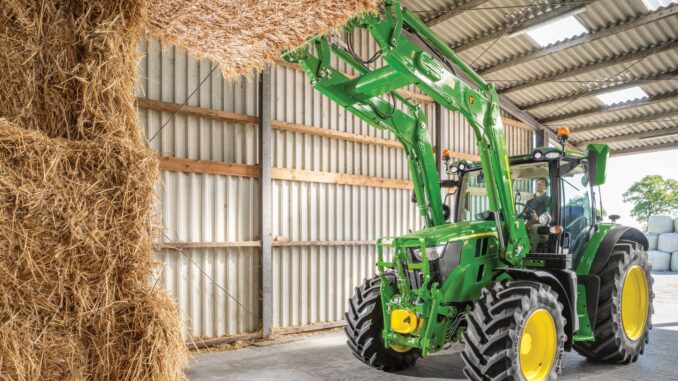
The John Deere 6120M is a 6M Series utility tractor built for heavier property, livestock, hay, loader, and mixed farm work rather than simple suburban mowing, with a 4-cylinder diesel platform, multiple transmission configurations, hydraulic systems, PTO equipment, and either cab or open-station layouts depending on spec.
This guide is written for practical owner-level troubleshooting, maintenance planning, parts lookup, and repair decisions, with a clear line between realistic DIY work and jobs that usually belong with a John Deere dealer or a well-equipped diesel tractor shop.
John Deere 6120M model overview
The John Deere 6120M sits in Deere’s 6M utility tractor family alongside the 6110M, 6130M, and 6145M, and the operator’s manual covers those closely related models together because they share major operating, service, and chassis systems. For most owners in the USA and Canada, the 6120M is a mid-size utility tractor used for loader work, mowing, transport, feeding, light tillage, and PTO-driven implement tasks where durability and hydraulic capability matter more than compact size.
Key systems owners should understand on the John Deere 6120M include the diesel engine and fuel system, DEF and exhaust aftertreatment system, transmission and hydraulic system, front-wheel-drive axle, PTO systems, electrical and charging system, and the cab ventilation and filtration system on cab-equipped machines. Those are also the systems that generate most real-world repair questions, especially around starting, warning lights, fuel delivery, drive performance, belt wear, filter service, and hydraulic or transmission complaints.
General overview of the John Deere 6120M
From a repair perspective, the John Deere 6120M is more complex than a lawn tractor but still owner-serviceable in several core areas because Deere publishes clear operator-level service intervals, fluid checks, filter changes, and routine inspections. The manual includes separate sections for controls, engine operation, exhaust cleaning, PTO, hydraulic equipment, periodic service, troubleshooting, diagnostic trouble codes, specifications, and serial-number identification, which is useful when building a complete maintenance article around this model.
Important John Deere 6120M systems and service areas include:
-
Engine oil and filtration, with engine oil filter RE504836 listed in Deere’s replacement parts guide.
-
Primary and final fuel filtration, with primary fuel filter DZ115389 and final fuel filter DZ115390 listed for the 6110M/6120M guide.
-
Air intake service, with primary air filter AL230505 and secondary air filter AL225872 in the replacement parts guide.
-
Crankcase ventilation service, with filter DZ105100 listed at a 1500-hour interval.
-
Transmission and hydraulic filtration, including transmission oil filter AL221066 and hydraulic oil filter AL232896 in Deere’s guide.
-
Cab filtration on equipped units, including recirculation air filter L214634 and fresh air filter AL225552.
-
Charging and belt service, with alternator options and engine accessory belts such as L202229 and L225274 varying by equipment build.
-
Battery service, with Deere listing AL203839 and AL203840 battery options depending on configuration.
John Deere 6120M troubleshooting approach
The best way to diagnose a John Deere 6120M is to start with the symptom the owner actually sees, not with a random part swap. On this tractor, the main symptom groups are starting issues, poor running or loss of power, warning lights or aftertreatment concerns, hydraulic and transmission problems, front axle or brake issues, electrical faults, and unusual vibration, belt noise, or fluid leaks.
A symptom-first approach matters because the same complaint can come from more than one system. For example, a no-start can come from battery voltage, safety interlocks, fuel restriction, air in the fuel system, or an electrical issue, while low power can point to fuel filters, air restriction, DEF-related derate conditions, or a more serious engine or aftertreatment fault.
Emergency John Deere 6120M repair needs
Some John Deere 6120M problems should be handled immediately because they affect safety, can trigger expensive secondary damage, or can turn a minor service job into a major repair. Stop using the tractor until checked if you have brake problems, steering or front-axle looseness, severe overheating, major hydraulic leaks, charging-system overvoltage, fuel leaks, or repeated engine protection warnings.
John Deere 6120M starting issues
If the John Deere 6120M cranks slowly, clicks, will not crank, or starts and dies, deal with it early because repeated low-voltage starts can stress the battery, starter, wiring, and control systems. The operator’s manual includes battery safety, slave-battery starting, disconnect procedures, fuel checks, and fuse access because Deere treats starting complaints as both a service and safety issue.
Common causes:
-
Weak or failed battery.
-
Poor cable connection or bad ground connection.
-
Faulty charging system or alternator over/undercharging.
-
Restricted fuel filters or air in the fuel system.
-
Fuse, relay, or movement-inhibitor issue.
Basic checks:
-
Inspect battery terminals, grounds, and disconnect switch condition.
-
Check battery state and charging-system behavior before replacing parts.
-
Inspect fuel filter service history and look for signs of air or contamination.
-
Check fuses, relays, and any active warnings on the display.
-
If the tractor still will not start, move to proper diagnostic testing rather than continued cranking.
John Deere 6120M running and power-loss problems
If the John Deere 6120M starts but lacks power, surges, smokes, or falls into derate, the issue can affect work output quickly and may involve fuel, air, DEF, or exhaust-cleaning systems. Ignoring this type of complaint can increase fuel use, shorten filter life, and in some cases lead to aftertreatment service work that is far more expensive than routine maintenance.
Common causes:
-
Plugged primary or final fuel filter.
-
Restricted primary or secondary air filter.
-
DEF system filter issues or related aftertreatment faults.
-
Dirty radiator, condenser, or engine-surrounding area causing heat-related problems.
-
Fuel contamination or overdue tank service.
Basic checks:
-
Check whether the fuel and air filters are overdue by hours or years.
-
Clean the radiator, condenser, and debris-packed areas around the engine.
-
Review display warnings tied to DEF, exhaust cleaning, or engine protection.
-
Confirm fuel quality and service the tank or filters if contamination is suspected.
-
Escalate quickly if power loss is paired with stop warnings, overheating, or persistent derate.
John Deere 6120M vibration and noise
A John Deere 6120M that develops new vibration, belt squeal, driveline noise, or wheel-end noise needs attention because the tractor’s weight and torque can turn looseness into axle, brake, or driveline damage. Deere’s scheduled service sections repeatedly call for wheel-bolt checks, axle bolt checks, lubrication, drawbar wear inspection, and drive-belt inspection for exactly this reason.
Common causes:
-
Worn or loose engine accessory belt.
-
Loose wheel hardware or front axle hardware.
-
Brake or clutch-related wear in transmission or axle systems.
-
PTO stub shaft issues or driveline attachment problems.
-
Worn tie-rod ends or steering components on front axle setups.
Basic checks:
-
Shut down and inspect belt condition, tracking, and tension-related wear signs.
-
Check for loose front and rear wheel hardware to Deere torque spec.
-
Inspect PTO area, drawbar, and hitch hardware for looseness or wear.
-
Check steering response and visible tie-rod or axle play.
-
Use dealer support if noise appears internal to transmission, clutch packs, or brakes.
John Deere 6120M overheating and leaks
Overheating, coolant loss, oil leaks, or hydraulic leaks on a John Deere 6120M are immediate repair priorities because the manual specifically warns about fire, hot exhaust, cooling-system hazards, and high-pressure fluids. Debris buildup around the radiator and condenser is a routine owner-level issue, but persistent temperature rise or major leaks need fast action.
Common causes:
-
Dirty radiator, condenser, or debris around the engine.
-
Low coolant or neglected coolant testing.
-
Worn hoses or hydraulic lines.
-
Engine oil or transmission/hydraulic oil leaks.
-
DEF contamination or leakage around the DEF system.
Basic checks:
-
Clean the cooling pack and engine bay area safely before deeper diagnosis.
-
Check coolant, engine oil, and transmission/hydraulic oil levels.
-
Inspect hoses and lines visually; do not use hands on suspected high-pressure leaks.
-
Look for warning lights or stop messages before restarting.
-
Use dealer service for repeated overheating, pressurized leaks, or internal fluid mixing.
John Deere 6120M transmission and drive problems
When a John Deere 6120M hesitates, will not move properly, shifts abnormally, or loses front-drive performance, the repair path depends heavily on the specific transmission and axle setup installed. The manual covers PowrQuad, PowrQuad Plus, AutoQuad Plus, and CommandQuad Plus operating and service items separately, which is why owners should identify the exact transmission before ordering parts or assuming a fault.
Common causes:
-
Low transmission/hydraulic oil level.
-
Overdue transmission/hydraulic filter service.
-
Movement inhibitor or safety-circuit fault.
-
Front axle oil-level or final-drive issue.
-
Internal transmission or clutch-pack problems beyond owner-level diagnosis.
Basic checks:
-
Confirm the exact transmission type on the tractor before troubleshooting.
-
Check transmission/hydraulic oil level and filter service history.
-
Review whether the first-100-hour and 500-hour service points were completed.
-
Check for active faults, inhibitor issues, or PTO safety-circuit problems.
-
Move to dealer diagnostics if the tractor still slips, jerks, or refuses to move.
John Deere 6120M electrical problems
Electrical complaints on the John Deere 6120M often show up as no-crank, charging problems, light failures, blown fuses, intermittent warnings, or starting-aid faults. Deere gives owner access to fuses, relays, battery isolation, and customer-level diagnostic code access, but not every fault is realistic to solve without proper testing equipment.
Common causes:
-
Weak battery or bad battery connections.
-
Failed or overcharging alternator.
-
Fuse or relay failure.
-
Corroded grounds.
-
Lighting-circuit or starting-aid component issues.
Basic checks:
-
Inspect battery condition and verify charge voltage.
-
Check accessible grounds and fuse panels.
-
Test lights and compare with any dashboard indicators or faults.
-
Replace simple bulbs or fuses only after finding the cause of failure.
-
Use dealer diagnosis for repeated electrical faults or controller-related issues.
DIY or dealer for the John Deere 6120M?
The line on the John Deere 6120M is fairly clear: owner DIY work makes sense for inspections, filters, fluids, belts, batteries, cab filters, and visible wear items, but dealer-level work is often the safer choice once the issue involves high-pressure fuel, major hydraulics, transmission internals, DEF dosing faults, braking systems, or electronic diagnostics that require Deere-specific procedures.
Good DIY jobs on the John Deere 6120M
-
Engine oil and filter service.
-
Fuel filter replacement and fuel-system bleeding where covered by the manual.
-
Primary air filter and cab filter replacement.
-
Battery replacement, terminal cleaning, and ground inspection.
-
Accessory belt inspection and straightforward belt replacement if access and routing are clear.
-
Cooling-pack cleaning and routine fluid-level checks.
Advanced DIY or dealer jobs on the John Deere 6120M
-
Alternator replacement where access is tight and charging diagnosis is needed first.
-
Front axle oil service and final drive work.
-
Transmission/hydraulic filter and oil service on tractors with complex configurations or contamination concerns.
-
DEF filters, dosing-unit filtration, and aftertreatment-related fault diagnosis.
-
Brake, clutch, movement-inhibitor, PTO safety-circuit, or hydraulic troubleshooting.
-
Any repair involving high-pressure fuel or internal transmission components.
Skill level guide
-
Beginner: daily checks, light inspection, radiator cleaning, battery terminal cleaning, fluid-level checks.
-
Intermediate: engine oil and filter, fuel filters, air filters, cab filters, battery replacement, basic belt service.
-
Advanced: charging-system diagnosis, front axle service, hydraulic filter service, DEF filtration, serial-specific driveline or transmission repairs.
John Deere 6120M parts needed, OEM numbers, and ordering details
Before ordering John Deere 6120M parts, gather the full model name, Product Identification Number, engine serial number, transmission type, axle configuration, cab or open-station configuration, and any optional equipment such as front PTO or front hitch. That matters because Deere lists several component variations on this platform, including multiple alternators, batteries, belts, and axle arrangements depending on build spec.
OEM parts are usually the safest choice on the John Deere 6120M for belts, filters tied to extended service intervals, DEF components, and safety-sensitive electrical or brake-related items because fit and specification matter. Aftermarket can be reasonable for batteries, some common filters, and selected wear parts, but only when the seller clearly cross-references the Deere number and your exact tractor configuration.
John Deere 6120M parts diagrams and service manuals
For the John Deere 6120M, the most useful manual and diagram sources are Deere’s operator manual, Deere’s replacement parts guide, Deere’s parts portal, and a reputable Deere-focused parts seller with a model-specific maintenance page.
Recommended sources:
-
John Deere operator manual for controls, identification, lubrication, periodic service, troubleshooting, storage, and serial-number locations.
-
John Deere replacement parts guide PDF for common service parts, intervals, and selected part numbers.
-
John Deere parts portal for official parts lookup and dealer-backed ordering.
-
Green Farm Parts 6120M maintenance guide for a model-oriented service-parts shopping page that can help with common maintenance items.
How to locate John Deere 6120M serial and engine numbers
These numbers matter because the John Deere 6120M platform has multiple equipment branches and serial breaks, and Deere’s own manual separates Product Identification Number, engine serial number, transmission serial number, front-wheel-drive serial number, and cab serial number. If you skip identification before ordering, you increase the risk of getting the wrong filter, belt, alternator, battery, or drivetrain part.
Steps to locate them:
-
Find the Product Identification Number plate using the operator manual’s serial-number and type-plate section.
-
Record the engine serial number from the engine identification location listed in Section 150 of the manual.
-
Note the transmission serial number if the repair involves shifting, movement, PTO, or drivetrain parts.
-
Record front-wheel-drive axle serial details on MFWD tractors before axle, steering, or hub-related parts orders.
-
If cab parts are involved, note the cab serial number as well because cab hardware and filtration parts can vary.
Buying John Deere 6120M parts online and in stores
The best buying strategy for John Deere 6120M parts is to identify the tractor correctly first, confirm the Deere OEM number second, and then choose the seller based on how serial-sensitive the part is. On a utility tractor like this, guessing from photos alone is a bad strategy because many parts differ by transmission, axle, cab, front PTO, and production break.
-
Online: best for common maintenance parts when you already have the OEM number and your build details; good starting points are Deere’s parts site, Deere’s replacement-parts PDF, and Green Farm Parts.
-
Dealer counter: best for serial-specific electrical, hydraulic, front-axle, PTO, DEF, transmission, and cab parts.
-
Retail stores: acceptable for fluids, batteries, and some consumables only when the packaging clearly cross-references the John Deere 6120M and the exact Deere number.
Useful URLs:
Step-by-step John Deere 6120M fitting guide for common parts
These are four of the more realistic owner-level jobs on a John Deere 6120M because they map closely to Deere’s routine service structure and have a clear maintenance benefit.
Change the John Deere 6120M engine oil and filter
This job supports starting reliability, lubrication quality, and long engine life, and Deere lists engine oil and filter service at first 100 hours and then every 500 hours or annually when the stated oil and fuel conditions are met.
-
Park safely, lower implements, stop the engine, and let the machine cool.
-
Open the hood and access the service area as described in the lubrication and service section.
-
Drain engine oil into a suitable container and remove the old RE504836 filter.
-
Lubricate the new filter gasket lightly, install the new filter, and refill with the specified oil grade from the manual.
-
Start the engine, check for leaks, shut down, and recheck oil level after settling.
Replace John Deere 6120M fuel filters
This job often fixes hard starting, poor running, low power, or fuel restriction complaints, and Deere lists the primary and final filters at the 500-hour service interval.
-
Park safely and clean the area around the filter housings before opening anything.
-
Remove the old primary and final fuel filters and compare them with DZ115389 and DZ115390 replacements.
-
Install the new filters carefully, making sure seals seat correctly.
-
Bleed air from the fuel system if required using the as-required service procedure in the manual.
-
Restart, check for leaks, and confirm the engine runs cleanly under load.
Replace the John Deere 6120M primary air filter
This helps restore power, reduce restriction, and protect the engine from dust ingestion, and Deere lists the primary element at 1500 hours or 2 years depending on use.
-
Open the air-cleaner housing without allowing dirt to fall into the intake path.
-
Remove the used primary filter and inspect the housing for dust buildup or sealing damage.
-
Clean the housing gently; do not force debris farther into the system.
-
Install the correct new primary element, such as AL230505 where applicable, and reseal the housing properly.
-
If the secondary filter is also due or damaged, replace that at the same time rather than reusing a questionable element.
Replace the John Deere 6120M battery
Battery service addresses no-crank complaints, weak starts, and unstable electrical behavior, and Deere provides battery access and disconnect procedures in the operator’s manual. Because the 6120M may use AL203839 or AL203840 depending on build, verify fitment before purchase.
-
Park safely, key off, and disconnect the ground cable first.
-
Access the battery compartment using the service-access steps from the manual.
-
Remove hold-down hardware, lift out the old battery safely, and clean the tray and terminals.
-
Install the correct replacement battery, secure it properly, and reconnect positive first and ground last.
-
Start the tractor and verify charging voltage so a bad alternator does not damage the new battery.
John Deere 6120M maintenance to prevent repeat problems
Most repeat John Deere 6120M failures come from skipped inspections, overdue filters, poor cooling-pack cleanliness, or buying parts without checking the tractor’s exact configuration. Deere’s own maintenance structure is built around preventing those avoidable failures before they become drivability, hydraulic, or aftertreatment complaints.
Focus areas:
-
Starting reliability: keep battery terminals clean, inspect grounds, and stay ahead of battery and charging issues.
-
Running performance: change fuel and air filters on schedule and service contaminated fuel systems promptly.
-
Fire and overheating prevention: clean radiator, condenser, and debris-packed engine areas regularly.
-
Drive performance: monitor transmission/hydraulic oil level, filter intervals, and movement-inhibitor concerns.
-
Electrical reliability: check lights, fuses, relays, and visible grounds before faults become intermittent time-wasters.
John Deere 6120M maintenance schedule and seasonal checklist
The schedule below follows Deere’s operator-level service structure for the 6110M/6120M family and should always be adjusted to your actual hours, environment, and machine configuration. If your tractor runs in dust, loader work, livestock yards, or cold-weather conditions, inspection frequency may need to be tighter even when the official replacement interval stays the same.
Daily or before each use on the John Deere 6120M
-
Clean the radiator, condenser, and area surrounding the engine.
-
Check coolant level.
-
Check fuel filters.
-
Check engine oil level.
-
Check transmission/hydraulic oil level.
-
Check brakes and lights.
After the first 100 hours on the John Deere 6120M
-
Replace transmission/hydraulic oil filters.
-
Check air intake hoses.
-
Change front-wheel-drive axle oil where specified.
-
Tighten applicable front-hitch, drawbar, or loader-frame hardware if equipped.
-
Lubricate the tractor’s lubrication points.
Every 500 hours on the John Deere 6120M
-
Check movement inhibitor function for the transmission fitted to the tractor.
-
Check PTO actuation safety circuit.
-
Inspect engine drive belt for wear.
-
Change fuel filters.
-
Change engine oil and engine oil filter, and replace transmission/hydraulic oil filters.
-
Check wheel, axle, drawbar, and hitch hardware torque and lubricate required points.
Every 1500 hours or 2 years on the John Deere 6120M
-
Change cab air filters.
-
Change engine air cleaner primary element.
-
Change crankcase vent or oil-separator filter where equipped.
-
Change transmission/hydraulic oil and clean intake screen.
-
Change front-wheel-drive axle oil where specified.
Every 4500 to 6000 hours on the John Deere 6120M
-
Replace the secondary engine air element at 4500 hours.
-
Clean DEF tank and change DEF dosing-unit or line filtration as specified.
-
Change engine coolant at 6000 hours following Deere’s guidance.
-
Replace in-line DEF filter at 6000 hours where equipped.
Seasonal checklist for the John Deere 6120M
-
Spring or heavy-use start: test battery condition, inspect belts, service overdue filters, and clean cooling pack.
-
Mid-season: recheck wheel torque, fluid levels, hose condition, and debris buildup around radiator and condenser.
-
Fall or pre-storage: complete annual inspections, clean tractor thoroughly, address warning lights, and follow Deere long-term storage procedures.
Repair, upgrade, or replace the John Deere 6120M?
In most cases, a John Deere 6120M is worth repairing when the problem is isolated to maintenance parts, charging components, hoses, filters, belts, or straightforward axle and cab service, because Deere still supports the platform with manuals and service parts. Upgrade or replacement becomes more realistic when repeated electronic, transmission, hydraulic, or aftertreatment repairs stack up against the tractor’s value and your downtime costs.
Repair if:
-
The issue is limited to filters, belts, battery, alternator, cab filters, hoses, or routine service items.
-
The tractor is otherwise sound and has a known maintenance history.
-
The repair can be tied to one confirmed fault rather than a chain of unresolved symptoms.
Upgrade if:
-
Your current 6120M lacks hydraulic, loader, cab, lighting, or electrical capacity needed for the work you now do.
-
Repeated repairs are caused by using the tractor beyond its intended workload or configuration.
-
A higher-output alternator, battery, or equipment package solves a recurring use-case limitation.
Replace if:
-
The tractor has major transmission, hydraulic, or engine issues combined with poor overall condition.
-
Serial-specific parts and labor costs are approaching the value of the machine in your market.
-
Downtime is now costing more than ownership of a newer, better-matched tractor.
John Deere 6120M troubleshooting FAQ
1. Why will my John Deere 6120M not start?
A John Deere 6120M no-start usually comes down to battery condition, cable or ground issues, fuel restriction, fuse or relay faults, or an interlock-related problem. Start with battery voltage, visible cable condition, and fuel-filter history before assuming a major electrical failure. If it cranks poorly or not at all, charging-system testing is often just as important as battery replacement.
2. Why does my John Deere 6120M crank slowly?
Slow cranking usually points to a weak battery, dirty terminals, poor grounds, or charging problems that left the battery undercharged. Cold weather, repeated short runs, and an aging battery make the symptom worse. Check cables and charging voltage before buying a new starter.
3. Why does my John Deere 6120M start and then die?
This often indicates fuel delivery trouble, air in the fuel system, restricted filters, or a control-related issue rather than a simple dead battery. If fuel filters are overdue, replacing and bleeding them is one of the first realistic owner checks. Repeated stall-after-start behavior with warning lamps calls for deeper diagnostics.
4. Why is my John Deere 6120M low on power?
Low power commonly comes from restricted fuel filters, dirty air filters, cooling-system contamination, or DEF and aftertreatment issues that push the tractor into reduced performance. Check service intervals and warning messages before assuming injector or turbo failure. A dirty cooling pack can also worsen power complaints under load.
5. Why is my John Deere 6120M showing DEF or exhaust warnings?
The operator’s manual includes specific sections on exhaust filter cleaning, parked regeneration, aftertreatment indicators, and SCR system operation because those warnings are normal diagnostic categories on this model family. Sometimes the issue is a maintenance-related filter or usage condition, while other cases need dealer diagnosis. Do not ignore repeated warnings until the tractor derates badly.
6. Can a dirty fuel filter make a John Deere 6120M hard to start?
Yes, especially if the filter service interval has been stretched or fuel contamination is present. Deere lists both primary and final fuel filters as routine 500-hour service items on this tractor family. Hard starting, stumble, and low power are common symptom patterns when fuel flow is restricted.
7. What fuel filters fit the John Deere 6120M?
Deere’s replacement parts guide lists DZ115389 as the primary fuel filter and DZ115390 as the final fuel filter for the 6110M/6120M guide covered here. Owners should still confirm by PIN and build before ordering because production changes and equipment variation always matter.
8. What engine oil filter does a John Deere 6120M use?
Deere lists engine oil filter RE504836 in the replacement parts guide for the 6110M/6120M family. That filter is tied to the published oil-service interval, including the stricter conditions for extended 500-hour service. Use the manual and your serial information to confirm the exact service setup on your tractor.
9. How often should I change John Deere 6120M engine oil?
Deere states that engine oil and filter service is after the first 100 hours and then every 500 hours or annually when the required oil, OEM filter, and low-sulfur diesel conditions are met. If those conditions are not met, Deere notes a shorter 250-hour change interval. That is one reason OEM filters matter on this platform.
10. Why is my John Deere 6120M overheating?
The most owner-level cause is debris packed into the radiator, condenser, and engine area, which Deere calls out in daily maintenance. Low coolant, hose problems, or deeper cooling-system faults are the next tier of concern. Stop and investigate early because overheating on a diesel utility tractor gets expensive fast.
11. How do I clean the John Deere 6120M cooling pack?
At owner level, the goal is to remove chaff, dirt, and packed debris from the radiator, condenser, and surrounding engine area as part of routine service. Follow Deere’s safe-maintenance guidance and avoid forcing debris deeper into the cores. If overheating persists after cleaning, move beyond basic maintenance checks.
12. Why does my John Deere 6120M battery keep going dead?
Repeated battery discharge usually means either the battery is failing or the charging system is not working correctly. The charging system can also damage the battery if output is too high, which is why voltage testing matters. Check grounds, terminals, and alternator behavior before replacing batteries repeatedly.
13. What battery fits the John Deere 6120M?
Deere lists AL203839 as a 12 V 154 Ah battery option and AL203840 as a 12 V 174 Ah option in the replacement parts guide. The correct one depends on build configuration, so fitment should be verified with the tractor’s identification details.
14. Why is my John Deere 6120M alternator not charging?
Alternator complaints can come from the alternator itself, poor grounds, wiring issues, loose belt condition, or battery problems that mimic a charging fault. Because this platform also has multiple alternator options, part replacement should follow testing, not guesswork. An overcharging alternator is just as serious as an undercharging one.
15. What drive belt fits a John Deere 6120M?
Deere lists at least two accessory belt options in the replacement guide, including L202229 and L225274 for tractors with air conditioning, with different lengths shown. That is exactly why owners should verify the tractor build before ordering a belt from an online listing.
16. Why is my John Deere 6120M belt squealing?
Belt squeal usually points to wear, glazing, contamination, misalignment, or charging and accessory load issues rather than a belt that simply needs spray dressing. Deere includes drive-belt wear checks in its scheduled service list. Replace worn belts and inspect pulleys and charging components at the same time.
17. Why is my John Deere 6120M hydraulic system acting weak?
Weak hydraulics can come from low oil level, overdue filters, contamination, internal wear, or a tractor-configuration issue tied to specific hydraulic equipment. Start with fluid level and service history before assuming pump failure. If the problem is hot-oil related, contamination and cooling load also matter.
18. What transmission oil filter does the John Deere 6120M use?
Deere lists transmission oil filter AL221066 in the replacement parts guide for this family. It is a scheduled service part after the first 100 hours and then every 500 hours thereafter. Confirm the exact service setup if the tractor has special drivetrain options.
19. What hydraulic filter does the John Deere 6120M use?
Deere’s guide lists hydraulic oil filter AL232896 for the covered 6110M/6120M series service information. As with other filters, it is smart to verify by PIN before ordering.
20. Why will my John Deere 6120M not move properly?
Poor movement can be caused by low transmission/hydraulic oil, inhibitor issues, PTO or safety-circuit related faults, front-axle issues, or internal transmission trouble. Because Deere supports multiple transmission families on this model range, exact symptom description is critical. Jerking, slipping, or no-move complaints that remain after fluid checks are usually dealer territory.
21. Why is the John Deere 6120M movement inhibitor causing trouble?
Deere specifically includes movement-inhibitor checks in scheduled service because proper function matters to safe tractor operation. If the tractor behaves as though it is electronically holding movement or refusing expected response, this is not a part to guess at blindly. Record fault behavior and seek proper diagnosis if basic checks do not resolve it.
22. Why is my John Deere 6120M PTO not working correctly?
PTO issues can come from safety-circuit faults, engagement controls, driveline attachment problems, or deeper internal issues. Deere includes PTO safety-circuit checks in 500-hour service for a reason. If the PTO will not engage or disengage correctly, stop and diagnose rather than forcing operation.
23. Why does my John Deere 6120M have warning lights but still run?
Some warnings indicate a developing issue rather than an immediate shutdown, especially in electrical, aftertreatment, or service-reminder categories. The manual gives customer-level access to diagnostic trouble code information, which helps separate routine alerts from urgent faults. Persistent warnings should still be investigated before they turn into derate or no-start conditions.
24. How often should I replace the John Deere 6120M air filters?
Deere lists the primary air filter at 1500 hours or 2 years, whichever comes first, and the secondary element at every fourth primary change or around 4500 hours depending on schedule wording. Dusty work may require inspection sooner even if replacement comes later.
25. What air filters fit the John Deere 6120M?
In the replacement parts guide fetched here, Deere lists AL230505 as the primary air filter and AL225872 as the secondary air filter. Verify against your serial and service information before purchase.
26. How often should I replace cab filters on a John Deere 6120M?
Deere lists the recirculation and fresh-air cab filters at 1500 hours or 2 years in the replacement parts guide for equipped tractors. The operator manual also includes annual and as-required cab service items, so very dusty use may justify more frequent inspection.
27. What cab filters fit the John Deere 6120M?
Deere lists L214634 for the recirculation air filter and AL225552 for the fresh-air filter, with quantity two for each in the guide reviewed here. Cab configuration should still be confirmed before ordering.
28. Why is my John Deere 6120M using more fuel than normal?
Higher fuel use can come from restricted filters, dirty cooling packs, improper operating habits, aftertreatment issues, or simply running the tractor in the wrong speed and load range. Deere includes fuel-consumption guidance and correct travel-speed selection because operation and maintenance both affect efficiency. Start with maintenance before blaming the engine itself.
29. How do I find the John Deere 6120M PIN and engine serial number?
The operator’s manual includes a serial-number section with the Product Identification Number plate, engine serial number, transmission serial number, and other component plate locations. That section should be your first stop before ordering anything more complex than basic consumables.
30. Where can I get a John Deere 6120M operator’s manual?
A direct John Deere operator-manual page for the 6110M, 6120M, 6130M, and 6145M family is available online through Deere’s manual viewer. That manual is the best source for owner-level operation, service intervals, troubleshooting, and identification data.
31. Where can I find John Deere 6120M parts diagrams?
The best place to start is Deere’s official parts portal, supported by the replacement parts guide PDF for common maintenance items. For routine service parts, a Deere-focused seller with a model-specific guide can also help, but official lookup is still the safest route for serial-sensitive parts.
32. Is OEM better than aftermarket for the John Deere 6120M?
OEM is usually the better call for belts, DEF-related service parts, fit-sensitive filters tied to service intervals, and safety-related electrical or driveline parts. Aftermarket can be fine for selected batteries and consumables, but only when the cross-reference is exact and the seller is reputable.
33. Is the John Deere 6120M realistic for DIY repair?
Yes for routine service and some intermediate repairs, but not as a blanket rule for every fault. Owners can reasonably handle filters, fluids, batteries, visual inspections, and some belt work, while dealer support makes more sense for transmission, brake, hydraulic, DEF, and electronic diagnostics.
34. When should I stop troubleshooting my John Deere 6120M myself?
Stop at the point where the issue involves high-pressure fuel, major hydraulic leaks, brake performance, repeated electronic warnings, transmission internals, or any condition that creates a safety risk. Those are the jobs where expert diagnosis protects both the tractor and the operator.
35. Is it still worth repairing a John Deere 6120M?
Usually yes when the problem is a confirmed maintenance or wear-item repair and the tractor is otherwise structurally sound. It becomes less attractive when high-value systems fail together or downtime costs are higher than moving into a better-matched replacement machine.
John Deere 6120M common engine codes and fixes
The most common 6120M engine-related fault families are fuel delivery, air pressure/boost, manifold air temperature, EGR, coolant level/temperature, and low fuel-pressure style codes, and the practical fixes usually start with filters, fuel quality, intake restriction, cooling-pack cleanliness, wiring checks, and then dealer diagnostics if the fault returns.
Common engine codes
John Deere’s diagnostic tables show engine-code families such as 96 fuel level mismatch, 97 water-in-fuel signal, 100 engine oil pressure signal, 101 crankcase pressure signal, 102 manifold air pressure signal, 103 turbocharger speed signal, 105 manifold air temperature signal, 111 engine coolant level alarm switch, and 127 transmission oil pressure signal. A model-specific 6120M fault list also highlights engine EGR valve position faults such as 000027.03.
Typical fixes
-
97 water-in-fuel signal: drain contaminated fuel, replace fuel filters, check tank contamination, and inspect the water separator and sensor circuit.
-
100 low oil pressure signal: stop the tractor, verify oil level and correct oil/filter service, and do not keep running it until pressure is confirmed.
-
102 manifold air pressure signal: inspect the air filter, charge-air hoses, intercooler piping, and boost-related wiring or sensors.
-
103 turbocharger speed signal: check for intake leaks, damaged turbo plumbing, sensor faults, or sticking turbo components; this often needs dealer-level diagnosis if it is active.
-
105 manifold air temperature signal: clean the cooling pack, check connectors and sensor wiring, and confirm the charge-air path is not heat-soaked or restricted.
-
111 coolant level alarm switch: top up with the correct coolant, check for leaks, and inspect the level sensor if the warning stays on.
-
000027.03 EGR valve position too high: clean and inspect EGR-related components, connectors, and related intake/exhaust plumbing; if the code keeps returning, it usually needs dealer diagnosis or component replacement.
Owner-first diagnosis
Start with the obvious service items before replacing electronic parts. On the 6120M, that means fuel filters, air filters, coolant level, battery health, charging voltage, and a clean radiator/condenser pack, because Deere’s maintenance schedule and parts guide show those as routine service points on this tractor family.
When to stop DIY
Stop immediately if the code is tied to oil pressure, repeated derate, turbo speed faults that return, coolant loss, or any warning that affects safe operation. Those faults can quickly turn into engine damage, so the next step is proper diagnostic testing rather than trial-and-error part swapping