
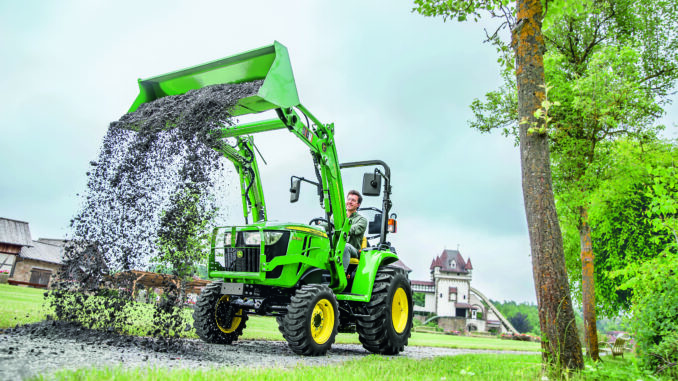
The John Deere 3039R is a 3R Series compact utility tractor built for property owners and small-acreage users who need more capability than a lawn tractor but still want a machine that is manageable for routine DIY care. Deere’s North America operator information groups the 3039R with the 3033R and 3046R, and the official replacement-parts guide identifies it as a Final Tier 4 compact utility tractor with engine, hydraulic, transmission, axle, and cab systems that require scheduled service.
This guide is written for USA and Canada owners who want a practical, symptom-first reference for John Deere 3039R repair, troubleshooting, maintenance, parts lookup, and service planning. It covers realistic DIY checks, common service parts, where to find manuals and diagrams, and a large FAQ aimed at the problems owners actually run into in day-to-day use.
General overview of the John Deere 3039R
The John Deere 3039R sits in Deere’s premium 3R compact utility tractor range, above simple residential mowers and aimed at users who may run loaders, mid-mount mower decks, rear implements, or year-round property-maintenance attachments. Deere’s own model literature and manuals place the 3039R in the North American compact tractor lineup with operator, service-identification, and maintenance support tied closely to serial number and configuration.
The main systems owners typically deal with on a John Deere 3039R are the diesel engine and fuel system, air-intake and filtration system, hydraulic and transmission system, front axle, electrical charging and starting system, and cab HVAC filtration on cab-equipped tractors. Those are also the systems reflected in Deere’s official replacement-parts guide, which lists engine filters, transmission and hydraulic filters, axle-related service parts, battery, alternator, and cab air filters for this model.
Common John Deere 3039R service parts owners regularly buy include engine oil filter M806419, hydraulic/transmission oil filter LVA13065, primary air filter RE68048, secondary air filter RE68049, water separator MIU802421, final fuel filter MIU803127, fresh-air cab filter MIU10010, recirculation cab filter MIU10011, and filter kit LVA21038. Depending on configuration, Deere also lists fuel filter LVA12726 for cab applications, fuel filter LVA12678 for MFWD-related service listings, battery TY26498, drive belt LVU29376, and HVAC belt LVU29375 in the official guide.
John Deere 3039R troubleshooting approach
The best way to troubleshoot a John Deere 3039R is to start with the symptom the owner can clearly see, hear, smell, or feel during operation. That approach reduces wasted parts swapping and lines up with how Deere structures its operator information around product identification, controls, engine operation, air intake, fuel, coolant, exhaust, electrical, lubrication, and periodic service tasks.
For this tractor, the main symptom groups are starting issues, poor running or power loss, hydraulic or drive complaints, overheating or fluid leaks, electrical and charging faults, and abnormal vibration or noise. Cab-equipped units also add HVAC airflow complaints, while implement-related issues may require a second diagnosis path for the attached deck, loader, or rear implement rather than the tractor itself.
Emergency John Deere 3039R repair needs
Some John Deere 3039R problems need immediate attention because they can make the tractor unsafe or can quickly damage expensive components. Any warning signs involving major hydraulic leaks, overheating, brake or steering problems, fuel leaks, repeated belt loss, charging failure, or severe drivetrain noise should stop work until the cause is found.
John Deere 3039R starting issues
If the John Deere 3039R cranks slowly, does not crank, or starts and dies, treat that as more than an inconvenience because repeated starting attempts can flatten the battery, strain the starter circuit, and hide a fuel-system problem. Deere lists battery, alternator, water separator, and final fuel filter among the model’s key service items, which makes these high-priority inspection points.
Common causes:
-
Weak or failing battery TY26498.
-
Dirty or loose battery cable connections, or poor grounds affecting cranking and charging circuits.
-
Restricted fuel flow from a neglected water separator MIU802421 or final fuel filter MIU803127.
-
Air in the fuel system after filter service or after running the tractor very low on fuel.
-
Safety interlock, PTO, or range-selector conditions that prevent normal starting procedure, as covered in the operator’s manual.
Basic owner checklist:
-
Confirm the battery is fully charged and cable ends are clean and tight.
-
Check fuel level and inspect the water separator and fuel filter service history.
-
Follow the exact starting sequence in the operator’s manual, including PTO and operator controls.
-
Look for warning lights, blown fuses, or obvious harness damage before cranking again.
-
If the engine still will not start or repeatedly stalls after filter work, move to dealer-level fuel-system diagnosis.
John Deere 3039R running and power issues
A John Deere 3039R that starts but lacks power, surges, smokes excessively, or struggles under load often has an air, fuel, or service-interval problem. Since Deere specifies regular engine oil, fuel-filter, and air-filter maintenance for this model, overdue service is one of the first things to check before assuming major engine trouble.
Common causes:
-
Restricted primary air filter RE68048 or secondary air filter RE68049.
-
Dirty or overdue fuel filters MIU802421 and MIU803127.
-
Old engine oil or incorrect maintenance intervals reducing overall engine performance.
-
DPF or emissions-related issues that need dealer diagnosis, since Deere flags the DPF as a qualified-service item.
-
Load demands beyond tractor setup, ballast, or attachment condition.
Basic owner checklist:
-
Inspect the primary and secondary air filters and replace as required.
-
Check the fuel filters and separator service interval against your hour meter.
-
Verify engine oil was changed at the proper interval with the correct filter.
-
Remove unnecessary load and test the tractor under a lighter task.
-
If warning indicators or regeneration-related problems appear, book dealer diagnosis rather than guessing.
John Deere 3039R vibration and noise
New vibration, squeal, rumble, or rattling on a John Deere 3039R should be treated seriously because it can point to belt trouble, loose driveline parts, damaged rotating components, or axle issues. Deere’s parts guide specifically lists drive belts, clutch and brake components, tie-rod parts, and axle-related items, all of which can contribute to noise or vibration if worn or loose.
Common causes:
-
Worn or slipping drive belt LVU29376 or HVAC belt LVU29375 on cab tractors.
-
Loose hardware around shields, engine accessories, or mounting points.
-
Front-end steering or tie-rod wear, including LVA14959, LVA14960, or complete tie-rod assembly LVA19527.
-
Implement imbalance or attachment driveline issues rather than a tractor fault.
-
Brake or clutch component wear in more advanced cases.
Basic owner checklist:
-
Stop the tractor and inspect visible belts, guards, and mounting hardware.
-
Separate tractor-only noise from implement-related noise by testing safely without the attachment engaged.
-
Check steering linkage and front-end components for looseness or damage.
-
Replace obviously cracked or frayed belts before they fail completely.
-
Escalate internal clutch, brake, or driveline noise to a dealer technician.
John Deere 3039R overheating and leaks
Overheating or visible leaks on a John Deere 3039R can turn into expensive repairs quickly, especially where engine coolant, fuel, or hydraulic oil is involved. Deere publishes approximate cooling-system, crankcase, transmission/hydraulic, and front-axle capacities for the 3039R, which shows how important correct fluid level and leak control are on this tractor.
Common causes:
-
Low coolant or contaminated cooling system.
-
Hydraulic or transmission leaks leading to low system oil.
-
Engine oil leaks causing low crankcase level.
-
Fuel leaks around filters, separator, or hoses after recent service.
-
Packed debris reducing airflow through cooling areas during loader, mowing, or heavy seasonal work.
Basic owner checklist:
-
Park safely and let the tractor cool before opening any service points.
-
Check coolant, engine oil, and hydraulic/transmission levels against the manual.
-
Trace fresh leaks to the highest visible wet point rather than the lowest drip point.
-
Inspect recently serviced filters and seals for double-gasket or loose-install problems.
-
Stop using the tractor until any major hydraulic, coolant, or fuel leak is repaired.
John Deere 3039R transmission and drive problems
If the John Deere 3039R hesitates, feels weak in travel, loses hydraulic response, or shows drivetrain-related performance changes, owners should think fluid condition, filter condition, and configuration-specific hydraulic issues first. Deere identifies the transmission and hydraulic system as a major service area with HY-Gard capacity and dedicated filters, and those intervals matter to drive performance.
Common causes:
-
Overdue hydraulic/transmission filter service, including LVA13065.
-
Low hydraulic/transmission oil level.
-
Front axle service neglect affecting MFWD performance or component life.
-
Incorrect fluid type or mixed fluids.
-
Internal hydrostatic or hydraulic faults beyond owner-level diagnosis.
Basic owner checklist:
-
Check for active leaks and verify oil level before further use.
-
Review the tractor’s hour meter against hydraulic filter replacement intervals.
-
Confirm the correct Deere-approved fluid has been used.
-
Inspect external linkages and controls for obvious damage or binding.
-
Refer persistent drive weakness, hydraulic noise, or travel loss to a dealer.
John Deere 3039R electrical problems
Electrical problems on the John Deere 3039R usually show up as hard starting, dim lights, charging issues, intermittent warnings, or dead accessories. Deere’s official parts information for this model includes battery TY26498 and alternator RE505895, which makes charging-system checks especially relevant when electrical symptoms stack up.
Common causes:
-
Weak battery or charging failure.
-
Loose grounds, corroded terminals, or damaged wiring.
-
Alternator output issues on tractors using RE505895.
-
Blown fuses or switch faults.
-
Cab electrical accessory problems on enclosed units.
Basic owner checklist:
-
Load-test the battery or substitute a known-good fully charged battery.
-
Clean and tighten both battery terminals and grounds.
-
Inspect fuses and visible wiring before replacing parts.
-
Confirm belt condition if charging output has dropped.
-
Use dealer diagnosis for intermittent harness or module faults.
DIY or dealer for the John Deere 3039R?
For most owners, the line on a John Deere 3039R is simple: routine service, filters, battery work, and visible belt or cab-filter jobs are realistic DIY tasks, while internal hydraulic, emissions, clutch, transmission, and advanced electrical diagnosis usually belong with a Deere dealer or an experienced compact-tractor technician. That boundary matters more on a premium compact tractor because a wrong repair can create expensive secondary damage in the fuel, hydraulic, or emissions system.
Good DIY jobs
-
Engine oil and filter changes using the correct interval and filter.
-
Air filter inspection and replacement.
-
Water separator and final fuel filter replacement if the owner follows the manual carefully.
-
Cab fresh-air and recirculation filter cleaning or replacement.
-
Battery replacement, terminal cleaning, and basic charging checks.
-
Visible belt inspection and straightforward replacement where access is simple.
Advanced DIY or dealer jobs
-
Fuel-system bleeding after service when starting remains difficult.
-
Hydraulic/transmission oil and filter service if the owner is not set up for clean fluid handling.
-
Tie-rod, steering, clutch, or brake work requiring precise adjustment.
-
DPF and emissions-related diagnosis, which Deere flags as dealer or qualified-service work.
-
Deep electrical fault tracing, no-start diagnostics, and charging-system testing beyond basic checks.
Skill level guide
-
Beginner: engine oil checks, battery cleaning, air-filter inspection, cab-filter cleaning.
-
Intermediate: engine oil and filter replacement, fuel-filter service, accessory-belt replacement, basic leak tracing.
-
Advanced: hydraulic service, steering repairs, persistent no-start diagnosis, emissions troubleshooting.
John Deere 3039R parts, OEM vs aftermarket, and ordering information
Before ordering parts for a John Deere 3039R, gather the full model name, the Product Identification Number (PIN), engine identification, and the exact tractor configuration, especially whether it is open-station or cab-equipped. Deere’s documentation separates identification and replacement parts by model and configuration, and even the official parts guide shows different listings for some items such as fuel and cab-service filters.
The most useful rule is to use OEM parts for belts, fit-sensitive filters, hydraulic components, and safety-related items, while carefully cross-referenced aftermarket parts can be acceptable for some batteries and basic consumables. On compact tractors, mistakes in filter specification or belt fit can create hard-to-diagnose performance issues, so part-number accuracy matters more than saving a small amount upfront.
John Deere 3039R diagrams and manuals
The best places to find John Deere 3039R diagrams and manuals are Deere’s official operator manual pages, Deere replacement-parts guide PDFs, Deere Parts or Technical Publications channels, and a reputable Deere-focused parts retailer that indexes parts by model. Using a mix of official literature and model-specific parts pages gives owners both the maintenance schedule and the exploded-view lookup they need before ordering parts.
Useful sources:
-
John Deere 3033R/3039R/3046R operator manual — best for operating procedures, safety, controls, service locations, and official maintenance instructions.
-
John Deere 3039R replacement parts guide PDF — best for common filter, belt, battery, and service-part numbers plus capacities.
-
John Deere Parts support portal — useful starting point for official parts support and dealer-backed ordering channels.
-
Green Farm Parts 3039R maintenance guide — useful for quick maintenance part references and model-specific service consumables.
How to locate John Deere 3039R serial and engine numbers
The model, PIN, and engine identification matter because John Deere compact tractors can change parts by serial break, configuration, or engine family, and the correct numbers reduce wrong-part orders. Deere’s operator information includes a product identification section, which is the first place owners should check before buying repair parts or consulting a dealer.
Steps to identify your tractor:
-
Check the operator’s manual section on product identification so you know the correct Deere terminology for the tractor’s identification points.
-
Locate the tractor Product Identification Number tag on the machine and photograph it before ordering parts.
-
Record whether the tractor is open station or cab, because cab filters and some related service parts differ.
-
Find and record the engine identification details from the engine label before ordering engine-service components.
-
Keep the PIN, engine numbers, and current hour reading together when shopping online or visiting a dealer counter.
Buying John Deere 3039R parts online and in stores
The safest buying strategy for John Deere 3039R parts is to confirm the OEM number first, then compare pricing and availability across official Deere channels and trusted model-specific suppliers. This is especially important for fuel, hydraulic, and cab-service parts where a visually similar item may still be wrong for the tractor’s exact configuration.
-
Online: verify OEM numbers against the manual or official parts guide, especially for PIN-sensitive or cab-specific items.
-
Dealer counter: best for hydraulic, steering, electrical, emissions, and serial-specific parts where staff can confirm fitment by PIN.
-
Retail stores: acceptable for common consumables such as some batteries and cross-referenced filters, but only when packaging clearly lists the John Deere 3039R or the exact OEM cross-reference.
Useful links:
John Deere 3039R fitting guide for common parts
These are four of the highest-value DIY service jobs on a John Deere 3039R because they directly affect starting, running quality, reliability, and comfort. Always work from the operator’s manual for safety and shutdown procedure before touching hot, pressurized, or moving components.
Changing the John Deere 3039R engine oil and filter
This job helps protect the diesel engine and is one of the most important routine services on the tractor. Deere’s maintenance sources list engine oil filter M806419 for this model and place engine oil service on a regular hour-based interval.
-
Warm the engine briefly, park safely on level ground, shut down, and allow hot components to cool enough for safe service.
-
Drain the old engine oil into a suitable container and remove the old oil filter.
-
Lightly oil the gasket on the new M806419 filter and install it correctly without over-tightening.
-
Refill with the specified engine oil quantity and grade from the manual or guide, then start briefly and recheck level after shutdown.
-
Inspect for leaks around the filter and drain point before returning the tractor to work.
Replacing John Deere 3039R fuel filters
Fuel-filter service often fixes hard starting, stalling, weak running, and loss of power caused by restricted flow. The 3039R service references identify MIU802421 as the water separator and MIU803127 as the final fuel filter, with replacement at 400 hours or annually for the final fuel filter.
-
Clean the area around the filters before opening the system so dirt does not enter the fuel side.
-
Remove the old separator or filter carefully and compare the new part number before fitting.
-
Lubricate any sealing surfaces as specified and install the new parts squarely.
-
Prime or bleed the system only as directed in Deere procedures for the engine family.
-
Start the tractor, check for leaks, and monitor for smooth running.
Replacing John Deere 3039R air filters
Air-filter service is a simple way to restore performance and protect the engine from dust ingestion. Deere lists RE68048 as the primary air filter and RE68049 as the secondary filter, with checks at longer intervals and replacement as required.
-
Open the air-cleaner housing carefully and note the installed filter orientation.
-
Remove the primary filter first and inspect the housing for heavy dust or debris.
-
Replace the secondary filter only if needed or if the manual calls for it; do not damage sealing surfaces.
-
Install the new filters correctly and close the housing fully so unfiltered air cannot bypass the elements.
-
Test run the tractor and recheck for proper fit if power complaints remain.
Replacing John Deere 3039R cab air filters
On cab tractors, fresh-air and recirculation filters matter for operator comfort and HVAC performance. Deere lists MIU10010 and MIU10011 for these jobs and recommends cleaning or replacement every 50 hours and as required.
-
Confirm your tractor is cab-equipped and identify which filter you are changing.
-
Open the filter access points and remove the old element without dumping debris into the ducting.
-
Clean loose dust from the area before installing the new filter.
-
Fit the new MIU10010 or MIU10011 in the correct direction and close the housing securely.
-
Run the HVAC system and confirm airflow improves across settings.
Preventing repeat John Deere 3039R problems
Regular maintenance on a John Deere 3039R does more than extend component life; it also prevents many of the symptoms owners describe as random failures. The official service references for this model repeatedly point back to filter condition, fluid level, scheduled replacement intervals, and clean service practices as the biggest reliability factors.
Focus areas:
-
Starting reliability: keep the battery, fuel separator, and final fuel filter in good condition.
-
Engine performance: inspect air filters and stay current on oil service.
-
Overheating and leak prevention: monitor coolant, engine oil, hydraulic oil, and fresh seepage before it becomes a major leak.
-
Drive performance: service hydraulic and transmission filters on time and use the correct fluid.
-
Electrical reliability: keep terminals clean, belts in good shape, and charging output consistent.
-
Cab comfort: clean or replace cab filters regularly so dust buildup does not choke HVAC airflow.
John Deere 3039R maintenance schedule and checklist
The John Deere 3039R maintenance plan should follow the official operator and service-interval literature for the tractor’s exact configuration. The sources available for this model show daily checks along with 50-hour, 200-hour, 400-hour, 600-hour, 1200-hour, annual, and as-required items, depending on system and component.
Daily or before each use
-
Check engine oil level.
-
Check coolant level.
-
Check hydraulic/transmission oil level.
-
Inspect for fuel, oil, or hydraulic leaks.
-
Check general tractor condition, guards, and visible hardware before operation.
Every 50 hours
-
Clean or replace fresh-air cab filter MIU10010 as required.
-
Clean or replace recirculation cab filter MIU10011 as required.
-
Carry out any periodic inspections specified in the operator’s manual for your configuration.
Every 200 hours or yearly
-
Replace engine oil filter M806419 and perform engine oil service.
-
Review all fluid levels and visible service points for contamination or seepage.
Every 400 hours
-
Replace water separator/fuel service components as specified for the 3039R.
-
Replace final fuel filter MIU803127, or do it annually if that comes first.
-
Replace hydraulic/transmission filter items listed for your tractor configuration.
Every 600 hours and beyond
-
Check primary air filter RE68048 and secondary air filter RE68049; replace as required.
-
Continue hydraulic/transmission service according to the official longer interval stated for your serial and configuration.
-
Plan dealer review of any emissions-related service items, including DPF-related concerns.
Seasonal checklist
-
Spring: inspect battery condition, fluids, filters, and any belts before heavy mowing or loader season.
-
Mid-season: check for dust-loaded air or cab filters and inspect for leaks or loose hardware.
-
Fall or pre-winter: service fuel filters on time, confirm coolant protection, and correct any hydraulic seepage before storage or snow-season work.
Repair, upgrade, or replace the John Deere 3039R?
For most owners, a John Deere 3039R is worth repairing when the issue is isolated to service parts, wear items, filters, belts, battery, or accessible steering and linkage components. The decision shifts toward upgrading or replacing when the tractor’s tasks have outgrown its setup, or when major hydraulic, transmission, engine, or emissions repairs begin stacking up against the machine’s value and downtime.
Repair if:
-
The problem is clearly tied to routine service items or a single worn part.
-
The tractor is otherwise reliable and the repair restores normal function at reasonable cost.
-
The issue was caused by overdue maintenance rather than core component failure.
Upgrade if:
-
The current setup lacks the attachment, ballast, cab, or hydraulic capability your jobs now require.
-
Repeated performance complaints are really application mismatch rather than a fault.
-
You need better year-round comfort or productivity than the current configuration offers.
Replace if:
-
Major hydraulic, transmission, emissions, and electrical repairs are all arriving at once.
-
The tractor has become unreliable enough that downtime is hurting property work or business use.
-
Total repair cost is no longer sensible compared with the machine’s real-world condition and value.
John Deere 3039R troubleshooting FAQ
1. Why will my John Deere 3039R not start?
The most common starting causes are a weak battery, poor cable connections, restricted fuel flow, or an operating-condition issue such as PTO or control position. On this model, Deere specifically lists the battery, water separator, and final fuel filter as important service items, so those are sensible first checks before deeper diagnosis.
2. Why does my John Deere 3039R crank but not fire?
A crank-no-start condition often points to fuel delivery, air in the fuel system after service, or a safety/start procedure issue rather than a dead battery. Check recent fuel-filter work, fuel level, and whether the tractor is being started exactly as described in the operator’s manual.
3. Why does my John Deere 3039R start and then stall?
This usually suggests fuel restriction, contaminated fuel, or air introduced during filter replacement. Since the model uses a water separator and final fuel filter with regular service intervals, overdue or incorrectly installed filters are a strong possibility.
4. Why is my John Deere 3039R low on power?
Low power commonly comes from restricted air filters, fuel filters, overdue engine service, or pushing the tractor beyond its current setup. Deere’s maintenance references for the 3039R make air and fuel filtration central to performance, so start there first.
5. Why is my John Deere 3039R blowing black smoke?
Black smoke usually means the engine is getting more fuel than clean air for the load and condition. A dirty air filter, heavy load, or another intake-related issue is more likely than a random internal engine failure and should be checked before continued operation.
6. Why does my John Deere 3039R run rough after a fuel filter change?
Rough running after filter service often means the system has not been primed or bled correctly, or a seal is not seated properly. Recheck the installed part numbers, inspect for leaks, and follow Deere’s start and fuel-service procedure rather than continuing to crank it repeatedly.
7. Why is my John Deere 3039R battery always going flat?
A repeatedly discharged battery may be old, undercharged, or not being replenished by the alternator and belt drive. Deere lists both battery TY26498 and alternator RE505895 in the parts guide, so charging-system checks make sense after basic terminal cleaning.
8. Why are the lights weak on my John Deere 3039R?
Dim lights usually indicate low battery voltage, poor connections, or reduced charging output. Start with the battery and grounds, then inspect the belt condition and overall charging health before replacing switches or lamps.
9. Why is my John Deere 3039R alternator not charging?
Charging failure can be caused by the alternator itself, wiring faults, poor grounds, or a slipping belt. Because Deere publishes both the alternator and related belt information for this model, those parts are reasonable inspection points before deeper electrical diagnosis.
10. Why does my John Deere 3039R overheat?
Overheating can result from low coolant, airflow restriction, debris buildup, or a cooling-system fault. Deere provides cooling-system capacity data for the 3039R, reinforcing that correct coolant level and leak-free operation are essential.
11. Why is my John Deere 3039R leaking hydraulic oil?
Hydraulic leaks usually come from hoses, fittings, filters, or damaged seals, and they should be repaired quickly to avoid low-oil operation. Since the 3039R relies heavily on the hydraulic/transmission system for work and travel functions, running low can cause bigger problems fast.
12. Why is my John Deere 3039R leaking fuel?
Fuel leaks are often found around recently serviced filters, hose connections, or sealing surfaces. After any fuel-system work, inspect the separator and filter area carefully and stop using the tractor until leaks are fixed.
13. Why does my John Deere 3039R squeal when I start it?
A startup squeal often points to a worn or slipping belt, especially if the sound changes with engine speed. Deere lists drive and HVAC belt part numbers in the official guide, which makes belt inspection a sensible early step.
14. Why is my John Deere 3039R vibrating more than usual?
Extra vibration can come from loose hardware, steering wear, belt damage, or an attachment problem rather than the tractor itself. Separate tractor-only operation from implement operation first so you do not replace the wrong part.
15. Why does the steering feel loose on my John Deere 3039R?
Loose steering may involve tie-rod wear, front-end component wear, or fasteners that need inspection. Deere’s 3039R guide lists the tie-rod assembly and right- and left-hand tie-rod parts, so steering hardware is a known service area.
16. Why does my John Deere 3039R feel weak in drive?
Weak travel performance often points to low hydraulic/transmission fluid, overdue filter service, or a more serious hydrostatic issue. Check fluid level and maintenance history first because Deere ties transmission performance closely to hydraulic service condition.
17. Why is my John Deere 3039R hydraulic response slow?
Slow hydraulic response can happen when fluid is low, filters are overdue, or the system is leaking or contaminated. Since the 3039R uses shared hydraulic/transmission service items, maintenance neglect can show up as both work and travel complaints.
18. How often should I change the oil on a John Deere 3039R?
Available Deere maintenance references for the 3039R show engine oil and filter service at 200 hours or annually, whichever comes first. Always verify against the exact manual for the tractor’s serial and configuration before ordering parts or setting reminders.
19. What oil filter fits a John Deere 3039R?
The engine oil filter commonly listed for the John Deere 3039R is M806419 in the maintenance and filter references reviewed here. Confirm that number against your tractor’s identification details before purchase.
20. What fuel filter does a John Deere 3039R use?
The 3039R references reviewed here list MIU802421 as the water separator and MIU803127 as the final fuel filter, with some configuration-related listings also shown in Deere’s guide. Matching the part to your exact tractor setup is important before ordering.
21. What air filters fit a John Deere 3039R?
The main engine air filters are RE68048 for the primary and RE68049 for the secondary element. Deere indicates these should be checked at longer intervals and replaced as required rather than changed blindly on a short schedule.
22. Does a John Deere 3039R have cab air filters?
Yes, cab-equipped John Deere 3039R tractors use separate fresh-air and recirculation filters. Deere lists MIU10010 for fresh air and MIU10011 for recirculation, both with a 50-hour clean-or-replace guidance.
23. What battery fits a John Deere 3039R?
The official replacement-parts guide reviewed here lists TY26498 as the 12 V battery for the 3039R. Battery fit should still be confirmed by configuration and dealer lookup when buying locally.
24. What alternator fits a John Deere 3039R?
The Deere guide lists alternator RE505895 as a 200 A, 12 V alternator for this tractor. Because charging complaints can also come from wiring and belt issues, confirm diagnosis before ordering one.
25. What is the John Deere 3039R hydraulic/transmission filter number?
One of the key hydraulic/transmission filter numbers shown for the 3039R is LVA13065. Check the tractor PIN and the official guide because some hydraulic service references vary by configuration.
26. Can I use aftermarket filters on a John Deere 3039R?
Aftermarket filters can work when the cross-reference is exact and the supplier is reputable, but OEM parts remain the safer choice for fit-sensitive or critical systems. On a compact tractor with hydraulic, fuel, and emissions complexity, a wrong filter can cost more than the savings.
27. Where can I find a John Deere 3039R parts diagram?
A parts diagram is best sourced from Deere’s official parts ecosystem or from a Deere-focused model-specific parts supplier. The official replacement-parts guide is a strong starting point because it already maps many common service parts to this tractor.
28. Where can I get a John Deere 3039R operator’s manual?
The operator’s manual is available through Deere’s manual-view pages for the 3033R, 3039R, and 3046R tractors. That manual is the right source for startup procedure, service-point location, product identification, and routine maintenance tasks.
29. Is a John Deere 3039R easy to work on at home?
For routine service, yes, especially for filters, battery checks, and visual inspections. For hydraulic, emissions, and advanced electrical faults, it becomes less DIY-friendly because the systems are more complex than those on a basic lawn tractor.
30. When should I take my John Deere 3039R to a dealer?
Dealer help makes sense when the tractor has persistent no-start issues, active hydraulic leaks, overheating, charging faults that survive basic checks, or any emissions-related warning or DPF concern. Those are the jobs most likely to need model-specific tools, serial-based information, or deeper diagnostic experience.
31. Is the John Deere 3039R worth repairing?
It usually is when the fault is limited to maintenance items, belts, battery, filters, or accessible linkage parts. The case becomes weaker when multiple high-cost systems such as transmission, hydraulics, and emissions all need major work at the same time.
32. How do I know if I need OEM John Deere 3039R parts?
Choose OEM when the part affects safety, sealing, belt fit, hydraulic performance, or exact filtration standards. That is why OEM is usually the safer route for fuel, hydraulic, and configuration-sensitive service parts on this tractor.
33. Why is the cab HVAC airflow weak on my John Deere 3039R?
Weak cab airflow is commonly caused by loaded fresh-air or recirculation filters on cab tractors. Deere’s 50-hour clean-or-replace guidance for MIU10010 and MIU10011 exists because dusty operating conditions can clog them fairly quickly.
34. How often should I service John Deere 3039R fuel filters?
The available Deere references show fuel filter replacement at 400 hours or annually, whichever comes first, for the final fuel filter on this tractor. Owners who use the tractor less often should still pay attention to the annual limit rather than only the hour meter.
35. What information should I have before ordering John Deere 3039R parts?
Have the full model name, the tractor PIN, engine identification, current hour reading, and whether the tractor is cab or open station. Those details help parts staff and online catalogs match the correct filters, belts, and configuration-specific items the first time.