
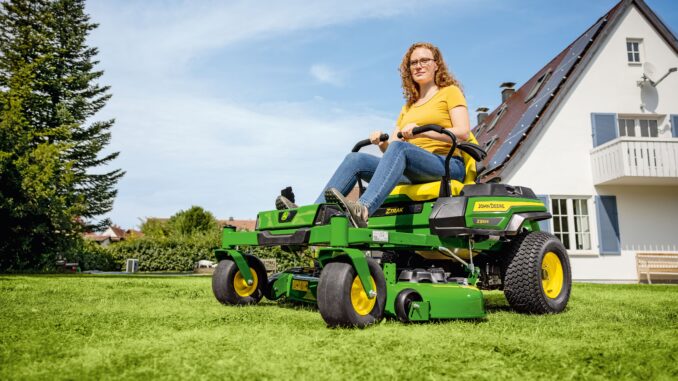
The John Deere Z950M is a commercial-grade ZTrak zero-turn mower commonly used on larger residential properties, acreage, estates, and light-to-medium professional mowing work. Deere’s Z900M-series operator literature and dealer parts references place it in the heavier-duty zero-turn range, with hydrostatic drive, a commercial mower deck, and separate engine, deck, hydraulic, electrical, and safety systems that all affect troubleshooting and maintenance decisions.
This guide is written for owners in the USA and Canada who are comfortable with routine service and some intermediate repairs. It follows a symptom-first format so the starting point is what the owner actually sees—hard starting, poor cut, belt noise, loss of drive, vibration, or electrical faults—before moving to likely causes, practical checks, and realistic DIY limits.
General overview of the John Deere Z950M
The John Deere Z950M sits in Deere’s Z900M commercial zero-turn lineup rather than the lighter homeowner-focused lawn tractor range. Deere documentation for the Z900M family emphasizes operator controls, machine ID numbers, service intervals, and deck-specific parts, which matters because a Z950M with a 60-inch deck does not use exactly the same parts as every other Z900M variant.
On a John Deere Z950M with a 60-inch deck, the key systems owners deal with most often are the engine and fuel system, air intake and ignition system, mower deck and belt drive, hydrostatic traction drive, electrical/safety switch circuit, and the hydraulic side of the drive system. In day-to-day ownership, most complaints trace back to a few high-use wear items: engine oil filter AM107423, fuel filter AM116304, primary air filter M131802, secondary air filter M131803, spark plug M805853, hydraulic filter kit MIA881446, traction drive belt TCU34299, and 60-inch deck belt TCU35604.
John Deere Z950M troubleshooting approach
Diagnosis on a John Deere Z950M should always begin with the symptom, because the same machine can show similar behavior for very different reasons. A mower that leaves uncut strips may have dull blades, wrong deck pitch, plugged baffles, low blade-tip speed from belt slip, or simply ground speed that is too fast for conditions.
The main symptom groups for this model are starting issues, running/performance issues, cut-quality problems, vibration and noise, overheating or leaks, transmission and drive complaints, and electrical or safety-interlock faults. Organizing the repair process this way prevents random parts replacement and helps owners decide early whether the job is simple service, a moderate mechanical repair, or dealer-level work.
John Deere Z950M emergency and immediate repair needs
Some John Deere Z950M problems should stop operation immediately because they create a safety hazard or can quickly damage expensive components. Belt smoke, strong fuel smell, hydraulic leaks, repeated blade impacts, major vibration, failed safety switches, or a deck spindle that is making grinding noise all fall into the “repair before using again” category.
Starting issues on a John Deere Z950M
When a John Deere Z950M will not crank or will crank but not start, the issue often looks minor at first but can leave owners chasing the wrong part. Safety interlock problems, weak batteries, poor cable connections, contaminated fuel, or clogged air and fuel filters are much more common than major internal engine failure.
Common causes:
-
Weak or failing battery, commonly TY25221 on parts lists for this model.
-
Dirty or loose battery terminals or a poor ground connection.
-
Faulty ignition switch, PTO switch, brake switch, or seat/safety interlock issue.
-
Restricted fuel flow from old fuel or a clogged AM116304 fuel filter.
-
Fouled or worn M805853 spark plug, or a heavily restricted air filter set M131802/M131803.
Basic checks:
-
Confirm the PTO is off, motion controls are in the correct start position, and the parking brake and seat conditions satisfy the interlock system.
-
Check battery voltage and inspect both terminals and grounds for corrosion or looseness.
-
Inspect fuel freshness and verify the fuel filter is not restricted or installed backward.
-
Remove and inspect the spark plug and air filter elements if the engine cranks but will not fire cleanly.
-
Stop DIY diagnosis if cranking speed is normal but there is no spark or repeated fuse/switch failure, because that usually needs deeper electrical testing.
John Deere Z950M cut-quality problems
Cut-quality complaints on a John Deere Z950M usually show up as stragglers, uneven height, clumps, scalping, or a deck that sounds loaded down. These issues matter because many owners assume the deck belt or spindle has failed when the real cause is blades, deck setup, cleaning, or mowing conditions.
Common causes:
-
Dull, bent, mismatched, or wrong-lift blades.
-
Slipping or worn 60-inch deck belt TCU35604.
-
Plugged underside of deck, damaged baffles, or packed grass limiting airflow.
-
Incorrect deck level or pitch.
-
Ground speed too high for heavy, wet, or overgrown grass.
Basic checks:
-
Inspect blades for sharpness, straightness, and correct installation orientation.
-
Check the 60-inch deck belt for glazing, cracking, frayed edges, or loss of tension.
-
Clean the underside of the deck and inspect baffles and discharge area for packed debris.
-
Verify deck level side-to-side and front-to-rear according to the operator’s setup method.
-
Test again at a slower ground speed in dry grass before assuming a hard-part failure.
Vibration and noise on a John Deere Z950M
A vibrating John Deere Z950M should never be ignored because vibration can quickly damage spindle bearings, sheaves, belts, and deck hardware. The most common trigger is blade damage from impact, but loose pulleys, worn bearings, or belt problems can create similar symptoms.
Common causes:
-
Bent or unbalanced blade after striking an object.
-
Loose blade hardware or spindle-related wear.
-
Worn idlers, sheaves, or deck bearings.
-
Belt damage or belt debris riding in pulley grooves.
-
Foreign material wrapped around spindle shafts or pulleys.
Basic checks:
-
Shut the mower down immediately and inspect all blades before running again.
-
Spin each spindle by hand with the machine secured and listen for roughness or grinding.
-
Inspect pulleys and idlers for wobble, belt dust, or heat marks.
-
Replace damaged blades in matched sets when needed rather than mixing old and new blades.
-
Hand off the job if vibration remains after blade and belt inspection, because hidden spindle or crankshaft damage is possible.
Overheating and leaks on the John Deere Z950M
Heat and leaks on a John Deere Z950M can turn into expensive repairs quickly, especially around the engine compartment and hydraulic system. Debris buildup, restricted cooling airflow, engine-oil issues, fuel leaks, and hydraulic seepage all deserve immediate attention before more runtime is added.
Common causes:
-
Grass and dust packed into engine cooling areas or around muffler and screens.
-
Low or degraded engine oil.
-
Fuel seepage from lines, caps, or filter connections.
-
Hydraulic leaks around filters, hoses, or fittings.
-
Extended operation in extreme dust or heat without shortened service intervals.
Basic checks:
-
Clean cooling screens, external engine surfaces, and debris from around hot components.
-
Verify engine oil level and service history, including AM107423 oil filter replacement timing.
-
Check for wet spots, stained hoses, or drips around fuel and hydraulic connections.
-
Stop using the mower if fuel odor is strong or hydraulic oil is visibly leaking.
-
Use dealer help if heat persists after cleaning and oil checks, especially if power drops at the same time.
John Deere Z950M transmission and drive problems
Drive complaints on a John Deere Z950M usually show up as weak pulling power, one side tracking differently, loss of speed, or a machine that feels jerky on one lap and normal on the next. On this style of zero-turn, owners should think in terms of traction drive belt condition, linkage adjustment, hydraulic condition, and whether the problem affects one side or both.
Common causes:
-
Worn or slipping traction drive belt TCU34299.
-
Hydraulic filter/service neglect, including overdue MIA881446 hydraulic filter kit maintenance.
-
Linkage or control tracking adjustment issues.
-
Air in hydraulic system after service or a leak.
-
Internal hydro wear, especially on higher-hour machines.
Basic checks:
-
Determine whether the issue is both sides or only one side; that narrows the diagnosis fast.
-
Inspect the traction drive belt and pulleys for wear, glazing, or contamination.
-
Review the hydraulic service history and inspect for filter or hose leakage.
-
Check neutral return and control linkage adjustment before assuming hydro failure.
-
Use dealer diagnosis if the mower still lacks power after belt and linkage checks, because internal hydro repair is rarely a practical homeowner DIY job.
Electrical problems on a John Deere Z950M
Electrical faults on a John Deere Z950M often look random because several safety switches work together to allow starting and PTO engagement. The practical diagnosis path is to start with battery condition, fuses, visible wiring damage, and switch symptoms before replacing major parts.
Common causes:
-
Weak battery or poor cable connections.
-
Bad ignition switch, PTO switch, or brake switch.
-
Damaged wiring near moving or hot components.
-
Corroded connectors in outdoor storage conditions.
-
Blown fuse caused by a short rather than by a bad battery.
Basic checks:
-
Test battery condition first instead of assuming a switch failure.
-
Inspect fuse condition and look for wiring rub points.
-
Check whether the symptom is “won’t crank,” “won’t engage PTO,” or “dies when control position changes,” because each points to a different part of the safety circuit.
-
Inspect ignition, PTO, and brake switch operation if the symptom is repeatable.
-
Avoid bypassing safety switches as a permanent fix, because Deere’s interlock design is part of safe operation.
DIY or dealer? Repair decision guide for the John Deere Z950M
The line on a John Deere Z950M is usually straightforward: routine service, blade work, filters, basic belt replacement, deck cleaning, and visual electrical checks are realistic DIY jobs, while hydrostatic internal repairs, deeper electrical diagnosis, engine internal work, and structural deck or spindle housing repairs are usually better left to a dealer or a very experienced technician. This mower is serviceable for a hands-on owner, but it is still a commercial machine with enough weight, stored belt tension, and safety interlocks that poor repair habits can create both injury risk and expensive secondary damage.
Good DIY jobs on a John Deere Z950M
-
Engine oil and AM107423 oil filter changes.
-
Fuel filter AM116304 replacement.
-
Primary and secondary air filter service using M131802 and M131803.
-
Spark plug M805853 inspection and replacement.
-
Blade replacement or sharpening, deck cleaning, and deck-level checks.
-
60-inch deck belt inspection and replacement when access and routing are understood.
Advanced DIY or dealer jobs for a John Deere Z950M
-
Hydraulic filter and hydro-related service if the owner is not already comfortable with hydraulic systems.
-
Spindle, sheave, and idler replacement where alignment matters.
-
Electrical fault tracing beyond simple battery, fuse, and visible switch checks.
-
PTO clutch diagnosis or replacement.
-
Internal hydro repair, engine compression issues, or persistent overheating after normal cleaning and service.
Skill level guide
-
Beginner: air filter service, engine oil checks, battery terminal cleaning, blade inspection, deck cleaning.
-
Intermediate: spark plug replacement, fuel filter replacement, deck leveling, deck belt replacement, switch testing with a meter.
-
Advanced: spindle rebuilds, PTO clutch work, hydraulic service, fault tracing through the interlock system, and hydro diagnosis.
Parts needed, OEM vs aftermarket, and what information you need for a John Deere Z950M
Before ordering parts for a John Deere Z950M, gather the full machine model, the product identification number or PIN, the engine model and serial number, and the exact deck size. Deere’s operator literature records spaces for the machine, engine, and transaxle identification numbers, and Deere parts references are set up around that information because serial breaks and deck configurations can change the correct replacement part.
OEM parts are usually the safest choice for belts, hydraulic service items, PTO and safety-switch components, and any part where fit, routing, or switch logic matters. Aftermarket parts are more acceptable for blades, batteries, and some filters if the cross-reference is exact and the seller clearly states compatibility with the John Deere Z950M 60-inch configuration rather than only the broader Z900 family.
Where to find parts diagrams and service manuals for the John Deere Z950M
The most useful sources are Deere’s operator manual pages, Deere’s Technical Information Store, Deere’s official parts storefront, and a Deere-focused maintenance or parts seller with model-specific lists. Together these cover operating procedures, service intervals, parts identification, serial-number-sensitive ordering, and quick cross-checking when an owner is not yet sure which wear item is installed.
-
John Deere operator manual — useful for controls, safety, maintenance intervals, adjustment basics, and ID-number locations.
-
John Deere Technical Information Store — useful for official manual lookup and Deere publication references.
-
Shop.Deere official parts page example — useful for confirming OEM part numbers, dimensions, and purchase channels for selected parts.
-
Green Farm Parts Z950M maintenance guide — useful as a quick model-specific service-parts list, though owners should still verify by PIN.
How to locate model, serial, and engine numbers on a John Deere Z950M
These numbers matter because the Z950M can share family-level part descriptions with other Z900 models while still using serial-break-specific switches, belts, or electrical items. Deere’s operator literature provides spaces to record machine, engine, and transaxle identification details, and those numbers are the first thing a dealer will ask for on any parts call.
-
Park the machine safely on level ground, remove the key, and let hot components cool.
-
Find the machine Product Identification Number plate on the mower chassis as described in the operator literature and record it exactly.
-
Locate the engine model and serial tag on the engine shrouding or engine area and photograph it for reference.
-
Confirm that the deck is the 60-inch version before ordering blades, belts, or spindle parts.
-
Keep the machine PIN, engine serial, and any deck tag photos together so online or dealer orders can be checked against the right configuration.
Buying John Deere Z950M parts online and in physical stores
The best buying strategy is to identify the OEM number first, then compare the exact part across official Deere sources and reputable Deere-focused sellers. That reduces the risk of ordering a generic Z900-family item that physically fits but is wrong for the John Deere Z950M 60-inch deck or the serial range on the mower.
-
Online: confirm OEM numbers, check serial/PIN notes, and compare deck-size references before buying from Shop.Deere, Green Farm Parts, or a model-specific deck parts page such as RDM Parts.
-
Dealer counter: best choice for ignition switches, PTO switches, hydraulic items, serial-break parts, and any order where the old part number has been superseded.
-
Retail stores: acceptable for common consumables like batteries, spark plugs, and some filters only if the packaging clearly cross-references the exact engine or OEM part number.
Step-by-step fitting guide for common John Deere Z950M parts
These are the highest-impact DIY service jobs for a John Deere Z950M 60-inch mower because they address the faults owners see most often: poor starting, dirty running, weak cut quality, and belt-related deck complaints. The safe approach is always to remove the key, let rotating parts stop fully, and prevent accidental PTO engagement before touching the deck or engine area.
Replacing the John Deere Z950M engine air filters
A dirty air filter set often causes hard starting, rich running, soot, and power loss. The Z950M service list identifies a primary filter M131802 and a secondary filter M131803 for routine maintenance.
-
Park safely, shut the engine off, and open the engine access area.
-
Open the air cleaner housing carefully so dirt does not fall into the intake.
-
Remove the primary element first and inspect the secondary element behind it.
-
Replace dirty or damaged elements with M131802 and M131803 as needed; do not force an element into place.
-
Clean the housing sealing surfaces and reassemble securely before restarting.
Changing the John Deere Z950M spark plug
A worn spark plug can cause hard starting, misfire, rough idle, and weak performance under load. The common plug listed for this model is M805853, but owners should still verify against the engine tag when ordering service stock.
-
Allow the engine to cool fully and disconnect the plug lead.
-
Remove the old plug and inspect it for carbon, oil fouling, or heavy wear.
-
Compare the replacement plug to the old one and verify thread reach and part number.
-
Install the new plug carefully by hand first to avoid cross-threading.
-
Reconnect the lead firmly and test-run the mower for smooth starting and idle.
Replacing John Deere Z950M blades
Blade service fixes many complaints that owners initially blame on the deck belt or spindle. Deere-focused parts sources list several blade styles for this mower, including standard-, low-, and high-lift options, so match the blade style to the deck setup and mowing conditions instead of buying by length alone.
-
Secure the mower, remove the key, and safely access the deck underside using a method approved for the machine.
-
Mark blade orientation before removal so the cutting edge and sail direction are not reversed on installation.
-
Replace bent or badly worn blades rather than trying to reuse them.
-
Install matched blades of the correct style for the 60-inch deck and tighten hardware to the manual specification.
-
Test-cut a small area and recheck for smooth operation and even cut quality.
Replacing the John Deere Z950M 60-inch deck belt
A worn deck belt can cause slow blade speed, squeal, heat, poor discharge, and uneven cutting. Deck parts sources for this configuration identify TCU35604 as the 60-inch mower deck drive belt used on Z950M deck parts listings.
-
Remove the key, lower the deck safely, and study the belt routing before removal.
-
Inspect idlers, sheaves, and guards while the old belt is still installed so any misalignment is easier to spot.
-
Release tension carefully and remove the old belt without prying against pulley flanges.
-
Route the new TCU35604 belt exactly as required for the 60-inch deck and confirm it is seated fully in each pulley groove.
-
Rotate the system by hand where safe, then test engagement briefly and recheck tracking before full mowing use.
Maintenance to prevent John Deere Z950M problems from coming back
Regular maintenance on a John Deere Z950M prevents most repeat faults because the same wear items affect starting, power, cut quality, belt life, and drive consistency. Deere-focused maintenance references also note that dusty conditions, heat, and harsh terrain justify shorter service intervals than the baseline chart.
-
Starting reliability: keep the battery charged, terminals clean, fuel fresh, air filters serviced, and the spark plug in good condition.
-
Cut quality: sharpen or replace blades on time, keep the 60-inch deck clean underneath, and inspect the deck belt before it becomes glazed or stretched.
-
Fire and overheating prevention: remove packed debris from cooling areas, screens, muffler areas, and the deck top regularly.
-
Drive performance: watch for belt wear, linkage changes, and hydraulic service neglect before the mower starts tracking poorly.
-
Electrical reliability: protect wiring, keep connectors dry and clean, and address intermittent switch symptoms early instead of bypassing them.
John Deere Z950M maintenance schedule and year-round checklist
The published maintenance structure for this mower centers on before-use checks plus recurring service at 8, 100, and 200-hour intervals for key items in the Deere-focused Z950M maintenance list. Owners should still follow the operator’s manual for the exact machine and engine, but the recurring parts schedule consistently highlights engine oil and filter service, air filters, fuel filter, and hydraulic-related upkeep.
Daily / before each use on a John Deere Z950M
-
Check engine oil level.
-
Inspect the mower for loose hardware, leaks, damaged blades, and abnormal tire condition.
-
Clean debris from cooling areas, deck top, and operator platform.
-
Verify the safety interlock system and controls operate normally.
-
Inspect belt areas and deck underside if cut quality changed on the last use.
After 8 hours on the John Deere Z950M
-
Service engine oil and oil filter at the interval indicated in the Z950M maintenance list for AM107423 and engine oil.
-
Recheck for leaks, loose fasteners, and belt dust after early operation on a newly serviced machine.
-
Clean the machine thoroughly if it has been operating in heavy dust or clippings.
Every 25 hours
-
Inspect blades, deck belt condition, idlers, and spindle area for wear or heat signs.
-
Clean or inspect air intake areas more often in dusty mowing conditions.
-
Check battery terminals and visible wiring connections.
Every 50 hours or yearly
-
Review blade condition and balance, deck level, and general cut-quality setup.
-
Inspect traction drive belt condition and visible hydro-related components.
-
Replace annual-use items sooner if the mower sees seasonal but heavy commercial-style workload.
Every 100 hours on a John Deere Z950M
-
Replace engine oil filter AM107423 and engine oil at the recurring interval shown in the maintenance list.
-
Service the primary air filter M131802 as needed at the listed interval.
-
Inspect fuel and ignition service condition before peak mowing season.
Every 200 hours or similar
-
Replace fuel filter AM116304.
-
Replace the secondary air filter M131803 and service the primary element as required.
-
Perform the larger recurring oil service indicated for the model and inspect hydraulic-service history, including MIA881446 hydraulic filter kit needs.
Seasonal checklist for the John Deere Z950M
-
Spring: change overdue oil and filters, inspect battery condition, sharpen blades, inspect the 60-inch deck belt, and test PTO engagement before heavy use.
-
Mid-season: clean cooling areas often, inspect blades and belt tracking, and shorten air-filter service intervals in dry or dusty weather.
-
Fall or storage prep: clean the mower thoroughly, inspect for leaks or belt wear, stabilize fuel as appropriate for the engine, and record any winter repair list before the next season.
Repair, upgrade, or replace a John Deere Z950M?
For a John Deere Z950M, repair usually makes sense when the machine is mechanically sound overall and the issue is limited to normal wear items such as blades, belts, filters, switches, battery, or a spindle-related repair. Upgrade makes sense when repeated cut-quality complaints, discharge performance needs, or operating conditions point toward a different blade style or more suitable maintenance setup, while full replacement is more rational when hydrostatic, engine, and deck wear all start stacking together at the same time.
Repair if…
-
The problem is isolated to normal service parts such as filters, spark plug, blades, battery, deck belt, or a switch.
-
The mower still tracks properly, starts reliably, and the deck shell and frame are sound.
-
The parts cost is modest compared with the machine’s remaining service life.
Upgrade if…
-
The mower is basically healthy but your grass conditions need a different blade style or improved maintenance routine.
-
You are repeatedly pushing wet, heavy, or fast-growth conditions and need to optimize setup before blaming the machine.
-
OEM fit-sensitive parts are being replaced, and you want to avoid repeat failures from marginal aftermarket substitutes.
Replace if…
-
The mower has major hydro, engine, and deck issues at the same time.
-
Structural repairs, repeated electrical faults, or chronic overheating are combining with high hours and poor reliability.
-
Repair cost is approaching the value of a better-condition commercial zero-turn.
Expanded troubleshooting FAQ for the John Deere Z950M
1. Why will my John Deere Z950M not start?
On this mower, start with the basic interlock conditions before assuming an engine problem. Deere’s operator material and Z950M parts references point owners toward the battery, ignition circuit, PTO switch, brake/safety inputs, fuel delivery, air filters, and spark plug as the most realistic first checks.
2. Why does my John Deere Z950M crank but not fire?
A cranking engine with no start usually means the starter circuit is doing its job but combustion is not happening correctly. Old fuel, restricted fuel flow, a fouled M805853 spark plug, clogged M131802/M131803 air filters, or an ignition-related fault are much more likely than a sudden internal engine failure.
3. Why does the John Deere Z950M battery keep going dead?
Repeated battery discharge often comes from poor connections, a weak battery, charging issues, or an intermittent electrical fault rather than from normal storage alone. TY25221 is a common replacement battery listing for this model, but owners should inspect cables and grounds first so they do not replace a good battery and leave the real cause in place.
4. Why does my John Deere Z950M start and then stall?
A start-then-stall symptom often points to fuel restriction, interlock behavior, or a dirty air system. Check whether the stall is linked to seat movement, PTO engagement, or control-position changes, because that helps separate safety-circuit faults from fuel and ignition issues.
5. Why does my John Deere Z950M run rough at full throttle?
Rough running under load usually comes from dirty air filters, plug issues, fuel restriction, or overheating from debris-packed cooling areas. Since this machine often works in dusty mowing conditions, air-service neglect is one of the first things to rule out.
6. Why is my John Deere Z950M low on power in tall grass?
Low power in grass does not always mean the engine is failing. Dull blades, a slipping deck belt, plugged underside of the deck, fast travel speed, and overdue air or fuel service can all reduce cutting performance and make the engine feel weaker than it really is.
7. Why does the John Deere Z950M leave uncut strips?
Uncut strips usually come from blade condition, blade type, deck setup, or blade-speed loss rather than from one dramatic failure. Inspect blade sharpness and style, clean the underside of the deck, and check the 60-inch belt TCU35604 before moving on to spindle or pulley diagnosis.
8. Why is the cut uneven on my John Deere Z950M?
Uneven cutting usually traces back to deck level, tire condition, blade wear, or mowing speed in rough terrain. This is why a symptom-first approach matters: a mower can look mechanically serious when the fix is actually deck adjustment and blade service.
9. Why does my John Deere Z950M scalp the lawn?
Scalping often means the deck setup is wrong for the terrain or the mower is running too low and too fast over uneven ground. Before changing hard parts, check deck height, anti-scalp rollers, blade condition, and whether the area is being cut too aggressively for its contour.
10. Why does the John Deere Z950M clump grass badly?
Clumping usually happens when airflow is reduced or the machine is being pushed too hard for the conditions. Wet grass, packed deck buildup, wrong blade style, and reduced blade speed from a worn belt are common reasons.
11. Why does my John Deere Z950M vibrate when the blades are engaged?
If vibration begins with PTO engagement, focus on the deck side first. Bent blades, a damaged spindle, loose hardware, belt damage, or pulley problems are much more likely than a traction-drive issue.
12. Why is the John Deere Z950M making a squealing noise?
A squeal often means a belt is slipping or an idler or pulley bearing is complaining. On a 60-inch machine, inspect the deck belt TCU35604 and the traction belt TCU34299 before running the mower longer, because heat and belt dust can quickly lead to a bigger failure.
13. Why does my John Deere Z950M have heavy blade vibration after hitting something?
That symptom should be treated as an immediate shutdown issue. Blade damage after impact can transfer stress into the spindle, sheave, and even the engine side of the drive if the mower is kept in service.
14. Why does the John Deere Z950M burn through deck belts?
Repeat belt failure usually means something besides age is wrong. Misrouting, worn pulleys, seized idlers, spindle drag, debris in pulley grooves, or a belt that is wrong for the exact 60-inch configuration are all realistic causes.
15. What deck belt does a John Deere Z950M 60-inch use?
Deck parts sources for the 60-inch Z950M configuration identify TCU35604 as the mower deck drive belt. Because Deere parts can change by deck and serial range, it is still wise to verify by PIN before ordering multiple spares.
16. What traction drive belt fits the John Deere Z950M?
Deere-focused Z950M parts references list TCU34299 as the traction drive belt. If the mower has drive complaints, inspect the belt and pulleys first, but do not assume every tracking or weak-drive symptom is caused by the belt alone.
17. Which spark plug does a John Deere Z950M use?
A common Z950M parts listing shows spark plug M805853. Since engine-tag verification is always smart on commercial mowers, use the current plug and engine identification to confirm the match before stocking extras.
18. Which filters should I keep on hand for a John Deere Z950M?
The recurring service items most worth stocking are AM107423 engine oil filter, AM116304 fuel filter, M131802 primary air filter, M131803 secondary air filter, and usually the M805853 spark plug. Owners who mow a lot of acreage also often keep a spare deck belt and blade set ready to go.
19. Why does my John Deere Z950M overheat?
Overheating is commonly linked to debris-packed cooling areas, restricted airflow, or neglected oil service rather than a major internal failure. Because zero-turns ingest dust and dry clipping residue quickly, regular cleaning around hot engine components matters as much as parts replacement.
20. Why do I smell fuel on my John Deere Z950M?
Fuel odor is never something to ignore. Stop using the mower and inspect the cap, filter connections, fuel lines, and the area around the engine for seepage or wetness before restarting.
21. Why is hydraulic oil leaking on my John Deere Z950M?
Hydraulic leakage can come from filters, hose connections, or component seals and should be addressed early. If the leak is obvious and external, owners can inspect it visually, but internal hydro problems or recurring seepage after a filter service usually justify dealer-level diagnosis.
22. Why is my John Deere Z950M weak on one side?
One-side weakness usually points to a side-specific hydro, linkage, or wheel-drive issue rather than a general engine problem. Determine whether the fault is only in forward, only in reverse, or in both directions, then inspect linkage and belt condition before assuming the hydro unit is failed.
23. Why does the John Deere Z950M not track straight?
Tracking problems can come from linkage adjustment, tire differences, hydro response variation, or wear that affects one side more than the other. Start with visible and adjustable items first, because that is far cheaper and more realistic than jumping straight to hydro replacement.
24. Why does my John Deere Z950M jerk when moving?
Jerky motion can result from belt slip, linkage issues, air in the hydraulic system after service, or hydro wear. The useful first question is whether the symptom appeared suddenly after maintenance or gradually over time, because that changes where to look first.
25. Why won’t the PTO engage on my John Deere Z950M?
If the PTO will not engage, think electrical and interlock system before replacing the clutch. Deere-focused parts references list PTO switches such as AUC11003 and TCA21027 for Z950M applications, so switch, brake, seat, and wiring checks should happen before clutch replacement.
26. Why does my John Deere Z950M shut off when I move the controls?
That usually points to the safety system reacting to an unsafe or incorrect operating condition, or to a switch or wiring issue. Check whether the brake, seat, and PTO conditions are correct and whether the symptom happens in a repeatable pattern.
27. Why does my John Deere Z950M blow a fuse?
A blown fuse is usually a symptom, not the root cause. Look for rubbed wiring, moisture in connectors, shorted accessories, or a switch failure before simply installing more fuses and hoping the problem goes away.
28. How often should I change the oil on a John Deere Z950M?
The Deere-focused maintenance list for this model shows engine oil and AM107423 oil filter service recurring at 8, 100, and 200-hour points in its schedule summary. Owners should confirm the exact engine and operating conditions against the operator’s manual, especially if the mower runs in heat, dust, or severe service.
29. How often should I replace the air filters on a John Deere Z950M?
The maintenance list ties primary and secondary air-filter service to recurring 100 and 200-hour intervals, with more frequent attention in dirty conditions. In real use, dust level matters as much as the hour meter, so owners who mow dry ground or roadside edges often need to inspect far sooner.
30. How often should I replace the fuel filter on a John Deere Z950M?
The Z950M service-parts list identifies AM116304 and shows a 200-hour replacement interval in its maintenance summary. If fuel quality has been questionable or the mower has sat for a long period, inspection may be needed sooner than the routine interval.
31. Should I use OEM belts on a John Deere Z950M?
OEM belts are usually the smarter choice on this mower because belt fit, length, side profile, and routing tolerance directly affect blade speed and belt life. Deere’s own parts listings and model-specific references make it clear that exact belt identification matters, especially on deck-drive and traction-drive applications.
32. Are aftermarket blades OK for a John Deere Z950M?
Aftermarket blades can be acceptable if the lift profile, length, center hole, thickness, and application match the exact deck configuration. The mistake is buying only by deck width and ignoring whether the mower was set up for standard-, high-, low-, or mulch-oriented blades.
33. Why does my John Deere Z950M cut better after I slow down?
Because mowing speed directly affects how much grass the deck can process per second. When grass is heavy or wet, reducing speed gives the deck more time to cut, lift, and discharge clippings cleanly instead of recutting or leaving stragglers.
34. Can a homeowner service a John Deere Z950M?
Yes, many routine jobs are realistic for a careful owner with basic tools. Filters, spark plug, blades, battery work, deck cleaning, and some belt work are practical DIY tasks, but hydro repair, advanced electrical tracing, and major spindle or PTO diagnosis are usually better left to a dealer.
35. When should I stop troubleshooting my John Deere Z950M and call a dealer?
Stop DIY work when the mower has persistent no-spark issues, repeated fuse failures, major vibration after blade inspection, strong fuel smell, hydraulic leakage, internal hydro symptoms, or overheating that continues after normal cleaning and service. Those are the points where continued guessing can cost more than proper diagnosis.