
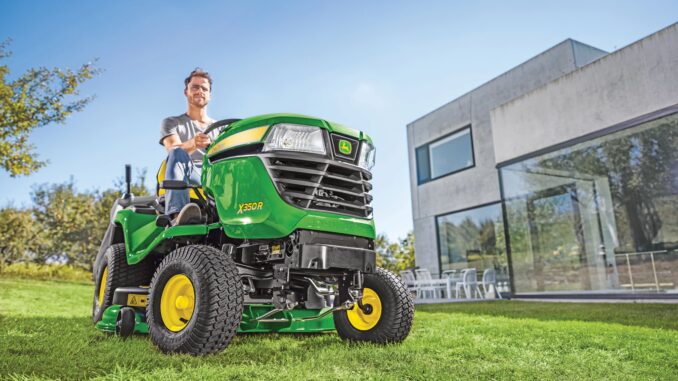
The John Deere S180 is a 100 Series lawn tractor built around a 24 hp V-twin engine, a 54-inch Edge mower deck, electric PTO engagement, and a heavy-duty hydrostatic transmission with side-by-side pedals. This guide is written for homeowners in the USA and Canada who want a practical, symptom-first reference for troubleshooting, repair decisions, routine maintenance, parts lookup, and common service jobs.
The S180 sits toward the upper end of the 100 Series lineup and is aimed at larger home lawns where owners want more deck width and a stronger V-twin setup than smaller entry-level models. The sections below cover what commonly goes wrong, what to check first, which jobs are realistic DIY work, which parts owners frequently replace, and how to maintain the machine on the intervals listed by John Deere.
General overview of the John Deere S180
The John Deere S180 belongs to the 100 Series lawn tractor family covered by operator’s manual OMUC22642 for S100, S110, S120, S130, S140, S160, S170, and S180 tractors. In that range, the S180 combines a 54-inch deck with electric PTO controls, making it better suited to medium-to-large residential mowing than smaller 42-inch models in the same family.
Its key systems are straightforward for a homeowner to understand. The engine and fuel system include a gasoline V-twin engine, air filter, fuel filter, spark plugs, and engine oil/filter service points. The mower system centers on the 54-inch Edge deck, three blades, deck belt, deck spindles, anti-scalp wheels, and deck leveling hardware. The drive system uses a hydrostatic transmission with forward and reverse pedals, while the electrical system includes the battery, key switch, PTO switch, fuse area, wiring, and seat/brake safety interlocks.
Several common service parts owners regularly buy for the S180 are clearly identified in Deere’s parts and maintenance sheet. These include the 54-inch mower blade set GY20679, the 54-inch mower deck belt GX21395, the Easy Change oil filter assembly AUC12916, fuel filter GY20709, and air filter GY21057.
John Deere S180 troubleshooting approach
A good diagnosis starts with the symptom the owner sees, not with random parts swapping. On the S180, the main symptom groups are starting problems, poor running, weak or uneven cut quality, vibration and noise, overheating or fluid leaks, drive or traction complaints, and electrical or safety-switch issues.
That symptom-first approach matters because one fault can create several complaints. For example, a loose or worn deck belt can show up as weak cutting, blade-speed loss, belt noise, or visible belt dust, while debris around cooling areas can contribute to overheating risk and even fire danger.
Emergency and immediate John Deere S180 repair needs
Some S180 problems should be handled before the tractor is used again because they affect safety or can quickly damage expensive parts. These include fuel leaks, missing guards, severe blade vibration, damaged wiring, inoperative safety switches, belt failures, and heavy debris buildup around hot engine or muffler areas.
John Deere S180 starting issues
If the S180 will not crank, only clicks, or starts and stalls, the machine may be disabled by a basic interlock or a low-voltage condition rather than a major engine fault. Leaving these problems unresolved can strand the tractor and can also lead to unnecessary battery, starter, or switch replacement.
-
Common causes:
-
Weak battery or poor cable connection.
-
Brake not fully applied or operator not seated correctly for the safety circuit.
-
PTO left engaged.
-
Dirty fuel, restricted fuel filter, or stale gasoline.
-
Fouled spark plug or restricted air filter.
-
Confirm the PTO switch is off, the brake is set, and the operator is seated correctly.
-
Check battery terminals for looseness or corrosion and inspect nearby wiring on the left side near the fuse block.
-
Verify fuel quality and filter condition, then inspect the air filter and spark plugs.
-
If the engine cranks normally but will not fire, move on to spark, fuel delivery, and plug condition before ordering parts.
John Deere S180 cut-quality problems
Poor cut quality on the S180 usually shows up as ragged tips, streaks, uncut strips, clumping, or scalping. These issues matter because they often point to blade-speed loss, a deck setup problem, or worn cutting parts rather than just wet grass.
-
Common causes:
-
Dull, bent, or mismatched blades.
-
Worn or slipping deck belt.
-
Deck out of level side-to-side or front-to-rear.
-
Anti-scalp wheels set incorrectly.
-
Grass packed under the deck or mowing too fast for conditions.
-
Inspect blades and blade hardware before anything else.
-
Check deck level; Deere specifies side-to-side blade tip difference no more than 1/8 inch and front blade tip 1/8 to 1/4 inch lower than the rear.
-
Inspect the deck belt for glazing, cracking, or stretch.
-
Clean the underside and top of the deck and confirm anti-scalp wheel adjustment is correct.
John Deere S180 vibration and noise
A sudden vibration on the S180 should be treated as an immediate stop-and-check problem. Continuing to mow with vibration can damage spindle bearings, belts, pulleys, and deck hardware, and it can also become a blade safety issue.
-
Common causes:
-
Bent or damaged blade.
-
Blade bolt looseness or debris packed around a spindle.
-
Failing spindle bearings or damaged pulley.
-
Belt damage or pulley misalignment.
-
Shut the machine down and inspect blades for bends, cracks, or impact damage.
-
Check blade mounting security and look for wrapped wire or heavy grass buildup around spindle areas.
-
Inspect the belt and pulleys for wear or wobble.
-
Do not keep mowing until the vibration source is identified.
John Deere S180 overheating and leaks
The S180 operator’s manual puts strong emphasis on keeping the machine clean because debris around hot or moving parts can create a fire hazard. Overheating, oily buildup, fuel smell, or smoke should always be investigated right away.
-
Common causes:
-
Grass and debris packed around the muffler, manifold, engine screens, cooling fins, or oil cooler area.
-
Oil leak attracting dust and debris.
-
Fuel line, cap, or filter leakage.
-
Heavy buildup around transmission or driveline areas.
-
Inspect the muffler, shield, manifold, engine intake screen, cooling fins, deck top, transmission area, and battery/fuse side panel area.
-
Clean all packed debris only with the engine off and cooled down.
-
Trace any wet area to find whether it is engine oil or fuel.
-
Replace leaking fuel-system parts before further use.
John Deere S180 transmission and drive problems
Drive complaints on the S180 usually appear as weak uphill pull, slow response, loss of ground speed, or inconsistent forward and reverse movement. Sometimes the cause is not the transmission itself but tire condition, brake drag, linkage issues, or owner expectations on slopes and heavy towing.
-
Common causes:
-
Brake not fully releasing.
-
Debris or damage around driveline and transmission area.
-
Slope use beyond safe operating limits.
-
Tire pressure issues reducing traction.
-
Check tire pressure and confirm the brake fully releases.
-
Inspect underneath for debris buildup around transmission and driveline areas.
-
Test operation on level ground before assuming internal transmission failure.
-
If performance remains poor with no obvious external cause, dealer diagnosis is the safer next step.
John Deere S180 electrical problems
Electrical issues on the S180 can range from a simple blown fuse or corroded battery terminal to a failed switch or damaged harness. Because the machine relies on safety interlocks, a small electrical fault can also mimic a starting or PTO problem.
-
Common causes:
-
Weak battery or dirty terminals.
-
Fuse or wiring problem near the left side panel area.
-
Faulty PTO switch, seat switch, or brake interlock.
-
Moisture or corrosion in connectors.
-
Check battery condition and cable tightness first.
-
Inspect the fuse and nearby harness routing on the left side panel area.
-
Confirm the PTO and safety-switch functions match normal starting procedure.
-
If the fault is intermittent or requires circuit testing, move the job into advanced DIY or dealer territory.
DIY or dealer for John Deere S180 repairs
For the S180, the usual dividing line is simple: routine service, deck setup, blades, belts, filters, and basic electrical checks are realistic DIY work for many owners, while internal engine, hydrostatic transmission, major electrical diagnosis, and valve-clearance work are better left to a dealer or an experienced technician.
Good DIY jobs
-
Engine oil and Easy Change oil filter service where applicable.
-
Air filter and fuel filter replacement.
-
Spark plug service.
-
Blade sharpening or replacement.
-
Deck belt inspection and replacement.
-
Deck leveling and anti-scalp wheel adjustment.
-
Battery replacement and terminal cleaning.
Advanced DIY or dealer jobs
-
Electrical diagnosis with a meter when safety interlocks or PTO circuits are intermittent.
-
Spindle replacement if pulleys are seized or heavily corroded.
-
Internal hydrostatic transmission diagnosis.
-
Engine valve-clearance check and adjustment, which Deere lists at 200 hours and directs to the dealer.
-
Internal engine repairs, charging-system faults, and wiring-harness repairs.
Skill level guide
-
Beginner: Air filter, fuel filter, battery, basic blade removal, deck cleaning, tire-pressure checks.
-
Intermediate: Deck belt replacement, spark plugs, deck leveling, switch testing, blade sharpening/balancing.
-
Advanced: Spindle work, electrical fault tracing, major driveline diagnosis, engine adjustments.
John Deere S180 parts needed, OEM vs aftermarket, and what information you need
Before ordering S180 parts, gather the full model name, the tractor Product Identification Number, the engine serial number, and confirmation that the machine is using the 54-inch mower deck. Deere specifically states that dealers need the serial number or PIN when parts are ordered, and the operator’s manual also provides space to record the engine serial number.
OEM parts make the most sense for belts, safety switches, fit-sensitive deck parts, and anything that directly affects guarding or operator safety. Aftermarket parts can be reasonable for batteries, some blades, filters, and tune-up items, but only when the listing clearly cross-references the S180 and the 54-inch deck configuration.
Where to find parts diagrams and service manuals
The most useful S180 references are Deere’s operator’s manual, Deere’s technical publications portal, JDParts, and a model-specific dealer sales or parts page. Each source serves a different purpose, so using them together usually saves time and reduces wrong-part orders.
-
Official operator’s manual PDF — Best for service intervals, safety procedures, deck leveling specs, operator controls, and troubleshooting basics.
-
John Deere Technical Information Store — Best for purchasing technical publications and parts catalog information beyond the operator’s manual.
-
JDParts / Deere parts ordering — Best for parts lookup and ordering by model and serial-sensitive configuration.
-
John Deere S180 product page example — Useful for quick confirmation of engine/deck basics and model positioning.
How to locate John Deere S180 model, serial, and engine numbers
These numbers matter because Deere uses them to match the correct configuration, parts, and service information. Ordering parts without the PIN and engine data increases the risk of getting the wrong components, especially when engines or running changes differ by serial range.
-
Park the tractor safely on level ground, remove the key, and let hot parts cool.
-
Locate the tractor Product Identification Number on the left side of the frame; Deere illustrates that PIN location in the manual.
-
Record the full PIN exactly as shown on the tag.
-
Find the engine serial number at the engine location shown in the manual for the V-twin engine.
-
Confirm that the machine is the S180 with the 54-inch deck before ordering mower parts.
Buying John Deere S180 parts online and in stores
The best buying strategy is to confirm the OEM number first, then compare availability across Deere and reputable mower-parts sellers. This is especially important for the S180 because belts, blades, and deck parts must match the 54-inch setup, while engine consumables should match the actual engine serial and specification.
-
Online: Use the OEM number and verify S180 plus 54-inch deck compatibility before checkout; Deere points owners to JDParts for ordering and information.
-
Dealer counter: Best for serial-sensitive parts, switch issues, wiring, and anything unclear from a generic listing.
-
Retail stores: Fine for oil, batteries, spark plugs, and common filters if the packaging clearly cross-references the S180 or the exact OEM part number.
-
Helpful URLs: JDParts, Technical Publications, and a dealer S180 page such as AHW John Deere S180.
Step-by-step fitting guide for common John Deere S180 parts
The jobs below cover the S180 service items most owners replace to fix poor running, hard starting, weak cut quality, and general neglect-related problems.
Replacing the John Deere S180 air filter
A restricted air filter can make the S180 run rich, lose power, and foul plugs sooner.
-
Park safely, remove the key, and let the engine cool.
-
Open the air cleaner housing and remove the old element and precleaner if fitted.
-
Wipe out loose debris without pushing dirt into the intake.
-
Install the correct replacement air filter, listed on Deere’s S180 parts sheet as GY21057.
-
Refit the cover securely and inspect the surrounding intake area for debris.
Replacing the John Deere S180 fuel filter
Fuel starvation, surging, or no-start complaints can come from a restricted fuel filter.
-
Work in a ventilated area with the engine cool and no ignition sources nearby.
-
Clamp or manage the fuel line as needed to reduce spillage.
-
Remove the old filter and note the direction of fuel flow.
-
Install the replacement filter; Deere’s S180 sheet lists fuel filter GY20709.
-
Check carefully for leaks before returning the tractor to service.
Replacing John Deere S180 blades
Blade replacement is one of the biggest improvements you can make when the S180 starts leaving ragged grass, strips, or excess clumping.
-
Park safely, disconnect spark plug wires or the battery negative cable, and wear gloves.
-
Raise and secure access safely, then remove the blade hardware.
-
Inspect each blade and replace worn or damaged blades in complete sets as Deere recommends.
-
Install the correct 54-inch blade set; Deere lists GY20679 for the three-blade pack.
-
Tighten hardware to specification from the manual or parts literature and confirm blades rotate freely by hand with the engine disabled.
Replacing the John Deere S180 deck belt
A worn deck belt often causes blade-speed loss, squeal, poor discharge, and an uneven cut on the S180.
-
Park safely, lower the deck as needed, and disable accidental starting.
-
Note the belt routing before removal or use the routing decal and parts diagram.
-
Remove the old belt from the deck pulleys and inspect pulleys and spindle areas for damage or buildup.
-
Install the correct 54-inch mower deck belt, GX21395, making sure the belt sits fully in pulley grooves.
-
Test PTO engagement briefly and recheck tracking before mowing normally.
Maintenance to prevent John Deere S180 problems reoccurring
Regular service matters more on the S180 than many owners realize because small issues like debris buildup, dull blades, or neglected filters often trigger bigger problems later. Deere’s maintenance sheet and manual focus heavily on cleanliness, lubrication, filter service, blade condition, and deck-drive inspection.
-
Starting reliability: Keep the battery connections clean, replace stale fuel, service the fuel filter, and keep the air filter in good condition.
-
Cut quality: Keep blades sharp, deck level correct, anti-scalp wheels adjusted properly, and the deck belt in serviceable condition.
-
Fire and overheating prevention: Remove grass and debris from the muffler, engine screens, cooling fins, deck top, and transmission area before and after use.
-
Drive performance: Check tire pressures, inspect for driveline-area buildup, and do not ignore brake drag or sudden performance changes.
-
Electrical reliability: Keep battery terminals tight and inspect the fuse and wiring area under the left side panel.
John Deere S180 maintenance schedule and year-round checklist
John Deere lists a simple but important service pattern for the S180, with daily checks plus service points at 8 hours, 25 hours, 50 hours or yearly, and 200 hours. Using those intervals is the best way to prevent repeat failures and to catch wear items before they damage other components.
Daily or before each use
-
Check and test safety systems.
-
Check tire pressure and brakes.
-
Check fuel level and engine oil level.
-
Remove grass and debris from the engine compartment, muffler area, and top of mower deck before and after operating.
-
Clean the air intake screen.
-
Check below the machine for fluid leaks and tighten loose hardware.
After 8 hours
-
Lubricate mower spindles and pivot points.
-
Lubricate front axle pivot and axle spindles.
-
Lubricate front axle wheel bushings.
Every 25 hours
-
Check or replace the mower drive belt.
-
Lubricate mower spindles and pivot points.
-
Lubricate front axle pivot and axle spindles.
-
Lubricate front axle wheel bushings.
Every 50 hours or yearly
-
Change engine oil and replace the filter.
-
Clean or replace the air filter precleaner and element, more often in dusty conditions.
-
Replace the fuel filter.
-
Sharpen or replace mower blades.
Every 200 hours
-
Check and adjust valve clearance through a John Deere dealer.
Seasonal John Deere S180 checklist
-
Spring: Change engine oil/filter if due, inspect blades, inspect the deck belt, clean the machine thoroughly, and confirm deck level before peak mowing starts.
-
Mid-season: Recheck blade sharpness, remove buildup from cooling and deck areas, and inspect belts and filters in dusty conditions.
-
Fall or end of season: Clean the tractor thoroughly, inspect for leaks or worn parts, service filters as due, and store the machine only after combustible debris is removed and hot parts have cooled.
Repair, upgrade, or replace the John Deere S180?
For most homeowners, the S180 is worth repairing when the chassis, engine, deck shell, and transmission are still fundamentally sound because common maintenance parts are easy to source and many failures are routine wear issues. Upgrade decisions usually come into play when mowing conditions have outgrown the tractor or when attachment needs, property size, or repeated heavy-duty use point toward a stronger platform.
Repair if…
-
The issue is a normal wear item such as blades, filters, battery, or deck belt.
-
The tractor starts and drives well but has cut-quality or maintenance-related problems.
-
The deck shell, frame, and wiring are still in good shape.
Upgrade if…
-
You consistently need more durability, attachment capability, or a heavier-duty machine than a 100 Series tractor is designed for.
-
Your lawn size and mowing hours justify stepping above a residential platform.
-
Repeated repairs are tied to operating demands rather than simple wear items.
Replace if…
-
The machine has combined engine, transmission, and deck damage that pushes repair cost beyond realistic homeowner value.
-
Safety-related issues such as severe structural deck damage or chronic electrical problems make the tractor unreliable.
-
Parts and labor needed exceed the value of the tractor compared with a sound replacement unit.
John Deere S180 troubleshooting FAQ
1. Why will my John Deere S180 not start?
The most common causes are a discharged battery, PTO engaged, brake not fully set, seat-switch/interlock issues, stale fuel, or a restricted fuel or air system. Start with the basic operator interlocks, then check battery terminals, fuel condition, air filter condition, and spark plug condition before replacing bigger parts.
2. Why does my John Deere S180 click but not crank?
A click with no crank often points to low battery voltage, corroded battery terminals, or a poor cable connection rather than a failed engine. Check cable tightness and corrosion first, then load-test the battery if the problem repeats.
3. Why does my John Deere S180 crank but not fire?
If the engine cranks normally but will not start, focus on fuel delivery, stale fuel, spark plug condition, and air restriction. A clogged fuel filter or badly fouled plugs can create this exact symptom on homeowner tractors.
4. Why does my John Deere S180 start and then stall?
A partially restricted fuel filter, contaminated fuel, or a choke or air-filter problem can make the engine start and die quickly. Check the fuel filter, fuel freshness, and air cleaner before assuming a carburetor or ignition failure.
5. Why is my John Deere S180 running rough?
Rough running usually comes from dirty fuel, an overdue air filter, fouled spark plugs, or debris affecting engine cooling and breathing. Service the easy consumables first because they are common failure points and low-cost checks.
6. Why does my John Deere S180 lose power while mowing?
Power loss under load often means the engine is struggling with airflow, fuel flow, or excessive deck load from dull blades or packed grass. Clean the deck, inspect the air filter, and make sure the blades and belt are in good condition.
7. Why does my John Deere S180 backfire or pop?
Backfiring can happen with fuel-quality problems, ignition issues, or operating conditions that upset normal combustion. Check for stale fuel, poor tune-up condition, and obvious intake or exhaust issues before digging deeper.
8. Why is my John Deere S180 hard to start when cold?
Cold-start problems are commonly linked to weak battery condition, fuel quality, poor plug condition, or an overdue air-filter service. Verify the throttle/choke procedure is correct and then work through those routine maintenance items.
9. Why does my John Deere S180 battery keep going flat?
Repeated battery discharge can come from loose terminals, corrosion, age, poor charging, or a tractor that sits too long between uses. Clean and tighten the terminals first, then test battery and charging performance if the issue continues.
10. Why does my John Deere S180 blow fuses?
A blown fuse points to a wiring short, pinched harness, moisture intrusion, or a failed electrical component. Inspect the fuse-block and left-side wiring area carefully, because the manual specifically identifies that zone as one of the machine cleanout and inspection areas.
11. Why will the PTO on my John Deere S180 not engage?
The S180 uses an electric PTO engagement system, so faults can involve the switch, wiring, safety interlocks, or battery voltage. Check that the operator conditions are correct first, then inspect fuse, wiring, and switch behavior before assuming clutch failure.
12. Why are the blades on my John Deere S180 not spinning?
If the engine runs but the blades do not spin, the deck belt may be broken or off, the PTO may not be engaging, or the pulley system may have a mechanical fault. A visual belt inspection is one of the fastest and most useful first checks.
13. Why does my John Deere S180 leave uncut strips?
Uncut strips are usually caused by dull blades, low blade speed, deck-level errors, or overlapping too little when mowing. Start with blade condition and deck level because Deere provides clear deck-level specifications in the manual.
14. Why is my John Deere S180 cutting unevenly?
An uneven cut commonly means the deck is out of level, tire pressures are uneven, blades are worn, or the deck wheels are adjusted incorrectly. Measure deck level on a flat surface and correct tire pressure before replacing parts.
15. Why does my John Deere S180 scalp the lawn?
Scalping usually comes from low cutting height, incorrect anti-scalp wheel position, or deck pitch and level problems. The manual notes that deck wheels should sit slightly off the ground in normal setup and be adjusted with mowing height in mind.
16. Why does my John Deere S180 leave ragged grass tips?
Ragged tips almost always point to dull blades or grass being torn instead of cleanly cut. Sharpen or replace the blades as a set and recheck deck speed and belt condition.
17. Why does my John Deere S180 clump grass?
Clumping comes from heavy or wet growth, mowing too fast, low blade speed, or excess buildup under the deck. Clean the deck, sharpen the blades, and reduce ground speed in tough conditions.
18. Why does my John Deere S180 cut lower on one side?
That symptom usually means the deck is not level side-to-side or tire pressures differ enough to tilt the machine. Deere’s manual says the blade-tip difference side-to-side should not exceed 1/8 inch.
19. Why is my John Deere S180 deck belt squealing?
Belt squeal usually means belt wear, glazing, contamination, poor routing, or pulley issues. Inspect the belt for cracking and glazing and check pulley condition before installing a replacement.
20. Why does my John Deere S180 keep throwing or breaking the deck belt?
Repeated belt problems usually mean a worn pulley, spindle drag, routing problem, or debris damage rather than just a bad new belt. Inspect the full belt path and spindle condition before fitting another belt.
21. Why is my John Deere S180 vibrating badly?
Severe vibration is commonly caused by a bent blade, damaged spindle, loose hardware, or debris wrapped around rotating parts. Stop mowing immediately and inspect blades and spindle areas before using the tractor again.
22. Why does my John Deere S180 make a knocking noise from the deck?
A deck knock can come from a loose blade, blade contacting debris, bad spindle bearings, or pulley trouble. Do not keep mowing until the cause is identified because secondary damage can build quickly.
23. Why is one spindle on my John Deere S180 getting hot?
An overheating spindle usually suggests bearing failure, over-tight drag, debris intrusion, or damage after an impact. That is usually beyond routine maintenance and often becomes an advanced DIY or dealer repair.
24. Why does my John Deere S180 smell hot after mowing?
A hot smell can simply be normal warm components, but it can also mean grass packed near the muffler, engine screens, deck top, or transmission area. Deere specifically warns that debris around hot or moving parts can create fire risk, so inspect and clean the machine thoroughly.
25. Why is my John Deere S180 leaking fuel?
Fuel leaks can come from lines, fittings, the filter area, or the tank/cap system. Stop using the tractor until the leak is found and corrected because fuel leaks are both a fire and reliability problem.
26. Why is my John Deere S180 leaking oil?
Oil leaks often start small and then attract dirt and grass that make diagnosis harder. Clean the area first, identify the source, and repair it before debris accumulation creates a heat or fire issue.
27. Why does my John Deere S180 lose drive power on hills?
Poor hill performance can be caused by traction loss, tire issues, brake drag, or demands that exceed safe operating limits. Deere also warns against operating beyond the slope guidance in the manual, because control and rollover risk increase as slope increases.
28. Why does my John Deere S180 move slowly in forward or reverse?
If both directions feel weak, start with brake release, tire pressure, and underside inspection around driveline areas. If those checks do not reveal the issue, dealer diagnosis is usually smarter than guessing at internal hydrostatic problems.
29. Why does my John Deere S180 creep when parked or feel hard to stop?
A creeping or braking complaint can indicate linkage adjustment issues, brake drag, or a transmission-related problem. Basic external checks are reasonable DIY work, but repeated symptoms should be evaluated before the tractor is used on slopes or near hazards.
30. How often should I service my John Deere S180?
Deere’s published intervals for the S180 include daily checks, lubrication after 8 hours, mower-belt inspection at 25 hours, yearly or 50-hour service for oil/filter, air filter, fuel filter, and blades, plus valve-clearance inspection at 200 hours through a dealer. Dusty conditions justify more frequent air and oil attention.
31. How often should I change the oil on a John Deere S180?
The S180 maintenance sheet lists engine oil and filter service yearly or every 50 hours, whichever comes first. If mowing conditions are dusty or especially demanding, service more often than the base interval.
32. How often should I replace the air filter on a John Deere S180?
John Deere lists cleaning or replacing the air filter precleaner and element yearly or every 50 hours, whichever comes first, with more frequent service in dusty conditions. If the tractor operates in dry summer dust, checking it earlier is sensible.
33. How often should I replace the fuel filter on a John Deere S180?
The published maintenance sheet calls for fuel filter replacement yearly or every 50 hours. Replacing it on schedule is a simple way to prevent fuel-starvation complaints and hard starting.
34. When should I sharpen or replace John Deere S180 blades?
Deere lists blade sharpening or replacement yearly or every 50 hours, but many homeowners need attention sooner depending on acreage, ground conditions, and debris strikes. If cut quality drops, inspect the blades right away instead of waiting for the calendar.
35. Should I buy OEM or aftermarket parts for my John Deere S180?
OEM is the safer choice for belts, safety-related parts, and fit-sensitive components because exact routing and fit matter on the 54-inch deck and electrical systems. Aftermarket can be acceptable for some consumables when the seller clearly cross-references the exact S180 application and OEM number.