
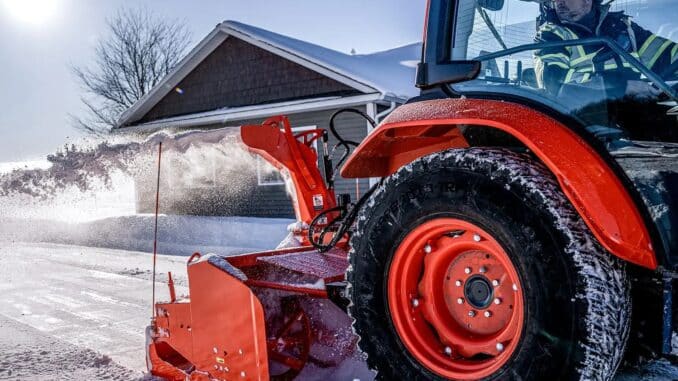
Kubota B2781B Snow Blower Guide
The Kubota B2781B is a 51-inch, two-stage, front-mounted tractor snow blower. It uses a compatible tractor’s mid-PTO drive arrangement and front quick hitch rather than its own engine. Buying or installing one requires more than matching the Kubota name: the tractor, hitch, driveline, controls, and mounting hardware must form an approved combination.
Its forward-facing position suits driveway and property snow removal without the sustained backward operation associated with a conventional rear-mounted blower. However, missing mounting components, incorrect ballast, worn driveline parts, and unsuitable skid-shoe settings can make an otherwise serviceable attachment expensive or unsafe to use.
This guide covers identification, compatibility checks, installation, traction, operating technique, maintenance, troubleshooting, and off-season storage.
Kubota B2781B Specifications and Design
The B2781B uses an auger to gather snow and feed it into a separate discharge fan, or impeller. This two-stage arrangement moves snow through the chute rather than simply pushing it into banks.
The following specifications apply to the B2781B covered by the attachment manual for serial number 21503940 and higher. Match the manual to the identification plate before applying specifications or ordering parts.manualslib
| Item | B2781B specification |
|---|---|
| Attachment type | Front-mounted, two-stage snow blower |
| Cutting width | 51 inches, or 1,295 mm |
| Cutting height | 22.63 inches, or 575 mm |
| Listed operating weight | 355 pounds, or 161 kg |
| Standard chute rotation | Manual |
| Main drive arrangement | Tractor-powered through the compatible front hitch and PTO driveline system |
The cutting height describes the opening, not a promise that the blower can clear that depth in one pass under every condition. Wet snow, packed roadside berms, available tractor power, and travel speed determine the practical bite.
Do not confuse the B2781B with the wider B2782B or assume that parts from earlier B2781 versions interchange. Similar model numbers can conceal differences in mounting components, controls, and replacement parts.
Kubota B2781B Compatibility and Required Components
The B2781B is not a universal loader attachment, rear three-point implement, or hydraulically driven skid-steer snow blower. Its installation depends on a matched front quick hitch, mechanical drive components, and tractor-specific controls.
Documented applications include B2320, B2620, B2920, B2301, and B2601 tractors, but the required installation packages differ. Historical equipment listings specify different quick-hitch and mid-PTO driveline combinations for these tractor families. A blower advertised as fitting one does not automatically arrive ready for another.srm.magic.ms+1
What to verify before buying
Record the tractor’s complete model designation and the blower’s serial number, then confirm:
-
Approval for that exact tractor and configuration.
-
Correct front quick hitch and tractor mounting hardware.
-
Correct mid-PTO driveline and any required front shaft section.
-
Compatible lift valve, hoses, and couplers.
-
Chute-control brackets, rods, wiring, and hydraulic components where fitted.
-
Required rear ballast and permissible axle loads.
-
Compatibility with existing loader brackets, mower equipment, or other installed accessories.
Have an authorized dealer check the complete combination when the original installation history is unknown.
PTO speed and driveline matching
Do not apply a generic rear-PTO snow-blower speed to this front-mounted system. Use the tractor and hitch instructions for PTO selection, engagement, operating engine speed, and driveline assembly.
A shaft that connects physically can still have the wrong length, shielding, or operating geometry. Do not shorten, weld, or adapt an unidentified shaft simply to make it fit.
Inspecting a used package
A complete used installation can be considerably more useful than a cheaper blower housing alone. Check that the seller includes the tractor-side hitch, mounting brackets, shaft sections, control supports, pins, and shields.
Inspect for:
-
Cracked welds or distorted hitch components.
-
Bent auger flights or impeller damage.
-
Loose bearings and excessive shaft movement.
-
Gearbox leakage.
-
Worn sprockets or a damaged reduction chain.
-
Seized chute rotation.
-
Missing guards and illegible safety labels.
-
Heavily worn skid shoes and scraper edge.
Structural cracks, questionable fabrication, or major shaft damage require professional assessment before operation.
Mounting and Control Setup
Install the attachment on firm, level ground using the instructions for both the blower and its specific hitch. Keep bystanders out of the coupling area.
-
Inspect the hitch, locking mechanism, shaft couplings, and guards before bringing the tractor into position.
-
Follow the prescribed coupling sequence and verify that the hitch locks fully.
-
Before connecting the driveline or working around the attachment, lower it, disengage the PTO, stop the engine, set the parking brake, and remove the key.
-
Connect the correct driveline and confirm that its locking devices engage.
-
Relieve hydraulic pressure as instructed before connecting clean couplers.
-
Install chute controls without creating interference with steering, pedals, steps, or the operator.
-
Check hose and wiring clearance throughout the approved lift and steering range.
-
Test lift and chute functions in a clear area before introducing snow.
Never work beneath an attachment supported only by hydraulic pressure. Use approved supports whenever the procedure requires access underneath.
Chute rotation and deflector controls
Manual chute rotation is standard on the B2781B. Hydraulic rotation and powered deflector arrangements also appear in the equipment documentation, but kit suitability must be checked against the particular blower and installation.
Chute rotation changes discharge direction; the deflector changes the discharge angle. They are separate functions, and adding one powered control does not necessarily provide the other.
Do not buy a used control kit solely because its description mentions a Kubota snow blower. Confirm mounting pattern, brackets, valve requirements, electrical connections, and serial-number applicability.
Traction, Ballast, and Tractor Balance
A front-mounted blower places weight ahead of the tractor. Correct rear ballast helps preserve balance, while suitable tires and approved traction aids help transmit power to the ground.
These functions are related but not interchangeable. Chains can improve grip without supplying the counterweight required for a safe installation.
Choosing traction aids
Use only traction equipment approved for the tractor’s tires and available clearance. Check the space around fenders, steering components, hydraulic lines, and other nearby parts.
Steel chains can improve traction but may mark asphalt, concrete, and decorative paving. Alternative traction products also require correct sizing and approval; do not assume they provide equivalent grip in every condition.
After installation, inspect clearance at the relevant steering and axle positions. Stop immediately if chains strike the machine.
Selecting ballast
Follow the tractor and attachment requirements for rear weights, wheel weights, liquid ballast, or an approved rear-mounted counterweight. Do not substitute a universal weight recommendation.
Ballast position matters as well as mass. A rear implement changes overall length and maneuverability, while excessive weight can overload tires, axles, or transport equipment.
Four-wheel drive does not eliminate wheelspin, sliding, or long stopping distances. Reduce speed before turns and slopes, and avoid abrupt braking or direction changes.
Operating the Kubota B2781B Effectively
Match forward speed to the snow load while maintaining the prescribed PTO operating conditions. Trying to force the housing through a drift overloads the attachment rather than increasing useful output.
The B2781B should not be used as a dozer blade. When snow volume exceeds its processing capacity, reduce travel speed or take a narrower pass.manualslib
Before starting
-
Remove loose objects and mark curbs, drop-offs, drainage features, and driveway edges.
-
Check hitch locks, shaft guards, fasteners, hoses, and ballast.
-
Inspect the intake and chute for frozen snow with the engine stopped and power isolated.
-
Check tires and traction-aid clearance.
-
Clear steps, lights, cooling areas, and the operator’s view.
-
Plan discharge away from people, vehicles, windows, roads, and neighboring property.
Never test a blockage by engaging the PTO against a visibly frozen auger or impeller.
Warm-up and initial engagement
Follow the tractor’s cold-start instructions. Allow engine, transmission, and hydraulic response to stabilize before demanding heavy work, and engage the PTO using the specified procedure.
Test steering, brakes, lift, and chute controls in a clear area. Stop if the driveline vibrates, the attachment makes abnormal noises, or a control fails to respond normally.
Gravel, pavement, and decorative surfaces
Adjust both skid shoes to establish the scraper clearance specified for the surface. On gravel, leave sufficient clearance to reduce stone pickup rather than trying to scrape down to loose aggregate.
A frozen base can reduce gravel disturbance, but stones can still enter the blower and become dangerous projectiles. On decorative surfaces, inspect the shoes and scraper for burrs and consider whether another removal method is safer for the finish.
Wet snow and deep drifts
Wet snow requires slower feeding and may clog more readily. Narrow the pass before allowing the engine to labor heavily, and avoid forcing snow into an already restricted chute.
For deep or hardened banks, approach cautiously and let the blower process the material. Do not ram frozen berms or use the attachment to break up ice.
Visibility and transport
Use the tractor’s approved ROPS and seat-belt arrangement, and keep bystanders away from the intake and discharge area. Close-fitting insulated clothing and gloves should preserve control feel without creating entanglement hazards.
Carry the blower at the prescribed transport position, only as high as necessary for clearance. Disengage the PTO for transport and travel slowly enough to retain steering and braking control.
Clearing a Blockage Safely
A stopped auger or fan can retain stored energy. Never reach into the intake or discharge chute, even after shutting off the engine.
-
Stop travel and disengage the PTO.
-
Park on firm, level ground and lower the blower.
-
Set the parking brake, stop the engine, and remove the key.
-
Wait until every moving component has stopped.
-
Follow the attachment’s power-isolation instructions.
-
Use a suitable clean-out tool, keeping hands and feet out of the mechanism.
If ice or a foreign object cannot be removed safely, obtain service rather than dismantling loaded components beside the driveway.
Kubota B2781B Maintenance and Wear Checks
Routine maintenance centers on the driveline, reduction chain, gearbox, auger protection, bearings, skid shoes, scraper, and chute mechanism.
Use the lubrication schedule and products specified for the blower’s serial number. Do not assume that gearbox lubricant, tractor hydraulic fluid, and general-purpose grease are interchangeable.
Shear bolts
Shear bolts protect components by failing under an excessive load. Replace them only with the specified fasteners; ordinary bolts or stronger substitutes can defeat that protection.
After a failure, isolate power and inspect for an obstruction, frozen mechanism, bent flighting, or another mechanical fault before installing a replacement. Repeated failures during light work need investigation rather than progressively stronger bolts.
Chain, gearbox, and driveline
Inspect chain condition and adjust tension using the prescribed procedure. Excessive tension can damage bearings, while insufficient tension can allow poor engagement.
Check gearbox leakage and oil level as directed. Shaft shields and guards must be reinstalled before operation.
Persistent vibration, grinding, significant shaft play, or contaminated gearbox oil requires qualified diagnosis. Internal gearbox repair and damaged driveline rebuilding are not routine driveway maintenance.
Skid shoes, scraper, and chute
Inspect both shoes for uneven wear and check the scraper before wear reaches the housing. Confirm that the chute turns freely without forcing a frozen mechanism.
Maintain the rotation mechanism and adjustment points with the specified lubricant. Keep lubricant away from surfaces where it could create unsafe footing or collect excessive abrasive debris.
Supporting Tractor Winter Preparation
The B2781B has no engine, fuel tank, battery, or cooling system of its own. Those maintenance requirements belong to the host tractor.
For diesel tractor operation, use clean, seasonally appropriate fuel and inspect the water separator as instructed. Apply only approved conditioners at the labeled rate; do not add gasoline, alcohol, or improvised solvents.
Check the tractor’s battery, approved cold-weather fluids, coolant freeze protection, and any fitted engine heater. Do not charge a visibly frozen, cracked, swollen, or leaking battery.
Allow cold hydraulics to respond gradually. Investigate persistent sluggishness, cavitation, or leakage, and never use bare hands to search for a pressurized hydraulic leak.
Troubleshooting the Kubota B2781B
| Symptom | Likely causes | Safe first checks | When professional service is needed |
|---|---|---|---|
| Repeated clogging | Excessive feed rate, wet snow, restricted chute, frozen buildup | Isolate power, clear with a tool, then reduce pass width or travel speed | Clogging continues with abnormal noise or damaged components |
| Poor discharge | Overfeeding, incorrect PTO operating conditions, partial obstruction, incomplete auger operation | Check prescribed operation and inspect after shutdown | Bent impeller, persistent vibration, or suspected internal failure |
| Auger stops moving snow | Failed shear bolt, obstruction, driveline or gearbox fault | Shut down and inspect protective fasteners and visible components | Repeated failures or suspected gearbox damage |
| Entire blower loses drive | PTO disengagement, uncoupled shaft, chain or driveline failure | Isolate power and inspect accessible connections | Damaged couplings, shaft, sprockets, or gearbox |
| Excessive vibration | Ice buildup, foreign object, bent rotating part, loose mounting | Stop immediately and inspect after isolation | Vibration remains or structural damage is visible |
| Gravel is being thrown | Insufficient scraper clearance or unstable surface | Reassess skid settings and surface conditions | Shoes or housing are bent or cannot hold adjustment |
| Tractor struggles to steer or gain traction | Unsuitable ballast, poor grip, excessive bite | Check approved ballast, tires, chains, and operating technique | Steering faults or unstable handling persists |
| Lift or chute hydraulics respond poorly | Cold fluid, coupler problem, leakage, control fault | Warm gradually and inspect external connections safely | High-pressure leakage or persistent malfunction |
Storage and Return to Service
Clean away snow, grit, and deicing residue after use. Let the attachment dry before enclosed storage, and avoid directing high-pressure water into bearings, seals, or protected drive components.
For off-season storage:
-
Inspect and repair wear before corrosion hides damage.
-
Lubricate the specified points.
-
Protect exposed metal with an appropriate corrosion inhibitor.
-
Cap disconnected hydraulic couplers and protect electrical connectors.
-
Store shafts and loose controls securely.
-
Support the detached blower on a firm surface or suitable stable blocking.
-
Never leave it suspended by hydraulic pressure.
Before the next season, inspect for seized components, rodent damage, loose fasteners, and leakage. Reinstall all guards, verify the mounting and ballast, and test the complete system in a clear area.
Kubota B2781B FAQs
Will a B2781B fit any Kubota B Series tractor?
No. Compatibility depends on the exact tractor, front hitch, driveline, controls, and mounting package. Verify the complete installation rather than relying on brand or series alone.
Is the B2781B front-mounted or rear-mounted?
It is a front-mounted snow blower. It is not a conventional rear three-point or inverted rear blower.
What is its clearing width?
The B2781B has a 51-inch cutting width. The similarly named B2782B is a different, wider model.
Does it have its own engine?
No. It receives mechanical power from the compatible tractor’s PTO drive arrangement.
Can it clear a gravel driveway?
Yes, with appropriate skid-shoe adjustment and cautious operation, but it can still collect and throw stones. Avoid attempting a bare-ground scrape on loose gravel.
Are tire chains enough instead of rear ballast?
No. Chains improve grip; required ballast addresses balance and loading. Follow both requirements independently.
Why does it clog in wet snow?
The intake may be receiving snow faster than the fan and chute can discharge it, or ice may be restricting flow. Clear blockages safely, then reduce travel speed or pass width while maintaining prescribed PTO operation.
When is a walk-behind blower more practical?
A walk-behind machine may suit narrow paths, small properties, confined storage, or locations inaccessible to the tractor. The B2781B is more useful where an approved tractor installation can maneuver and discharge snow safely.
Priorities Before the Next Snowfall
Confirm the complete hitch and driveline package before buying parts or mounting the blower. Resolve vibration, recurring shear-bolt failures, damaged guards, and uncertain ballast before operating.
Keep the tractor, hitch, and attachment manuals together. Correct mounting, controlled feeding, suitable surface clearance, and safe blockage removal matter more than trying to clear every drift in one pass.