
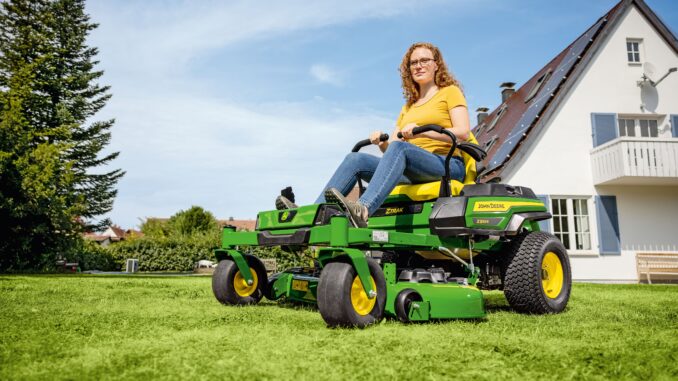
The John Deere Z445 is a residential zero-turn mower built for homeowners who want faster mowing than a lawn tractor, with strong maneuverability around trees, beds, and other obstacles. This guide focuses on practical repair decisions, symptom-first troubleshooting, maintenance intervals, common service parts, and realistic DIY limits for owners in the USA and Canada.
The Z445 sits in Deere’s EZtrak residential zero-turn range and was commonly paired with a 54-inch Edge deck, making it a good fit for medium to larger home properties where cut speed and trimming ability matter more than towing or ground-engaging work. Owners usually deal with the same core systems as other residential zero-turns: engine and fuel delivery, mower deck and blades, hydrostatic drive components, electrical and safety interlocks, and routine wear items such as belts, filters, plugs, and battery parts.
John Deere Z445 model overview
The John Deere Z445 is an EZtrak residential zero-turn mower rather than a lawn tractor, so it is designed first for mowing productivity and maneuverability, not for pulling heavy attachments or working rough ground. In the Deere lineup, it sits above basic riding mowers in handling and mowing speed, but it is still a homeowner machine rather than a commercial zero-turn.
Most owners will care about five systems on the John Deere Z445:
-
Engine and fuel system, including air filter, oil filter, fuel filter, spark plugs, and fuel cap.
-
Mower system, including deck belt, blades, gage wheels, front roller, and spindle lubrication points.
-
Drive system, including the drive belt and hydraulic filter used on different serial-number ranges.
-
Electrical system, including the key, ignition switch, battery, and safety-switch logic covered in the operator’s manual.
-
Chassis and deck setup, including deck leveling and grease points that directly affect cut quality and component life.
Several common John Deere Z445 service parts owners regularly buy include engine oil filters AM107423 or AM125424 depending on serial range, fuel filter AM116304, foam air filters M140295 or MIU12554, paper air filters M150949 or MIU12555, Briggs air filter MIU13120 on Briggs-equipped machines, spark plugs M805853 or MIU11020, hydraulic filters AM131054 or MIU13018, deck belt M158131, drive belts M154157, M160571, or M169705, ignition switch TCA22740, battery TY25878, and 54-inch blades such as M143520, M152726, or M145516 depending on blade style.
Troubleshooting approach for the John Deere Z445
The best way to diagnose a John Deere Z445 is to start with the exact symptom the owner sees, not with a random parts swap. A mower that cranks slowly, a mower that cranks but will not fire, a mower that cuts unevenly, and a mower that loses drive all point to different systems and should be checked in different orders.
Main symptom groups on the John Deere Z445 usually fall into these categories:
-
Starting issues, including no-crank, weak crank, or cranks-but-will-not-start faults.
-
Running issues, such as surging, misfiring, poor power, or stalling under load.
-
Cut-quality problems, including streaks, scalping, ragged tips, and poor discharge.
-
Vibration and noise, often linked to blades, deck hardware, pulleys, or belt damage.
-
Overheating, smoke, leaks, or fire-risk debris buildup around the engine and deck.
-
Transmission or drive complaints, including weak tracking, loss of one side, or belt-related drive problems.
-
Electrical and safety-switch issues, including seat-switch, brake, key-switch, or interlock faults.
John Deere Z445 emergency repair needs
Some John Deere Z445 problems should not be postponed because they can make the mower unsafe or turn a small repair into a much more expensive one. The main red-flag issues are severe vibration, fuel leaks, damaged blades or spindle hardware, smoking belts, loss of steering or drive control, and electrical faults that bypass or confuse the safety system.
4.1 John Deere Z445 starting issues
A John Deere Z445 that will not crank or only clicks may have a simple battery or switch issue, but it can also leave you stranded mid-job and sometimes encourages unsafe jumping or bypassing attempts. Treat repeated no-start complaints as a system problem, not just a battery problem.
Common causes:
-
Weak or failed battery TY25878.
-
Corroded battery terminals or poor ground connection.
-
Faulty ignition switch TCA22740 or worn key/switch connection.
-
Safety interlock not satisfied, such as PTO engaged or operator-presence issue.
-
Dirty air filter, stale fuel, clogged fuel filter AM116304, or worn spark plugs.
Basic checks:
-
Confirm PTO is off and the machine is set exactly as the operator’s manual requires for starting.
-
Inspect battery terminals for corrosion and confirm cables are tight.
-
Replace overdue fuel, air, and spark-plug service items if maintenance history is unknown.
-
Check whether the engine cranks normally, cranks slowly, or does not crank at all before buying parts.
4.2 John Deere Z445 cut-quality problems
Cut-quality complaints on a John Deere Z445 usually show up as scalping, strips of uncut grass, ragged grass tips, clumping, or one side of the deck cutting lower than the other. These issues matter because poor cut quality often points to deck setup, blade condition, or belt problems that can worsen quickly.
Common causes:
-
Dull, bent, or mismatched blades.
-
Wrong blade style for the job, such as side-discharge vs high-lift vs mulching blades.
-
Deck out of level.
-
Worn mower belt M158131.
-
Grass buildup under the deck or damaged gage wheels/front roller.
Basic checks:
-
Clean the underside of the deck with the engine off, key removed, and blades fully stopped.
-
Inspect all blades for bends, cracks, and uneven wear.
-
Verify deck level before assuming spindle damage.
-
Inspect the deck belt and pulley path for glazing, cracking, or poor tension.
4.3 Vibration and noise
Strong vibration on a John Deere Z445 is an immediate stop-work symptom because it can damage spindles, belts, engine mounts, and deck hardware in a short time. Any new metallic noise, thumping, or belt squeal should be investigated before further mowing.
Common causes:
-
Bent or loose blade.
-
Blade installed incorrectly or blade hardware loose.
-
Debris wrapped around spindle areas.
-
Damaged pulley or failing deck bearing/spindle assembly.
-
Cracked or slipping belt.
Basic checks:
-
Stop mowing immediately and inspect blades before restarting.
-
Remove packed debris around pulleys and spindle housings.
-
Check for belt damage and pulley wobble.
-
If vibration remains after blade inspection, move the job into advanced DIY or dealer territory.
4.4 Overheating and leaks
Overheating, smoke, hot-oil smell, or visible fuel and oil leaks on a John Deere Z445 should be addressed quickly because air-cooled mower engines depend heavily on clean airflow and intact fuel and lubrication systems. Dry grass packed around hot engine areas also raises fire risk.
Common causes:
-
Blocked cooling fins or debris around engine screens.
-
Engine oil overdue or low.
-
Fuel filter or fuel-line issues.
-
Loose oil filter or seepage around service points.
-
Operating in very heavy grass with a dirty deck and restricted discharge.
Basic checks:
-
Shut down and let the engine cool before touching anything.
-
Clean external debris from engine and deck areas.
-
Check oil level and service history.
-
Trace leaks before replacing parts so you do not misdiagnose drips blown around by airflow.
4.5 John Deere Z445 transmission and drive problems
Drive complaints on a John Deere Z445 usually feel like weak traction, poor response, inability to hold speed on one side, or a machine that barely moves although the engine runs normally. Some problems are belt-related and owner-fixable, while hydro-related faults usually move closer to dealer-level work.
Common causes:
-
Worn or slipping drive belt, with part number varying by serial range.
-
Hydraulic filter issues on machines due for that service item.
-
Linkage problems or control adjustment issues.
-
Internal hydrostatic wear or failure.
Basic checks:
-
Inspect the drive belt for cracking, glazing, and correct routing.
-
Check whether the problem affects one side or both sides, which helps separate linkage from broader drive issues.
-
Inspect for obvious oil leakage around hydro components.
-
If motion remains weak after belt and linkage checks, dealer diagnosis is usually the safer next step.
4.6 John Deere Z445 electrical problems
Electrical issues on the John Deere Z445 often show up as intermittent starting, PTO refusal, sudden shutdown, or inconsistent response when seat or brake position changes. Because the safety system is part of normal operation, random bypassing can create both safety and diagnostic problems.
Common causes:
-
Weak battery or poor terminal contact.
-
Worn ignition switch TCA22740.
-
Faulty operator-presence or PTO-related safety-switch inputs.
-
Damaged wiring, especially after vibration or rodent exposure.
Basic checks:
-
Start with battery and cable condition before suspecting modules or switches.
-
Confirm the problem is repeatable and tied to a control position or truly random.
-
Inspect visible wiring and connectors for looseness or damage.
-
Leave safety-system bypass testing to advanced troubleshooting only.
DIY or dealer?
For the John Deere Z445, the normal line is simple: routine service, blades, basic belts, filters, plugs, battery work, and deck setup are realistic owner jobs, while hydrostatic diagnosis, internal engine work, valve adjustment, deeper electrical tracing, and major spindle or control-system repairs are better suited to an experienced technician or dealer.
Good DIY jobs
-
Engine oil and oil-filter service.
-
Air-filter and fuel-filter replacement.
-
Spark-plug replacement.
-
Blade removal, sharpening or replacement, and deck cleaning.
-
Deck leveling and basic deck-belt replacement.
-
Battery replacement and terminal cleaning.
Advanced DIY or dealer jobs
-
Drive-belt replacement where access is difficult or routing is uncertain.
-
Hydro drive diagnosis or loss-of-motion complaints.
-
Valve-clearance check and adjustment, which Deere lists at 200 hours and directs to the dealer.
-
Repeated safety-switch or wiring faults that need electrical testing.
-
Spindle, pulley, or engine problems that continue after basic checks.
Skill level guide
-
Beginner: Filters, battery, spark plugs, deck cleaning, visual inspections.
-
Intermediate: Blades, deck belt, deck leveling, tracing basic no-start issues.
-
Advanced: Drive-system diagnosis, electrical fault-finding with a meter, valve service, and repairs involving hydro components.
John Deere Z445 parts information
Before ordering John Deere Z445 parts, gather the full model name, the Product Identification Number or serial range, the engine model and engine serial number, and the deck size or deck version on the machine. This matters because Deere used serial-number breaks for several Z445 service parts, including maintenance kits, oil filters, hydraulic filters, and drive belts.
OEM parts are the safer choice for belts, ignition and safety-related items, exact-fit deck parts, and anything with serial-number breaks because fit and routing matter more than saving a small amount up front. Aftermarket parts can be acceptable for some filters, blades, batteries, and tune-up items, but only when the cross-reference is exact and the deck, engine, and serial range have all been verified first.
Manuals and diagrams for John Deere Z445
The most useful sources for John Deere Z445 owners are the official operator’s manual, Deere parts support pages, Deere maintenance reminder sheets, and a Deere-focused parts catalog with illustrated breakdowns.
-
Operator’s manual for operating instructions, safety procedures, control use, and owner-level service guidance.
-
John Deere owner support page for model support entry points, manuals, and owner resources.
-
Deere maintenance reminder sheet PDF for part numbers and routine service items on the Z445 with 54-inch Edge deck.
-
Green Farm Parts Z445 page for model-specific illustrated shopping and part lookup support.
How to locate John Deere Z445 numbers
Correct identification prevents wrong-part orders, especially on a John Deere Z445 where filters, maintenance kits, and drive-related parts can change by serial-number range. You should record the mower serial number, deck serial number, and engine identification before ordering anything expensive.
-
Park the machine safely on level ground, remove the key, and let all moving parts stop.
-
Find the John Deere Z445 machine identification label on the mower and record the serial or PIN information shown there.
-
Record the deck serial number from the mower deck tag, since blade and deck-component fit depends on deck version as well as mower model.
-
Locate and record the engine model and serial number directly from the engine shroud or engine label before ordering plugs, filters, or tune-up parts.
-
Match all numbers against the parts diagram or maintenance sheet rather than ordering from model name alone.
Buying John Deere Z445 parts
The best buying strategy is to use the John Deere Z445 model name only as a starting point, then confirm serial range, deck version, and engine details before checkout. That extra step matters most for maintenance kits, drive belts, hydraulic filters, air filters, and spark plugs.
-
Online: use exact OEM numbers and double-check serial notes before ordering from Deere or Deere-focused suppliers.
-
Dealer counter: best for serial-sensitive parts, tricky diagrams, and problems where you are not yet sure which component failed.
-
Retail stores: acceptable for oil, grease, batteries, and some tune-up items only when the packaging clearly cross-references the exact engine or Deere part number.
Useful links:
John Deere Z445 fitting guide
These are the most useful owner-level service jobs on a John Deere Z445 because they directly affect starting, running quality, and cut quality. Always use the operator’s manual for machine-specific safety steps before starting work.
Change the air filter on a John Deere Z445
This job helps a John Deere Z445 that is running rich, losing power, or overdue for scheduled service.
-
Park safely, remove the key, and let the engine cool.
-
Open the air-cleaner housing and remove the foam and paper elements in order.
-
Compare the old filters with the replacements so you do not mix serial-range or engine-specific parts.
-
Wipe loose dirt from the housing without forcing debris into the intake.
-
Install the new elements in the correct order and close the housing securely.
Replace spark plugs on a John Deere Z445
Fresh spark plugs often help a John Deere Z445 that starts hard, misfires, or runs rough under load.
-
Work on a cool engine and pull the plug leads carefully.
-
Remove the old plugs and inspect them for fouling or abnormal deposits.
-
Confirm the replacement plug number matches the engine on your machine, such as M805853 or MIU11020.
-
Install the new plugs correctly and reconnect the leads firmly.
-
Start the engine and check for smoother idle and throttle response.
Change the John Deere Z445 mower deck belt
A new mower belt can cure blade-speed loss, poor cutting, and belt squeal on the John Deere Z445 when the old belt is glazed, cracked, or stretched.
-
Lower the deck, remove the key, and make the machine fully safe before working around the belt path.
-
Photograph or sketch the belt routing before removal.
-
Remove tension from the belt system and lift the old belt off the pulleys carefully.
-
Install the correct belt, such as M158131 for the 54-inch mower deck listing, and verify it sits fully in every pulley groove.
-
Rotate the system by hand where safe and legal, then test at low throttle before mowing normally.
Replace or service John Deere Z445 blades
Blade service fixes many John Deere Z445 complaints involving ragged cut, vibration, streaking, and poor discharge.
-
Secure the mower safely and access the deck following operator-manual precautions.
-
Remove each blade and inspect for bends, cracks, and uneven wear.
-
Replace with the correct blade style for your setup, such as side-discharge M143520, high-lift M152726, or mulching M145516.
-
Reinstall blades correctly and make sure hardware is tightened to specification from the proper service literature.
-
Test-cut a small area and recheck for vibration before full use.
Maintenance to prevent repeat problems
Regular maintenance does more than protect resale value on a John Deere Z445; it prevents the exact faults owners complain about most, including hard starting, weak cut quality, vibration, belt failures, and hot-running problems. The official interval chart is short, but the machine benefits most when owners combine those scheduled services with frequent cleaning and visual checks.
Focus areas:
-
Starting reliability: keep battery terminals clean and stay current on air filter, fuel filter, spark-plug, and oil-filter service.
-
Cut quality: sharpen or replace blades as needed, level the deck, grease deck spindles on schedule, and inspect the mower belt regularly.
-
Fire and overheating prevention: remove dry grass and debris from engine and deck areas after use.
-
Drive performance: inspect the drive belt and watch for leaks or gradual loss of response.
-
Electrical reliability: do not ignore intermittent starting or switch-related symptoms, because early diagnosis is usually easier than later harness repair.
John Deere Z445 maintenance schedule
The official John Deere Z445 service intervals include a break-in filter change at 8 hours, recurring 50-hour or annual engine-filter service, 50-hour or annual deck-spindle lubrication, 100-hour or annual air-filter replacement, and a 200-hour valve-clearance check that Deere directs to the dealer. The Deere 54-inch maintenance reminder sheet also lists recurring oil, filter, fuel-filter, spark-plug, and grease items across the first 250 hours of operation.
Daily / before each use
-
Check engine-oil level and overall condition before mowing.
-
Inspect for fuel, oil, or hydraulic leaks.
-
Check blades, deck area, and discharge path for damage or packed debris.
-
Confirm controls and safety interlocks operate normally.
After 8 hours
-
Change engine filter on Z445 as listed in Deere’s service interval chart.
-
Use the break-in point to inspect for loose hardware, leaks, or unusual belt wear.
-
Record serial-specific service parts now so future ordering is easier.
Every 25 hours
-
Inspect deck belt and drive belt condition even though replacement is not a fixed 25-hour item.
-
Clean around the engine, deck, and pulleys to reduce heat and fire risk.
-
Check blade condition and deck level if cut quality has changed.
Every 50 hours or yearly
-
Change engine filter on the John Deere Z445.
-
Lubricate mower deck spindles on Z445 models listed by Deere.
-
Change engine oil in line with the Deere reminder sheet cycle shown for the model.
-
Grease fittings as needed with Deere multi-purpose grease.
Every 100 hours or yearly
-
Replace both foam and paper air-filter elements.
-
Replace fuel filter AM116304.
-
Replace spark plugs according to the Deere reminder sheet interval set shown through the 250-hour chart.
-
Inspect blades and belts closely before the heavy mowing season continues.
Every 200 hours
-
Check and adjust engine valve clearance; Deere directs owners to the dealer for this service.
-
Replace air-filter elements again if due under your hours and operating conditions.
-
Replace fuel filter and spark plugs again where your schedule and conditions justify it.
Seasonal checklist
Spring
-
Install fresh air and fuel service parts if the mower sat over winter and the old service history is uncertain.
-
Inspect battery condition, blade sharpness, and belt condition before first full use.
-
Clean the deck thoroughly and confirm level before peak mowing begins.
Mid-season
-
Recheck spindle lubrication, belt wear, and blade condition.
-
Remove packed grass from deck and engine areas more often during fast growth periods.
-
Watch for developing vibration or cut-quality change rather than mowing through it.
Fall / end of season
-
Clean the mower fully before storage and inspect for worn parts to order ahead of next season.
-
Stabilize or manage fuel correctly according to operator-manual practice for storage.
-
Note serial-number-specific filters, plugs, and belts used this season for the next service cycle.
Repair, upgrade, or replace?
For most owners, a John Deere Z445 is worth repairing when the issue is limited to normal wear items such as belts, blades, filters, plugs, battery, deck setup, or a single switch, because these are ordinary homeowner-service problems on an otherwise useful residential zero-turn. Upgrade or replacement decisions become more sensible when the machine has repeated hydro, engine, or structural deck issues that stack into a large repair bill.
Repair if…
-
The fault is a routine service item or a single wear component.
-
The mower starts, runs, and drives well aside from the current problem.
-
Deck, frame, and hydro response are still basically sound.
Upgrade if…
-
You need more deck width, heavier-duty construction, or a machine better suited to rougher acreage.
-
Repair costs are moderate but your mowing demands have outgrown a residential zero-turn.
-
You want to move into a newer machine with easier parts support and fewer age-related electrical issues.
Replace if…
-
The John Deere Z445 has major hydrostatic and engine issues at the same time.
-
Deck structure, spindle mounts, or multiple control and electrical systems all need work together.
-
The estimated repair cost approaches the value of a sound used replacement machine in your market.
John Deere Z445 troubleshooting FAQ
1. Why will my John Deere Z445 not start?
A John Deere Z445 that will not start should first be separated into no-crank, slow-crank, or cranks-but-will-not-fire. Battery condition, terminal corrosion, PTO position, and safety-interlock status are the first things to check before buying parts. If it cranks normally but does not fire, move next to fuel delivery, air filter condition, and spark plugs.
2. Why does my John Deere Z445 just click when I turn the key?
A clicking John Deere Z445 usually points to low battery voltage, poor cable connection, or high resistance at terminals or grounds. Start by cleaning and tightening battery connections, then evaluate the battery itself before assuming the starter or ignition switch is bad.
3. Why does my John Deere Z445 crank but not fire?
When the John Deere Z445 cranks but will not fire, the likely areas are fuel, spark, air, or a safety condition affecting ignition or PTO logic. Old fuel, a clogged fuel filter AM116304, overdue plugs, or restricted air filters are all realistic owner-level causes.
4. Why does my John Deere Z445 start and then stall?
This often happens when fuel flow is weak, the air filter is heavily restricted, or the engine is compensating for poor tune-up condition. Check the fuel filter, fuel freshness, and air-filter elements before chasing deeper faults.
5. Why is my John Deere Z445 running rough?
A rough-running John Deere Z445 often has overdue spark plugs, dirty air filters, stale fuel, or a partially restricted fuel system. If basic tune-up work does not improve it, look for ignition or engine issues rather than continuing to mow it hard.
6. Why does my John Deere Z445 lose power in tall grass?
Power loss in heavy grass is often a mix of mowing conditions and maintenance condition. Dull blades, a dirty deck underside, a worn deck belt, and restricted air intake all reduce effective mowing performance.
7. Why is the cut uneven on my John Deere Z445?
Uneven cutting on a John Deere Z445 usually comes from deck level, blade condition, tire-related stance issues, or buildup under one side of the deck. Start with the simple checks before suspecting spindle or deck-shell damage.
8. Why does my John Deere Z445 leave strips of uncut grass?
Strips usually mean blade-tip performance is down or deck airflow is poor. Inspect blade sharpness, blade type, deck cleanliness, and the condition of the mower deck belt M158131 on 54-inch deck setups.
9. Why does my John Deere Z445 scalp the lawn?
Scalping is usually a setup problem rather than a failed part. Check deck level, mowing height, terrain changes, and gage-wheel condition before replacing components.
10. Why are the grass tips ragged after mowing with my John Deere Z445?
Ragged grass tips point to dull blades more often than anything else. Remove the blades, inspect for wear or bends, and sharpen or replace them with the correct 54-inch blade style for your setup.
11. Why is my John Deere Z445 vibrating badly?
Bad vibration is a stop-now symptom on this mower. The most common causes are bent blades, loose blade hardware, damaged pulleys, belt issues, or debris packed around rotating parts.
12. Why does my John Deere Z445 make a squealing noise?
Squealing usually points to belt slip, a pulley issue, or a bearing beginning to fail. Inspect the mower belt and drive belt for glazing and cracking first, because that is the easiest owner-level check.
13. Why does the John Deere Z445 deck belt keep coming off?
A belt that keeps coming off usually means the real problem is elsewhere. Misrouted installation, pulley misalignment, seized bearings, weak tension, or damaged belt guides can all throw a belt repeatedly.
14. What is the mower deck belt number for a John Deere Z445?
For the Z445 with 54-inch Edge deck in Deere’s reminder sheet, the mower deck belt is listed as M158131. Always confirm against your deck version and serial details before ordering.
15. What drive belt does a John Deere Z445 use?
The John Deere Z445 uses different drive belt numbers depending on serial range, including M154157, M160571, and M169705 in Deere’s maintenance reminder sheet. That is why serial confirmation matters before parts ordering.
16. Which blades fit a John Deere Z445 54-inch deck?
Deere lists several 54-inch blade options for the John Deere Z445, including M143520 for side discharge, M152726 for high lift, and M145516 for mulching. Match the blade style to how the mower is configured and how you want it to perform.
17. Why does my John Deere Z445 burn through blades quickly?
Fast blade wear usually means the mower is hitting abrasive soil, sand, roots, rocks, or hidden obstacles rather than suffering from a deck fault. A blade style mismatch can also make owners think the blades are worn out when the real issue is cut performance in local conditions.
18. Why is my John Deere Z445 smoking?
Smoke can mean oil on hot surfaces, debris buildup near hot engine parts, or an engine problem that needs quick attention. Shut the mower down, clean it, and look for leaks before restarting.
19. Why does my John Deere Z445 run hot?
The Z445 relies on clean airflow around an air-cooled engine, so debris-packed screens and cooling areas are a common cause of hot running. Overdue oil service and extremely heavy mowing conditions can make the problem worse.
20. Why is my John Deere Z445 leaking fuel?
A fuel leak should be treated as urgent because of fire risk. Inspect the cap area, lines, and filter connections, and do not keep mowing until the source is found.
21. Why won’t my John Deere Z445 move properly?
If the engine runs but the mower barely moves, start with the drive belt and obvious linkage issues before assuming hydro failure. Deere’s reminder sheet shows that drive-belt part numbers vary by serial range, so correct identification matters here too.
22. Why does one side of my John Deere Z445 feel weaker than the other?
One-sided weak drive often points to linkage adjustment, one-side hydro issues, or a more localized mechanical problem rather than a general engine problem. Compare left and right response carefully before ordering parts.
23. Can I replace the hydraulic filter on a John Deere Z445 myself?
Many owners can replace straightforward hydraulic service items if access, cleanliness, and correct parts are all under control. But if the job is tied to drive complaints, contamination concerns, or hydro diagnosis, it is usually better treated as advanced DIY or dealer work.
24. What oil filter does a John Deere Z445 use?
Deere lists AM107423 and AM125424 as engine oil filter options for different John Deere Z445 serial ranges and engine configurations. Use the mower serial and engine details to choose correctly.
25. What air filter does a John Deere Z445 use?
The air-filter set depends on serial range and engine version. Deere lists foam and paper combinations such as M140295 with M150949, MIU12554 with MIU12555, and MIU13120 on Briggs-equipped versions.
26. What spark plugs fit a John Deere Z445?
Deere lists M805853 and MIU11020 as spark-plug numbers tied to engine variation on the John Deere Z445. The safest path is to confirm the engine identification directly before ordering.
27. How often should I service a John Deere Z445?
The official chart calls for an 8-hour break-in engine-filter change, 50-hour or annual filter and spindle-lube service, 100-hour or annual air-filter replacement, and a 200-hour valve-clearance check. Deere’s reminder sheet also tracks oil, fuel filter, spark-plug, and related service items through the first 250 hours.
28. How often should I grease a John Deere Z445 deck?
Deere lists mower deck spindle lubrication every 50 hours or annually for the Z445 models covered by the service chart. Greasing on schedule is cheaper than spindle replacement and helps prevent noisy, dry-running deck components.
29. When should I replace the air filter on my John Deere Z445?
Deere lists replacement of both foam and paper air-filter elements every 100 hours or annually. In dusty mowing conditions, inspection between intervals is still sensible even if full replacement is not yet due.
30. Is it worth repairing a John Deere Z445?
In many cases, yes, especially when the mower only needs normal wear items such as blades, belts, filters, plugs, battery, or deck adjustments. It becomes less attractive when hydrostatic, engine, and structural deck repairs pile up together.
31. When should I take my John Deere Z445 to a dealer?
Dealer help makes sense when the John Deere Z445 has hydro drive issues, persistent electrical faults, internal engine concerns, valve-clearance service, or repeated problems after basic maintenance has already been done correctly. That is also the safer route when the fault affects safe operation or you are tempted to bypass interlocks.
32. Why does my John Deere Z445 battery keep going dead?
A repeatedly dead battery can be caused by age, poor cable connections, parasitic drain, or a charging problem. Start with the battery, terminals, and visible wiring before moving into charging-system diagnosis.
33. Why won’t the PTO engage on my John Deere Z445?
When PTO engagement fails, check the safety-interlock conditions first because many mower systems will block operation if the required control positions are not met. If the conditions are correct, move next to switch, wiring, and electrical testing rather than assuming the clutch itself is bad.
34. Why does my John Deere Z445 backfire or pop?
Popping or backfiring can come from tune-up neglect, poor fuel quality, ignition issues, or operating changes that leave unburned fuel in the exhaust path. Start with air filter, spark plugs, and fuel condition before chasing more complicated causes.
35. What should I check before ordering John Deere Z445 parts online?
Before ordering, collect the full John Deere Z445 model name, mower serial range, deck details, and engine identification. This is especially important because Deere lists different maintenance kits, filters, drive belts, and some tune-up parts by serial break or engine version.