
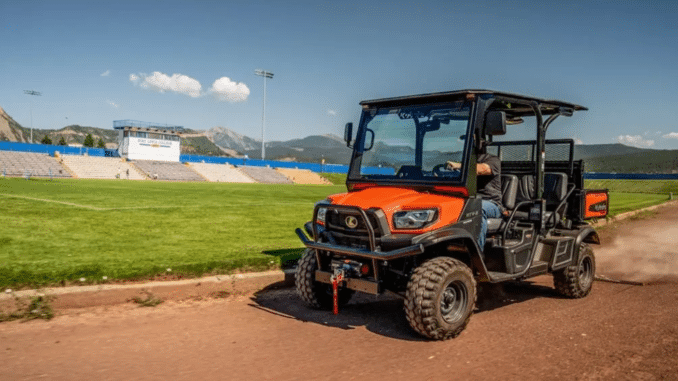
Kubota RTV900, RTV900XT, RTV1100 and RTV1140 Serial Number and Year Guide
The Kubota RTV900, RTV900XT, RTV1100 and RTV1140 belong to the earlier full-size utility-vehicle range. Identifying one correctly requires more than recognising its bodywork or reading a large model decal. The exact model designation, vehicle serial number and fitted configuration all matter when buying parts, choosing manuals or assessing a used machine.
This Kubota RTV serial number guide explains how to identify these earlier vehicles, distinguish vehicle and engine numbers, investigate production details and check accessory requirements. It also covers the paperwork and identification checks that help buyers recognise discrepancies before committing to a purchase.
The most useful starting point is the complete model designation and vehicle number. Neither an approximate year nor an engine number replaces that information.
Identification locations, number formats and available records can differ by model, production period and market. A vehicle identifier does not automatically reveal its exact build date, ownership history or every modification made since manufacture.
Which earlier full-size Kubota RTV models does this guide cover?
This guide covers the following earlier model groups:
| Model group | Identification to record | Important limitation |
|---|---|---|
| RTV900 | Full model designation, including any additional letters or numbers, and vehicle serial number | Different RTV900 versions must not automatically be treated as identical |
| RTV900XT | Exact RTV900XT designation and vehicle serial number | Do not assume all earlier RTV900 parts or manuals apply |
| RTV1100 | Full model code and vehicle serial number | Do not confuse the RTV1100 with the later RTV-X1100C |
| RTV1140 / RTV1140CPX | Exact designation shown on the vehicle and supporting records | Do not confuse these vehicles with the later RTV-X1140 |
Detailed model listings include designations such as RTV900G, RTV900R, RTV900T, RTV900W and RTV1100CW9, as well as RTV900XT and RTV1140CPX. Record the designation actually assigned to your vehicle rather than shortening every version to its numerical model name.kubotausa+1
“Earlier full-size RTV models” is a useful grouping for this guide, not one official model designation or one shared serial-number sequence.
Compact RTV400Ci, RTV500 and RTV520 models, later diesel RTV-X vehicles and the RTV-XG850 Sidekick are outside its scope.
Quick answer: where to find the identification number
The serial-number location differs between the earlier model groups.
| Model / production group | Main vehicle identification location | What to look for | Model-specific limitation |
|---|---|---|---|
| RTV900 | Driver side, on the frame rail between the battery and cargo box | Main vehicle serial-number identification and associated model information | Confirm the applicable arrangement for the exact version |
| RTV900XT | Check the operator’s manual for the precise model | Main vehicle model and serial-number identification | Do not assume the RTV900 location applies without checking |
| RTV1100 | Driver side, next to the rollover-protection structure, between the cargo box and the back of the seat or cabin | Main vehicle identification | Do not substitute RTV-X1100C location information |
| RTV1140 | Driver side, next to the rollover-protection structure, between the cargo box and the back of the seat or cabin | Main vehicle identification | Confirm the instructions applicable to the exact RTV1140CPX or other designation |
The driver-side frame-rail location applies to the RTV900 guidance, while the RTV1100 and RTV1140 use the area beside the rollover-protection structure between the seating or cabin area and the cargo box. These location descriptions relate to United States model guidance; imported or differently specified vehicles require model-specific confirmation.kubotausa
How to inspect the identification safely
-
Park on firm, level ground.
-
Apply the parking brake and stop the engine.
-
Allow hot components to cool before reaching nearby.
-
Locate the identification using the exact model’s operating instructions.
-
Photograph the identification and copy every character.
-
Record the model designation separately where it appears in a separate field.
Follow the applicable instructions before opening panels, moving seats or raising the cargo bed. Never work beneath an unsupported raised cargo bed.
Where left and right are mentioned, they mean left and right from the seated operator’s position.
Plate, label or stamped number: do not assume they are identical
A number located on a frame rail is not necessarily stamped directly into the frame. It may be carried on an identification plate or label.
Do not assume there is a second hidden frame number unless that arrangement is confirmed for the exact model.
Also distinguish the main vehicle identification from:
-
Engine identification.
-
Emissions information.
-
Rollover-protection identification.
-
Warning decals.
-
Cab or enclosure labels.
-
Accessory and attachment identification.
Vehicle serial number, VIN, PIN and engine number: the difference
Different identifiers relate to different products or records.
| Identification number | What it identifies | Typical use | Where to check |
|---|---|---|---|
| Vehicle model designation | The particular vehicle model and version | Selecting the correct vehicle and parts group | Main vehicle identification and original paperwork |
| Vehicle serial number | The individual utility vehicle | Parts enquiries, record matching and dealer support | Main vehicle identification |
| PIN, where applicable | A product identified under that terminology | Product-record enquiries | Applicable identification and vehicle records |
| VIN, where applicable | A vehicle identified under an applicable VIN system | Registration and vehicle-record processes | Relevant identification and registration documents |
| Engine model and serial number | The fitted engine | Engine parts and engine-specific service work | Engine identification and applicable instructions |
| Transmission or axle identifier, where provided | A particular drivetrain assembly | Assembly-specific parts and repairs | Relevant component identification |
| Accessory model and serial number, where assigned | A separately identified accessory | Accessory parts and installation support | Accessory plate, label or instructions |
| Registration or title number | An administrative record | Registration and document enquiries | Registration certificate, title or local equivalent |
Not every model has every identifier listed above.
For these earlier RTVs, vehicle serial number is the appropriate general term. Do not automatically rename it a VIN or apply a passenger-car VIN decoder.
A registration number, title number or engine number should not be substituted for the main vehicle serial number.
How to read an earlier Kubota RTV serial number
Copy the identifier exactly as it appears.
Preserve:
-
Letters and numerical characters.
-
Leading zeroes.
-
Any prefix forming part of the serial number.
-
The distinction between separate model and serial-number fields.
Do not join the model designation and serial number simply because they appear next to each other.
There is no universal character-by-character decoder
A single decoding method cannot be confirmed for the RTV900, RTV900XT, RTV1100 and RTV1140 range.
Do not assume that:
-
Every identifier contains the same number of characters.
-
Every serial number is entirely numerical.
-
A particular letter identifies the year.
-
The tenth character is a model-year code.
-
A road-vehicle check-digit calculation applies.
-
The same number means the same production position across different models.
A serial sequence may indicate build order within an applicable product group. It does not automatically reveal an exact calendar production date.
If you need a production detail, ask for that specific fact to be checked against the exact model and complete vehicle number.
Year and production identification
The original RTV900 was introduced in 2004, the RTV1100 followed in 2006, and the later RTV-X range was introduced in 2013. These are product-history milestones, not annual serial-number ranges or proof of the production year of an individual vehicle.kubotausa
A vehicle described as “an early RTV” still needs its exact model identified. Neither its age nor the absence of an “X” in the model name establishes a complete parts application.
Dates that should not be confused
| Description | What it establishes | What it does not automatically establish |
|---|---|---|
| Model year | A manufacturer’s model-year classification, where applicable | Exact build date |
| Calendar production date | When the vehicle was manufactured | First sale or registration |
| First retail sale | When the vehicle was first sold | Manufacturing year |
| Registration date | When registration occurred | Original production date |
| Warranty start date | The recorded start of applicable warranty arrangements | Exact manufacturing date |
| Manual publication date | When a publication was issued or revised | Vehicle age |
| Modification date | When later equipment was installed | Original factory specification |
A replacement engine, cab, cargo bed or bonnet may not share the vehicle’s production date.
How to establish a vehicle’s year
-
Read the exact model designation.
-
Photograph the complete vehicle serial number.
-
Establish the original country of sale where possible.
-
Collect original invoices, registration documents and service records.
-
Ask a Kubota dealer what production information can be confirmed.
-
Keep the distinction between model year, production period and exact build date.
A universal public year-decoding table cannot be confirmed for these earlier full-size models.
Do not use a serial-number range belonging to an RTV-X900 to date an RTV900, or an RTV-X1100C range to date an RTV1100.
Where were these earlier RTVs manufactured?
Manufacturing origin must be established for the particular vehicle.
Check any relevant origin information on its identification and original records. Ask a Kubota dealer to confirm uncertain details.
Do not treat an engine’s manufacturing origin as proof of where the complete vehicle was assembled. A manual’s publishing address, copyright statement or “Printed in” wording also does not establish the assembly factory.
Parts, manuals and accessory compatibility
Correct parts selection begins with the vehicle model and serial number, but some repairs require additional identifiers.
An engine, transmission assembly, axle, cab or attachment can have its own identification requirements. Not every component is individually serialised, and not every earlier RTV carries the same equipment.
What to collect before ordering
| What you need | Number or information to use | Why it matters | What to confirm before ordering |
|---|---|---|---|
| General vehicle parts | Exact model, suffix and vehicle serial number | Separates vehicle versions and production changes | Market and applicable serial-number break |
| Engine parts | Engine model and serial number, plus vehicle details | Engine revisions or replacements can affect application | Actual fitted engine and required specification |
| Transmission or drivetrain parts | Vehicle details and relevant assembly identification | Assemblies and internal components may differ | Installed assembly and replacement history |
| Axle or final-drive parts | Applicable axle identification and vehicle details | Similar housings do not guarantee identical internals | Correct assembly and production coverage |
| Cab and body parts | Vehicle version and cab or enclosure identity | Factory and aftermarket equipment can differ | Mountings, seals, hardware and clearance |
| Cargo-bed parts | Actual bed configuration and vehicle details | Bed arrangements are not universally interchangeable | Bed structure, hinges, latch and related hardware |
| Bed-lift parts | Actual lifting-system details | Different mechanisms require different components | Lift arrangement, controls and connections |
| Accessory replacement parts | Accessory manufacturer, model and serial number where assigned | Accessory parts may be separate from vehicle parts | Exact accessory version |
| Installation components | Vehicle and accessory application | Main accessory fitment may require additional kits | Mounts, guards, wiring and controls |
| Electrical or hydraulic equipment | Actual fitted system and accessory requirements | Capacity and connection requirements vary | Approved installation and operating requirements |
Step-by-step parts-ordering process
-
Identify the vehicle precisely.
-
Record its full serial number.
-
Identify the system or component being repaired.
-
Collect the relevant engine or assembly information.
-
Find the applicable parts listing.
-
Read any serial-number restriction carefully.
-
Compare the fitted component with the illustration and description.
-
Disclose replacements and modifications.
-
Obtain confirmation where the application remains uncertain.
Do not rely on an online serial-number range alone when ordering safety-critical, engine-specific or drivetrain parts.
Why serial-number breaks matter
A serial-number break identifies an application change. It does not necessarily mark the beginning of a new model year.
The change might affect:
-
One replacement part.
-
A complete assembly.
-
A related bracket or housing.
-
Electrical connectors or controls.
-
Several parts that must be used together.
The relevant threshold may refer to the vehicle, engine or another assembly. Check which number the listing actually requests.
Choosing manuals for earlier models
Match the manual to:
-
Exact model designation.
-
Relevant suffix.
-
Original market.
-
Stated serial-number coverage.
-
Fitted component or accessory, where applicable.
An RTV900 manual is not automatically appropriate for an RTV900XT. An RTV1100 manual should not be replaced with an RTV-X1100C publication simply because both vehicles have enclosed cabs.
Separate accessory instructions may also be needed.
Used-vehicle checks for earlier full-size RTVs
Identification checks are particularly important when a vehicle has accumulated years of repairs, replacement components and accessory installations.
Identification and paperwork
-
Confirm that the main vehicle identification is present and readable.
-
Compare the complete number with the seller’s documents.
-
Check the full model designation and suffix.
-
Investigate unexplained disturbance or inconsistent markings.
-
Ask for supporting records for authorised replacement identification.
-
Resolve discrepancies before purchase.
Plate appearance alone does not prove authenticity.
Actual fitted configuration
Inspect the vehicle rather than relying solely on its advertised model name.
Check:
-
Engine identity.
-
Drivetrain arrangement.
-
Seating and passenger provision.
-
Cab, canopy or open configuration.
-
Cargo bed and lifting equipment.
-
Accessory manufacturer and model.
-
Mounting kits, controls and wiring.
-
Evidence of major component replacement.
Do not assume that a canopy establishes rollover protection, or that an additional seat establishes approved passenger capacity.
Ownership, finance and mechanical condition
Check the seller’s identity and request evidence supporting their right to sell.
Arrange suitable theft and finance or lien enquiries for the country involved. Ask a dealer about applicable recalls, campaigns and available service information.
Treat the hour-meter reading as one observation, not verified lifetime use. Compare it with maintenance records, controls, seat wear and overall condition.
A successful identification check does not replace a mechanical inspection.
Frequently asked questions
Where is the serial number located on a Kubota RTV900, RTV900XT, RTV1100 or RTV1140?
On the RTV900, check the driver-side frame rail between the battery and cargo box.
On the RTV1100 and RTV1140, check the driver side beside the rollover-protection structure, between the cargo box and the back of the seating or cabin area. These locations are identified for United States model guidance.kubotausa
For the RTV900XT, confirm the precise location in the operator’s manual for that model rather than assuming the RTV900 instructions apply unchanged. Photograph the complete identification and record the model designation separately.
Where is the identification plate or stamped vehicle number on an earlier full-size Kubota RTV?
Start at the model-specific identification location rather than searching randomly for a stamped frame number.
The RTV900 location is on the driver-side frame rail, while the RTV1100 and RTV1140 locations are beside the rollover-protection structure between the seating area and cargo box.kubotausa
A frame-mounted identifier is not automatically a number stamped directly into the frame. Check whether your vehicle uses a plate, label or another specified arrangement. Do not assume a second stamped identifier exists without model-specific confirmation.
How do I identify an earlier Kubota RTV if the serial-number plate is missing?
Collect surviving identification, original invoices, registration documents and service records. Photograph the vehicle, identification area, controls, engine and major assemblies.
Ask an authorised Kubota dealer to help establish the model and determine whether the original vehicle identity can be confirmed. Body decals and replacement engines are not sufficient proof on their own.
Do not recreate, restamp or fit an unofficial plate. Replacement identification must be handled through an authorised process and any relevant authority. If you are buying the vehicle, resolve the identity issue before payment.
Is the vehicle serial number the same as the engine serial number?
No. The vehicle serial number identifies the complete RTV under its applicable identification system. The engine serial number identifies the fitted engine.
Record both when investigating engine parts or a vehicle with uncertain replacement history. A replacement engine may have different identification and production details from the original engine.
Do not use the engine number as the vehicle identifier on sales paperwork unless a particular administrative process expressly requests it. Likewise, an engine’s age does not establish the vehicle’s manufacturing year.
Do earlier Kubota RTVs use a serial number, PIN or VIN?
Vehicle serial number is the appropriate general term for this guide.
Use the actual terminology shown on the particular vehicle and its market-specific records. Do not assume that every earlier RTV has separate serial, PIN and VIN numbers, or that those terms describe interchangeable fields.
If a registration document uses “VIN” while the vehicle identification uses “serial number”, ask the relevant authority or dealer to clarify the relationship. Do not alter the vehicle number to fit a generic online decoder.
How many digits or characters are in an earlier Kubota RTV identification number?
A single character count cannot be applied safely to every RTV900, RTV900XT, RTV1100 and RTV1140 production group.
Read the number exactly as displayed and preserve any letters or leading zeroes. Keep a separate model field separate from the serial-number field.
A website expecting a 17-character road-vehicle VIN may be unsuitable for the number you have. Do not add characters, omit a prefix or combine unrelated fields to make the entry fit.
Can I look up an earlier Kubota RTV by serial number?
You can use the exact model and complete serial number for parts enquiries, dealer identification requests and applicable record checks.
However, a Kubota RTV serial number lookup is not automatically a year decoder, theft check or complete history report. Different enquiries require different systems and supporting information.
Start by identifying what you need to establish: production details, a parts application, recall coverage or a paperwork discrepancy. Provide the model and serial number together rather than assuming the sequence alone is unique across every Kubota product.
Can a Kubota dealer identify an earlier RTV from its complete vehicle number?
A dealer may be able to confirm certain details, subject to available records, market coverage and local policy.
Provide a clear photograph, the exact model designation and the original country of sale if known. Explain whether the enquiry concerns year identification, parts, recalls or another issue.
Older vehicles and imports may need additional investigation. Even when the original model is established, the dealer may need information about replacement engines, transmissions or accessories to advise on the vehicle as it exists today.
What year is my earlier Kubota RTV from its serial number?
There is no universal public year-decoding method for all four model groups.
Ask a dealer to check the exact model and complete vehicle number, then clarify whether the answer establishes a model year, production period or exact manufacturing date.
Do not date the machine from first registration alone. A vehicle may have been registered or sold after manufacture, and replacement components may carry unrelated dates.
For parts selection, the relevant serial-number break can be more useful than an approximate year.
How do I decode an RTV900, RTV900XT, RTV1100 or RTV1140 serial number?
Begin by copying it accurately, including letters and leading zeroes.
Do not assign meanings to individual characters unless those meanings have been verified for the exact identification system. A tractor serial-number chart, passenger-car VIN guide or later RTV-X decoder should not be assumed applicable.
In practice, the useful process is often record matching rather than decoding. Give the complete number and model to a dealer and ask for the particular fact you need confirmed.
Is there a model-year code in an earlier Kubota RTV identification number?
A universal model-year character cannot be confirmed for these model groups.
Do not assume that the tenth character identifies the year or that a letter prefix follows a passenger-car year chart. A prefix can have another purpose, and a serial sequence is not inherently a date.
If a model year is confirmed through an applicable record, retain that information and distinguish it from the actual build date. Avoid publishing a character-by-character explanation without verified applicability.
Are model-year serial-number ranges available for these earlier Kubota RTV models?
A trustworthy, complete annual serial-number table cannot be confirmed for the RTV900, RTV900XT, RTV1100 and RTV1140 range.
A parts threshold, fuel-approval threshold or recall range should not be converted into an annual production range. Each has its own purpose.
Use a published range only for the exact model and application it describes. Do not estimate missing endpoints, divide a multi-year range into equal annual blocks or transfer a range from an RTV-X model to an earlier vehicle.
How can I confirm a year-specific serial-number range for an earlier Kubota RTV?
Supply a dealer with the exact model, suffix, serial number and original market.
Ask whether a year-specific range is actually available and what the range represents. It may identify a model year, a production period or a particular change rather than every vehicle built in a calendar year.
If precise annual endpoints cannot be confirmed, use the verified production description instead. For repairs, request confirmation of the actual parts break rather than relying on a year estimate.
How can I tell whether my RTV is an early or later production model?
Define the comparison first. “Early” and “late” only become useful when tied to a particular model or component change.
Check the serial-number threshold relevant to the feature being investigated. Then compare the actual fitted component, because a later replacement may have been installed.
Do not classify an RTV900 as a later RTV900XT solely from replacement decals or bodywork. Likewise, a newer cargo bed or cab does not change the vehicle’s original production identity.
Where was my earlier Kubota RTV manufactured?
Confirm origin for the specific vehicle using applicable identification and original records.
A single assembly factory should not be assigned to every RTV900, RTV900XT, RTV1100 and RTV1140 without vehicle-specific confirmation. Ask a dealer where the available information is insufficient.
Do not infer complete-vehicle origin from an engine label, a parts package or a manual’s printing details. The country where the vehicle was purchased or registered may also differ from its manufacturing origin.
Does the serial number reveal the exact production date?
Not automatically.
A serial sequence may locate a vehicle within an applicable production group, but it does not inherently disclose a day, month or year. Exact dating requires an applicable date field or production record.
If only a model year or broad period is confirmed, describe it accurately. Do not substitute the first purchase date, a casting date or a replacement engine’s age.
A manual’s starting serial number is also not automatically an annual production boundary.
How do I use the serial number to find the right parts?
Select the exact vehicle designation first, then apply its complete serial number to any relevant restriction in the parts listing.
For engine and drivetrain work, collect the component information requested by the listing. Tell the supplier if the engine or assembly has been replaced.
Check the illustration against the actual installation, including connectors, mountings and associated parts. An apparently correct main component may still require different supporting hardware.
Obtain confirmation before ordering when the fitted equipment does not match the expected arrangement.
Why does an earlier Kubota RTV parts listing ask for a serial-number break?
The break separates applications before and after a production change.
It may concern the complete vehicle or a particular engine or assembly. The change may affect a single item or several components used together.
Read the boundary carefully and establish which identifier controls it. Do not assume that every change happened at the beginning of a model year.
If the component has been replaced, the vehicle’s original serial position may not fully describe the installed part.
Which parts changed after serial number [XXXXX]?
[XXXXX] is a generic illustration, not a documented threshold for one of these vehicles.
An accurate answer requires the exact model, market, component and actual serial-number break. It also requires identifying whether the threshold belongs to the vehicle or a separate assembly.
Do not assume that all parts changed together, or that a later part can be fitted to an earlier machine without associated components. Ask for application-specific confirmation rather than treating a generic number as a replacement-parts rule.
Do I need the vehicle serial number or engine serial number for engine parts?
Have both available, together with the engine model.
The vehicle details establish the original application, while the engine identification helps select parts for the actual engine. This is especially important after an engine replacement.
Also describe the component and installation. Electrical equipment, mounting arrangements and other application-specific items may require more than the basic engine model.
Do not order solely by approximate vehicle year or engine size when a relevant identifier is available.
How do I find the correct operator’s manual?
Match the manual to the exact model designation, market and any stated serial-number coverage.
Do not choose solely from a cover photograph or abbreviated advertisement. RTV900, RTV900XT, RTV1100 and RTV1140CPX should be treated as distinct applications until coverage is confirmed.
Ask a dealer to check unclear coverage. Accessories may need separate instructions, particularly where a cab, winch, plough or electrical system was installed later.
A manual publication date is not proof of the vehicle’s age.
Which workshop or service manual applies to my earlier RTV?
The correct workshop information must cover the exact model and applicable production group. Supplements or component-specific information may also be required.
Provide the vehicle number and explain the repair. A replaced engine or drivetrain assembly may require information beyond the original vehicle application.
Do not substitute RTV-X service information merely because the numerical model name looks similar. Procedures, specifications and parts arrangements must be checked for the earlier vehicle being repaired.
Does the serial number determine which filters, belts or battery I need?
It helps establish the vehicle application, but further checks may be needed.
Filters depend on the relevant engine or system. Battery selection requires the correct physical fit, securing method, terminal arrangement and electrical specification.
Distinguish an engine accessory belt from a transmission drive belt. Do not order a drivetrain belt merely because a generic UTV listing offers one.
Check the actual installation if previous owners changed the engine, charging equipment or accessories. A serial-number match does not override evidence of a different fitted component.
How do I identify the correct transmission, transaxle or axle parts?
Record the vehicle designation and serial number, then collect any relevant assembly identification.
Check the actual arrangement against the applicable parts and service information. Similar housings do not prove identical internal components.
If the assembly has been replaced, supply its identifying details and explain the replacement history. Photographs may help establish what is fitted, but visual resemblance alone is not enough for internal parts selection.
Do not carry later RTV-X drivetrain assumptions into an earlier model’s repair.
Can the serial number confirm the engine type, fuel type or drivetrain?
It may help a dealer establish the original specification, but it should not replace inspection.
Check the engine identification, controls and actual drivetrain arrangement. Original records describe the vehicle as supplied, not necessarily after years of repairs and modifications.
If the fitted equipment conflicts with the expected specification, investigate before selecting parts, fluids or repair procedures.
Do not infer a transmission arrangement from the generic term “UTV” or assume that all Kubota utility vehicles use the same system.
How do I identify the exact model, suffix and seating configuration?
Read the complete model designation from the vehicle identification and compare it with the paperwork.
Record additional letters and numbers rather than shortening the name to “RTV900” or “RTV1100”. Detailed versions can matter for parts selection.
Inspect the seating arrangement separately. Confirm the approved passenger provision for the exact vehicle and configuration.
A fitted extra seat, altered cargo area or changed body panel does not establish an approved seating arrangement. Where alterations are evident, obtain model-specific confirmation before carrying passengers.
Can the serial number confirm a factory cab, canopy or open configuration?
A dealer may be able to confirm some original configuration information, depending on available records.
However, inspect and identify the equipment actually fitted. A cab, roof, doors or windscreen may have been replaced or added by a later owner.
Do not assume every enclosure is a factory Kubota component. Nor does a canopy establish rollover-protection certification.
Do not drill, weld or modify a rollover-protection structure to install an incompatible accessory.
Which snowplough, winch or working accessory fits an earlier Kubota RTV?
Check compatibility for the exact model, production group and accessory system.
Identify the attachment and mounting frame separately. Confirm necessary brackets, controls, electrical capacity, hydraulic equipment and clearance.
A listing saying “fits RTV900” needs further checking if it does not identify the relevant versions or installation requirements. A later RTV-X900 installation should not be assumed suitable.
Also confirm applicable operating limits. A winch’s rated pull or an attachment’s mounting pattern does not establish the vehicle’s approved towing or carrying capacity.
How do I check cargo-bed, cab, door, windscreen and roof compatibility?
Identify the vehicle version and the manufacturer of the fitted bed or enclosure.
Check whether the accessory belongs to a matched system. Doors, roofs, windscreens, seals and latches may depend on one another rather than being universally interchangeable.
Confirm all necessary mountings and clearance, including cargo-bed movement and access for servicing.
Do not rely on nominal dimensions alone. A similarly sized panel or common bolt pattern is not proof of suitable fitment, and protective structures should not be modified to accommodate incompatible parts.
Does the serial number identify transmission, four-wheel-drive or bed-lift configuration?
It may support confirmation of the original specification, but it does not automatically describe the current installation.
Inspect the actual controls and components. Identify the fitted drivetrain and cargo-bed lifting mechanism rather than relying solely on a seller’s description.
Later conversions and replacement assemblies must be considered separately. A vehicle number cannot by itself prove that a powered lift or other accessory remains in its original arrangement.
Use the exact model’s operating information before testing unfamiliar systems.
Can I identify original options and accessories from the vehicle number?
Some original configuration or sales information may be available through a dealer, but a complete option history should not be assumed.
Factory equipment, dealer-installed packages and later aftermarket additions are different categories. An accessory may be genuine Kubota equipment without having been fitted at the factory.
Request invoices and installation records where originality matters. Compare those records with the actual accessory and its identification.
Matching paint, age or branding does not establish original fitment.
How do I find a separately fitted accessory’s model or serial number?
Check the accessory plate, label and applicable operating or installation instructions.
The identifying information may be on the main attachment, its mounting frame or a separate control assembly. Not every item carries an individual serial number.
Record the manufacturer and exact model, along with any assigned serial number. Do not confuse a casting number or individual part number with the complete accessory identity.
An accessory number identifies that item; it does not identify the host RTV or prove compatibility with it.
How do I check whether an earlier Kubota RTV has been reported stolen?
Use legitimate routes appropriate to the country where the purchase takes place.
In the UK, contact police where theft or altered identification is suspected and consider a recognised equipment-checking service such as The Equipment Register. Confirm that the proposed check covers the vehicle concerned.
In other countries, use the relevant local law-enforcement and recognised equipment-checking routes. A dealer may also assist with identification enquiries.
No matching record is not proof that the vehicle has never been stolen. Conduct finance or lien enquiries separately.
Can a dealer check warranty status using the serial number?
A dealer may be able to check recorded warranty information using the exact model and complete vehicle number.
For an older machine, ask what information remains available rather than assuming active coverage. Warranty arrangements depend on the applicable market, dates, terms and records.
A replacement component or later repair may involve separate paperwork and conditions. Request the relevant invoice or written warranty details.
Do not infer remaining cover from an apparent production year, low hour-meter reading or the seller’s assurance alone.
Can I check recalls or service campaigns by identification number?
Use the exact model and complete vehicle number when asking a dealer to check applicability and completion.
Do not apply an RTV-X recall to an RTV900, RTV1100 or RTV1140 simply because the numerical part of the name matches. Recall eligibility is model- and range-specific.
Safety recalls and other manufacturer service campaigns are not necessarily the same thing. Not every campaign is publicly searchable, and an absence of public results does not establish that no relevant work exists.
If a notice applies, follow its operating restrictions and remedy instructions.
What should I check on a used earlier RTV identification plate?
Check the complete model designation and every serial-number character. Compare them with the invoice and applicable registration or title records.
Look for unexplained disturbance, inconsistent information, damage or evidence that the identification area has been altered. Ask for an explanation and supporting records rather than deciding authenticity from appearance alone.
Check the fitted engine and major components separately. Their replacement may be legitimate, but it should be understood before ordering parts or valuing the vehicle.
Unresolved identification discrepancies justify further verification before purchase.
Does an authorised replacement identification plate affect resale value?
There is no predictable value change that applies to every vehicle.
The important issues are the reason for replacement, the authorisation process and the records linking the replacement identification to the machine.
Retain correspondence and supporting documents. A buyer, insurer or registration authority may request additional verification.
An authorised replacement supported by records should not be treated as equivalent to an undocumented or unofficial plate. However, the replacement does not itself resolve unrelated ownership, finance or mechanical concerns.
How can I verify that the vehicle number matches its paperwork?
Compare the full identifier character by character.
Check that the paperwork also describes the correct model and, where relevant, suffix. Investigate shortened numbers, omitted letters or documents that appear to use an engine number instead.
Ask the seller to resolve discrepancies through the appropriate dealer or authority before purchase. Do not alter the machine or documents yourself.
Matching paperwork is necessary, but it does not prove the absence of outstanding finance, theft history or an ownership dispute.
Can the serial number reveal previous owners or a complete service history?
Not through a guaranteed public search.
A dealer may hold some warranty, service or campaign information, but records may be incomplete, restricted or unavailable. Work completed by other workshops or owners may not appear.
Private ownership details should not be expected to be publicly accessible.
Ask the seller for invoices, purchase documents and evidence of major repairs. Compare those records with overall condition and the hour-meter reading, while recognising that the meter alone is not verified lifetime operating history.
Final verification checklist
Before ordering parts or buying a used Kubota RTV900, RTV900XT, RTV1100 or RTV1140
-
Confirm the exact model designation and all suffixes.
-
Record the complete vehicle serial number using the applicable terminology.
-
Collect the engine model and serial number for engine enquiries.
-
Identify the relevant transmission, axle or other assembly where required.
-
Record separate accessory models, numbers and installation kits.
-
Check the applicable serial-number break.
-
Inspect the actual configuration and identify replacements or modifications.
-
Obtain parts-catalogue or Kubota dealer confirmation for uncertain cases.
-
Check paperwork and arrange suitable theft and finance or lien enquiries before buying.
-
Confirm registration, approval, insurance and local requirements where public-road use is intended.