
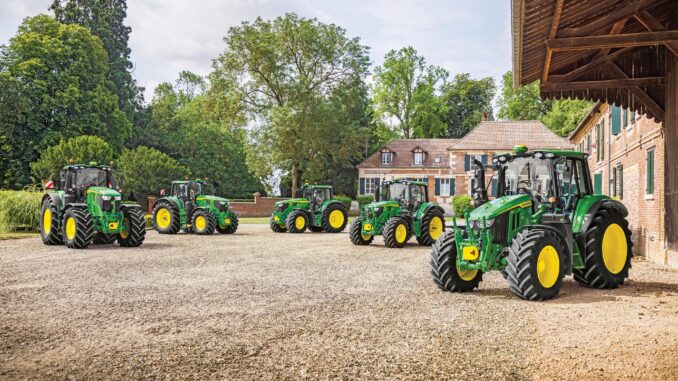
John Deere 2050 Utility Series Tractor Models and Maintenance Guide
The John Deere 2050 Utility Series is a legacy family of mid-sized agricultural utility tractors rather than a modern compact-tractor range. Sold in North America primarily during the 1980s, these machines were built for working farms, livestock operations, larger acreages, municipal work, and demanding loader or PTO jobs. Their capabilities extend well beyond those of today’s sub-compact and small compact tractors: many are heavy, full-frame utility tractors with diesel engines, substantial hydraulic capacity, Category 1/2 three-point hitches, 540-rpm PTO equipment, and available two-wheel drive or mechanical-front-wheel-drive configurations.
This page is a working directory for the John Deere 2050 Utility Series, bringing together model-specific guides, routine-maintenance material, and fault-finding resources in one place. Use it alongside the General John Deere Compact Tractor Guide as a wider entry point for smaller Deere machines, but note that the 2050 family belongs in the larger utility-tractor category. Individual model pages can then cover the exact engine, transmission, hydraulic system, electrical equipment, and parts differences for each tractor.
About the John Deere 2050 Utility Series
The John Deere 2050 Utility Series covers a broad group of legacy utility tractors generally ranging from roughly 45 hp to about 95 hp, depending on model and whether engine or PTO horsepower is quoted. The core North American range is commonly associated with models such as the 2150, 2350, 2550, 2750, and 2950, with related market-specific models and later 55-series successors often appearing in parts references and service literature.
These were not sub-compact tractors. Even the smaller tractors in the group were substantial agricultural machines intended for regular field and property work. At the upper end, a 2950 can weigh roughly 10,000 lb in a four-wheel-drive cab configuration, placing it firmly in the full-sized utility class rather than the compact class. The 2950 was offered in 2WD and 4WD/MFWD configurations, used a six-cylinder diesel, and could be specified with either a synchronized transmission arrangement or a partial powershift-style transmission, depending on configuration.tractortechspecs+1
Typical work includes:
-
Front-loader handling of manure, feed, soil, pallets, timber, and round materials.
-
Mowing and topping larger fields with rotary cutters or flail mowers.
-
Hay work, including raking, tedding, mowing, and light-to-moderate baling duties.
-
Cultivation, drilling, harrowing, and other PTO- or drawbar-powered implement work.
-
Snow clearance with rear blades, front blades, loaders, or rear-mounted blowers.
-
Estate, municipal, roadside, and livestock-yard maintenance.
Depending on model and specification, the series used diesel engines, manual synchronized gear transmissions, shuttle-capable arrangements, and, on some models, partial powershift transmission choices. Two-wheel drive was available on many tractors, while MFWD/4WD versions offered significantly improved traction for loader work, sloping ground, snow, wet fields, and draft implements. Open operator stations, two-post ROPS, canopies, and Sound-Gard cab versions appear across parts of the range; the 2950, for example, was available with ROPS, canopy, or air-conditioned Sound-Gard cab arrangements.tractor-specs
Technologies familiar from later John Deere compact R tractors—such as eHydro, LoadMatch, MotionMatch, and SpeedMatch—do not define this older series. The 2050 family instead relies on robust mechanical controls, conventional clutch-and-gear drivetrains, hydraulic wet-disc brakes, closed-center hydraulic systems on many models, mechanical PTO controls, and straightforward diesel fuel systems. That makes careful adjustment, clean oil, correct clutch operation, and disciplined linkage maintenance especially important.
In John Deere’s current product hierarchy, the 2050 Utility Series sits historically above the 1 Series and 2 Series compact tractors and overlaps the work territory now served by larger 4 Series compact tractors and the lower end of the 5 Series utility line. It should therefore be treated as a legacy utility-tractor platform, not as an equivalent of a modern 2R or 3R compact tractor.
John Deere 2050 Utility Series Tractor Models
The table below is an across-time working index for models publicly associated with the 2050 Utility Series or its closely related North American service and parts group. Model designations, horsepower figures, production dates, equipment choices, and market availability can vary by country, serial-number range, and transmission or driveline specification. Always verify the tractor’s identification plate and serial number before ordering parts or following a model-specific repair procedure.
The core 2050-family listings most consistently documented in North American material are the 2150, 2350, 2550, 2750, and 2950. John Deere service documentation also groups 2150, 2350, 2550, and 2750 with later 2155, 2255, 2355, 2355N, 2555, and 2755 models, which is useful when building maintenance and parts-content clusters. Public model lists also identify the 2550 at approximately 72 hp and the 2750 at approximately 83 hp, with 1983–1986 production shown in that source.deere+2
The 2950 is one of the larger and most capable models in the family. Public specifications describe a naturally aspirated 5.9 L six-cylinder diesel rated near 94 engine hp, 2WD or 4WD options, a closed-center hydraulic system, and transmission options including 16F/8R or 12F/8R configurations. It is also associated with John Deere 148, 260, and 265 front loaders in period specifications.tractortechspecs
2050 Utility Series Maintenance Guides
A well-maintained 2050 Utility Series tractor can remain useful for decades, but these are now legacy machines. Maintenance should be approached as preventive reliability work rather than simply reacting when a component fails. The exact service schedule, fluid capacity, filter number, and adjustment procedure vary by model and serial number, so the operator’s manual and technical manual for the specific tractor remain essential.
Routine Service and Checks
Start with a structured 2050 Utility Series service interval checklist. Before heavy seasonal work, inspect the engine oil level, coolant level and condition, air-cleaner restriction, fuel-water separator or sediment bowl, radiator screen, fan belt condition, battery terminals, steering linkage, brakes, tires, wheel hardware, and all visible hydraulic hoses.
For tractors that are still doing loader work, hay work, or PTO work, establish a practical service routine:
-
Check engine oil, coolant, hydraulic/transmission oil level, and visible leaks before extended use.
-
Grease all front-loader pivots, steering joints, axle pivots, three-point hitch points, clutch linkage points, and driveline points at the interval specified for the attachment and tractor.
-
Change engine oil and filters based on the operating manual interval, workload, and oil condition rather than relying only on calendar time.
-
Replace fuel filters and clean water/sediment collection components before cold weather or after contaminated-fuel concerns.
-
Keep the air-intake pre-cleaner, primary element, radiator screen, and cooling stack free of dust, chaff, grass seed, and oily debris.
-
Inspect hydraulic and transmission oil for water contamination, foaming, burnt odor, metal debris, or unexpected discoloration before assuming a hydraulic or driveline fault is mechanical.
Useful internal content targets for this section include 2050 Utility Series compact tractor service interval checklist, DIY maintenance for 2050 Utility Series tractors, John Deere 2050 Utility Series engine oil and filter guide, and John Deere legacy utility tractor cooling-system maintenance guide.
Do not assume that a filter, oil quantity, or fluid specification listed for a 2550 automatically applies to a 2950. The larger models can have different engines, hydraulic capacities, axle systems, and transmission arrangements. Even closely related tractors may differ by year, country of sale, 2WD/MFWD configuration, cab equipment, or optional transmission.
Hydraulics, Loader, and 3-Point Hitch
Hydraulic cleanliness is central to long service life. Many tractors in this family use closed-center hydraulic arrangements, and poor oil condition, air entry, contaminated filters, incorrect fluid, worn couplers, or a weak hydraulic pump can produce symptoms that may resemble each other. A slow loader does not automatically mean the pump has failed.
Before diagnosing major hydraulic components, check:
-
Reservoir oil level with the loader and three-point hitch in the required reference position.
-
Hydraulic filter condition and service history.
-
Coupler engagement on loader hoses and remote circuits.
-
Hose damage, wet fittings, cylinder-rod scoring, and leaking seals.
-
Loader mounting bolts, frame brackets, pivot pins, bushings, and grease points.
-
Three-point hitch draft links, lift links, stabilizers, check chains, balls, and retaining hardware.
-
Implement weight and whether the tractor/loader combination is correctly ballasted.
Use related articles such as Hydraulic maintenance and leak diagnosis on 2050 Utility Series tractors, Loader and three-point hitch maintenance for 2050 Utility Series, and John Deere closed-center hydraulic troubleshooting guide. For a specific tractor, a model guide should separate tractor hydraulic faults from loader-cylinder faults, quick-coupler restrictions, incorrectly connected hoses, and an overloaded implement.
Transmission and Drivetrain
The 2050 Utility Series commonly uses mechanical gear transmission designs, synchronized gear arrangements, shuttle-type direction changes, and model-specific partial powershift options rather than modern hydrostatic compact-tractor systems. That means clutch adjustment, correct gear selection, linkage condition, transmission oil, and operator technique all matter.
Transmission and driveline checks should include:
-
Correct clutch free play and proper release action.
-
Gear-selector and range-linkage adjustment.
-
Condition of the transmission/hydraulic oil and filters.
-
2WD/MFWD engagement operation where equipped.
-
Front-axle oil level, axle seals, driveshaft joints, steering-cylinder condition, and wheel-bearing play on MFWD tractors.
-
Differential-lock operation and linkage condition.
-
Brake adjustment and equal braking action.
-
PTO clutch, linkage, engagement mechanism, shaft shield, and implement driveline condition.
Suggested internal links include Transmission and driveline maintenance across 2050 Utility Series tractors, John Deere 2050 Utility Series clutch adjustment guide, and MFWD front axle inspection and maintenance for legacy John Deere utility tractors.
2050 Utility Series Troubleshooting Guides
This section should act as the main diagnostic hub. Readers should begin with the symptom, then move to the relevant system guide, and finally to the exact model page. A starting problem on a 2150 may share basic fuel-system checks with a 2950, but the engine, wiring, safety circuits, injection components, and service procedures can differ substantially.
Starting, Engine, and Fuel Problems
Common complaints include slow cranking, click-but-no-crank symptoms, a diesel that cranks but will not start, hard cold starts, rough running, white or black exhaust smoke, loss of power under load, overheating, and inconsistent engine speed. On older tractors, simple causes are common: weak batteries, corroded cable connections, poor ground straps, contaminated fuel, air entering the fuel system, restricted filters, or an ineffective cold-start aid.
Work logically before replacing expensive parts:
-
Confirm battery charge, cable condition, grounds, starter operation, and engine cranking speed.
-
Verify that there is clean fuel in the tank and that the fuel shutoff is open.
-
Inspect the sediment bowl, fuel filters, supply lines, return lines, and any signs of leakage or air entry.
-
Prime and bleed the fuel system exactly as specified for the model after a filter change or fuel run-out.
-
Check the air intake, exhaust obstruction, coolant level, belt condition, and engine temperature.
-
If power loss remains, investigate fuel restriction, injector condition, injection-pump performance, valve adjustment, compression, and load-related issues through the correct technical procedure.
Use model-specific pages alongside 2050 Utility Series tractor starting problems – diagnostics and fixes, Engine and fuel system issues across 2050 Utility Series models, and John Deere diesel fuel-system bleeding guide.
Hydraulic and Loader Performance Issues
Weak lift, slow loader movement, jerky cylinders, a three-point hitch that will not raise, a hitch that drifts down, noisy hydraulics, foamy oil, or poor remote-valve performance should be diagnosed methodically. A low oil level, plugged filter, collapsed suction hose, poorly seated quick coupler, oil contaminated by water, or air leak can all restrict performance without a failed pump being the root cause.
Pay close attention to the difference between these symptoms:
-
A loader that is slow in every function may point toward oil supply, filter restriction, pump output, or system pressure.
-
One weak or drifting loader function can indicate a cylinder-seal, hose, spool-valve, or coupler issue.
-
A three-point hitch that lifts poorly but the loader works normally may direct attention to hitch controls, linkage, rockshaft components, or internal valves.
-
Hydraulics that work cold but become weak hot can indicate oil condition, internal leakage, pump wear, or pressure-control problems.
Useful linked content includes Hydraulic performance problems on 2050 Utility Series tractors, Loader will not lift or is slow on 2050 Utility Series models, Three-point hitch will not raise on John Deere legacy utility tractors, and the individual model’s hydraulic troubleshooting guide.
Transmission, Drive, and PTO Problems
Transmission complaints may include difficult shifting, grinding, no movement in one or more ranges, clutch drag, clutch slip, poor uphill pulling, loss of MFWD drive, abnormal axle noise, brake drag, or a differential lock that will not engage. PTO complaints can include failure to engage, PTO speed loss under load, a PTO that stops unexpectedly, noisy operation, or a shaft that rotates when it should be disengaged.
Start with external and adjustment-related causes:
-
Confirm correct clutch-pedal free play and full pedal travel.
-
Check whether the gearshift, range, reverser, MFWD, PTO, and differential-lock linkages reach their full travel.
-
Verify the correct transmission/hydraulic fluid level and filter condition.
-
Inspect PTO shaft splines, safety shields, implement driveline guards, shear bolts, slip clutches, and implement gearbox condition.
-
Make sure the implement does not exceed the tractor’s PTO horsepower or hitch capacity.
-
Check that a dragging brake, seized bearing, over-tightened implement, or loader frame interference is not creating a misleading driveability complaint.
Use Drive and transmission problems on 2050 Utility Series tractors, PTO will not engage or drops out across 2050 Utility Series models, John Deere legacy utility tractor clutch and shift diagnosis, and the relevant 2150, 2350, 2550, 2750, or 2950 guide as the next steps.
Attachments and Implements
The John Deere 2050 Utility Series was designed to work with practical farm and property attachments. Correct matching matters because these tractors span a wide horsepower and weight range. A rear blade suitable for a 2150 may be too light for a 2950, while a heavy box blade, loader, or rotary cutter that a 2950 handles comfortably may overwhelm a smaller machine or be unsafe without adequate ballast.
Common compatible equipment categories include:
-
Front-end loaders for material handling, manure, feed, soil, gravel, fencing materials, and snow.
-
Rear-mounted or mid-mounted mowing equipment where applicable.
-
Rotary cutters and flail mowers for pasture, rough grass, field edges, and roadside work.
-
Box blades, rear blades, landscape rakes, scrapers, and grading equipment.
-
Disc harrows, cultivators, seeders, spreaders, and other three-point implements.
-
Hay equipment including rakes, tedders, mowers, and selected baling equipment within the tractor’s PTO and hydraulic limits.
-
Snow blowers, rear blades, front blades, and loader-mounted snow equipment.
-
Trailers and drawbar equipment, subject to braking, ballast, terrain, and towing-capacity limits.
When selecting an attachment, check the tractor’s engine and PTO horsepower, implement PTO requirement, hitch category, lower-link spacing, lift capacity, hydraulic remote requirements, loader mounting compatibility, axle type, tire configuration, and available ballast. A front loader nearly always calls for appropriate rear ballast, whether that is a heavy implement, wheel weights, liquid ballast, or a correctly engineered ballast box. Never assume that a loader’s lift rating applies at every point in its travel or that it remains safe without rear counterweight.