
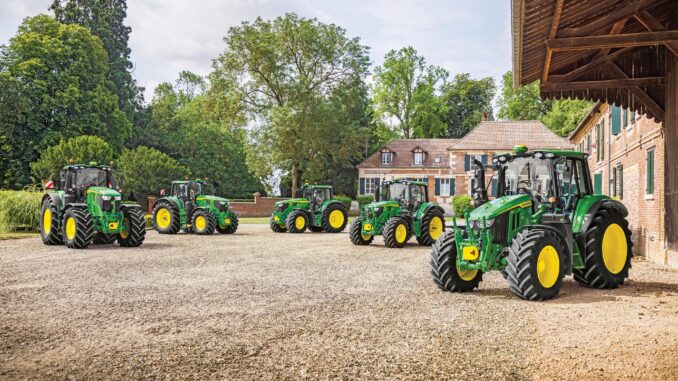
John Deere 5000 Utility Series Compact Tractor Models and Maintenance Guide
The John Deere 5000 Utility Series is a broad, legacy-to-modern family of agricultural utility tractors rather than a compact-tractor range in the modern 1–4 Series sense. Across its North American history, the 5000 name has covered practical 45 hp utility tractors through to substantially larger 100 hp-plus farm and livestock machines. That makes the series especially relevant to acreage owners, smallholders, hay producers, livestock operations, roadside and grounds contractors, and owners maintaining older Deere utility tractors.
This page is a working hub for the John Deere 5000 Utility Series. Use it to locate model-specific maintenance information, common-problem guides, parts and service references, attachment guidance, and troubleshooting material for both early 5000 tractors and later 5000-derived models. For the wider Deere ownership picture, start with the General John Deere Compact Tractor Guide, then move into the individual model and system-level guides listed throughout this directory.
About the John Deere 5000 Utility Series
John Deere used the 5000 designation for multiple generations of North American utility tractors. The earliest modern 5000 Utility Series machines included the 5200, 5300, 5400, and later 5500, introduced in the early 1990s. These were conventional agricultural utility tractors, generally spanning roughly 45 hp to 83 hp, and they became common on small farms, livestock holdings, hay operations, and larger rural properties. The original 5200, 5300, and 5400 were marketed from 1992 through 1997, with the 5500 joining later in that generation.deere+1
Later 5000-family development produced models such as the 5210, 5310, 5410, and 5510, followed by 5020, 5003, 5025, 5D, 5E, 5M, 5R, 5ML, and specialty derivatives. Therefore, “5000 Utility Series” can mean different things depending on the year, country, decal style, and whether the owner is referring to an original 1990s tractor or the wider John Deere 5 Family utility range.
Unlike a sub-compact tractor, a typical 5000-series Deere is a full agricultural utility tractor. It normally has a conventional agricultural chassis, Category I or Category II three-point hitch depending on model and configuration, independent or live rear PTO arrangements, a rear hydraulic remote option, and enough physical weight for serious loader and implement work. Four-wheel drive—often identified by Deere as MFWD—was common, while certain older and economy versions were also sold in 2WD form. The early 5000 tractors were available with several transmission arrangements, including basic gear transmissions; for example, the 5300 was offered with a 9-speed unsynchronized gear transmission.tractordata
Current 5 Family machines continue the idea, but with more segmentation:
-
5E tractors are generally the straightforward value-oriented utility models for property, chores, mowing, loader work, and light-to-medium farm duties.
-
5M tractors add more configuration, operator comfort, hydraulic capability, and versatility for regular livestock, hay, snow, and loader work.
-
5R tractors are more premium, feature-rich utility tractors aimed at intensive loader, transport, PTO, and mixed-farm use.
-
5ML and specialty versions are tailored toward particular operating environments, including low-profile, orchard, livestock, municipal, or specialty work depending on the model family and market.
Current 5E models in the United States range from the 50.1 hp 5050E to the 100 hp 5100E. Deere lists both 2WD and MFWD choices on several lower and mid-range 5E models, while the 5090E and 5100E are MFWD machines with open-station, standard-cab, and premium-cab availability. Modern 5 Family tractors cover roughly 50 hp through 130 hp in the mainstream North American lineup.deere+1
Typical equipment includes front-end loaders, bale spears, pallet forks, grapple buckets, rotary cutters, finish mowers, hay tools, rear blades, box blades, landscape rakes, post-hole diggers, tillers, snow blowers, snow pushers, and trailers. The correct tractor-and-implement match depends not only on engine horsepower, but also PTO horsepower, tractor weight, hydraulic flow, rear hitch category, tire type, ballast, and whether the tractor is equipped with a loader or front hydraulic outlets.
John Deere 5000 Utility Series Compact Tractor Models
The table below is an across-time North American directory for models publicly associated with the John Deere 5000 Utility Series and its major 5-family successors. It intentionally includes older, discontinued, replaced, and related derivatives where public North American information is available.
Because John Deere’s naming and marketing changed over several decades, this is not a claim that every model shared the same chassis or was sold under identical “5000 Utility Series” branding. Instead, it is a practical ownership index for tractors commonly treated as part of the 5000/5 Family utility lineage. Early 5000 tractors should not be confused with the much larger 1960s John Deere 5010 and 5020 standard-tread tractors, which were part of the New Generation line rather than the 1990s-onward 5000 Utility Series.tractordata+1
And See:
John Deere’s historical model lists show the original 5000 Utility Series as the 5200, 5300, 5400, and 5500 lineup, while Deere’s service literature also groups these tractors together for filters, fluids, and capacities. The 5003 generation included the 5103, 5203, 5303, and 5403, with the 5603 later extending the range. Current mainstream 5E offerings include the 5050E, 5060E, 5067E, 5075E, 5090E, and 5100E.deere+3
5000 Utility Series Maintenance Guides
Routine Service and Checks
A used or working John Deere 5000 Utility Series tractor benefits most from consistent, recorded preventive maintenance. The correct interval and fluid capacity vary significantly by model, engine, transmission, axle configuration, cab equipment, emissions equipment, and production year, so the operator’s manual and technical manual for the exact tractor serial number must always take priority.
For older 5200, 5300, 5400, and 5500 tractors, Deere publishes grouped quick-reference material covering filters, service intervals, and capacities. The guide identifies separate air-filter applications for the 5200/5300 and the 5400/5500, illustrating why owners should not order filters solely by the broad “5000 series” label.deere
A sensible routine service plan should include:
-
Check engine oil level before daily work or before each extended operating period.
-
Inspect coolant level only when the engine is cold, and keep the radiator screen, grille and cooling package clear.
-
Drain the water separator and monitor the fuel system for contamination, especially after long storage or fuel deliveries.
-
Grease loader pivots, three-point-hitch points, steering joints, front axle pivots, driveshaft points and other fittings at the interval specified for the tractor.
-
Inspect engine air filters and clean or replace them as appropriate; do not over-clean or damage the filter element.
-
Check hydraulic/transmission oil level with the implement lowered, tractor parked correctly, and oil at the condition specified by the manual.
-
Examine belts, hoses, clamps, electrical connections and battery cables before a small fault turns into downtime.
-
Check front tire condition, rear tire ballast, wheel fasteners and correct tire pressures, particularly before loader work or road travel.
-
Verify that brakes, parking brake, lights, hazard flashers, SMV emblem and ROPS or cab safety equipment are in safe operating condition.
Useful internal-link targets for this section include 5000 Utility Series service interval checklist, DIY maintenance for John Deere 5000 Utility Series tractors, John Deere 5000 Series filters and fluid capacities guide, and seasonal maintenance checklist for John Deere utility tractors.
Hydraulics, Loader, and 3-Point Hitch
Hydraulic condition is central to a utility tractor’s usefulness. A weak loader, delayed three-point lift, noisy pump, drifting implement, leaking hose, or slow remote cylinder may be caused by anything from low oil level and a plugged filter to a worn coupler, air ingress, incorrect hose connection, relief-valve trouble, a failing pump, or internal cylinder leakage.
Start with the simple checks:
-
Confirm the correct hydraulic/transmission oil level and specification.
-
Inspect for external leaks at hoses, quick couplers, loader valve blocks, cylinders, fittings, rear remote valves and hitch lift components.
-
Make sure loader quick couplers are fully seated and that hoses have not been crossed.
-
Check whether the symptom affects both loader and rear hitch functions, or only one circuit.
-
Compare cold and fully warmed operation, because a weakness that becomes worse when oil is hot can point toward internal hydraulic leakage or pump wear.
-
Check loader pins, bushings, grease points and mounting hardware, as mechanical binding can feel like a hydraulic problem.
-
Ensure the rear three-point hitch draft and position controls are set correctly for the job.
The original 5000 Utility tractors could be fitted with Deere loaders; period attachment references identify 520/522 loaders for certain 2WD applications and 540/542 loaders for certain 4WD applications on the 5200, 5300, and 5400. Confirm exact loader compatibility by tractor configuration, mounting frame, serial number, hydraulic valve arrangement, and whether the machine has 2WD or MFWD.tractordata
Planned internal links should include Hydraulic maintenance and leak diagnosis on John Deere 5000 Utility Series tractors, Loader and three-point hitch maintenance for John Deere 5000 Utility Series, and John Deere utility tractor loader cylinder inspection and reseal guide.
Transmission and Drivetrain
Transmission maintenance differs sharply between early gear-drive utility tractors and later PowrReverser, PowerReverser, PowrQuad, AutoQuad, IVT, or other advanced configurations. Never assume that a procedure, fluid check point, clutch adjustment, or calibration process from one 5-family tractor applies to another.
For basic checks across the series:
-
Maintain the correct transmission/hydraulic oil level and use the lubricant specified for the exact model.
-
Check for oil leaks around axle seals, PTO seals, transmission cases, hydraulic suction lines, front-wheel-drive components and final drives.
-
Inspect clutch operation and linkage on gear-drive models.
-
Check forward/reverse shuttle performance, range changes and gear engagement before assuming an internal transmission failure.
-
Examine the front MFWD driveshaft, universal joints, front axle pivot, steering components and front hub/axle seals.
-
On MFWD models, use matched tire sizes and maintain the specified rolling circumference relationship between front and rear tires.
-
Test differential-lock operation only in suitable conditions and avoid turning sharply with the lock engaged.
-
Inspect brakes and parking-brake function, especially on tractors used for loader work, slopes, towing, or road transport.
-
Check PTO engagement, PTO shaft seals, safety shields and implement driveline condition.
A useful hub article here is Transmission and driveline maintenance across John Deere 5000 Utility Series tractors. Individual pages can then separate early synchronized/unsynchronized gear transmissions from PowrReverser and more electronically controlled systems.
5000 Utility Series Troubleshooting Guides
Starting, Engine, and Fuel Problems
Starting complaints on John Deere 5000 Utility Series tractors commonly fall into three categories: the starter does not crank, the engine cranks but does not start, or the tractor starts but runs poorly. The first task is to identify which category applies before replacing parts.
For a no-crank condition, inspect battery state of charge, battery-cable condition, grounds, key switch operation, starter circuit, neutral-start circuit, clutch or transmission safety interlock, PTO safety circuit, fuses and relays. On an older tractor, corrosion at a ground cable or starter terminal is often more likely than a major engine fault. On a newer machine, an interlock or electronic-control issue may also prevent starting.
For crank-but-no-start faults, work through the fuel system from tank to injectors:
-
Confirm an adequate supply of clean diesel fuel.
-
Check the fuel shutoff, fuel filters, water separator and any sediment bowl.
-
Look for air leaks at filter seals, fuel lines, primer pumps and connections.
-
Prime and bleed the fuel system using the correct procedure after a filter replacement or fuel run-out.
-
Check for blocked tank venting, collapsed hoses or contaminated fuel.
-
Inspect glow-plug, intake-heater or cold-start-system operation where fitted.
-
Consider engine speed signals, solenoids, sensors and fault codes on later electronic models.
Power loss under load often points to fuel restriction, restricted air intake, overheating, incorrect PTO loading, a dragging brake, transmission or hydraulic load, turbocharger-related issues on applicable models, or an emissions-system concern on later Tier-compliant tractors.
Useful pages for this hub are John Deere 5000 Utility Series starting problems – diagnostics and fixes, Engine and fuel system issues across John Deere 5000 Utility Series models, and individual pages such as 5300 no-start troubleshooting guide or 5100E loss-of-power diagnosis guide.
Hydraulic and Loader Performance Issues
Weak lift, slow loader cycle times, jerky operation, poor steering response, hitch failure, or noisy hydraulic operation should be diagnosed systematically rather than treated as an automatic pump failure.
A quick symptom comparison is helpful:
Do not place hands near a suspected high-pressure hydraulic leak. Hydraulic oil escaping under pressure can penetrate skin and requires immediate emergency medical attention. Shut the tractor down, lower implements safely, relieve pressure according to the manual, and use appropriate inspection methods.
Build internal articles around Hydraulic performance problems on John Deere 5000 Utility Series tractors, Loader will not lift or is slow on John Deere 5000 models, and Three-point hitch will not raise or hold position on Deere utility tractors.
Transmission, Drive, and PTO Problems
A tractor that will not move, moves only in some ranges, slips under load, lacks hill-climbing ability, fails to engage MFWD, or has PTO problems needs a structured diagnostic path. Operators should first distinguish between an engine-power problem and a drivetrain problem. If engine rpm drops sharply under a normal load, investigate engine and fuel performance. If the engine holds rpm but the tractor does not pull, examine transmission, clutch, shuttle, hydrostatic system where applicable, brakes, MFWD, differential lock, or driveline components.
Common checks include:
-
Confirm the transmission selector, range lever, shuttle control and parking brake are in the correct positions.
-
Check clutch free play and clutch release operation on manual-clutch tractors.
-
Verify correct transmission/hydraulic oil level and condition.
-
Inspect for a dragging brake or seized parking brake.
-
Make sure MFWD is engaging when selected and that tire sizes are matched.
-
Check for warning lamps, stored diagnostic codes and calibration issues on modern electronically managed tractors.
-
Inspect PTO selector position, PTO clutch engagement controls, wiring, safety circuits, PTO shaft condition and implement driveline protection.
-
Verify that the implement itself is not seized, overloaded, incorrectly connected or fitted with a damaged shear bolt or slip clutch.
Useful hub links include Drive and transmission problems on John Deere 5000 Utility Series tractors, PTO will not engage or drops out across John Deere 5000 Utility Series models, and model-focused articles such as 5200 clutch and transmission troubleshooting guide, 5420 MFWD diagnosis guide, and 5090E PTO problems and fixes overview.
Attachments and Implements for the 5000 Utility Series
The John Deere 5000 Utility Series can operate a wide range of implements, but the correct match varies greatly between a 46 hp 5200, an 80 hp-plus 5500 or 5420, and a modern 100 hp-plus 5M or 5R. Engine horsepower alone is not sufficient for selecting equipment.
Common attachments and implements include:
-
Front-end loaders with general-purpose buckets, material buckets, bale spears, pallet forks, grapples, snow pushers and manure-handling tools.
-
Rear-mounted rotary cutters for pasture, field edges, rough grass and brush within the tractor’s PTO capability.
-
Finish mowers, flail mowers and grooming mowers for estate, roadside and grounds work.
-
Rear blades, box blades, landscape rakes and grading scrapers for tracks, gateways, yards and snow clearing.
-
Post-hole diggers, hydraulic post drivers and fence-maintenance equipment.
-
Three-point spreaders, sprayers, seeders, cultivators, tillers and light-to-medium ground-engaging equipment.
-
Hay tools including mower-conditioners, rakes, tedders, balers and bale wrappers, where tractor PTO power, weight and hydraulic capacity are adequate.
-
Snow blowers, rear blades, loader-mounted snow equipment and ballast packages for winter work.
When selecting an implement, check:
For older 5000-series tractors, do not rely only on online attachment listings. Verify the exact tractor model, production year, 2WD or MFWD configuration, loader mounting frame, hydraulic-valve arrangement, three-point-hitch category and serial-number break before buying used equipment.