
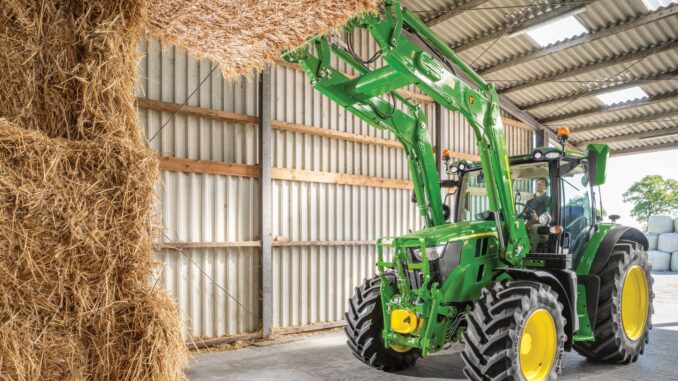
The John Deere 2955 is a 6-cylinder utility tractor built in Mannheim, Germany, with about 97 engine horsepower, independent PTO, closed-center hydraulics, and either two-wheel or four-wheel drive depending on configuration. For owners in the USA and Canada, it is a practical mid-size machine for mowing, loader work, hay, light tillage, and general property jobs, and this guide focuses on the repair, troubleshooting, maintenance, parts lookup, diagrams, manuals, and owner-level service decisions that matter most in real use.
John Deere 2955 model overview
The John Deere 2955 sits in Deere’s 55 Series utility tractor family and shares many service themes with related 6-cylinder Mannheim-built models such as the 3055 and 3155. In practical terms, that means owners are dealing with a diesel fuel system, a dry air intake system, hydraulic wet brakes, power steering, PTO driveline components, and a hydraulic/transmission system that must stay clean and correctly serviced to avoid expensive failures.
For many owners, the John Deere 2955 is large enough for serious acreage work but still common in owner-maintained fleets, which is why symptom-based troubleshooting matters so much. Most problems show up first as hard starting, low power, hydraulic sluggishness, steering or brake concerns, PTO issues, charging faults, or leaks rather than as an obvious single failed part.
General overview of the John Deere 2955
The main systems on the John Deere 2955 are the 5.9L John Deere diesel engine, the intake and fuel filtration system, the transmission and PTO driveline, the closed-center hydraulic system, steering and brake components, and the electrical charging and starting system. Depending on configuration, the tractor could be equipped with an 8-speed partially synchronized transmission, a 16-speed partial power shift transmission, or a 12-speed transmission, so exact parts matching should always be checked against the tractor PIN before ordering.
Common service parts owners regularly buy include the engine oil filter T19044, primary air filter AZ20623, secondary air filter AL67195, fuel filter AR50041, hydraulic/transmission oil filter AR75603, hydraulic/transmission return flow filter AL77061 or AL56469 or RE34958 depending on filter length, and hydrostatic steering oil filter AL31413. These are the parts that usually come up first when an owner is trying to restore starting quality, protect the fuel system, correct hydraulic service neglect, or bring a newly purchased used tractor up to a known baseline.
John Deere 2955 troubleshooting approach
Diagnosis on the John Deere 2955 should start with the symptom the owner actually sees, not with a guess about the part. A no-start, low-power complaint, slow steering complaint, weak hydraulics complaint, brake issue, or charging problem each points you toward a different system and helps prevent replacing expensive parts too early.
The main symptom groups for this tractor are:
-
Starting issues and poor cranking.
-
Running issues such as smoke, rough idle, weak power, or stalling.
-
Hydraulic and steering problems.
-
PTO and drive complaints.
-
Vibration and abnormal noise.
-
Overheating, fluid leaks, and warning-light concerns.
-
Electrical, charging, and lighting faults.
John Deere 2955 emergency repair needs
Some problems on the John Deere 2955 should be treated as immediate stop-use issues because they can create a safety risk or rapidly damage costly components. Hydraulic leaks under pressure, brake performance loss, steering loss, major charging failures, overheating, and severe driveline noise are not wait-until-later problems on a tractor in this size class.
John Deere 2955 starting issues
If the tractor cranks slowly, does not fire, or starts and then dies, the main concern is whether the problem is electrical, fuel-related, or caused by restricted air intake. Continued cranking without diagnosis can flatten batteries, overheat cables, and mask a fuel delivery issue.
Common causes
-
Weak or aged batteries; the tractor uses two 12-volt batteries in the electrical specification listed by TractorData.
-
Poor cable connections or bad grounds.
-
Restricted fuel flow through an overdue filter such as AR50041.
-
Dirty primary air filter AZ20623 or a plugged intake path.
-
Starter, solenoid, key-switch, or charging-system faults.
Basic owner checks
-
Confirm battery condition, cable tightness, and clean grounds.
-
Check for fuel supply, recent fuel contamination, and filter service history.
-
Inspect the air filter and restriction indicator behavior.
-
Verify whether the tractor cranks at normal speed or unusually slow speed.
-
Stop and move to deeper diagnosis if repeated cranking does not improve anything.
John Deere 2955 running and power problems
When a John Deere 2955 runs rough, smokes excessively, lacks pulling power, or dies under load, the issue is often tied to fuel delivery, air restriction, or maintenance neglect rather than a single dramatic failure. Owners should also keep in mind that a tractor with nearly 100 engine horsepower can hide several small problems that only become obvious under PTO or drawbar load.
Common causes
-
Dirty fuel filter or stale/contaminated diesel.
-
Air restriction from a clogged primary or overdue secondary element.
-
Poor injector performance or deeper engine issues.
-
Overdue engine oil and filter service.
-
Cooling system problems causing performance drop as operating temperature rises.
Basic owner checks
-
Replace neglected filters before chasing harder faults.
-
Inspect for black smoke, white smoke, or power loss under load.
-
Check for intake restriction and obvious fuel contamination.
-
Verify that scheduled oil service is current.
-
Escalate to dealer or diesel specialist work if the tractor still lacks power after basic service.
Vibration and noise
A new vibration, driveline knock, or rotating noise should be addressed quickly because it can point to PTO, driveline, engine accessory, brake, steering, wheel, or transmission problems. Continuing to run a vibrating tractor can turn a manageable repair into a major component failure.
Common causes
-
Loose wheel hardware or worn tires.
-
PTO or driveline issues.
-
Accessory or front-end rotating component wear.
-
Internal transmission or brake noise.
Basic owner checks
-
Identify whether the noise changes with engine speed, ground speed, or PTO engagement.
-
Inspect obvious external hardware and wheel condition.
-
Stop using PTO-driven equipment until the source is clearer.
-
Do not keep operating the tractor if the noise is heavy or metallic.
Overheating and leaks
Overheating, engine oil leaks, diesel leaks, or hydraulic leaks need prompt attention on the John Deere 2955 because heat and contamination quickly multiply repair cost. A pressurized hydraulic leak is especially serious because the tractor uses a closed-center hydraulic system operating at substantial pressure.
Common causes
-
Low fluid levels.
-
Restricted cooling pack or airflow.
-
Aged hoses, seals, or filter sealing surfaces.
-
Neglected hydraulic/transmission service intervals.
Basic owner checks
-
Park safely and locate the fluid type before adding anything.
-
Inspect around filters, hoses, and visible fittings.
-
Clean debris from cooling surfaces if accessible.
-
Stop use if fluid loss is active or temperature rises rapidly.
Transmission, PTO, and drive problems
If the tractor hesitates, shifts poorly, loses PTO function, or feels weak in hydraulic response, do not assume the transmission itself is ruined. On older utility tractors, fluid condition, filter neglect, control issues, or linkage concerns often need to be ruled out before deeper teardown work is considered.
Common causes
-
Overdue hydraulic/transmission filter service.
-
Low or contaminated hydraulic/transmission oil.
-
Linkage or control adjustment problems.
-
Internal clutch, PTO, or transmission wear.
Basic owner checks
-
Review when the hydraulic/transmission filters were last changed.
-
Confirm fluid level and inspect fluid condition.
-
Note whether the issue affects travel, PTO, steering, or all hydraulic functions.
-
Move to dealer-level diagnosis if symptoms involve slipping, grinding, or multiple systems failing together.
Electrical problems
Electrical issues often appear as weak cranking, no-crank, dim lights, charging trouble, or intermittent instrument and switch behavior. Because the John Deere 2955 uses an alternator charging system and dual batteries, poor connections can create a long list of misleading symptoms.
Common causes
-
Corroded battery terminals or grounds.
-
Weak batteries.
-
Alternator or regulator-related faults.
-
Key-switch, wiring, or connector problems.
Basic owner checks
-
Clean and tighten battery connections.
-
Check visible grounds and damaged wiring.
-
Observe whether lights dim during cranking.
-
Test charging output if the battery repeatedly goes flat.
DIY or dealer repair guide for the John Deere 2955
The realistic line on a John Deere 2955 is this: routine service, filters, battery work, simple inspections, and some external component replacement are good DIY jobs, but internal hydraulic, transmission, PTO, steering, brake, and injection-system work often crosses into dealer or specialist territory because of weight, test-equipment needs, and the cost of getting it wrong.
Good DIY jobs
-
Engine oil and filter service using T19044.
-
Primary and secondary air filter replacement using AZ20623 and AL67195.
-
Fuel filter replacement using AR50041.
-
Battery, cable, and terminal service.
-
External leak checks, hose inspection, and routine lubrication.
Advanced DIY or dealer jobs
-
Hydraulic/transmission diagnosis and internal repairs.
-
PTO clutch or driveline repairs.
-
Steering and brake hydraulic diagnosis.
-
Injection, compression, or internal engine work.
-
Cab electrical troubleshooting beyond simple charging and wiring checks.
Skill level guide
-
Beginner: Filters, battery service, visual inspections, basic fluid checks.
-
Intermediate: Belt-driven accessory work, electrical testing, hose replacement, careful service-interval catch-up.
-
Advanced: Hydraulic diagnosis, driveline work, steering and brake repair, transmission or PTO internals.
Parts for the John Deere 2955: OEM vs aftermarket
Before ordering parts for a John Deere 2955, gather the full model name, the tractor Product Identification Number or serial information, and any engine identification details available on the machine. This matters because transmission options, cab versus ROPS configuration, and running changes can affect fit, filter length, and related service parts.
For this tractor, OEM parts are the safer choice for hydraulic filters, fit-sensitive filters, and system-critical items where exact specifications matter, especially in the hydraulic and fuel systems. Aftermarket can be reasonable for batteries and some routine consumables if the cross-reference is exact and the supplier is reputable, but owners should be careful with bargain filters or unknown hydraulic components.
John Deere 2955 diagrams and manuals
The most useful official source is John Deere’s Manuals and Training page, which is where owners can download, view, or buy operator manuals, technical manuals, and parts catalogs for supported equipment. That is the best starting point for serial-specific documentation and for confirming publication numbers before spending money.
Useful sources include:
-
John Deere Manuals and Training for operator, technical, and parts publications.
-
John Deere Quick Reference Guides for Deere maintenance sheets and common service information where available by model family.
-
John Deere 50 & 55 Series 6-Cylinder Utility Tractors Filter Overview PDF for service intervals, filter part numbers, and capacities related to the model group.
-
TractorData John Deere 2955 page for quick reference specifications and serial plate location.
How to find John Deere 2955 serial and engine numbers
These identification numbers matter because they help match the correct manual, confirm the right parts, and avoid ordering mistakes on older tractors with multiple transmission and equipment variations.
-
Stand on the right side of the tractor and locate the serial number plate on the tractor frame above the front axle.
-
Record the complete model and serial information exactly as shown on the plate.
-
Check the engine for its identification tag or plate and copy that information for engine-related parts ordering.
-
Note whether the tractor has ROPS or cab equipment, since electrical and filter details can differ by configuration.
-
Take clear photos before ordering online so part suppliers can verify what you have.
Buying John Deere 2955 parts online and in stores
The best buying strategy is to identify the OEM number first, then shop by part number instead of by a vague model search. That helps prevent mix-ups on filters and configuration-sensitive items and usually saves time at both the dealer counter and online checkout.
-
Online: use official Deere resources first, then compare reputable sellers against the exact OEM part number and your serial information.
-
Dealer counter: best for hydraulic, transmission, steering, brake, or serial-specific parts where fit errors are expensive.
-
Retail stores: acceptable for common batteries and some fluids or consumables when packaging clearly cross-references the John Deere 2955 and the exact OEM number.
Useful links:
John Deere 2955 fitting guide for common service parts
These are the common DIY jobs most owners can handle if they work safely, use correct replacement parts, and follow the operator or technical documentation for torque, fluid, and access details.
Replacing the John Deere 2955 engine oil filter
This job restores lubrication protection and is one of the most important baseline service items on any used John Deere 2955.
-
Park the tractor safely, shut it down, and allow the engine oil to cool enough for safe handling.
-
Drain the engine oil into a suitable container following the operator manual procedure.
-
Remove the old oil filter and confirm the old gasket comes off with it.
-
Lightly oil the gasket on the new T19044 filter and install it by hand to the correct specification from the manual.
-
Refill with the correct oil, start the tractor, and check for leaks.
Replacing the primary and secondary air filters
This job helps cure power loss, smoke, and intake restriction issues caused by dirty filter elements.
-
Open the air cleaner housing carefully so dust does not fall into the clean side.
-
Remove the primary element AZ20623 and inspect the housing for dirt or damage.
-
Replace the secondary element AL67195 if it is due, damaged, or at the third primary change interval.
-
Clean the housing sealing surfaces without forcing debris farther inward.
-
Install the new filters correctly and make sure the housing seals fully.
Replacing the John Deere 2955 fuel filter
A fresh fuel filter is a high-value first step when hard starting, weak running, or uncertain service history is involved.
-
Shut off fuel if the tractor configuration allows and clean around the filter base before removal.
-
Remove the old AR50041 fuel filter and clean the mounting surface.
-
Install the new filter with a properly seated gasket.
-
Follow the correct priming or bleeding procedure from the manual before extended cranking.
-
Start the tractor and check carefully for leaks.
Servicing John Deere 2955 hydraulic and transmission filters
This is a preventive job more than a cure-all, but it is critical because the tractor’s hydraulic, steering, and transmission performance depend heavily on clean oil and correct filters.
-
Verify which return flow filter length your tractor uses before ordering AL77061, AL56469, or RE34958.
-
Drain or prepare the system according to the service procedure in the manual.
-
Replace the AR75603 hydraulic/transmission oil filter and the correct return flow filter together at the scheduled interval.
-
Refill with the correct oil and confirm proper level before startup.
-
Recheck for leaks and watch steering, hydraulic, and transmission behavior during the first short test run.
Maintenance for the John Deere 2955
Regular maintenance on the John Deere 2955 prevents the most expensive problems by keeping contamination out of the engine, fuel, hydraulic, steering, and transmission systems. On an older utility tractor, overdue filters and neglected fluid changes often cause more real-world trouble than dramatic one-part failures.
Focus areas should include:
-
Starting reliability, with attention to batteries, cable condition, and fuel filtration.
-
Engine breathing and power retention, with timely air filter service.
-
Hydraulic and steering protection, with correct filter intervals and clean oil.
-
Leak prevention, especially around hydraulic filters, hoses, and fittings.
-
Electrical reliability, especially charging-system condition on a dual-battery setup.
John Deere 2955 maintenance schedule
The Deere filter overview for the 50 and 55 Series 6-cylinder utility tractors provides the clearest official quick-reference interval data for the John Deere 2955 model group. Owners should still confirm exact procedures and capacities in the operator manual for their serial range and configuration.
Daily or before each use
-
Check engine oil level.
-
Check coolant level and look for obvious overheating risk or leaks.
-
Inspect for fuel, oil, or hydraulic leaks.
-
Check air restriction condition if the indicator has been active.
After initial 50 hours
-
Replace the hydraulic/transmission oil filter AR75603.
-
Replace the hydraulic/transmission return flow filter.
-
Review the tractor for leaks or loose fittings after early-service work.
After initial 100 hours
-
Replace the engine oil filter T19044 as part of the first engine oil service interval.
-
Inspect overall engine condition and check for seepage after warm operation.
Every 500 hours or yearly
-
Replace the engine oil filter T19044 and service engine oil under the listed Deere interval conditions.
-
Shorten the oil interval to 250 hours if the listed oil and fuel conditions are not met.
Every 600 hours
-
Replace the hydraulic/transmission oil filter AR75603.
-
Replace the hydraulic/transmission return flow filter at the same service.
Every 1200 hours
-
Replace the fuel filter AR50041 on the 2955.
-
Replace the hydrostatic steering oil filter AL31413.
Air filter intervals
-
Clean the primary air filter as required.
-
Replace the primary air filter if the restriction indicator continues to glow.
-
Replace the secondary air filter AL67195 at every third primary air filter change.
Seasonal checklist
-
Spring or heavy-work season start: baseline fluid and filter history, inspect cooling and intake systems, and address battery or charging weakness before field work.
-
Mid-season: monitor restriction indicators, leaks, and hydraulic response during longer work days.
-
Off-season: correct leaks, clean the tractor thoroughly, stabilize storage conditions, and record part numbers needed before the next season.
Repair, upgrade, or replace the John Deere 2955?
In many cases, a John Deere 2955 is worth repairing when the tractor is structurally sound and the engine, hydraulics, transmission, and PTO only need catch-up maintenance or isolated repairs, because it is a substantial utility tractor rather than a light-duty lawn model. The decision shifts toward upgrading or replacing when major systems stack up at once and the tractor no longer fits the jobs, attachments, or reliability expectations of the owner.
Repair if
-
The issue is mostly filters, batteries, hoses, leaks, or neglected service.
-
The tractor still starts, drives, steers, and lifts consistently once serviced.
-
The machine matches your acreage and implement needs.
Upgrade if
-
You need more hydraulic capability, cab comfort, or modern convenience than this series provides.
-
You use the tractor often enough that improved parts support and operator comfort justify moving up.
Replace if
-
The tractor has simultaneous engine, hydraulic, and transmission problems requiring major teardown.
-
Safety-related systems such as steering or brakes have recurring major faults.
-
Repair cost approaches the value of a better-condition replacement tractor.
John Deere 2955 troubleshooting FAQ
1. Why will my John Deere 2955 not start?
The most common starting points are weak batteries, poor cable connections, fuel restriction, or air-intake restriction. Because the John Deere 2955 uses dual batteries and a diesel fuel system, both electrical condition and fuel flow matter before blaming the starter or injection components. Start with battery and cable checks, then review fuel filter history and intake condition.
2. Why does my John Deere 2955 crank slowly?
Slow cranking usually points to battery condition, cable resistance, grounding problems, or starter-related issues. On an older tractor, dirty terminals and tired batteries are common enough that they should be checked before deeper diagnosis.
3. Why does my John Deere 2955 start and then die?
That symptom often suggests fuel delivery trouble, contaminated fuel, or air entering the fuel side after service. If the filter was recently changed, confirm the correct priming or bleeding procedure from the manual before assuming a larger fault.
4. Why is my John Deere 2955 low on power?
Low power on the John Deere 2955 is often tied to a restricted air filter, neglected fuel filter, poor fuel quality, or engine-related problems that become obvious only under load. Restore the basic service items first because they are cheaper and more common than internal repairs.
5. Why is my John Deere 2955 blowing black smoke?
Black smoke commonly means the engine is getting more fuel than clean air for the load condition, which can happen with intake restriction or fuel-system issues. Check the primary air filter and intake path before moving to injector diagnosis.
6. Why is my John Deere 2955 hard to start when hot?
Hard hot starting can come from electrical weakness, fuel delivery issues, or deeper engine condition problems that show up after heat soak. Start by verifying battery and cable health, then check whether the issue changed after recent service or fuel filter work.
7. Why does my John Deere 2955 have weak hydraulics?
Weak hydraulics can be caused by low or contaminated oil, overdue hydraulic filters, leaks, or deeper internal hydraulic wear. Since the tractor uses a closed-center hydraulic system, filter and oil condition are especially important before assuming pump failure.
8. Why is my John Deere 2955 steering hard?
Hard steering may be linked to hydraulic oil condition, the steering filter interval, low fluid, or broader hydraulic problems. If steering weakness appears alongside other hydraulic complaints, treat the system as a whole rather than chasing only the steering wheel symptom.
9. Why are the brakes on my John Deere 2955 weak?
The 2955 uses hydraulic wet disc brakes, so weak braking can involve hydraulic issues, wear, contamination, or adjustment-related concerns depending on the exact fault. Brake performance loss is a stop-use issue until the cause is understood.
10. Why is my John Deere 2955 PTO not working properly?
PTO trouble may come from controls, hydraulic problems, linkage issues, or internal PTO-related wear. Check whether the PTO problem happens by itself or together with other hydraulic or transmission symptoms because combined failures point to a bigger system issue.
11. Why does my John Deere 2955 overheat?
Overheating can be caused by low coolant, cooling-system blockage, airflow restriction, or engine-related operating problems. Owners should stop and inspect quickly because overheating can escalate into engine damage much faster than a routine service problem.
12. Why is my John Deere 2955 leaking hydraulic oil?
Common leak points include hoses, fittings, filter sealing surfaces, and aged components in a system that operates under significant pressure. Do not ignore active hydraulic leaks because fluid loss and contamination can quickly damage expensive parts.
13. Which oil filter fits the John Deere 2955?
The Deere filter overview lists T19044 as the engine oil filter for the John Deere 2955 model group entry. Owners should still confirm by serial and application before ordering from a non-Deere supplier.
14. Which air filters fit the John Deere 2955?
The John Deere 2955 listing shows AZ20623 as the primary air filter and AL67195 as the secondary air filter. The secondary element should not be cleaned and is replaced at every third primary air filter change.
15. Which fuel filter fits the John Deere 2955?
The filter overview lists AR50041 as the fuel filter for the 2955. That same Deere sheet also lists a 1200-hour replacement interval for that model.
16. Which hydraulic filters fit the John Deere 2955?
The main hydraulic/transmission oil filter is AR75603, and the return flow filter can be AL77061, AL56469, or RE34958 depending on required length. It is important to confirm which return filter your tractor uses before ordering.
17. Why does my John Deere 2955 battery keep going dead?
Repeated battery discharge often points to weak batteries, poor cable connections, or charging-system problems rather than a battery problem alone. Since the tractor uses an alternator system and dual batteries, test the charging side if the batteries do not stay up after charging.
18. How many batteries does a John Deere 2955 use?
TractorData lists the John Deere 2955 electrical system with two batteries, 12 volts, and 600 CCA. Use that as a specification baseline and then confirm physical size and terminal layout before buying replacements.
19. Where is the serial number on a John Deere 2955?
The serial number plate is on the right side of the tractor frame above the front axle. That location is one of the most useful details to check before ordering manuals or configuration-sensitive parts.
20. What horsepower is the John Deere 2955?
TractorData lists the John Deere 2955 at 97 engine horsepower, with claimed PTO power of 85 horsepower. Those numbers help explain why this tractor can handle heavier acreage tasks than smaller lawn and garden machines.
21. Is the John Deere 2955 two-wheel drive or four-wheel drive?
The John Deere 2955 was available in either two-wheel drive or four-wheel drive versions. That is another reason serial and exact configuration details matter before buying front axle or driveline parts.
22. What transmission does the John Deere 2955 have?
TractorData lists an 8-speed partially synchronized transmission, a 16-speed partial power shift option, and a 12-speed option for the model. Owners should match manuals and parts to the actual transmission in the tractor, not just the hood decal.
23. Why is my John Deere 2955 noisy in gear?
Noise in gear can indicate transmission, driveline, brake, axle, or hydraulic load issues depending on when the sound appears. A noise that changes with ground speed should be taken more seriously than one that only follows engine rpm at idle.
24. Why does my John Deere 2955 vibrate under load?
Load-related vibration can come from driveline imbalance, PTO issues, wheel and tire problems, or deeper transmission-related faults. Stop using attached equipment until you know whether the source is in the tractor, the implement, or the PTO connection.
25. Why is my John Deere 2955 using more fuel than usual?
Higher fuel use often follows restricted air intake, poor maintenance, low power under load, or operating problems that force the engine to work harder. Bringing the air and fuel service items up to date is the right first step.
26. How often should I change the engine oil filter on a John Deere 2955?
Deere’s filter overview lists replacement after the first 100 hours, then every 500 hours thereafter or annually under the stated oil and fuel conditions. The same sheet says the interval should drop to 250 hours if those conditions are not met.
27. How often should I change the hydraulic filters on a John Deere 2955?
The hydraulic/transmission oil filter and return flow filter are listed for replacement after the first 50 hours, then after the first 600 hours and every 600 hours thereafter. Replacing both together is the safer approach because Deere ties those services together on the reference sheet.
28. How often should I change the fuel filter on a John Deere 2955?
The Deere filter overview lists AR50041 with a 1200-hour interval for the John Deere 2955. If the tractor has contaminated fuel or unknown maintenance history, owners often replace it sooner as a baseline service step.
29. Can I use aftermarket filters on a John Deere 2955?
Aftermarket filters can work if they are high quality and cross-reference exactly to the Deere number, but hydraulic and fit-sensitive applications are where many owners prefer OEM. The risk with unknown aftermarket parts is not just filtration quality but also seal fit and application mismatch.
30. Where can I get a John Deere 2955 operator manual?
The best official source is John Deere’s Manuals and Training page, which is set up for viewing, downloading, and purchasing Deere manuals and publications. That is the right place to start before using third-party manual sellers.
31. Where can I get John Deere 2955 parts diagrams?
John Deere’s manual and publications resources are the most reliable starting point for official parts information, while Deere maintenance and quick-reference resources help with routine service identification. TractorData is useful for quick specification checks, but it is not a substitute for official parts breakdowns.
32. Is the John Deere 2955 a good DIY tractor?
For routine maintenance and straightforward service work, yes, because common filters, battery service, and many visual inspections are realistic owner jobs. For hydraulic, PTO, steering, brake, and internal transmission repairs, it becomes a more advanced machine that often needs specialist support.
33. What should I check first on a used John Deere 2955?
Start with cold starting behavior, smoke, hydraulic response, steering feel, brake performance, visible leaks, charging condition, and evidence of routine filter service. A tractor that has simply been under-serviced is very different from one with multiple failing major systems.
34. Is the John Deere 2955 worth repairing?
It often is, especially when the machine is basically sound and the main needs are service catch-up, filter replacement, hoses, batteries, or isolated repairs. The answer becomes less favorable when engine, hydraulic, and transmission problems arrive together.
35. What is the best troubleshooting strategy for a John Deere 2955?
Start with the exact symptom, identify the affected system, bring overdue maintenance up to date, and only then move to deeper mechanical diagnosis. That approach usually saves money and avoids replacing good parts on an older utility tractor.