
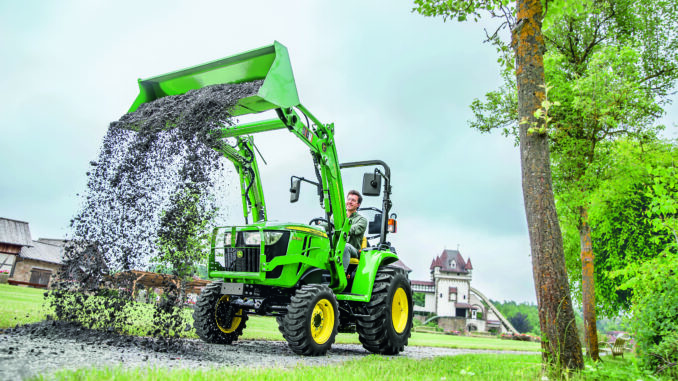
The John Deere 3038E is a compact utility tractor aimed at homeowners, acreage owners, and light property-management users who need more capability than a lawn tractor but do not necessarily need a larger farm tractor. Deere’s North American operator’s manual groups the 3038E with the 3032E, and common owner maintenance coverage for the 3038E centers on the diesel engine, fuel and air filtration, hydraulic/transmission system, front axle on MFWD machines, cooling system, and electrical controls.
For most owners in the USA and Canada, the 3038E is used for loader work, mowing with compatible attachments, driveway and property maintenance, material handling, and general small-acreage jobs. This guide covers practical repair decisions, symptom-based troubleshooting, maintenance priorities, common service parts, and a large FAQ so owners can separate realistic DIY work from jobs that are better handled by a Deere dealer.
John Deere 3038E model overview
The john deere 3038e sits in Deere’s compact utility tractor range rather than its residential mower lineup, which means owners deal with tractor-style systems such as diesel fuel filtration, hydraulic oil filters, cooling screens, front axle service on MFWD models, and safety interlocks rather than just mower-deck parts. Deere’s maintenance references for the 3038E also show longer-hour service intervals than a typical lawn tractor, including engine oil service at 200 hours or annually and several hydraulic/fuel filter services at 400 hours.
Typical systems owners need to understand on the john deere 3038e include:
-
Diesel engine and fuel system, including fuel filter and water-separator service.
-
Air intake and cooling system, including primary/secondary air filters and cooling screen cleaning.
-
Hydraulic and transmission system, including hydraulic and transmission/hydraulic filters.
-
Electrical and safety system, including seat switch, PTO switch, neutral start switch, battery, and light/electrical switches.
Several common service and repair parts owners regularly buy for the john deere 3038e include engine oil filter M806419, primary air filter M131802, secondary air filter M131803, hydraulic oil filter LVA14703, transmission/hydraulic filter LVA16054, battery TY26498, PTO switch LVA11437, neutral start switch RE12411, and fan belt M801821. Deere-focused parts retailers also list serial-number-sensitive filter kits, including LVA21128 for earlier serial ranges and LVA21037 for serial number 610001 and up.
John Deere 3038E troubleshooting approach
The best way to diagnose a john deere 3038e is to start with the symptom the owner sees rather than replacing parts by guesswork. Deere’s published maintenance and inspection guidance emphasizes routine checks such as engine oil, coolant, fuel sediment bowl, air restriction indicator, safety interlocks, transmission oil level, and cooling screens, which makes those the first places to look before moving to deeper diagnosis.
Main symptom groups on the john deere 3038e usually include:
-
Starting issues, such as no crank, slow crank, or crank-but-no-start.
-
Running issues, such as low power, rough running, smoke, or regeneration-related diesel concerns on later serial ranges with DPF-related parts listed.
-
Hydraulic and drive issues, such as weak loader response, noisy hydraulics, or poor movement.
-
Overheating and leak issues, especially from clogged cooling screens, coolant problems, hoses, or belt issues.
-
Electrical and safety-switch issues, including battery, seat switch, PTO switch, neutral start switch, or lighting/control faults.
John Deere 3038E emergency and immediate repair needs
Some john deere 3038e problems should be addressed right away because they affect safety or can lead to much more expensive damage. Fuel leaks, hydraulic leaks under pressure, overheating, charging failures, belt failures, and safety-interlock problems can all move from “inconvenient” to “machine-stopping” quickly if ignored.
John Deere 3038E starting issues
If the john deere 3038e will not crank, cranks slowly, or cranks but will not fire, stop and diagnose before repeated starting attempts drain the battery or overwork the starter. Hard starting can also indicate fuel delivery problems, interlock issues, or weak electrical supply rather than a single failed part.
Common causes:
-
Weak or failing battery TY26498.
-
Dirty or loose battery terminals.
-
Faulty neutral start switch RE12411.
-
PTO or seat safety-switch faults, including PTO switch LVA11437 or seat switch AM131968.
-
Fuel restriction from a dirty fuel filter or water-separator issue.
-
Air in the diesel fuel system after filter service.
Basic checks:
-
Confirm PTO is off, range/gear selector is in the correct start position, and operator presence conditions are met.
-
Check battery voltage, terminal tightness, and visible corrosion.
-
Inspect the fuel sediment bowl/filter area for water or contamination.
-
If recently serviced, bleed the fuel system as required before assuming a bad injector or pump.
John Deere 3038E vibration and noise
Unusual vibration or noise on the john deere 3038e should be treated seriously because it can point to loose wheel hardware, belt issues, driveline wear, hydraulic cavitation, or attachment-related problems. Deere’s maintenance charts specifically call for wheel bolt torque checks and regular lubrication, which are important because loose or dry components often show up first as noise and vibration.
Common causes:
-
Loose wheel bolts or hardware.
-
Worn or slipping fan/alternator belt M801821.
-
Dry grease points or hitch/linkage wear.
-
Attachment driveline or implement imbalance.
-
Hydraulic aeration or low fluid level.
Basic checks:
-
Stop using the tractor and inspect wheel bolt torque and tire condition.
-
Check visible belt condition and tension.
-
Grease all scheduled fittings and inspect hitch/linkage wear points.
-
Remove the implement from the equation if needed and test the tractor by itself.
John Deere 3038E overheating and leaks
A john deere 3038e that runs hot, smells hot, pushes coolant, or shows fluid under the machine needs immediate attention because heat and fluid loss can damage the engine, hydraulic system, or wiring. Deere’s routine service guidance specifically includes checking coolant level, cleaning cooling air screens daily, checking radiator hose clamps, and cleaning radiator fins at longer intervals.
Common causes:
-
Plugged cooling air screens or dirty radiator fins.
-
Low coolant level.
-
Loose or aging radiator hoses, including upper LVU17635 or lower LVU17636.
-
Faulty thermostat M811034 or leaking thermostat gaskets M805834/M805835.
-
Slipping or broken fan belt M801821.
Basic checks:
-
Shut the tractor down and let it cool before opening anything pressurized.
-
Clean screens and inspect radiator fins for packed debris.
-
Check coolant level and hose condition.
-
Inspect the fan belt and verify it is intact and properly tensioned.
John Deere 3038E transmission and hydraulic problems
If the john deere 3038e moves poorly, the loader is weak, or hydraulics sound noisy, do not keep working it hard because low oil level, restricted filters, or internal wear can get worse quickly. Deere service references for the 3038E identify both a hydraulic oil filter and a transmission/hydraulic filter, with an initial transmission/hydraulic filter change after 50 hours and later service at 400-hour intervals.
Common causes:
-
Low transmission/hydraulic oil level.
-
Restricted hydraulic or transmission/hydraulic filter, including LVA14703 or LVA16054.
-
Air entering the hydraulic system.
-
Dirty fluid or overdue service.
-
Internal pump, valve, or hydro/mechanical drivetrain issues requiring dealer diagnosis.
Basic checks:
-
Verify oil level with the tractor on level ground using the correct procedure from the operator’s manual.
-
Review service history to see whether the 50-hour or 400-hour filter change has been missed.
-
Look for leaks around hoses, couplers, filter bases, and axle/hydraulic areas.
-
If symptoms remain after level and filter checks, move toward dealer testing rather than guessing at hydraulic internals.
John Deere 3038E electrical problems
Electrical problems on the john deere 3038e often show up as no-start, intermittent shutoff, dead lights, or erratic switch behavior. Because Deere parts listings for this model include multiple switches and bulbs, owners should first separate a power-supply issue from a single failed switch or lamp circuit.
Common causes:
-
Weak battery TY26498.
-
Blown fuse or poor fuse connection.
-
Failed headlight switch AM124875, PTO switch LVA11437, turn signal switch LVA12928, or seat switch AM131968.
-
Corroded grounds or battery cables.
-
Faulty oil pressure or temperature-related sender/switch faults.
Basic checks:
-
Test the battery and charging system first.
-
Check fuses before replacing switches.
-
Inspect harness plugs around the battery, dash, and operator platform.
-
Replace individual switches only after confirming they are actually the fault.
Summary:
How to troubleshoot 3038E hydraulic slow downs
How to check hydraulic filter and fluid condition
What causes John Deere 3038E overheating
How to test for coolant electrolysis with a multimeter
To test a John Deere 3038E for coolant electrolysis, use a digital multimeter to measure DC voltage between the coolant and a known-good chassis/engine ground. The probe must touch only the coolant—not the radiator neck, tank, or any metal—because metal contact invalidates the reading. A result under roughly 0.10 V (100 mV) is reassuring; readings approaching or above 0.30 V (300 mV) warrant investigation for stray current, poor grounds, charging-system faults, or degraded coolant.streetmusclemag+2
What you need
-
A digital multimeter with DC-voltage measurement and preferably millivolt resolution.
-
Clean access to coolant in the radiator filler neck or a pressurised expansion/degas tank.
-
A clean bare-metal engine/block ground or direct access to the negative battery post.
-
Safety gloves and eye protection.
Avoid testing through an unpressurised coolant recovery bottle if it may not contain active circulating coolant. Test at the radiator filler neck or pressurised coolant reservoir where possible.
Safety setup
-
Start only with the engine fully cold if you must remove a radiator or pressurised reservoir cap.
-
Park on level ground, set the parking brake, lower implements, and keep hands clear of belts, fan, and rotating components.
-
Never remove a radiator cap from a hot or pressurised cooling system.
-
Do not allow either meter lead to contact the fan, belts, battery positive terminal, or moving parts.
-
Do not use the multimeter’s resistance/ohms setting on a live electrical system. Use DC volts first; later, take an AC-voltage reading as a secondary check.awrracing+1
DC-voltage test
1. Set the meter
-
Select DC volts—shown as
V⎓,VDC, or a solid line over a dashed line. -
Use auto-ranging, or select the 2 V / 20 V range.
-
If the meter has a millivolt setting, you may use it once you know the reading is below 1 V.
2. Connect the probes
-
Connect the black/negative probe to the clean negative battery post. A clean, unpainted engine block point is an acceptable cross-check.
-
Suspend the red/positive probe in the coolant.
-
Keep the metal tip immersed but ensure it touches coolant only. It must not touch the filler neck, radiator core, cap seat, reservoir wall, hose clip, or any other metal.
This measures the electrical potential between the coolant and the tractor’s ground circuit.streetmusclemag+2
3. Record readings in stages
Take readings and write them down:
For the 3038E, useful load changes include switching lights on, engaging electrically controlled accessories where applicable, or switching the PTO only if it is safe and the implement is disconnected or otherwise properly controlled. The principle is to change one electrical load at a time and watch whether the reading rises sharply.autoserviceworld+2
Reading the result
Different cooling-system sources set different action thresholds, so treat the number as a diagnostic guide—not a standalone verdict.
Several technical references use 0.30 V as the maximum acceptable reading, while some radiator specialists use 0.10 V as the level at which corrective action should begin. The key warning signs are a reading that is high, rises substantially as rpm increases, or spikes when a particular circuit is turned on.streetmusclemag+3
Test AC voltage too
After the DC test, repeat using AC volts (V~) on the lowest suitable range.
-
Keep the black probe on battery negative or clean engine ground.
-
Keep the red probe immersed in coolant only.
-
Repeat at idle and at roughly 1,500–2,000 rpm.
Unexpected AC voltage can point to alternator diode/ripple problems. The formal cooling-system guidance recommends checking both AC and DC voltage rather than DC alone.awrracing+1
If the reading is high
First determine whether it is mainly coolant chemistry or an active electrical fault:
-
Repeat the reading with engine off and all electrical systems off.
-
Repeat with the engine at idle, then at higher rpm.
-
Switch electrical loads on and off one at a time.
-
If the reading rises with engine speed or one circuit, inspect battery terminals, engine-to-frame ground straps, chassis grounds, alternator wiring/output, accessory wiring, and any added electrical equipment.
-
If the reading remains high even with the battery disconnected, the coolant itself may be conductive because it is old, contaminated, mixed incorrectly, or chemically depleted. Replace coolant only after fixing any electrical cause; otherwise the new coolant can be damaged quickly.techtips+1
On a 3038E with unexplained overheating or recurring radiator/cooling-system corrosion, have a Deere-capable technician check ground integrity and charging-system ripple as part of the diagnosis. Do not assume electrolysis is the cause until you have first ruled out the more common problems—blocked radiator fins/screens, low coolant, a coolant leak, a poor belt, thermostat restriction, or inadequate coolant circulation.
How do I trace a stray current in a John Deere 3038E
How do I check voltage drop on the battery cable
How to check the positive cable step by step
What causes John Deere 3038E overheating
John Deere 3038E DIY or dealer repair decision guide
For the john deere 3038e, the normal DIY line is routine maintenance, visible bolt-on parts, filters, battery, bulbs, and basic switch replacement, while the dealer line begins where diagnostic tools, hydraulic pressure testing, engine-internal work, emissions-related diesel hardware, or transmission teardown become likely. This is especially important because Deere parts listings show serial-number breaks on some 3038E service parts, and later serial ranges include DPF-related components that most homeowners should not treat as trial-and-error repairs.
John Deere 3038E good DIY jobs
-
Engine oil and filter changes using M806419 and the correct oil specification.
-
Primary and secondary air filter inspection or replacement using M131802 and M131803.
-
Fuel filter and water-separator service if you can bleed the system correctly afterward.
-
Battery replacement with TY26498 and terminal cleaning.
-
Replacing simple switches such as seat, PTO, or light switches after confirming the fault.
-
Cooling-screen cleaning, radiator-fin cleaning, and greasing scheduled fittings.
John Deere 3038E advanced DIY or dealer jobs
-
Hydraulic pressure diagnosis or pump/valve work.
-
Clutch, transmission, or drivetrain internal repairs.
-
Injector testing, timing-related engine work, or valve adjustment, which Deere charts tie to dealer-level service at longer intervals.
-
DPF or emissions-related diagnosis on later serial-number machines with MIA883483-listed particulate filter hardware.
-
Major electrical harness tracing for intermittent faults.
John Deere 3038E skill level guide
-
Beginner: Engine oil, air filter checks, coolant checks, battery service, grease points.
-
Intermediate: Fuel filter replacement and bleeding, switch replacement, belt inspection/replacement, hose replacement.
-
Advanced: Hydraulic diagnosis, deep electrical troubleshooting, injector work, valve adjustment, transmission or front-axle internal repairs.
John Deere 3038E parts, OEM numbers, and ordering details
Before ordering john deere 3038e parts, gather the full tractor model, the Product Identification Number (PIN), and the engine model/serial information because Deere and Deere-focused parts suppliers break some filters and kits by serial number range. That matters on this model because Green Farm Parts lists different filter kits and fuel-related service parts for serial number 610001 and up versus earlier machines.
Key details to collect before ordering parts for the john deere 3038e:
-
Full model name: John Deere 3038E.
-
Product Identification Number / PIN from the tractor identification area described in Deere’s operator’s manual.
-
Engine model and serial number.
-
Any implement or attachment model if the symptom involves mower, loader, or rear implement hardware.
-
Serial-number break information when ordering filter kits or fuel-system parts.
John Deere 3038E service parts table
OEM parts are usually the safest choice on the john deere 3038e for filters with serial-number breaks, belts, switchgear, and fit-sensitive items because wrong-spec parts can create false troubleshooting trails. Aftermarket parts can still make sense for batteries, bulbs, and some filters when the seller gives a clean cross-reference for the exact 3038E serial range and engine application.
John Deere 3038E manuals and parts diagrams
Useful sources for john deere 3038e owners include Deere’s operator’s manual page for the 3032E/3038E, Deere parts support pages, and reputable Deere-specialist retailers with model-specific maintenance pages. The Deere operator’s manual is most useful for identification, controls, maintenance procedures, and safety checks, while Deere-focused parts pages are useful for service part numbers and serial-number breaks.
Suggested links:
-
John Deere 3032E/3038E operator’s manual — identification, controls, safety, and official operating procedures.
-
Green Farm Parts 3038E maintenance guide — quick service parts, filter kit numbers, and common repair parts.
-
John Deere parts support — entry point for Deere parts lookup and dealer-linked parts support.
-
NAPA 3038E parts page — useful for checking common aftermarket consumables such as batteries and basic service items.
John Deere 3038E model, PIN, and engine number locations
The correct numbers matter on the john deere 3038e because filter kits, fuel-system parts, and some emissions-related components vary by serial range. Deere’s operator’s manual includes product-identification content for the 3032E/3038E family, and owners should record these numbers before ordering any major service parts.
Steps to locate the key numbers on the john deere 3038e:
-
Park the tractor safely, lower implements, shut the engine off, and remove the key before looking for tags or plates.
-
Locate the tractor Product Identification Number / PIN on the machine identification area described in the Deere operator’s manual.
-
Record the full model exactly as shown, including any serial-number sequence.
-
Locate and record the engine model and serial number from the engine tag or label.
-
Keep photos of both tags on your phone so you can verify parts at the dealer counter or online listing.
John Deere 3038E buying parts online and in stores
The best strategy for john deere 3038e parts buying is to use OEM numbers first and shopping sites second. That approach reduces mistakes on serial-number-sensitive filters and helps avoid buying a “fits 3038E” listing that only fits one engine or serial break.
-
Online: Match the exact OEM number first, then confirm serial range and seller notes using sources such as Deere-linked parts support, Green Farm Parts, or NAPA.
-
Dealer counter: Best for serial-number-specific filters, switchgear, hydraulic parts, cooling-system parts, and any uncertainty involving later serial-number changes.
-
Retail stores: Fine for batteries, oils, grease, bulbs, and some filters if the packaging clearly cross-references the John Deere 3038E and the correct OEM number.
Useful URLs:
John Deere 3038E step-by-step fitting guide for common parts
John Deere 3038E engine oil and filter change
This john deere 3038e job helps prevent premature engine wear and matches Deere’s 200-hour or annual oil-filter replacement interval.
-
Warm the engine briefly so the oil drains more completely, then park safely on level ground and shut it off.
-
Drain the engine oil into a suitable pan and remove the old oil filter M806419.
-
Lightly oil the new filter gasket and install the new filter by hand according to normal filter-tightening practice.
-
Refill with the correct engine oil, start the tractor, and check for leaks.
-
Shut it down, recheck the oil level, and top off as needed.
John Deere 3038E air filter service
This john deere 3038e job helps with hard starting, black smoke, and power loss caused by intake restriction. Deere lists primary filter M131802 and secondary filter M131803 for this model.
-
Open the air-cleaner housing carefully so dirt does not fall into the clean side.
-
Remove the primary element first and inspect it for heavy dust, damage, or oil contamination.
-
Replace the secondary element only if required and avoid blowing dirt deeper into the intake tract.
-
Clean the housing and dust valve area gently before reassembly.
-
Refit the housing securely and check that all clamps seal properly.
John Deere 3038E fuel filter and water-separator service
This john deere 3038e job is one of the first checks for hard starting, stalling, and low-power complaints. Green Farm Parts lists different fuel-filter and separator numbers by serial range, so confirm the serial before ordering.
-
Confirm whether the tractor is in the earlier or later serial-number range before buying parts.
-
Shut the tractor off, clean the area around the filter/separator, and place a container underneath.
-
Remove the old filter or separator, install the correct new part, and ensure seals seat properly.
-
Prime or bleed the fuel system as required before extended cranking.
-
Start the tractor and check carefully for leaks or air-entry symptoms.
John Deere 3038E battery replacement
This john deere 3038e job fixes many slow-crank and intermittent electrical complaints when the battery is at the end of its life. Common replacement listing TY26498 appears in Deere-focused 3038E parts references.
-
Turn the key off and disconnect the negative cable first.
-
Disconnect the positive cable and remove the hold-down hardware.
-
Clean the tray and cable ends before installing the replacement battery TY26498.
-
Install the new battery, connect positive first and negative last, and secure the hold-down.
-
Test cranking speed and charging performance before assuming other parts are bad.
John Deere 3038E maintenance to prevent repeat problems
Regular maintenance on the john deere 3038e prevents many of the owner complaints that later get blamed on expensive components. Deere’s own interval structure shows that daily checks, scheduled filter changes, cooling-system cleaning, lubrication, and periodic oil services are the real foundation of reliability on this tractor.
Focus areas:
-
Starting reliability: Keep the battery healthy, filters fresh, and fuel system clean and air-free.
-
Engine and cooling health: Check coolant, clean screens, and inspect the fan belt and hoses before they fail.
-
Hydraulic performance: Maintain correct oil level and do the 50-hour and 400-hour filter services on time.
-
Electrical reliability: Keep terminals clean and investigate interlock faults early instead of bypassing switches.
-
Chassis durability: Grease fittings, inspect hardware, and monitor tire pressure and wheel torque.
John Deere 3038E maintenance schedule and year-round checklist
Deere maintenance references for this class of tractor show a repeating pattern of pre-use checks, 50-hour inspections, 200-hour engine service, 400-hour filter service on the 3038E parts guide, and coolant replacement on a longer calendar interval. The exact wording varies between Deere publications and Deere-focused maintenance guides, but the major service points are consistent enough to build a practical owner schedule.
John Deere 3038E daily or before each use
-
Check fuel level and fill if necessary.
-
Check engine oil level.
-
Check radiator coolant level.
-
Check the fuel filter sediment bowl.
-
Check and clean cooling air screens.
-
Test the safety interlock system.
John Deere 3038E after the first 50 hours
-
Replace the transmission/hydraulic filter LVA16054.
-
Check alternator/fan belt tension.
-
Check radiator hose clamps.
-
Check wheel bolt torque.
John Deere 3038E every 50 hours
-
Check MFWD oil level where applicable.
-
Lubricate tractor grease fittings.
-
Check wheel bolt torque.
-
Check tire pressure.
-
Check battery condition/electrolyte where applicable.
John Deere 3038E every 200 hours or yearly
-
Change engine oil and replace oil filter M806419.
-
Clean the fuel filter sediment bowl.
-
Check alternator belt tension.
-
Check and clean radiator cooling fins.
-
Lubricate the 3-point hitch.
John Deere 3038E every 400 to 600 hours
-
Replace hydraulic oil filter LVA14703 every 400 hours.
-
Replace transmission/hydraulic filter LVA16054 every 400 hours after the initial 50-hour change.
-
Replace fuel filter and fuel/water-separator components every 400 hours or annually, depending on serial range.
-
Check or replace primary and secondary air filters around 600 hours or as required.
John Deere 3038E every 2 years
-
Change radiator coolant.
John Deere 3038E seasonal checklist
-
Spring: Change overdue engine oil/filter, inspect battery condition, clean cooling system, and verify all lights and interlocks.
-
Mid-season: Recheck greasing, cooling screens, tire pressures, and visible hose/belt condition.
-
Fall or pre-winter: Replace overdue fuel filters, drain any water contamination, check coolant protection, and service the battery before cold weather.
John Deere 3038E repair, upgrade, or replace?
For the john deere 3038e, repair usually makes sense when the tractor is structurally sound and the problem is confined to wear items, filters, hoses, belts, battery, switches, or clearly identifiable bolt-on components. Upgrade makes more sense when the tractor is basically healthy but no longer matches the workload, while replacement becomes more rational when repeated hydraulic, engine, or transmission faults start stacking labor costs beyond the value of the machine for your use case.
John Deere 3038E repair if…
-
The issue is a battery, filter, switch, hose, belt, or other routine service part.
-
Maintenance has been neglected and the symptoms reasonably match overdue service.
-
The tractor otherwise starts, drives, and hydraulically functions normally after basic service.
John Deere 3038E upgrade if…
-
You routinely need more lift, more hydraulic capability, more PTO performance, or more operator comfort than the 3038E provides.
-
The tractor is sound, but your property tasks have outgrown it.
John Deere 3038E replace if…
-
The engine, transmission, and hydraulic system all show major wear at the same time.
-
Repair costs are moving into repeated dealer-only work with no clear end point.
-
You need reliability more than another troubleshooting cycle.
John Deere 3038E Troubleshooting FAQ
1. Why will my 3038e not start?
Start with the basics the tractor actually needs to permit cranking: sufficient battery power, the correct transmission/range position, PTO off, and working safety interlocks. On the 3038E, common no-start items include the battery, seat switch, PTO switch, and neutral start switch, so check power and switch function before assuming a fuel or starter failure.
2. Why does my john deere 3038e crank slowly?
Slow cranking usually points to a weak battery, poor cable connections, corrosion at the terminals, or a charging problem that left the battery undercharged. Because TY26498 is the common battery listing for this model, battery condition is one of the first practical checks before moving on to the starter itself.
3. Why does my 3038e crank but not fire?
If it cranks but will not start, think fuel delivery, air in the fuel system, contaminated diesel, or a blocked fuel filter before assuming something major. Deere service guidance also highlights fuel sediment-bowl checks and fuel-system bleeding, both of which are important after filter changes or water contamination.
4. Why does my john deere 3038e lose power under load?
Low power often comes from restricted air flow, dirty fuel filters, contaminated fuel, or overdue maintenance rather than internal engine damage. Check the air filter elements, fuel filter service history, and cooling condition first because the 3038E has clearly defined service parts and intervals for those systems.
5. Why does my 3038e blow black smoke?
Black smoke usually means the engine is getting too much fuel for the amount of clean air available, so a restricted air filter is a common place to start. On this tractor, the primary and secondary air filters are standard service items, and neglected intake service can show up as smoke and reduced power together.
6. Why does my john deere 3038e overheat?
Overheating is often caused by blocked cooling air screens, dirty radiator fins, low coolant, or a slipping fan belt. Deere’s maintenance schedule specifically calls for daily cooling-screen cleaning and periodic radiator-fin cleaning, which is a strong hint that debris buildup is a common real-world cause.
7. Why is coolant leaking from my john deere 3038e?
Coolant leaks usually come from hose deterioration, loose clamps, radiator problems, thermostat housing issues, or overheating that forced coolant out. The 3038E parts listings include upper and lower radiator hoses plus thermostat-related parts, which are sensible checks before suspecting something more serious.
8. Why does my john deere 3038e battery keep going dead?
A battery that repeatedly goes dead may simply be worn out, but it can also point to poor cable connections, charging issues, parasitic drain, or infrequent use. Start with battery age and charging output, then inspect grounds and terminals before replacing switches or other electrical parts.
9. Why do the lights on my 3038e not work?
Lighting faults are often caused by a blown bulb, bad switch, fuse issue, or poor connection instead of a whole-system failure. Deere-focused parts references list specific light and switch parts for the 3038E, so isolate whether the problem is the bulb, the control switch, or missing power at the circuit.
10. Why does the PTO on my john deere 3038e not engage properly?
A PTO complaint can be electrical, mechanical, or attachment-related, but owners should first confirm the PTO switch and interlock logic are working correctly. Because the 3038E uses a listed PTO switch part and safety logic affects operation, switch faults are worth checking before deeper driveline diagnosis.
11. Why does my john deere 3038e hydraulic system feel weak?
Weak hydraulics usually come from low fluid level, restricted filters, aerated oil, or overdue service. Since the 3038E uses both a hydraulic oil filter and a transmission/hydraulic filter with defined replacement intervals, review the service history before assuming the pump is worn out.
12. Why is my 3038e loader slow to lift?
A slow loader commonly means low hydraulic oil, restricted flow, cold oil, or a filter problem, though worn cylinders or a weak pump are also possible. Basic owner checks should focus on oil level, leaks, filter age, and whether the problem changes as the machine warms up.
13. Why does my john deere 3038e move poorly or lose drive?
Poor movement can come from low transmission/hydraulic oil, filter restriction, linkage issues, or more serious drivetrain faults. On this model, it makes sense to verify oil level and overdue hydraulic filter service first because those are relatively common and much cheaper than internal repair.
14. Why does my john deere 3038e make a whining hydraulic noise?
Hydraulic whining often means low oil level, aeration, filter restriction, or cold thick fluid. If the noise appeared after service, suspect air entry or an installation issue before blaming the pump.
15. Why does my 3038e shake or vibrate during operation?
Vibration usually points to loose wheel hardware, driveline imbalance, attachment problems, worn linkage points, or engine-related issues. Deere’s schedule specifically includes wheel bolt torque checks and regular greasing, both of which are easy owner checks when vibration appears.
16. Why does my john deere 3038e squeal from the front of the engine?
A squeal from the front of the engine often suggests a slipping fan or alternator belt, especially if it gets worse on startup or with electrical load. Since M801821 is the listed fan belt for this model, belt condition and tension are sensible first checks.
17. Why does my 3038e stall after starting?
Stalling soon after startup often points to restricted fuel flow, water contamination, air in the fuel system, or an intermittent electrical/interlock problem. If the problem started after filter service, bleeding the fuel system correctly should move near the top of the checklist.
18. Why does my john deere 3038e run rough at idle?
Rough idle can be caused by dirty fuel, fuel restriction, air in the system, intake restriction, or less commonly injector-related issues. Start with consumables and maintenance history first because filters and contamination are much more common than internal injector faults on owner-used machines.
19. Why does my john deere 3038e burn through air filters quickly?
If air filters load up quickly, the machine is probably working in very dusty conditions or the housing and dust-unloader area are not being cleaned often enough. Deere’s guidance already notes that harsh dust or terrain can require more frequent service than the normal interval.
20. How often should I change john deere 3038e engine oil?
The 3038E maintenance guide lists the engine oil filter at every 200 hours or annually, whichever comes first, and that is the practical owner benchmark for oil service as well. Very dusty work, heavy loader use, or lots of short-run cold starts can justify shorter intervals.
21. How often should I replace john deere 3038e hydraulic filters?
The 3038E guide lists hydraulic oil filter LVA14703 at every 400 hours and transmission/hydraulic filter LVA16054 after the initial 50 hours and then every 400 hours. Those intervals make a big difference in hydraulic response and drivetrain reliability, so they are worth tracking closely.
22. How often should I replace john deere 3038e fuel filters?
The listed fuel filter and fuel/water-separator parts are replaced every 400 hours or annually, depending on serial range and service usage. If the tractor sees poor fuel storage conditions or water contamination, owners may need to inspect and service them sooner.
23. What air filters fit the john deere 3038e?
The common 3038E air filter listings are primary filter M131802 and secondary filter M131803. Always confirm by serial number and seller cross-reference before ordering, especially if the tractor’s history is unclear.
24. What battery fits the john deere 3038e?
A commonly listed battery for the 3038E is TY26498. Even so, verify terminal layout, physical size, and cold-weather performance requirements before buying from a local battery retailer.
25. Why does my john deere 3038e keep blowing a fuse?
A repeatedly blown fuse usually indicates a short, rubbed wire, failed switch, or component drawing too much current, not just “a bad fuse.” Replace the fuse only once for testing, then inspect the affected circuit carefully so you do not damage the harness.
26. Why does my john deere 3038e safety switch system act up?
Intermittent safety-switch problems often come from dirty connectors, worn seat-switch contacts, PTO-switch faults, or adjustment issues around the operator platform and controls. Because the 3038E has multiple commonly replaced interlock-related switches listed in parts references, owners should diagnose the exact switch rather than bypassing the system.
27. Can I use aftermarket filters on the john deere 3038e?
Yes, but only when the aftermarket brand clearly cross-references to the exact OEM number and serial range for your tractor. OEM is still the safer choice for serial-sensitive filters and any part where a wrong spec could create fuel, hydraulic, or fitment issues.
28. Is it worth repairing a john deere 3038e with hydraulic problems?
It often is, provided the problem is still in the early stage and limited to fluid level, filters, hoses, or an external leak. Once the issue points toward internal pump, valve, or transmission damage, the decision depends on dealer diagnosis, labor cost, and the tractor’s overall condition.
29. When should I take my john deere 3038e to a dealer?
Take it to a dealer when the repair involves internal hydraulic diagnosis, transmission work, injector testing, valve adjustment, emissions-related hardware, or recurring electrical faults you cannot isolate. Deere’s own broader service schedules also reserve some longer-interval procedures, such as injector inspection and valve-clearance adjustment, for dealer-level service.
30. Can I do my own john deere 3038e maintenance?
Yes, many owners can handle engine oil service, air filters, battery replacement, greasing, coolant checks, screen cleaning, and some fuel-filter work. The key is to stay within tasks that do not require special diagnostic equipment and to record the serial number before ordering parts.
31. What should I check on a john deere 3038e before every use?
Before each use, check fuel level, engine oil level, coolant level, fuel sediment bowl condition, cooling-air screens, and the safety interlock system. Those items appear repeatedly in Deere maintenance guidance because they catch many expensive problems early.
32. Why does my john deere 3038e keep running hot in dusty conditions?
Dusty conditions pack cooling screens and radiator fins much faster than normal use, which reduces airflow and raises operating temperature. Deere’s 3038E maintenance guidance explicitly notes that extreme dust and terrain require more frequent service than normal intervals.
33. What information do I need before ordering john deere 3038e parts online?
You should have the full model, the tractor PIN, the engine model/serial number, and any relevant serial-range break information. That matters because common 3038E maintenance kits and some fuel-system parts differ between earlier and later serial-number machines.
34. Why does my john deere 3038e still have problems after I changed the filters?
If symptoms remain after filter replacement, the issue may be trapped air in the fuel system, the wrong filter for the serial range, low fluid level, another blocked component, or a non-filter-related fault. This is why it helps to confirm the exact OEM number and follow up with bleeding, leak checks, and fluid-level checks instead of assuming the new part fixed everything.
What fluids and filters does the 3038E use
For a 3038E you’re dealing with standard compact-tractor fluids (engine oil, transmission/hydraulic oil, front axle oil, coolant, diesel fuel) plus a small set of core filters (engine oil, air, fuel, and hydraulic/trans filters).
Engine oil and filter
-
Engine oil type: 15W‑40 John Deere Plus‑50 II (or equivalent meeting the same spec) is the recommended engine oil for the 3038E.
-
Engine oil filter: M806419 is the common Deere oil filter number for the 3038E and 3E series.
Transmission / hydraulic system
-
Transmission/hydraulic fluid: John Deere Hy‑Gard (or low‑viscosity Hy‑Gard depending on temperature/owner’s manual) is the typical spec used for the transmission and hydraulics on the 3038E.
-
Hydraulic oil filter: LVA14703 is listed as the hydraulic oil filter.
-
Transmission/hydraulic filter: LVA16054 is the transmission/hydraulic filter, with initial change at 50 hours and then at 400‑hour intervals.
Front axle
-
Front axle fluid: The MFWD front axle generally uses the same spec as the tractor’s hydraulic/transmission fluid (Hy‑Gard‑type oil) rather than a separate gear oil, per owner reports and dealer guidance.
Fuel system
(Exact filter numbers depend on serial range; always verify by PIN.)
-
Primary fuel filter / water separator: Common listings include M811032 and MIU802421 depending on serial number.
-
Final fuel filter: MIU800645 or MIU803127 are listed for different serial ranges of the 3038E.
Air intake
-
Primary (outer) air filter: M131802 is the standard primary air element on 3025E/3032E/3038E tractors.
-
Secondary (inner) air filter: M131803 is the matching safety/secondary air element.
Coolant
-
Engine coolant: John Deere‑spec heavy‑duty engine coolant (e.g., Cool‑Gard‑type) is recommended; capacities and exact coolant spec are in the Deere coolant/oil/trans fluid capacity chart and operator’s manual.
Quick summary list (filters)
Typical OEM filter set you’ll see marketed for the 3038E (check serial range):
-
Engine oil filter: M806419.
-
Hydraulic oil filter: LVA14703.
-
Transmission/hydraulic filter: LVA16054.
-
Primary air filter: M131802.
-
Secondary air filter: M131803.
-
Fuel filters/water separator: MIU800645, MIU803127, M811032, MIU802421 (serial‑dependent).