
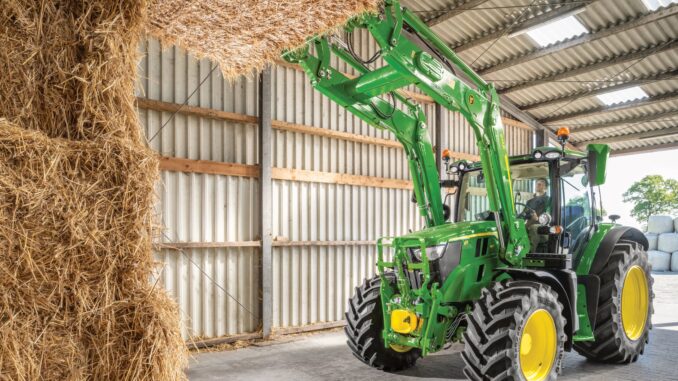
The John Deere 4100 is a compact utility tractor built for mowing, light loader work, landscaping, and year-round property maintenance, and its official operator literature covers service, troubleshooting, storage, and specifications for the model 4100 with gear transmission. This guide is structured for homeowner and DIY users in the USA and Canada, with a symptom-first approach that focuses on realistic at-home checks, common service parts, maintenance intervals, and the point where dealer support makes more sense.
John Deere 4100 model overview
The John Deere 4100 sits in Deere’s compact utility tractor range rather than the lawn tractor lineup, so it is designed for heavier property work than a typical residential mower, including use with mower decks, 3-point hitch implements, and front-driven attachments depending on setup. The official service chart for the model references core systems including the engine, gear transmission, MFWD front axle, cooling system, electrical system, safety interlocks, and mower deck lift linkage, which tells you where most repair and maintenance attention goes.
For most owners, the important systems are:
-
Engine and fuel system: diesel engine, fuel filter sediment bowl, primary air filter, oil and oil filter.
-
Drive system: gear transmission oil, MFWD oil level, steering free play, wheel hardware, and axle-related lubrication points.
-
Cooling system: radiator coolant level, cooling air screens, radiator fins, hoses, hose clamps, and fan belt tension.
-
Electrical and safety: battery, fuses, light bulbs, ignition switch, PTO switch, neutral start switch, and safety interlock system.
Common service parts owners often buy for this platform include the engine oil filter M806419, fuel filter M801101, primary air filter M131802, secondary air filter M131803, transmission filter AM10273, transmission or hydraulic oil filter LVA10419, and battery TY26498. Frequently purchased repair parts listed by Deere-focused parts sellers also include ignition switch RE45963, PTO switch M132725, starter RG60654, relay LVA13729, thermostat M811034, and several fan belt variants including LVU11661, LVU11662, LVU11835, and M808685 depending on engine and alternator configuration.
Troubleshooting the John Deere 4100
The best way to diagnose a John Deere 4100 is to start with the symptom you can actually see, hear, or feel, then work inward from simple checks before replacing parts. On this model, the main owner-facing problem groups are starting issues, poor running, overheating, hydraulic or drive concerns, vibration and noise, electrical faults, and safety interlock problems.
A practical symptom list for the John Deere 4100 includes:
-
Will not crank or will not start.
-
Starts but runs rough, smokes, or lacks power.
-
Runs hot or pushes coolant.
-
Tractor moves poorly or has gear or MFWD-related issues.
-
PTO or mower performance is weak.
-
Battery goes flat, lights fail, or safety switches stop operation.
Immediate John Deere 4100 repairs
Some John Deere 4100 problems should be dealt with straight away because they can create a safety risk or lead to much more expensive damage. The big red-flag items are overheating, fuel leaks, charging or battery faults that affect safe starting, steering looseness, damaged cooling screens or fins, and any failure of the safety interlock system.
1. John Deere 4100 starting issues
If the tractor will not crank, cranks slowly, or cranks but will not fire, the issue usually involves the battery, switches, fuel delivery, or air in the fuel system rather than a major engine failure. Because the official chart specifically calls out battery service, fuse checks, safety system testing, and fuel system bleeding, those are the first places to start.
Common causes:
-
Weak or dirty battery connections.
-
Blown fuse or faulty relay.
-
Bad ignition, seat, PTO, or neutral start switch.
-
Air in the diesel fuel system.
-
Dirty fuel filter or sediment bowl issue.
Basic owner checks:
-
Check battery condition and clean terminals.
-
Test the safety interlock system and verify PTO and transmission controls are in the correct starting position.
-
Inspect fuses and relay-related connections.
-
Check fuel level, sediment bowl condition, and whether the fuel system needs bleeding.
-
If it still will not start, move on to switch testing or dealer diagnosis.
2. John Deere 4100 running and power loss
A John Deere 4100 that starts but runs rough, lacks power, or smokes often has an air intake, fuel filter, or maintenance-related problem before it has an internal engine problem. The maintenance chart emphasizes regular checks of the air restriction indicator, dust unloader valve, sediment bowl, and scheduled fuel filter replacement, which aligns with the most common real-world causes.
Common causes:
-
Restricted air filter.
-
Fuel contamination or partially blocked fuel filter.
-
Air leaks or loose air filter hose clamps.
-
Old engine oil and neglected service.
-
Injector or valve-clearance issues on higher-hour machines.
Basic owner checks:
-
Inspect the air filter system and dust unloader valve.
-
Check the fuel sediment bowl for water or debris.
-
Replace the fuel filter if service history is unknown or hours are high.
-
Confirm engine oil and filter service is current.
-
If symptoms remain, injector testing and valve clearance are better left to a dealer.
3. John Deere 4100 overheating and leaks
Overheating matters immediately because compact tractors can pack debris into screens and fins quickly, and continued use when hot can damage the engine. Deere’s service chart specifically tells owners to check coolant level, clean cooling air screens daily, inspect hose clamps, and clean radiator fins at longer intervals.
Common causes:
-
Plugged cooling air screens or dirty radiator fins.
-
Low coolant level.
-
Loose hose clamps or aged radiator hoses.
-
Incorrect fan belt tension.
-
Thermostat or water circulation issue.
Basic owner checks:
-
Shut the tractor down and let it cool fully.
-
Check coolant level and inspect for obvious leaks.
-
Clean cooling air screens and inspect radiator fins carefully.
-
Check fan belt condition and tension.
-
Replace leaking hoses or have the cooling system tested if overheating continues.
4. John Deere 4100 transmission and drive problems
On the John Deere 4100, drive complaints often come down to low transmission oil, neglected MFWD service, linkage adjustment, or wear in driveline and steering components rather than a complete transmission failure. The operator chart specifically includes routine checks for gear transmission oil, MFWD oil, wheel bolt torque, tire pressure, steering free play, and center pin end play.
Common causes:
-
Low gear transmission oil.
-
Low MFWD oil.
-
Tire pressure mismatch affecting driveline feel.
-
Loose wheel hardware.
-
Steering or front-end wear.
Basic owner checks:
-
Verify gear transmission oil level.
-
Check MFWD oil level and service history.
-
Check tire pressures side to side.
-
Inspect wheel bolt torque and front-end looseness.
-
If gear engagement, grinding, or internal driveline noise persists, that is usually dealer territory.
5. Electrical and safety problems
Electrical faults on the John Deere 4100 often show up as no-crank issues, intermittent starting, dead lights, or unexplained shutdowns tied to switches and wiring rather than major charging-system failure. The service literature specifically includes testing safety systems, checking fuses, cleaning or replacing the battery, and changing bulbs as routine owner-level tasks.
Common causes:
-
Dirty or weak battery.
-
Blown fuse.
-
Faulty ignition switch.
-
Faulty seat, PTO, or neutral start switch.
-
Bad relay or poor connection.
Basic owner checks:
-
Test battery voltage and cable tightness.
-
Check all fuses before buying parts.
-
Verify interlock switch operation one by one.
-
Inspect ignition switch and relay connections.
-
If faults are intermittent, tracing wiring is usually an advanced DIY or dealer job.
DIY or dealer?
For a John Deere 4100, the normal DIY line is routine service, visual diagnosis, filters, fluids, basic electrical checks, belts, hoses, batteries, and simple switch replacement, while dealer work usually starts when diagnosis requires pressure testing, injector work, valve adjustment, internal transmission repair, or advanced electrical tracing.
Good DIY jobs
-
Engine oil and filter changes.
-
Fuel filter and sediment bowl service.
-
Air filter inspection or replacement.
-
Battery cleaning or replacement.
-
Fuse, bulb, and some switch replacement.
-
Cooling screen and radiator fin cleaning.
Advanced DIY or dealer jobs
-
Injector inspection and testing.
-
Valve clearance adjustment.
-
Internal transmission diagnosis.
-
Persistent overheating after normal cooling-system checks.
-
Steering or front axle wear requiring disassembly.
-
Complex safety interlock and wiring faults.
Skill level guide
-
Beginner: fluid level checks, grease points, screen cleaning, battery care, fuse replacement.
-
Intermediate: engine oil and filter, fuel filter, air filter, coolant service, belt inspection, switch replacement.
-
Advanced: fuel bleeding, electrical diagnosis with a meter, front-end adjustments, cooling-system repair, driveline troubleshooting.
John Deere 4100 parts and part numbers
Before ordering parts for a John Deere 4100, collect the full model name, tractor PIN, engine model and serial number, and any attachment or mower deck details because Deere used serial- and configuration-sensitive parts across compact tractor setups. This matters especially for belts, switches, alternator-related parts, and any engine-specific components where multiple versions were fitted.
OEM versus aftermarket guidance for the John Deere 4100 is simple: stick with OEM for belts, switches, interlock-related parts, and any fit-sensitive or safety-critical items, while reputable aftermarket options can make sense for batteries, some filters, and basic consumables if the cross-reference is exact. On older compact tractors, the wrong low-cost substitute often wastes more time than it saves, especially where serial breaks or engine variants are involved.
Manuals and parts diagrams
Useful sources for John Deere 4100 owners include the official Deere operator manual pages, Deere’s parts catalog system, Deere technical publications, and Deere-focused parts retailers that group service items by model.
Recommended sources:
-
Official operator manual service interval chart: manuals.deere.com for maintenance intervals, storage, troubleshooting, and service topics.
-
Deere parts catalog: partscatalog.deere.com for exploded diagrams and OEM part lookup by model and serial.
-
Deere technical publications: techpubs.deere.com for official manuals and publication references.
-
Deere-focused retailer: Green Farm Parts for commonly serviced 4000-series maintenance items and part numbers.
How to find the numbers
The model, PIN, and engine serial numbers matter because they help separate one John Deere 4100 configuration from another when parts differ by serial range, engine version, or installed equipment.
Use this approach:
-
Find the tractor PIN plate on the tractor frame area specified in the machine identification section of the operator literature or on the machine itself.
-
Record the full John Deere 4100 model designation exactly as shown.
-
Find the engine model and serial number on the engine tag before ordering fuel, belt, cooling, or electrical parts.
-
Record any mower deck model, front attachment details, or tire setup if those systems are involved.
-
Photograph every tag before ordering online so you can match part notes and serial breaks accurately.
Buying John Deere 4100 parts
The smartest buying strategy is to confirm the OEM part number first, then compare pricing and availability, rather than starting with a generic keyword search. That is especially important on a John Deere 4100 because old compact tractors often have multiple supersessions, engine changes, or attachment-specific variations.
-
Online: best for filters, batteries, switches, belts, and planned service parts once the OEM number is confirmed.
-
Dealer counter: best for serial-sensitive parts, driveline items, cooling-system parts, and anything unclear in the parts diagram.
-
Retail stores: acceptable for oil, coolant, batteries, grease, and some cross-referenced filters if the packaging clearly matches the machine and engine.
Useful links:
-
Farming Parts John Deere 4100 page for model-based parts lookup and serial-sensitive ordering advice.
John Deere 4100 fitting guide
These are four high-impact DIY jobs that solve many of the common service complaints owners see on older compact tractors.
Change the engine oil and filter
This job helps with starting quality, engine life, and general reliability, and Deere calls for an oil and filter change after the first 50 hours and then every 100 hours.
-
Park safely, lower implements, shut down, and let the engine cool enough to work around.
-
Drain the engine oil into a suitable container.
-
Remove the old oil filter and install the correct replacement filter such as M806419 if it matches your configuration.
-
Refill with the correct oil grade for your climate and verify the level on the dipstick.
-
Start briefly, check for leaks, shut down, and recheck the oil level.
Replace the fuel filter
This is a high-value job when the John Deere 4100 starts hard, lacks power, or has been sitting with older fuel, and Deere lists fuel system service including sediment bowl checks and scheduled filter replacement.
-
Shut off fuel if equipped and clean around the filter area first.
-
Remove the old fuel filter, such as M801101 if confirmed for your tractor.
-
Inspect and clean the sediment bowl while you are there.
-
Install the new filter carefully with correct sealing surfaces.
-
Bleed the fuel system if needed, then restart and check for leaks.
Service the air filter system
Air restriction causes many rough-running and low-power complaints, and Deere tells owners to check the dust unloader valve, restriction indicator, primary air filter, and hose clamps.
-
Open the air cleaner housing and inspect the primary and secondary elements.
-
Empty debris from the dust unloader valve and inspect for cracking.
-
Replace dirty or damaged elements with the correct parts, commonly M131802 and M131803 where applicable.
-
Check all intake hose clamps before closing the housing.
-
Restart and verify that power and smoke symptoms improve.
Clean the cooling package
This is one of the most important preventive jobs on a John Deere 4100 because chaff and debris can quickly trigger heat problems during mowing and loader work.
-
Let the engine cool completely before cleaning.
-
Remove loose debris from the tractor and engine area.
-
Clean the cooling air screens thoroughly.
-
Inspect and clean radiator fins carefully without bending them.
-
Check coolant level and fan belt condition before returning the tractor to service.
Maintenance to prevent repeat failures
Regular maintenance matters more on a John Deere 4100 than chasing parts after a failure because many common complaints begin with missed service rather than sudden breakdown. Deere’s own schedule shows that daily checks, 50-hour inspections, 100-hour oil service, 500-hour fuel and drivetrain service, and two-year coolant replacement all play a direct role in reliability.
Focus areas:
-
Starting reliability: keep the battery clean, test safety systems, inspect fuses, and keep fuel service current.
-
Engine performance: monitor the air restriction indicator, sediment bowl, air filter hose clamps, and scheduled oil changes.
-
Overheating prevention: clean debris from the engine and cooling screens after use and clean radiator fins at the specified interval.
-
Drive performance: keep gear transmission and MFWD oil levels correct, check tire pressure, and watch wheel bolt torque.
-
Electrical reliability: clean or replace the battery as needed and fix intermittent switch faults before they leave the tractor unable to start.
John Deere 4100 maintenance schedule
The official John Deere 4100 operator literature lays out a clear service schedule with tasks before each use, after each use, as needed, after the first 50 hours, every 10 hours or daily, every 50 hours, every 100 hours, every 200 hours, every 500 hours, and every 2 years. For a homeowner machine, the easiest way to use it is to combine the overlapping checkpoints into a simple year-round routine.
Daily / before each use
-
Check fuel tank level.
-
Check engine oil level.
-
Test safety systems.
-
Check radiator coolant level.
-
Check gear transmission oil level.
-
Check and clean cooling air screens.
After each use
-
Clean debris from the tractor.
-
Clean debris from the engine, especially cooling air screens.
-
Check for loose, missing, or damaged parts.
After first 50 hours
-
Change engine oil and filter.
-
Check alternator belt tension.
-
Check radiator hose clamps.
-
Check air filter hose clamps.
-
Check wheel bolt torque.
Every 50 hours
-
Check MFWD oil level.
-
Lubricate tractor grease fittings.
-
Check wheel bolt torque.
-
Check tire pressure.
-
Check battery electrolyte.
-
Lubricate mower deck lift linkage and SCV linkage.
Every 100 hours or yearly
-
Change engine oil and filter.
Every 200 hours
-
Clean fuel filter sediment bowl.
-
Check alternator belt tension.
-
Check and clean radiator cooling fins.
-
Lubricate 3-point hitch.
Every 500 hours
-
Check primary air filter.
-
Check air filter hose clamps.
-
Replace fuel filter.
-
Check engine speeds.
-
Change MFWD oil.
-
Change gear transmission oil.
-
Have fuel injectors inspected by a dealer.
-
Have engine valve clearance adjusted by a dealer.
Every 2 years
-
Change radiator coolant.
Seasonal checklist
-
Spring: change engine oil if due, test safety systems, inspect battery condition, and clean cooling areas before mowing season.
-
Mid-season: clean radiator fins, inspect the air intake system, verify tire pressure, and lubricate all grease points.
-
Fall or off-season: clean the tractor thoroughly, inspect for loose or damaged parts, service fuel and coolant needs, and store only after overdue maintenance is caught up.
Repair, upgrade, or replace?
For a John Deere 4100, repair usually makes sense when the tractor is structurally sound and the issue is limited to service items, switches, belts, filters, battery, cooling, or external components, while replacement becomes more reasonable when the machine has multiple major system problems at once.
Repair if:
-
The problem is clearly limited to maintenance items or a single subsystem.
-
The tractor starts, runs, and drives well aside from one fault.
-
Parts are still easy to source at sensible cost.
Upgrade if:
-
You need more hydraulic capability, attachment compatibility, or comfort than the 4100 provides.
-
Repeated seasonal work is pushing the tractor beyond light-property expectations.
-
You are already spending on attachments and want a newer platform with better support.
Replace if:
-
The tractor has engine, transmission, front axle, and electrical issues together.
-
Parts diagnosis is becoming serial-number dependent and costly across several systems.
-
Repair cost approaches the value of a sound used compact tractor in the same class.
John Deere 4100 FAQ
1. Why will my John Deere 4100 not start?
A no-start on a John Deere 4100 is usually battery, safety switch, fuse, relay, or fuel related before it is a major engine fault. Start by checking battery condition, PTO and transmission starting positions, safety interlock operation, fuel supply, and whether the system needs bleeding.
2. Why does my John Deere 4100 crank but not fire?
If it cranks but will not fire, think fuel delivery or air in the fuel system first. Check the sediment bowl, inspect the fuel filter, confirm clean fuel is reaching the engine, and bleed the system if you opened the filter or ran it low.
3. Why is my John Deere 4100 hard to start when cold?
Cold-start difficulty often points to weak battery output, old fuel, marginal filter condition, or overdue maintenance. On an older compact diesel, even a slightly weak battery or partially restricted fuel filter can make a big difference in cold weather.
4. Why does my John Deere 4100 battery keep going flat?
A flat battery usually comes from corrosion, an aging battery, poor cable connections, charging issues, or a tractor that sits too long between uses. Clean the terminals first, load-test the battery, and then move to charging-system checks if the problem returns.
5. Can a bad safety switch stop my John Deere 4100 from cranking?
Yes, because Deere specifically includes safety system testing in the normal service routine, and faults in seat, PTO, or neutral start circuits can prevent cranking. If the machine behaves inconsistently, a switch or connection issue is a realistic cause.
6. Why does my John Deere 4100 run rough?
Rough running usually means air restriction, dirty fuel, water in the fuel system, or a service interval that has been missed. Check the air filter system, restriction indicator, dust valve, sediment bowl, and fuel filter before assuming injector trouble.
7. Why is my John Deere 4100 low on power?
Low power often comes from restricted air flow, poor fuel supply, or neglected maintenance rather than internal engine wear. A dirty air cleaner or partially plugged fuel filter can make the tractor feel weak under load very quickly.
8. Why is my John Deere 4100 smoking?
Smoke can come from restricted air, fuel issues, or engine problems, so color and operating conditions matter. Start with air and fuel service checks because those are the most common owner-level causes and the easiest to correct.
9. Why does my John Deere 4100 overheat?
The most common causes are plugged cooling screens, dirty radiator fins, low coolant, loose hose clamps, or fan belt issues. Deere specifically tells owners to check coolant level and clean cooling air screens regularly, which shows how central those items are on this tractor.
10. Should I keep running my John Deere 4100 if it is getting hot?
No, overheating should be treated as an immediate stop-and-check issue because continued use can damage the engine. Let it cool, clean the cooling package, check coolant level and belt condition, and inspect for leaks before restarting.
11. Why is coolant leaking on my John Deere 4100?
Coolant leaks often come from hose, clamp, radiator, or thermostat housing issues on older compact tractors. Because Deere includes hose clamp checks in scheduled service, those are worth inspecting before assuming a larger failure.
12. Why does my John Deere 4100 lose coolant slowly?
A slow coolant loss can come from minor seepage at hoses, clamps, the radiator, or a cap issue rather than a dramatic failure. Clean the area first, pressure-test if needed, and do not ignore it just because the leak is small.
13. Why does my John Deere 4100 have poor drive performance?
Check gear transmission oil level, MFWD oil level, tire pressures, and wheel hardware first. Poor drive feel is not always a transmission failure, and basic setup issues can make the tractor feel weak or rough.
14. Why is my John Deere 4100 steering loose?
Steering looseness can come from normal wear in the front end, free-play adjustment needs, or center pin wear. Deere specifically lists steering wheel free play and center pin end play among the as-needed checks, so that is a normal inspection area.
15. Why does my John Deere 4100 make front-end noises?
Front-end noises often point to lubrication needs, loose hardware, tire issues, or wear in steering and axle joints. Check grease points, wheel bolt torque, tire pressure, and visible looseness before digging deeper.
16. Why are the lights not working on my John Deere 4100?
Dead lights usually come from a blown fuse, failed bulb, weak battery, or switch problem. Since Deere lists fuse checks and bulb changes as owner-level tasks, those are the first and cheapest tests to do.
17. Why does my John Deere 4100 blow fuses?
Fuse failure usually means a short, a damaged wire, a failing component, or the wrong fuse size. Replace with the correct rating, then inspect the related circuit carefully if the fuse fails again.
18. What does the fuel sediment bowl do on a John Deere 4100?
The sediment bowl helps separate water and debris from the fuel before it reaches the rest of the system. Deere calls for checking it daily and cleaning it at longer service intervals, which shows how important it is to diesel reliability.
19. How often should I change the oil on a John Deere 4100?
The official chart calls for an oil and filter change after the first 50 hours and then every 100 hours. For a lightly used homeowner tractor, many owners treat the 100-hour interval as an annual target if they do not reach the hours first.
20. How often should I replace the fuel filter on a John Deere 4100?
The service chart says to replace the fuel filter every 500 hours. In practice, many owners will change it sooner if starting or power issues appear, or if fuel quality has been questionable.
21. How often should I check the air filter on a John Deere 4100?
The tractor should have the air system checked daily at the dust valve and restriction indicator, while the primary air filter is checked at the 500-hour interval and replaced as required. Dusty mowing and property work can shorten real-world service life considerably.
22. How often should I change the coolant in a John Deere 4100?
Deere’s chart calls for coolant replacement every 2 years. That interval matters because coolant condition affects both freeze protection and corrosion control inside the engine and radiator.
23. How often should I service MFWD oil on a John Deere 4100?
The chart says to check MFWD oil every 50 hours and change it every 500 hours. If the front axle has been neglected, it is smart to inspect for contamination and leaks at the same time.
24. How often should I change gear transmission oil on a John Deere 4100?
The official service interval for changing gear transmission oil is every 500 hours, while the oil level should be checked much more often. A tractor that feels different in the drivetrain deserves an oil-level check before anything else.
25. Why is my John Deere 4100 alternator belt loose or squealing?
A loose or worn belt can squeal, reduce charging performance, and contribute to cooling issues depending on configuration. Deere includes alternator belt tension checks during break-in and again at 200-hour service, so this is a known wear point.
26. Can I use aftermarket filters on a John Deere 4100?
You can use aftermarket filters if the cross-reference is exact and the brand is reputable, but OEM is safer when there is any doubt about fit or specification. On an older tractor with engine variants, confirming the correct Deere number first is the smart move.
27. Should I buy OEM belts for my John Deere 4100?
Yes, OEM belts are usually the better choice because fit and length matter, and the parts listings show several belt numbers depending on engine and alternator setup. A nearly correct aftermarket belt can create repeat failures or charging and cooling problems.
28. Where can I find the correct John Deere 4100 part number?
The best sources are Deere’s parts catalog, official publications, and Deere-focused parts sellers that list OEM numbers by model. Always verify with your PIN and engine information before ordering.
29. Is the John Deere 4100 a good DIY tractor?
Yes, it is a good DIY machine for routine service and basic repairs because the official maintenance schedule is clear and the common service parts are well known. It becomes less DIY-friendly when diagnosis moves into injectors, valve adjustment, internal driveline work, or complex wiring.
30. What repairs on a John Deere 4100 should go to a dealer?
Dealer-level work includes injector inspection, valve-clearance adjustment, persistent overheating after basic checks, internal transmission issues, and advanced electrical diagnosis. Those jobs either require special tools, deeper testing, or enough labor that misdiagnosis gets expensive fast.
31. Why does my John Deere 4100 need frequent cleaning around the engine?
Because the service chart specifically tells owners to clean debris from the tractor and engine, especially cooling air screens, after use. This tractor can collect grass, dust, and chaff in ways that directly affect cooling and long-term reliability.
32. What should I check before buying John Deere 4100 parts online?
Check the full model name, PIN, engine model and serial, and any attachment details before placing the order. That one step prevents many wrong-part problems, especially with electrical parts, belts, and engine-specific items.
33. Why does my John Deere 4100 keep having repeat starting problems after I replaced one part?
Repeat starting issues usually mean the original diagnosis was too narrow and another link in the chain, such as battery condition, cables, switches, relay, or fuel delivery, was missed. A symptom-first check of the whole starting system works better than replacing parts one at a time without testing.
34. Is a used John Deere 4100 still worth repairing?
Often yes, because many faults on these tractors are still maintenance-item or external-component problems rather than terminal failures. The decision changes when the tractor has major engine, drivetrain, front axle, and electrical issues at the same time.
35. What is the best maintenance habit for a John Deere 4100 owner?
The single best habit is a short pre-use and post-use routine that checks oil, coolant, safety systems, fuel condition, and cooling cleanliness every time the tractor works. That small routine lines up directly with Deere’s own service chart and prevents a large share of avoidable breakdowns.