
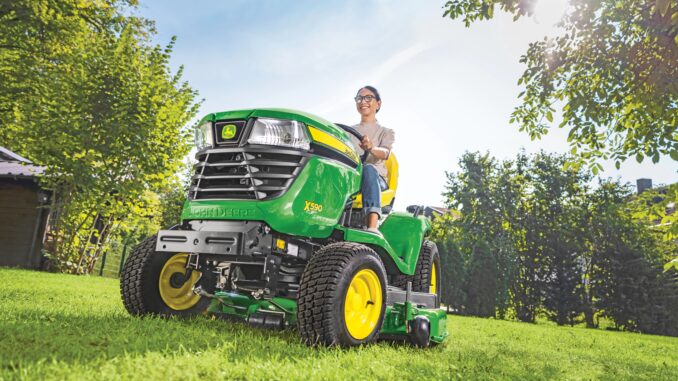
The John Deere 455 is a diesel-powered lawn and garden tractor built for heavier residential mowing and year-round attachment work, with a 22 hp Yanmar 3-cylinder engine, hydrostatic drive, and support for mower decks such as the 54-inch deck covered in Deere’s maintenance sheet. This guide is written for homeowners in the USA and Canada who want a practical, symptom-first reference for repair decisions, service parts, troubleshooting, maintenance planning, and finding the right diagrams and manuals.
Compared with lighter lawn tractors, the John Deere 455 sits in Deere’s heavier garden tractor class and is commonly chosen by owners who need more durability, stronger traction, hydraulic lift functions, and compatibility with attachments beyond simple mowing. The goal here is to help you identify what is realistic DIY work, what usually needs better tools or deeper diagnosis, and where to find the correct parts information before ordering.
John Deere 455 model overview
The John Deere 455 is part of the 400-series lawn and garden tractor family and uses a 22 hp Yanmar 881 cc 3-cylinder diesel engine with a hydrostatic transmission. Deere’s operator information also shows key owner-facing systems such as the 2000 rpm mid PTO, hydraulic mower lift control, safety interlock system, coolant temperature gauge, oil pressure warning, and battery discharge warning.
For most owners, the main systems that matter in repair work are:
-
Engine and fuel system, including the diesel engine, fuel shut-off valve, fuel filter, air filter system, and glow/preheat function.
-
Mower system, including PTO engagement, spindle stop performance, deck-height control, deck belt, blades, gauge wheels, and deck leveling.
-
Drive system, including the hydrostatic transmission, transaxle oil filter, free-wheeling lever, cruise control, brake function, and differential lock.
-
Electrical and safety system, including the ignition switch, key, indicator lights, battery, seat switch, PTO switch, brake switch, and reverse implement controls.
Common service parts owners regularly replace on a John Deere 455 with 54-inch deck include the engine oil filter M806418, fuel filter CH15553, transaxle oil filter AM116156, outer air filter AM108243, inner air filter M94734, fan belt M800347, ignition switch AM136681, standard blade M115496, high-lift blade M135590, and mower belt M112269.
Troubleshooting the John Deere 455
The fastest way to diagnose a John Deere 455 is to start with the symptom the owner actually sees, not the part they think is bad. On this model, the main symptom groups are starting issues, poor running, cut-quality problems, vibration or noise, overheating or leaks, transmission or drive complaints, and electrical or safety-interlock faults.
A useful first pass is to separate problems into three buckets:
-
The tractor will not start or stay running, which usually points toward fuel delivery, battery/charging, interlock switches, glow/preheat sequence, or restricted air/fuel flow.
-
The tractor runs but cuts poorly or feels rough, which often relates to blades, deck belt condition, deck level, spindle/brake issues, or debris buildup.
-
The tractor moves or operates unsafely, which raises higher-priority concerns like brake issues, overheating, PTO brake faults, or safety-switch failures that should not be ignored.
John Deere 455 immediate repair needs
Some faults on a John Deere 455 should be addressed right away because they either make the tractor unsafe to use or can quickly damage expensive components. Deere specifically warns against operating the tractor when the safety interlock system fails a check, and it also flags overheating, low oil pressure, charging warnings, and PTO brake stopping faults as conditions that need prompt attention.
John Deere 455 starting issues
A no-start condition usually shows up as cranking without firing, no crank at all, or an engine that starts and quickly dies. Because this is a diesel model, owners should think about brake/PTO interlocks, battery condition, the preheat light sequence, fuel shut-off position, and filter restriction before assuming major engine trouble.
Common causes:
-
Park brake not locked or brake pedal not depressed during starting.
-
PTO switch left engaged.
-
Weak battery or charging problem, especially if the battery discharge light has been on.
-
Fuel shut-off valve closed or restricted fuel flow.
-
Dirty fuel filter CH15553 or air filter elements AM108243/M94734.
-
Fault in the seat, brake, or PTO safety interlock circuit.
Basic owner checks:
-
Confirm the PTO switch is off and the brake pedal is depressed or park brake locked.
-
Turn the key to run and verify the oil, battery, and preheat indicators behave normally.
-
Wait for the preheat indicator to go out before cranking.
-
Check that the fuel shut-off valve is open and that there is clean fuel in the tank.
-
Inspect battery connections and replace a clogged fuel or air filter if service is overdue.
John Deere 455 cut-quality problems
Cut-quality complaints usually show up as scalping, streaks, clumping, brown grass tips, or an uneven finish. On the 455, these are commonly tied to deck setup, dull blades, wrong travel speed, wet grass, deck buildup, or gauge-wheel and height-control settings.
Common causes:
-
Dull or bent blades.
-
Deck not leveled correctly.
-
Grass too wet, too tall, or being cut too aggressively.
-
Worn or slipping mower belt M112269.
-
Debris buildup under the deck reducing airflow.
-
Rear gauge wheels adjusted incorrectly.
Basic owner checks:
-
Clean the underside and top of the deck before further diagnosis.
-
Inspect the blades for dull edges, bends, or impact damage.
-
Verify the deck is level and the cutting height is set correctly.
-
Check belt condition and tension by looking for glazing, cracking, or slippage symptoms.
-
Slow ground speed and mow only dry grass at full PTO speed.
John Deere 455 vibration and noise
New vibration, rattling, or harsh deck noise matters because it can point to rotating-part damage that gets worse fast. On a garden tractor of this age, common sources are damaged blades, debris wrapped around spindles, worn deck components, or loose hardware around the mower or driveline.
Common causes:
-
Bent, unbalanced, or loose blades.
-
Debris packed around spindle or pulley areas.
-
Worn deck rollers or gauge-wheel parts.
-
Fan belt wear or pulley issues.
-
Loose wheel hardware or attachment mounting hardware.
Basic owner checks:
-
Stop operation immediately if vibration begins suddenly after striking something.
-
Inspect blades, blade mounting, and spindle area for impact damage or buildup.
-
Check deck rollers, gauge wheels, and visible pulleys for looseness.
-
Look over wheel bolts and deck mounting points before resuming work.
John Deere 455 overheating and leaks
Overheating on the John Deere 455 is serious because Deere states the temperature gauge entering the red range indicates engine overheating, and the PTO can shut off automatically when this happens. Oil-pressure warnings, fuel leakage, and hydraulic leaks also need quick action because they can lead to engine, fire, or transmission damage.
Common causes:
-
Debris blocking air intake screens or radiator screen.
-
Low engine oil or restricted oil filter service interval.
-
Cooling-system contamination or neglected service.
-
Fuel leaks around lines, cap, or filter area.
-
Hydraulic/transaxle service overdue or filter restriction.
Basic owner checks:
-
Stop and idle the engine down if the gauge approaches red, then shut down and cool safely.
-
Clean the air intake screens and radiator screen thoroughly.
-
Check engine oil level and recent filter/oil service history.
-
Inspect for visible fuel, oil, or hydraulic leaks before restarting.
-
Do not keep mowing with a warning light on.
John Deere 455 transmission and drive problems
Drive complaints usually show up as weak traction, poor response, creeping, or difficulty moving the tractor. Because the 455 uses hydrostatic drive and a differential lock, some issues come from controls or maintenance, while others point to deeper hydrostatic faults.
Common causes:
-
Low or overdue transaxle oil/filter service.
-
Free-wheeling lever not fully returned to operating position.
-
Brake drag or linkage issues.
-
Tire traction problems rather than actual transmission failure.
-
Internal hydrostatic wear, especially on high-hour machines.
Basic owner checks:
-
Make sure the free-wheeling lever has returned to the normal drive position.
-
Review whether transaxle oil and filter service is overdue.
-
Test traction on a safe flat area before assuming internal failure.
-
Check brake release and differential-lock operation.
-
Escalate to dealer or hydrostatic specialist if the tractor still lacks drive after service basics.
John Deere 455 electrical problems
Electrical faults often appear as no-crank, dim lighting, warning lamps staying on, PTO not engaging, or safety-system behavior that does not match the manual’s test results. On this tractor, interlock correctness is especially important because Deere says not to operate the machine if a safety test fails.
Common causes:
-
Weak or failed battery TY25881.
-
Faulty ignition switch AM136681 or worn key/cylinder area.
-
Burned out indicator or headlight bulbs.
-
Seat, brake, or PTO switch faults.
-
Charging-system problem if the battery discharge light stays on during operation.
Basic owner checks:
-
Check battery terminals, voltage, and main cable condition.
-
Verify indicator lights come on in the expected sequence at key-on.
-
Run the manual’s brake, PTO, and seat switch safety checks in a clear area.
-
Replace failed bulbs first before assuming a larger wiring fault.
-
Stop using the tractor until interlock faults are corrected.
DIY or dealer repairs
The usual line on a John Deere 455 is simple: routine maintenance, basic bolt-on service parts, deck service, and straightforward diagnostics are realistic DIY jobs, while hydrostatic internals, complex electrical faults, deep engine work, and unresolved overheating problems are better handled by a dealer or experienced diesel garden tractor shop.
Good DIY jobs
-
Engine oil and filter service.
-
Fuel filter and air filter replacement.
-
Blade replacement or sharpening.
-
Deck belt replacement.
-
Battery replacement.
-
Cleaning screens, deck underside, and mower airflow areas.
Advanced DIY or dealer jobs
-
Hydrostatic transmission diagnosis beyond basic filter and fluid service.
-
Safety interlock wiring faults that are not solved by switch testing.
-
PTO brake issues when blade stop time exceeds five seconds.
-
Cooling-system faults that continue after cleaning screens.
-
Internal diesel engine repair, injector problems, or low oil-pressure diagnosis.
Skill level guide
-
Beginner: Filters, battery, blade inspection, cleaning screens, checking warning lights.
-
Intermediate: Deck belt replacement, deck leveling, blade removal, switch testing, basic electrical checks.
-
Advanced: Hydrostatic service diagnosis, wiring repair, PTO brake service, engine or cooling-system troubleshooting beyond routine maintenance.
John Deere 455 parts and ordering info
Before ordering parts for a John Deere 455, gather the full model name, the tractor Product Identification Number, the engine model and serial information, and the deck size or attachment version actually installed on the machine. That matters because Deere parts support is built around model- and serial-specific lookup, and items like blades, belts, and attachment hardware can vary by deck size or setup.
OEM parts are the safer choice for belts, ignition/safety parts, exact-fit deck items, and any serial-sensitive component because fit and performance matter more than small savings. Aftermarket parts are often reasonable for batteries, some blades, and some filters, but only when the cross-reference is clear and tied to the exact tractor and deck configuration.
John Deere 455 diagrams and manuals
The most useful sources for John Deere 455 diagrams and manuals are Deere’s operator information, Deere parts support, and a Deere-focused parts retailer that lets you browse model-specific diagrams.
-
John Deere operator information for the 455 helps with controls, safety checks, service intervals, troubleshooting flow, and location-based operating procedures.
-
John Deere parts portal is the main official starting point for current parts lookup and ordering support.
-
John Deere 455 with 54-inch deck maintenance sheet PDF is valuable for quick service part numbers, capacities, and change intervals.
-
Weingartz John Deere 455 parts diagrams is useful when you want an illustrated aftermarket-friendly catalog view for a specific deck setup.
Finding model and serial numbers
These numbers matter because John Deere parts, manuals, and even deck-specific wear parts can change by serial range or installed attachment. Taking two minutes to verify tags before ordering usually saves far more time than returning the wrong belt, blade, or switch later.
-
Locate the tractor Product Identification Number plate on the tractor frame area indicated by Deere’s Product Identification section for the operator’s manual family.
-
Record the full tractor model exactly as shown, including whether the machine is 2WS or AWS if relevant to service parts.
-
Check the mower deck or other attachment for its own serial/model tag, because deck-specific parts like blades and belts depend on the installed deck rather than the tractor alone.
-
Find the engine model and serial information on the engine data label so diesel engine service parts can be matched correctly.
-
Keep all numbers in your phone or maintenance log before shopping online or visiting a Deere counter.
John Deere 455 parts buying strategy
The smartest approach is to identify the OEM number first, then shop by that number rather than only by a generic model listing. That reduces mistakes on older machines like the 455, where multiple deck sizes and steering variants can complicate simple-looking purchases.
-
Online: Best for comparing OEM numbers, checking deck-specific fit, and pricing routine service items; start with Deere Parts, the Deere maintenance sheet PDF, and a model guide such as Weingartz.
-
Dealer counter: Best for serial-sensitive parts, safety switches, hydrostatic items, and anything you are not 100 percent sure about.
-
Retail stores: Fine for oils, some batteries, and certain cross-referenced filters, but only if the packaging clearly matches the OEM number or exact model/deck setup.
Common John Deere 455 fitting jobs
These are four of the highest-value DIY jobs on a John Deere 455 because they solve many common complaints without major teardown.
Replace the John Deere 455 fuel filter
A fresh fuel filter helps cure weak running, hard starting, and fuel-starvation complaints on diesel garden tractors.
-
Park safely, shut the engine off, and let hot components cool.
-
Close the fuel shut-off valve before removing the old filter.
-
Remove the old CH15553 filter and compare the new one to the old part.
-
Install the new filter with clean connections and check hose condition while you are there.
-
Reopen the shut-off valve and verify there are no leaks before running the engine.
Change the John Deere 455 air filters
Air filter service protects power and helps reduce smoke, rough running, and restriction-related complaints.
-
Open the air cleaner housing and inspect both the outer AM108243 and inner M94734 elements.
-
Replace elements if they are dirty, damaged, or due for service based on restriction and condition.
-
Wipe out loose debris from the housing without forcing dirt into the intake path.
-
Seat both filters correctly and close the housing securely.
-
Recheck the air restriction indicator during later operation.
Replace John Deere 455 mower blades
Sharp, straight blades restore cut quality and reduce tearing, streaking, and vibration.
-
Park on level ground, shut the engine off, remove the key, and secure the deck safely for access.
-
Remove each old blade and inspect for bends, deep nicks, or uneven wear.
-
Install matching replacement blades such as M115496 or M135590 depending on the intended mowing setup.
-
Tighten hardware to the correct specification from the deck service information for your deck version.
-
Test mow a short dry area and confirm smooth operation with no vibration.
Replace the John Deere 455 deck belt
A worn deck belt can cause weak blade drive, poor cut, squeal, or intermittent PTO performance.
-
Confirm the correct belt part number for the installed deck, such as M112269 for the 54-inch deck sheet.
-
Lower and secure the deck, then note the belt routing before removal.
-
Remove the old belt from pulleys carefully and inspect idlers and guards while exposed.
-
Route the new belt exactly as required for the deck layout and make sure it seats fully in pulley grooves.
-
Recheck tracking and PTO operation after startup before returning to full mowing load.
John Deere 455 maintenance prevention
Regular maintenance prevents many John Deere 455 problems from becoming repair jobs, especially on older tractors that still work hard. Deere’s own maintenance reminders focus on fluid and filter intervals, grease, debris cleanup, and deck-related wear items because those are the systems most likely to create owner-visible failures first.
Focus areas:
-
Starting reliability: Keep the battery healthy, follow the preheat sequence, and replace restricted fuel and air filters on time.
-
Cut quality: Keep blades sharp, the deck level, and the underside clean so airflow stays strong.
-
Fire and overheating prevention: Remove grass and debris from the machine, especially around screens and hot engine areas.
-
Drive performance: Service hydrostatic fluid and filter at the listed intervals rather than waiting for weak drive symptoms.
-
Electrical reliability: Watch indicator behavior and correct charging or interlock issues early.
John Deere 455 maintenance schedule
The operator information and Deere maintenance sheet give a practical owner-level schedule built around before-use checks and hour-based service intervals. Exact tasks can vary slightly by deck and configuration, but the following structure matches the official guidance for the tractor family and 455 maintenance sheet.
Daily or before each use
-
Check the air restriction indicator.
-
Remove grass and debris from the machine.
-
Check fuel level, warning lights, and general operating condition before starting.
-
Inspect the deck area for buildup or damage before mowing.
After 8 hours
-
Reinspect the machine for debris accumulation and mower cleanliness after heavy mowing periods.
-
Check that blades and deck hardware remain secure after intensive use.
-
Monitor any fresh leaks, warning lights, or abnormal sounds that have appeared during operation.
Every 25 hours
-
Lubricate grease points as needed with Deere multi-purpose SD polyurea grease TY6341.
-
Inspect the mower system, gauge wheels, rollers, and visible belts for wear.
-
Check battery condition and cable security.
Every 50 hours or yearly
-
Change engine oil and replace oil filter M806418.
-
Replace transaxle oil filter AM116156 and service Low Viscosity Hy-Gard as specified.
-
Check fan belt M800347 and mower belt M112269 for wear.
-
Perform broader seasonal inspection of lights, switch function, and deck setup.
Every 200 hours
-
Deere’s maintenance sheet includes 50/200-hour intervals for engine oil, engine oil filter, transaxle oil filter, and Low Viscosity Hy-Gard service items.
-
This is also the point to review overall wear condition of belts, blades, battery, and deck running gear more critically.
Every 250 hours
-
Replace fuel filter CH15553.
-
Inspect the rest of the fuel system and shut-off valve area while the filter is being serviced.
Seasonal checklist
-
Spring: Change overdue filters, sharpen or replace blades, level the deck, and clean all cooling screens before the mowing season starts.
-
Mid-season: Recheck belt condition, deck cleanliness, tire traction, and warning-light behavior during peak use.
-
Fall or storage season: Clean the machine thoroughly, let the engine cool before storage, and prepare the tractor based on whether it will be parked or switched to another attachment.
Repair, upgrade, or replace
For most owners, a John Deere 455 is worth repairing when the core tractor is solid because it is a heavier diesel garden tractor with durable features that still appeal to homeowners doing more than light mowing. The decision shifts when repairs stack up across the engine, hydrostatic drive, deck, and electrical systems at the same time.
Repair if
-
The issue is limited to filters, belts, blades, battery, switches, or deck wear parts.
-
The engine starts and runs well and the hydrostatic drive is still fundamentally strong.
-
The tractor otherwise fits your property and attachment needs.
Upgrade if
-
You need features your current setup lacks, such as a different deck arrangement or attachment capability.
-
The tractor is usable but would benefit from fresh blades, correct deck parts, or better matched OEM components rather than repeated temporary fixes.
Replace if
-
The tractor has severe hydrostatic, engine, and electrical issues at the same time.
-
Safety-system problems remain unresolved and parts/service costs exceed the value of a sound machine.
-
Rust, neglect, and repeated overheating have affected multiple major systems.
John Deere 455 troubleshooting FAQ
1. Why will my John Deere 455 not start?
Start with the basics Deere calls out in the operating procedure: PTO off, brake pedal depressed or park brake locked, and correct use of the preheat cycle before cranking. After that, look at the battery, fuel shut-off position, fuel filter condition, and whether the safety interlock system is preventing starting.
2. Why does my John Deere 455 crank but not fire?
On a diesel 455, this often points to fuel delivery, restricted filters, or an incorrect preheat routine rather than spark-related issues. Check that the fuel shut-off valve is open, the fuel filter is not clogged, and the preheat indicator has had time to cycle before cranking.
3. Why does the John Deere 455 start and then die?
That symptom often fits fuel starvation, interlock trouble, or a seat/brake/PTO switch issue that changes state after startup. It is also worth checking for restricted air or fuel filters if routine service has been skipped.
4. What does the battery light mean on a John Deere 455?
Deere says the battery discharge indicator comes on when output is too low. If it stays on during operation, stop and investigate the charging system, battery condition, and electrical connections before running longer.
5. Why is the preheat light important on the John Deere 455?
The manual states the engine preheat indicator can stay on for up to about eight seconds when starting. On this diesel tractor, waiting for that light to go out improves normal starting and reduces needless cranking.
6. Why does my John Deere 455 overheat while mowing?
The most common owner-level cause is debris blocking the air intake screens or radiator screen. Deere specifically advises shutting down, cooling the machine safely, and cleaning those areas if the temperature gauge reaches the red range.
7. What should I do if the temperature gauge goes into the red?
Deere states that red-range temperature means the engine is overheating, and if the PTO is engaged it can shut off automatically. Let the engine cool at idle until the gauge returns to the green range, then shut down and clean the screens before further use.
8. Why is the oil pressure light on?
The operator information says the oil pressure light indicates engine oil pressure is too low. Stop the engine and check oil level and service status immediately rather than continuing to run it.
9. Why does my John Deere 455 cut unevenly?
Uneven cut usually comes from deck level, travel speed, blade condition, or mowing wet/tall grass. On the 455, also verify that the deck gauge wheels and height-control settings are correct for the lawn conditions.
10. Why does the John Deere 455 scalp my lawn?
Deere notes that scalping can result from cutting height being too low for the ground conditions and from incorrect gauge-wheel adjustment. Approaching ridges straight-on and adjusting cutting height upward usually helps.
11. Why are there brown tips on the grass after mowing?
Brown tips usually mean the grass is being torn instead of cleanly cut. Sharpen or replace dull blades and mow dry grass at the right speed to improve the finish.
12. Why does my John Deere 455 leave clumps of grass?
Wet grass, excessive growth, and deck buildup are common causes of clumping. Clean the deck, mow more often, and avoid trying to remove too much grass in one pass.
13. Why is my John Deere 455 vibrating so much?
Sudden vibration often points to bent blades, impact damage, or debris wrapped around rotating parts. Stop mowing immediately and inspect the blades, spindle area, and deck hardware before running again.
14. Can a bad blade cause deck vibration on a John Deere 455?
Yes, a bent or unbalanced blade is one of the most common causes of mower vibration. Replacing damaged blades with the correct Deere part number is usually the first fix to try.
15. Why does the mower belt keep slipping?
A slipping deck belt usually means wear, glazing, contamination, or incorrect routing. Confirm the belt matches the installed deck, inspect pulley condition, and replace the belt if it shows cracking or burnished sidewalls.
16. What blade part numbers fit a John Deere 455 with 54-inch deck?
Deere’s maintenance sheet lists M115496 as the standard blade and M135590 as the high-lift blade for the 54-inch deck setup. Always confirm the installed deck before ordering because the tractor itself may be paired with other deck sizes.
17. What is the John Deere 455 mower belt part number?
For the 54-inch deck sheet, Deere lists mower belt M112269. That number should still be confirmed against the actual deck tag because deck swaps are common on older tractors.
18. What oil filter does a John Deere 455 use?
Deere’s maintenance sheet lists engine oil filter M806418 for the 455 covered there. It also lists TY22064 5W30 engine oil with a 3.0 qt capacity on that sheet.
19. What fuel filter does a John Deere 455 use?
The Deere maintenance reminder sheet lists CH15553 as the fuel filter. The same sheet shows a 250-hour replacement interval for that part.
20. What transaxle oil filter fits the John Deere 455?
Deere lists AM116156 as the transaxle oil filter on the 455 maintenance sheet. Hydrostatic service items are worth keeping OEM because fit and flow characteristics matter.
21. What air filters fit a John Deere 455?
The Deere sheet lists outer air filter AM108243 and inner air filter M94734. Checking both elements together is smart because a dirty outer element often means the inner should be inspected closely too.
22. How often should I change the oil on a John Deere 455?
The Deere maintenance sheet shows 50/200-hour intervals for engine oil and the oil filter. In practice, many homeowner users treat annual service or every 50 hours as the safer target, especially on older machines.
23. How often should I replace the fuel filter on a John Deere 455?
The maintenance sheet lists a 250-hour interval for the CH15553 fuel filter. Replace it sooner if you suspect contaminated fuel or flow restriction.
24. How often should I service the transmission on a John Deere 455?
The Deere sheet shows 50/200-hour intervals for the transaxle oil filter and Low Viscosity Hy-Gard service items on the referenced 455 sheet. Because hydrostatic repairs are expensive, staying ahead of fluid and filter service is good preventive maintenance.
25. Why will the PTO not stay engaged?
PTO problems can come from switch faults, interlock issues, or overheating events that trigger shutdown behavior. If the PTO disengages unexpectedly, check warning indicators and run the manual’s safety-system tests before blaming the deck itself.
26. Why do the mower blades not stop quickly enough?
Deere says the mower spindle should stop turning within five seconds after PTO disengagement during the annual or 100-hour test. If it does not, the PTO brake needs service and the tractor should not just be used as normal.
27. Why does my John Deere 455 lose drive on hills?
Some loss of traction is a tire-and-surface issue rather than a hydrostatic failure, which is why Deere provides differential lock and weight guidance for traction situations. If the problem happens everywhere, review hydrostatic service history and basic drive checks next.
28. What is the free-wheeling lever on a John Deere 455?
Deere explains that the free-wheeling lever lets you move the tractor without starting the engine. If it is not fully returned to operating position afterward, the tractor may seem to have drive problems.
29. Can I use aftermarket parts on a John Deere 455?
Yes, but they are best limited to well-cross-referenced consumables such as some filters, batteries, and blades. OEM parts are usually the smarter choice for belts, ignition and safety parts, and exact-fit hydraulic or deck components.
30. Where can I find John Deere 455 parts diagrams?
The most useful places are Deere’s official parts portal and model-specific illustrated parts pages from Deere-focused retailers. Using the tractor PIN and deck identification will make those diagrams far more accurate.
31. Where can I find a John Deere 455 operator’s manual?
John Deere’s online operator information page for the 455 is one of the best owner references because it covers controls, safety tests, service intervals, troubleshooting, and operating instructions. It is more useful for day-to-day ownership than a generic resale listing of a manual.
32. Is the John Deere 455 worth repairing?
Often yes, because it is a diesel-powered garden tractor with heavier-duty features than many lighter residential machines. It becomes harder to justify when engine, hydrostatic, deck, and electrical repairs all pile up together.
33. What battery fits the John Deere 455?
The Deere maintenance sheet lists battery TY25881. As with other parts, confirm fit against the actual machine before ordering because battery sourcing and equivalent group sizing can vary by seller.
34. Why does my John Deere 455 shut the attachment off in reverse?
Deere states that any operating attachment will stop as the reverse foot pedal is depressed unless the Reverse Implement Option is deliberately used. That behavior is normal and is part of the tractor’s operating and safety design.
35. What should I check before buying parts for a John Deere 455 online?
Check the full model, Product Identification Number, engine information, and installed deck or attachment version before ordering. Then match the OEM number first, because older tractors are often sold or serviced with different decks and accessories than the original setup.