
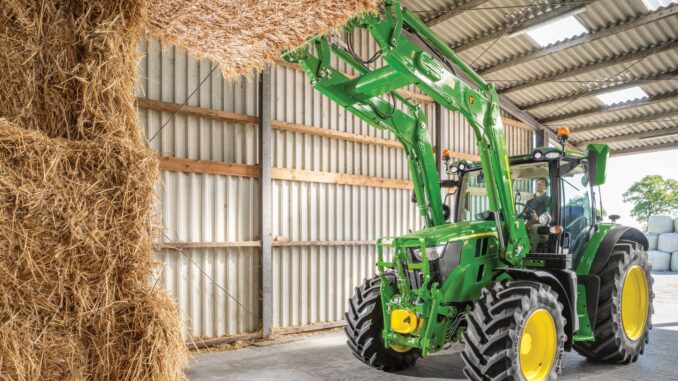
John Deere 4M Series Compact Tractor Models and Maintenance Guide
The John Deere 4M Series is a heavy compact utility tractor range built for owners who need considerably more capability than a sub-compact or light compact tractor, but still want a machine that is practical around an acreage, horse property, small farm, contracting yard, estate, or rural business. These tractors are commonly used for loader work, mowing, brush clearing, grading lanes, moving materials, operating PTO-driven implements, and winter snow work.
This page is an across-time directory for John Deere 4M Series tractors sold in the United States and Canada. It brings together current production models, Heavy Duty versions, and known legacy models, while directing readers toward model-specific maintenance, repair, attachment, and troubleshooting content. Use the General John Deere Compact Tractor Guide as the top-level starting point when comparing the 4M with smaller 1, 2, and 3 Series machines or more premium 4R tractors.
About the John Deere 4M Compact Tractor Series
John Deere positions the 4M Series as its practical, work-oriented heavy compact tractor family. It sits above the smaller 1 Series, 2 Series, and most 3 Series compact tractors, offering more engine power, machine weight, hydraulic capability, traction, and implement capacity for owners whose work regularly extends beyond lawn mowing and light landscaping.
The modern North American 4M range covers roughly 43 to 66 gross engine horsepower. The main models are the 4044M, 4052M, and 4066M, with the 4052M Heavy Duty and 4066M Heavy Duty intended for owners who need a more substantial three-point hitch arrangement and heavier implement capability. John Deere has also marketed the closely related 4049M as a legacy or superseded 4M model in North America. Current and recent official service information identifies 4044M, 4049M, 4052M, and 4066M tractors within the Final Tier 4 4M family.deere+1
These are true compact utility tractors rather than sub-compacts. They have a larger chassis, diesel engines, standard four-wheel drive, substantial rear-axle and front-axle assemblies, and the weight needed to make loader, ballast, traction, and ground-engaging work more productive. A 4M is often a sensible step up for properties where a 25-hp tractor feels underpowered for moving soil, handling round bales within safe limits, pulling wider cutters, maintaining long driveways, or running larger PTO equipment.
Transmission choices depend on model and configuration. Standard and recent 4M tractors have been offered with either a 12-forward/12-reverse PowrReverser transmission or a three-range eHydrostatic transmission. PowrReverser is especially useful for repetitive loader work because direction changes can be made with the reverser lever without clutching for every forward-to-reverse movement. The eHydro option suits operators who prefer pedal-controlled travel speed and precise maneuvering around buildings, trees, livestock areas, and landscaping. John Deere lists standard four-wheel drive across the current 4M models.deere
Most standard 4M models use a Category 1 three-point hitch and are compatible with John Deere’s iMatch Quick-Hitch system. The Heavy Duty models broaden the work envelope by providing Category 1 and Category 2 compatibility, telescoping draft links, and substantially higher hitch capacity for demanding rear-implement work. The 4052M Heavy Duty is listed with lift capacity up to 3,130 lb at the hitch points, making rear ballast and implement selection especially important.deere
Typical 4M attachments include a front loader, pallet forks, material bucket, grapple where hydraulics and tractor setup allow, rear blade, box blade, land plane, rotary cutter, finish mower, tiller, landscape rake, post-hole digger, snow blade, snow blower, and spreader. Depending on the exact model and transmission, the tractor may also be configured for mid-mount mowing or more specialized property-management jobs.
Within John Deere’s lineup, the “M” designation generally represents the practical, value-oriented specification tier, while the 4R Series is the more premium branch of the 4 Series family. The related 4R tractors may add features such as cab availability, enhanced electronic controls, Hitch Assist, auxiliary hitch control, and more premium operator amenities. The 4M series emphasizes core capability, durable mechanical systems, and a relatively straightforward open-station compact utility tractor layout.deere
John Deere 4M Compact Tractor Models
The table below is intended as an across-time North American directory. It includes current models, current Heavy Duty variants, and the known legacy 4049M. Specifications and configurations can vary by production year, market, transmission, loader package, tire choice, and dealer-installed equipment, so confirm serial-number-specific information before ordering parts or performing repairs.
The 4044M is the entry point to the modern 4M range, with about 43.1 gross horsepower and approximately 33.6 PTO horsepower in John Deere’s current comparison information. The 4052M is rated at about 51.5 gross horsepower and 41.2 PTO horsepower, while the 4066M reaches about 65.9 gross horsepower and 57 PTO horsepower. John Deere lists three-range hydrostatic or 12F/12R PowrReverser transmission availability for the standard 4044M, 4052M, and 4066M, all with four-wheel drive and open-station configurations.deere
The Heavy Duty 4052M and 4066M models retain the same general engine-power classes as their standard counterparts but are differentiated by their heavier three-point hitch arrangements. John Deere lists Category 1 and 2 hitch compatibility and telescoping draft links on both Heavy Duty models.deere+1
The 4049M should be treated as a legacy 4M directory entry. It appears in John Deere’s Final Tier 4 service and filter documentation alongside the 4044M, 4052M, and 4066M, even though it is not included in the current retail lineup shown on Deere’s compact-tractor comparison page.deere+1
4M Compact Tractor Maintenance Guides
A 4M Series tractor can remain a highly useful long-term machine if it receives routine service on schedule, uses the correct fluids and filters, and is inspected before small issues become costly failures. The exact intervals and capacities vary by model, serial number, engine emissions equipment, transmission, loader arrangement, and year, so the operator’s manual and technical manual for the specific tractor should always take priority.
Routine Service and Checks
Routine maintenance begins with regular walk-around checks: engine-oil level, coolant level, fuel-water separator condition, tire pressure, wheel hardware, loader pins, grease points, battery condition, hydraulic-hose routing, three-point hitch hardware, and safety-switch operation. Operators who use a loader frequently should also inspect for loose quick couplers, damaged hose sleeves, leaking cylinder rods, worn attachment pins, and cracked bucket cutting edges.
Typical scheduled work includes engine-oil and engine-filter changes, replacement of primary and final fuel filters where fitted, air-filter inspection, coolant-system checks, hydraulic and transmission-fluid service, front-axle oil service, and replacement of hydraulic or transmission filters. John Deere’s 4M Final Tier 4 quick-reference material identifies Hy-Gard fluid for the transmission/hydraulic system and front axle, Cool-Gard II coolant, and approximately 5.4 L or 1.4 US gallons of crankcase capacity with filter for the listed 4M models. The same guide lists approximately 47.3 L or 12.5 US gallons for the transmission and hydraulic system, although exact requirements must be verified for the individual tractor configuration.deere+1
Useful internal maintenance targets for this hub include:
-
4M compact tractor service interval checklist
-
DIY maintenance for 4M compact tractors
-
John Deere 4M engine oil, filter, and fuel-system service guide
-
Hydraulic maintenance and leak diagnosis on 4M tractors
-
Loader and 3-point hitch maintenance for 4M
-
4M compact tractor fluid capacities and filter cross-reference
Do not assume filters are interchangeable simply because two tractors share an engine-power class. Confirm the tractor’s model, serial-number range, emissions generation, and any factory cab or transmission variation before buying a service kit.
Hydraulics, Loader, and 3-Point Hitch
Hydraulic care matters particularly on a 4M because these tractors are regularly used for material handling, rear-implement lifting, and attachments that depend on reliable hydraulic response. Keep hydraulic oil clean, use the correct John Deere-approved fluid specification, change filters at the scheduled service interval, and inspect hose ends and couplers whenever an attachment is removed or fitted.
A weak loader, sluggish three-point hitch, or noisy hydraulic pump is not automatically a pump failure. Start with basic checks: hydraulic-fluid level, oil condition, correct engine speed, clogged filters, partially connected quick couplers, restricted hydraulic lines, external leaks, and excessive implement weight. Low hydraulic performance can also be caused by poor rear ballast choices, a load exceeding the loader’s rated lifting ability at the actual distance from the pivot pins, or cold oil during winter operation.
Loader pivots, bucket pins, quick-attach components, and three-point hitch joints need lubrication at the recommended intervals. Worn pins and bushings increase slack, reduce precision, and can accelerate damage to loader arms or attachment brackets. On Heavy Duty models, inspect telescoping draft-link parts, retaining clips, lift-arm ends, stabilizers, and Category 2 implement hardware carefully because heavier implements can impose greater stress on hitch components.
Transmission and Drivetrain
The eHydrostatic versions need clean hydraulic oil, correctly adjusted pedals and linkages, and careful monitoring for changes in response, unusual noises, overheating, or a loss of pulling power. A hydrostatic tractor may feel weak when the range selection is too high for the task, when the engine is not operating at suitable rpm, or when the operator demands more travel speed than the load allows. Select a lower range for heavy loader work, climbing, pushing into a pile, or pulling a ground-engaging implement.
PowrReverser tractors need attention to the transmission oil, clutch and reverser response, shift linkage condition, and any abnormal delay or harshness when changing direction. Although the wet-clutch reverser enables clutchless shuttle changes in normal operation, operators should still reduce throttle and avoid aggressive direction changes under heavy load to reduce driveline shock.deere
Across all 4M models, inspect front-axle oil, four-wheel-drive engagement, front driveshaft or propeller-shaft components, axle seals, differential areas, wheel fasteners, and tire condition. Match tire pressures side-to-side, especially on loaded rear tires, because uneven tire diameter or pressure can affect traction, steering feel, and four-wheel-drive operation.
4M Compact Tractor Troubleshooting Guides
This section is designed as a symptom-based hub. Individual pages should separate common series-wide issues from model-specific diagnostic differences, since a 4044M, 4052M Heavy Duty, and 4066M may share broad system layouts but can have different components, wiring, service procedures, and serial-number changes.
Starting, Engine, and Fuel Problems
A no-start condition on a 4M often begins with simple causes: low battery charge, poor terminal connections, a failed safety-interlock condition, incorrect range or PTO position, fuel starvation, water contamination, or a fuel filter restricted by debris or cold-weather waxing. Before replacing electrical parts, inspect battery terminals, grounds, fuses, key-switch operation, seat switch, PTO switch, range-neutral arrangement, and wiring connectors.
Cold starting can be affected by weak batteries, slow cranking speed, incorrect engine oil viscosity for the temperature, fuel gelling, moisture in the fuel system, air leaks on the low-pressure fuel side, or glow-plug/preheat-system faults where applicable. If the engine cranks normally but does not fire, check fuel quantity, filter condition, water separator, fuel shutoff position, and evidence of air in the fuel system before assuming injector or injection-pump failure.
Power loss under load may be related to a blocked air filter, restricted fuel filter, contaminated fuel, a clogged radiator or grille screen, engine derate conditions, turbocharger or intake faults on turbocharged models, excessive implement load, or incorrect transmission range selection. The 4044M uses a naturally aspirated diesel engine, while the 4052M and 4066M use turbocharged diesel engines, so diagnostic paths can differ between models.deere+1
Useful problem-focused internal targets include:
-
4M compact tractor starting problems – diagnostics and fixes
-
Engine and fuel system issues across 4M models
-
4044M hard-start and low-power troubleshooting guide
-
4052M and 4066M turbo diesel troubleshooting guide
-
John Deere 4M safety switch and no-crank diagnosis
Hydraulic and Loader Performance Issues
Weak loader lift, slow cycle times, jerky bucket movement, or a three-point hitch that will not raise properly should be approached in a structured sequence. Check hydraulic oil level and temperature, run the engine at the correct working rpm, confirm all couplers are fully seated, inspect for external leaks, and make sure the attachment is not overloaded.
A loader that lifts normally empty but stalls with a heavy load may be operating within its actual limits rather than malfunctioning. Lift capacity falls as the load moves farther forward from the loader pivot pins, which is why a pallet-fork load may be harder to raise than a similarly sized bucket load. Inadequate rear ballast can also make a tractor unstable even before its hydraulic limit is reached.
Jerky hydraulics can result from air intrusion, low fluid, sticky couplers, contaminated oil, restricted filters, bent cylinder rods, dry pivot points, or a hydraulic attachment that has not been properly connected. If the three-point hitch is slow or does not hold position, inspect the hitch control settings, linkage condition, hydraulic oil, rockshaft components, and implement weight before investigating internal hydraulic faults.
Suggested hub pages include Hydraulic performance problems on 4M compact tractors, Loader won’t lift or is slow on 4M models, and 4M three-point hitch troubleshooting and adjustment guide.
Transmission, Drive, and PTO Problems
A tractor that will not move, moves weakly, slips on hills, or lacks pulling ability should first be checked for simple operator and setup issues. Confirm the range lever is fully engaged, the parking brake is released, four-wheel drive is selected when appropriate, the differential lock is not being misused, and the correct transmission range has been chosen for the task.
On eHydro models, a high range under heavy load can feel like a transmission fault when it is actually an operating-range issue. Lower the range, raise engine rpm to the appropriate working speed, and reduce travel-pedal demand. If the problem remains, inspect hydraulic/transmission fluid condition, filters, linkage adjustment, pedal return, warning indicators, and possible brake drag.
PowrReverser models should be checked for proper shuttle response, transmission fluid level, linkage operation, clutch-related behavior, and electrical or hydraulic controls relevant to the reverser system. Avoid continuing to operate a tractor with severe hesitation, grinding, overheating, abnormal transmission noise, or repeated loss of drive, because further use can turn an adjustment or oil-contamination problem into a larger repair.
PTO problems may include failure to engage, engagement followed by immediate shutdown, poor PTO speed under load, driveline vibration, or a PTO that drops out when an implement is used. Check PTO switch operation, safety interlocks, implement driveline length, shear bolts or slip clutches, shaft lubrication, implement load, correct PTO speed selection, and the tractor’s engine rpm. Never diagnose PTO engagement with hands, clothing, or tools near a rotating shaft.
Suggested internal destinations include:
-
Drive and transmission problems on 4M compact tractors
-
PTO won’t engage or drops out across 4M models
-
eHydro range, pedal, and loss-of-drive diagnosis
-
PowrReverser shifting and shuttle troubleshooting guide
-
4M four-wheel-drive and front-axle troubleshooting
Attachments and Implements for the 4M Compact Tractor Series
The 4M Series has the engine power, machine weight, and chassis size to operate a much broader attachment range than smaller compact tractors. However, implement selection should always be based on the exact tractor model, PTO horsepower, hitch category, hydraulic capacity, tire choice, ballast plan, terrain, and intended workload.
Common 4M attachments and implements include:
-
Front-end loaders with general-purpose or materials buckets
-
Pallet forks, bale spears, grapples, and other loader-mounted tools where hydraulics and capacity permit
-
Mid-mount mowers where offered and appropriately configured
-
Rear finish mowers and rotary cutters
-
Rear blades, box blades, land planes, and landscape rakes
-
Tillers, overseeders, spreaders, aerators, and post-hole diggers
-
Snow blowers, rear snow blades, front blades, and snow pushers
-
Light-to-moderate disc harrows, cultivators, and other ground-engaging implements suited to tractor weight and traction
Standard 4M tractors are generally listed with Category 1 three-point hitches, while the Heavy Duty versions have Category 1 and 2 compatibility. This distinction is important because a physically compatible implement may still be too heavy, too wide, too demanding for the PTO, or poorly matched to the tractor’s safe ballast and traction limits.deere
PTO-driven implements should be matched primarily to PTO horsepower, not gross engine horsepower. A 4066M, for example, has substantially more PTO capacity than a 4044M, so a mower, tiller, chipper, or snow blower that is reasonable behind one model may overload the other. John Deere lists approximately 33.6 PTO hp for the 4044M, 41.2 PTO hp for the 4052M, and 57 PTO hp for the 4066M.deere
Front-loader work needs special attention to ballast. Use suitable rear ballast, follow the loader manual, keep heavy loads low while traveling, avoid side slopes, and do not judge lifting ability solely by an attachment’s advertised weight. The load center, attachment weight, material density, rear ballast, tire condition, and terrain all affect both lifting performance and safety.