
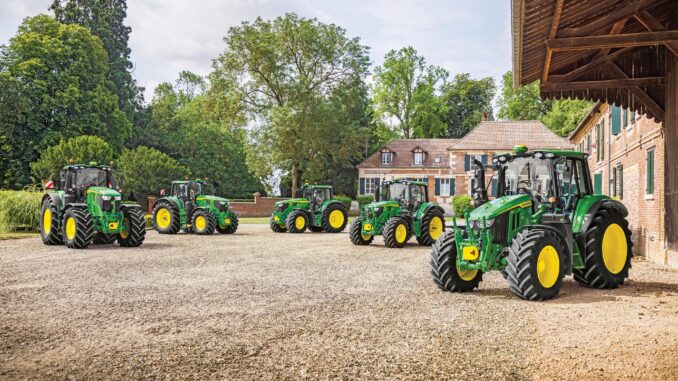
John Deere 4R Series Compact Tractor Models and Maintenance Guide
The John Deere 4R Series is the premium end of John Deere’s larger compact utility tractor range, built for acreage owners, small farms, estates, contractors, municipalities, and operators who need more capability than a sub-compact or light compact tractor can provide. These tractors are commonly used for front-loader work, mowing, snow removal, driveway and lane maintenance, material handling, rotary cutting, ground-engaging implements, and PTO-powered equipment.
This page is designed as an across-time directory for John Deere 4R Series compact tractors sold in the United States and Canada. It brings together current and legacy 4R models, while directing readers toward model-specific repair information, maintenance schedules, common-fault guides, and attachment advice. For broader comparisons across John Deere’s compact range, start with the General John Deere Compact Tractor Guide, then use this 4R hub to narrow the search to the relevant model and system.
And See:
John Deere 4 Series Repair Guide
About the John Deere 4R Series Compact Tractor Series
John Deere’s 4R Series sits at the upper end of its compact-tractor lineup. In the current and most recent North American range, the series spans approximately 43 to 66 gross engine horsepower, covering the 4044R, 4052R, and 4066R. Legacy references also identify the 4049R as part of the 4R family. These are physically substantial compact utility tractors rather than sub-compacts: they have four-cylinder diesel engines, four-wheel drive, a Category 1 three-point hitch, substantial hydraulic capacity, and the weight and wheelbase needed for serious loader and implement work.deere+1
The “R” designation is important. Within John Deere’s compact range, R models represent the more premium, operator-focused specification compared with M models. The 4R tractors have been available with either an open operator station or an enclosed cab, depending on model, configuration, and production period. Current 4R models offer eHydrostatic transmission and PowrReverser transmission options, standard 4WD, and a choice of PTO configurations.deere
For many owners, the eHydrostatic transmission is the key attraction. It suits repetitive loader work, mowing around obstacles, snow clearing, and jobs requiring frequent directional changes. The PowrReverser transmission is often preferred by operators who do sustained pulling, grading, hauling, or PTO work and want a more direct gear-transmission feel with clutch-free directional reversal.
The 4R Series also incorporates premium controls and convenience features associated with Deere’s R-tier compact tractors. Depending on year, model, and specification, these can include LoadMatch, MotionMatch, SpeedMatch, cruise control, Hitch Assist, rear auxiliary hitch control, electronic draft-related functions, advanced PTO options, and cab comfort equipment. The current 4044R, for example, is marketed with Hitch Assist, auxiliary hitch control, and hydrostatic transmission controls, while the series is positioned by Deere for loading, disking, brush clearing, scraping, and snow removal.deere+1
Typical equipment includes a front-end loader, pallet forks, material bucket, grapple, mid-mount mower where applicable, rotary cutter, finish mower, rear blade, box blade, landscape rake, tiller, snow blower, snow blade, spreader, and post-hole digger. A 4R is generally a better choice than a 1 Series or 2 Series for heavier attachments, bigger properties, regular loader use, and work requiring more PTO horsepower. It overlaps with the upper 3R range but adds a larger frame, higher power ceiling, and more capability for demanding acreage and light commercial work.
John Deere 4R Series Compact Tractor Models
The table below is intended as an across-time North American index. Model availability, emissions equipment, PTO configuration, cab availability, loader compatibility, and exact output can differ by serial number, year, and regional specification. The current Deere 4 Series lineup identifies the 4044R at 43.1 hp, the 4052R at 51.5 hp, and the 4066R at 65.9 hp; Deere technical and parts publications also document the discontinued 4049R alongside these models.deere+2
The 4044R, 4052R, and 4066R are the principal current 4R Series models in Deere’s North American compact range. Deere lists all three with standard 4WD and offers cab or open-station arrangements on the R models. The 4044R has a naturally aspirated four-cylinder diesel, while the 4052R and 4066R use turbocharged four-cylinder diesels.deere+1
The 4049R is a legacy model that deserves inclusion in a maintenance index because Deere’s own 4R service and quick-reference documentation identifies it with the 4044R, 4052R, and 4066R. Owners should always verify specifications and parts by tractor serial number rather than relying solely on the model number, particularly for filters, emissions-system parts, electrical components, hydraulic fittings, loader attachments, and software-related controls.manuals.deere+2
4R Series Compact Tractor Maintenance Guides
A 4R Series tractor can remain highly capable for many years, but its premium controls, hydraulic system, emissions equipment, front-loader use, and substantial implement loads make routine servicing especially important. Treat the operator’s manual and serial-number-specific technical documentation as the final authority for capacities, approved fluids, service intervals, and torque values.
Routine Service and Checks
Routine care should begin with daily or pre-operation checks. Inspect engine-oil level, coolant level, fuel supply, visible hydraulic leaks, radiator and screen cleanliness, tire condition, wheel hardware, loader pins, three-point linkage pins, and safety interlock operation. When the tractor is used for brush work, mowing, dusty grading, or snow work, pay particular attention to debris buildup around the radiator, oil cooler, air-intake screen, exhaust area, and wiring.
For scheduled maintenance, use a serial-number-specific service interval rather than assuming every 4R tractor uses the same parts or fluid volumes. Deere’s 4R quick-reference documentation identifies standard service categories including engine oil and filter, fuel filter, air filter, coolant, hydraulic/transmission fluid, front axle lubricant, and cab-related components where fitted. Some documented FT4-era 4R tractors use approximately 47 litres or 12.4–12.5 US gallons of Hy-Gard transmission/hydraulic fluid, but owners should confirm the exact capacity and product specification for their individual machine before filling.deere+1
Useful internal maintenance targets for a 4R content cluster include:
-
“4R Series compact tractor service interval checklist”
-
“DIY maintenance for 4R Series compact tractors”
-
“John Deere 4R engine oil, fuel filter, and air-filter service guide”
-
“Hydraulic fluid and front axle service on John Deere 4R tractors”
-
“John Deere 4R cab tractor seasonal maintenance checklist”
-
“4044R, 4052R, and 4066R service parts guide”
A practical owner workflow is to record the engine-hour reading, date, part number, fluid used, and observations after every service. This makes it much easier to identify recurring problems such as coolant loss, a contaminated hydraulic filter, weak battery charging, repeated fuel restriction, or an implement that is gradually becoming harder to lift.
Hydraulics, Loader, and 3-Point Hitch
The hydraulic system is central to how most 4R tractors earn their keep. It powers the loader, three-point hitch, rear selective control valves, and many hydraulic attachments. Hydraulic performance depends on correct fluid level, clean oil, an unrestricted filter, sound hoses and couplers, properly lubricated loader pivots, correct rear ballast, and a compatible attachment.
Grease loader pivot points, bucket linkage points, quick-attach mechanisms, steering linkage points, and implement pivots according to the tractor and loader manuals. Check hydraulic hoses for abrasion, wet fittings, cracked outer covers, crushed sections, and loose routing clamps. A small leak around a quick coupler may indicate contamination, damaged O-rings, an incompletely seated coupler, or pressure trapped in a hose.
A slow or weak loader is not automatically a pump failure. Check engine speed, hydraulic fluid level, filter condition, quick-coupler engagement, attachment weight, rear ballast, relief-valve operation, cylinder leakage, and whether the loader is being operated in an appropriate range. Deere documentation for 4R loader applications specifies a rated hydraulic flow of 60 L/min, or 16 gpm, for the referenced 4044R, 4049R, 4052R, and 4066R tractors, illustrating why correct maintenance and attachment matching matter on these higher-capacity compacts.manuals.deere+1
Useful internal targets include “Hydraulic maintenance and leak diagnosis on 4R Series tractors” and “Loader and 3-point hitch maintenance for 4R Series.”
Transmission and Drivetrain
Most 4R Series tractors in this range were offered with eHydrostatic or PowrReverser transmission choices. Each needs a different diagnostic mindset.
With eHydro, owners should monitor hydrostatic response, pedal operation, range selection, neutral return, cruise function, and transmission warning indicators. Slow travel, poor climbing performance, or apparent slipping may result from low engine speed, an incorrect range, dragging brakes, low hydraulic fluid, restricted filtration, linkage problems, or an electronic control issue rather than internal hydrostatic failure.
For PowrReverser-equipped tractors, inspect clutch-related adjustment where applicable, shift quality, reverser response, gear engagement, clutch-pedal operation, and transmission/hydraulic fluid condition. Avoid changing travel ranges under excessive load or forcing gears when the tractor is still rolling.
Across all 4R models, include front-axle service, driveshaft and universal-joint inspection where fitted, front-wheel-assist engagement checks, tire-pressure matching, and wheel-fastener inspections in the maintenance routine. Incorrect tire sizes, uneven tire pressures, or prolonged use of 4WD on high-traction paved surfaces can contribute to driveline wind-up and poor handling.
A useful supporting post is “Transmission and driveline maintenance across 4R Series compact tractors.”
4R Series Compact Tractor Troubleshooting Guides
This troubleshooting hub should direct readers first to the relevant model guide—such as a 4044R maintenance & troubleshooting guide or a 4066R problems and fixes overview—then to system-specific diagnostic articles. Although many symptoms recur across the series, exact wiring, sensors, emissions components, control settings, and service procedures can change between the legacy 4049R and later-production 4044R, 4052R, and 4066R tractors.
Starting, Engine, and Fuel Problems
Common complaints include a no-crank condition, cranking without starting, hard cold starts, intermittent stalling, poor throttle response, smoking, loss of power under load, overheating, or a warning light associated with engine or emissions controls.
Start with the basics before replacing expensive parts:
-
Confirm the battery is charged and cable terminals are clean and tight
-
Check the seat, PTO, range/neutral, brake, and other safety interlocks
-
Verify fuel level and inspect for water, stale diesel, or contamination
-
Drain the water separator where equipped and check fuel-filter service history
-
Inspect the air intake, air filter, radiator screen, and cooling pack
-
Check for stored diagnostic codes and note the exact warning message
-
Confirm the tractor has adequate engine speed before judging hydraulic or PTO performance
A tractor that starts but loses power under load may have fuel restriction, air-intake restriction, heat buildup, a clogged cooling pack, an emissions-system fault, a PTO/implement overload, or a transmission range that is too high. Do not repeatedly crank a tractor with a suspected fuel-delivery problem; diagnose the fuel supply, filter condition, shutoff position, and priming procedure first.
Useful content routes include “4R Series compact tractor starting problems – diagnostics and fixes” and “Engine and fuel system issues across 4R Series models.”
Hydraulic and Loader Performance Issues
Weak lift, slow cycle times, jerky loader movement, drifted loader arms, poor three-point response, or a rear implement that will not raise should be approached systematically.
First, check hydraulic-fluid level and condition, engine rpm, the correct control-lever position, quick-coupler connections, loader lockouts, and obvious external leakage. If an attachment has been changed recently, confirm that hose connections are matched correctly and that any diverter or third-function valve is in the intended position.
Jerky hydraulics can result from low fluid, air entry, cold oil, contaminated oil, sticking control valves, damaged couplers, cylinder seal bypass, or a binding pivot. A loader that slowly settles with the control in neutral may point to internal cylinder leakage, loader-valve leakage, or a load-holding issue. Never work beneath a raised loader or implement unless it is mechanically supported.
Useful guides include “Hydraulic performance problems on 4R Series compact tractors,” “Loader won’t lift or is slow on 4R Series models,” and “Three-point hitch will not raise, lower, or hold position on John Deere 4R tractors.”
Transmission, Drive, and PTO Problems
Drive complaints may include a tractor that will not move, moves only in one direction, lacks hill-climbing ability, jerks during travel, will not engage 4WD correctly, or has unusually high transmission noise. PTO complaints can include failure to engage, immediate disengagement, inconsistent PTO speed, implement stalling, or warning messages during PTO operation.
For hydrostatic tractors, make sure the parking brake is released, the correct range is selected, the operator is seated where required, and the engine is running at a suitable rpm. A compact tractor can feel weak simply because it is being asked to climb or push in high range with a heavy loader load or large attachment. Reduce load, select a lower range, and retest before assuming a hydrostatic failure.
For PTO problems, inspect the implement driveline, shear bolt or slip clutch, PTO shaft length, safety shields, electrical connections, and implement horsepower demand. A PTO that drops out may be reacting to an operator-presence condition, a switch or wiring problem, an overload, or a control-system fault. Stop the tractor, disengage the PTO, remove the key, and wait for all movement to stop before inspecting a PTO-driven implement.
Useful content routes include “Drive and transmission problems on 4R Series compact tractors,” “PTO won’t engage or drops out across 4R Series models,” and individual 4044R, 4049R, 4052R, and 4066R troubleshooting guides.
Attachments and Implements for the 4R Series Compact Tractor Series
The 4R Series is commonly equipped as a multi-purpose property-maintenance tractor rather than a single-task machine. The same tractor may mow in summer, manage a driveway in autumn, move snow in winter, and handle material or implement work throughout the year.
Common attachment categories include:
-
Front-end loaders with general-purpose buckets
-
Pallet forks, bale spears, grapples, and debris forks
-
Mid-mount or rear finish mowers where compatible
-
Rotary cutters for grass, weeds, and light brush within the tractor’s capacity
-
Rear blades and box blades for driveway shaping and surface maintenance
-
Landscape rakes, tillers, cultivators, and soil-preparation equipment
-
Snow blowers, front blades, rear blades, and spreaders
-
Post-hole diggers, sprayers, spreaders, and PTO-driven utility equipment
Compatibility depends on more than the attachment’s physical width. Check the tractor’s PTO horsepower, hitch category, lift capacity, hydraulic-flow requirement, number of selective-control valves, loader capacity, quick-attach standard, tire and ballast configuration, and the total working weight of the implement. The 4R Series uses Category 1 three-point hitch arrangements in Deere’s published current configuration, while certain 4M Heavy Duty models—not the standard 4R models—are listed with Category 1 and 2 capability. That distinction matters when comparing implements or assuming hitch compatibility across the broader 4 Series range.deere
A rotary cutter may be physically capable of attaching to a 4R tractor but still be unsuitable if it requires more PTO horsepower than the tractor can deliver, is too heavy for safe transport, or produces excessive front-end lightness without adequate ballast. Likewise, a loader can lift more safely and predictably when the rear of the tractor is correctly ballasted with a heavy three-point implement, ballast box, wheel weights, or appropriately filled tires, as permitted by Deere’s guidance.