
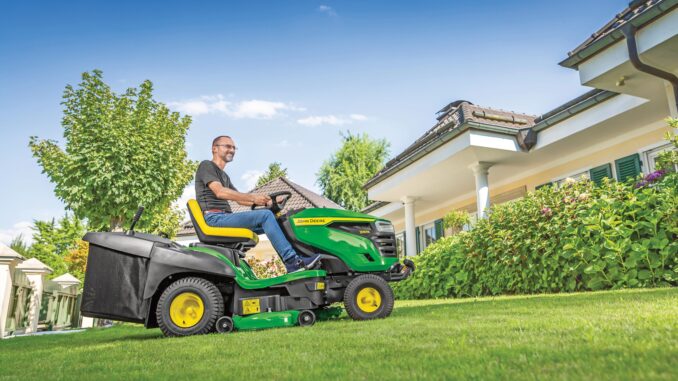
The John Deere E130 is a 100 Series lawn tractor built for homeowners who want a step up from entry-level riding mowers, with a 42-inch mower deck, hydrostatic foot-pedal drive, and a 22 hp V-twin Briggs & Stratton engine for regular mowing on medium residential properties. This guide is written for USA and Canada owners who want a practical, symptom-first reference for troubleshooting, maintenance, common repairs, parts sourcing, and realistic DIY decisions before booking dealer service.
John Deere E130 model overview
The John Deere E130 sits in the 100 Series lineup and is aimed at homeowners who need a lawn tractor for routine cutting, seasonal yard towing, and general property upkeep rather than heavy commercial work. Its operator controls include a brake pedal, park brake lock, throttle/choke lever, key switch, forward and reverse travel pedals, attachment engagement control, lift lever, and Reverse Implement Option, all intended to make it familiar to residential users moving up from smaller lawn tractors.
For most owners, the John Deere E130 is used as a mowing tractor first and a light yard-work machine second. That matters when diagnosing problems, because the most common complaints usually involve starting, uneven cutting, deck drive issues, debris buildup around hot components, and wear in routine service parts rather than major structural failures.
General overview of the John Deere E130
The John Deere E130 uses several core systems that matter when troubleshooting:
-
Engine and fuel system: 22 hp V-twin Briggs & Stratton gasoline engine, fuel filter, air filter, spark plugs, engine oil, and cooling fins all directly affect starting and running quality.
-
Mower system: a 42-inch deck with 3-in-1 blades, mower deck belt, spindle/brake components, deck leveling hardware, and anti-scalp wheels determine cut quality and vibration.
-
Drive system: hydrostatic pedal-controlled transmission and linkage affect forward and reverse response, hill performance, and overall drivability.
-
Electrical and safety system: battery, key switch, wiring, and operator-presence/safety interlocks influence cranking, PTO engagement, and shutoff complaints.
Common John Deere E130 service parts owners often buy include the 42-inch 3-in-1 mower blade GY20850, 42-inch mower deck belt GX20072, Easy Change oil filter system AUC12916, fuel filter GY20709, air filter GY21435, and mulch plug GY00115. Deere-focused parts retailers also maintain dedicated John Deere E130 parts pages, which helps when matching routine service items to the model before ordering.
Troubleshooting approach for the John Deere E130
The fastest way to diagnose a John Deere E130 is to begin with the exact symptom the owner sees, not the part they assume is bad. For example, “cranks but will not start,” “cuts unevenly,” “vibrates when blades engage,” and “moves weakly uphill” each point to different systems and different first checks.
Main symptom groups on the John Deere E130 include:
-
Starting and no-crank issues.
-
Running, surging, smoke, or power-loss complaints.
-
Cut-quality and deck-performance problems.
-
Vibration and abnormal noise.
-
Overheating, debris buildup, and leaks.
-
Transmission and drive response issues.
-
Electrical faults and safety-switch problems.
Emergency and immediate repair needs
Some faults on a John Deere E130 need immediate attention because they affect safe operation or can quickly damage expensive parts. Any machine with fuel leaks, severe vibration, blade-impact damage, overheated engine shrouding, damaged safety devices, or wiring problems near debris-packed hot areas should be parked until inspected.
4.1 Starting issues
A John Deere E130 that will not crank or starts intermittently can leave the operator stranded and can also point to battery, switch, wiring, or fuel problems that worsen with repeated attempts. Hard starting should be treated early, especially if the machine has old fuel, weak battery voltage, or neglected tune-up parts.
Common causes:
-
Weak or discharged battery.
-
Dirty or loose battery terminals.
-
Faulty safety interlock input, such as brake, seat, or PTO not in the correct state.
-
Stale fuel or restricted fuel filter.
-
Fouled or worn spark plugs.
-
Restricted air filter.
Basic owner checklist:
-
Confirm the PTO is disengaged, the brake is fully applied, and the controls are in the correct starting position.
-
Check battery terminals for corrosion and tightness.
-
Inspect fuel condition and replace old fuel if it smells stale.
-
Replace the fuel filter, air filter, and spark plugs if service history is unknown.
-
If it still will not crank, move on to interlock, switch, or wiring diagnosis.
4.2 John Deere E130 cut-quality problems
Poor cut quality on a John Deere E130 usually shows up as scalping, streaks, ragged grass tips, or strips of uncut grass. These issues are often caused by setup and wear rather than a major failure, so deck inspection should happen before deeper repairs.
Common causes:
-
Dull, bent, or mismatched blades.
-
Deck out of level side-to-side or front-to-rear.
-
Incorrect anti-scalp wheel adjustment.
-
Worn or slipping deck belt.
-
Grass packed under the deck.
Basic owner checklist:
-
Inspect blades for wear, bends, and balance issues.
-
Clean the underside and top of the mower deck after cooling the machine.
-
Verify tire pressures before leveling the deck.
-
Level the deck side-to-side, then set the front 1/8 to 1/4 inch lower than the rear.
-
Replace the belt if it is glazed, cracked, stretched, or slipping under load.
4.3 John Deere E130 vibration and noise
Sudden vibration on a John Deere E130 should be treated as a stop-now symptom because continued operation can damage spindles, belts, blade hardware, or the deck shell. Vibration after striking an object is especially important, since Deere instructs owners to stop and inspect the machine immediately after impact.
Common causes:
-
Bent blade or damaged blade bolt hardware.
-
Debris wrapped around spindles or pulleys.
-
Worn spindle bearings or pulley damage.
-
Belt damage or misrouting after prior service.
Basic owner checklist:
-
Shut the machine down, remove the key, and wait for all movement to stop.
-
Inspect blades and blade bolts for obvious impact damage.
-
Clear packed grass, wire, or string from spindle and belt areas.
-
Spin pulleys and spindles by hand with the engine disabled to feel for roughness.
-
If vibration remains, plan for spindle or deck-hardware repair rather than continued mowing.
4.4 John Deere E130 overheating and leaks
Heat and debris are a bigger problem on residential tractors than many owners expect, and the John Deere E130 manual repeatedly warns about fire risk from dry grass and leaves accumulating around hot or moving parts. Oil seepage, fuel leaks, or debris packed around the muffler, engine screens, transmission, and wiring should be corrected immediately.
Common causes:
-
Clogged intake screens or engine cooling fins.
-
Grass packed around muffler or engine shrouds.
-
Oil leaks collecting dust and debris.
-
Dirty deck and transmission area restricting airflow and trapping heat.
Basic owner checklist:
-
Let the machine cool fully before cleaning.
-
Clean the muffler area, intake screens, deck top, transmission area, and wiring area under the side panel.
-
Look for wet oil or fuel traces after cleaning.
-
Replace overdue air and fuel filters as part of the repair.
-
If leakage returns quickly, inspect seals, fuel lines, and fittings more closely.
4.5 John Deere E130 transmission and drive problems
Drive complaints often appear as weak hill climbing, sluggish pedal response, poor reverse speed, or a tractor that rolls poorly when the owner expects it to freewheel. Because the John Deere E130 is a homeowner machine, many apparent transmission failures are actually linkage, brake, bypass, or operating-position issues rather than a fully failed transaxle.
Common causes:
-
Parking brake dragging or not fully released.
-
Freewheel/bypass control not returned fully to drive position.
-
Linkage wear or binding.
-
Heat and age-related hydrostatic performance loss.
Basic owner checklist:
-
Confirm the park brake is fully disengaged.
-
Check that any tow/freewheel release is back in the correct position.
-
Inspect linkage for looseness, bending, or obstruction.
-
Test after the unit is fully warmed up, since weak hydro performance often shows more clearly hot.
-
Persistent internal hydro issues are usually beyond casual DIY repair.
4.6 Electrical problems on the John Deere E130
Electrical faults can show up as no-crank, intermittent shutdown, no lights, PTO not engaging, or repeated fuse issues. Because Deere highlights debris and wiring inspection under the left side panel and fuse-block area, owners should include those spots in any electrical diagnosis.
Common causes:
-
Corroded battery terminals.
-
Loose grounds or damaged wiring.
-
Blown fuse or contaminated fuse area.
-
Failing switch or safety interlock.
Basic owner checklist:
-
Clean and tighten battery terminals.
-
Inspect visible wiring around the battery, side panel, and fuse block for chafing or melted insulation.
-
Test for repeat fuse failure before fitting larger fuses, which should never be used as a shortcut.
-
Verify the PTO and brake positions during cranking tests.
-
Move to meter-based electrical diagnosis if the problem is intermittent.
John Deere E130 DIY or dealer repair guide
The realistic DIY line on a John Deere E130 is fairly clear: routine maintenance, blade service, deck leveling, filter changes, and simple belt work are usually owner-friendly, while internal engine, hydrostatic transmission, and complex electrical diagnosis are better left to experienced technicians.
Good DIY jobs
-
Engine oil and filter service or Easy Change service if equipped.
-
Air filter, fuel filter, and spark plug replacement.
-
Blade removal, sharpening, or replacement.
-
Deck cleaning, leveling, and anti-scalp wheel adjustment.
-
Battery terminal cleaning and battery replacement.
Advanced DIY or dealer jobs
-
Mower deck spindle replacement.
-
Complex belt routing or repeated belt-throwing issues.
-
Safety-switch or harness diagnosis with a multimeter.
-
Hydrostatic drive complaints that remain after linkage and brake checks.
-
Valve clearance adjustment, which Deere lists at 200 hours and directs to dealer service.
Skill level guide
-
Beginner: air filter, fuel filter, battery care, deck cleaning, blade inspection.
-
Intermediate: spark plugs, blades, deck belt, deck leveling, basic electrical checks.
-
Advanced: spindle repair, switch testing, wiring repairs, hydro linkage diagnosis.
Parts needed for the John Deere E130
Before ordering John Deere E130 parts, gather the full model name, the tractor Product Identification Number, the engine serial number, and the deck size or attachment details. Deere specifically notes that the dealer needs the serial number or PIN when ordering machine or attachment parts, and the machine PIN is located on the left side of the frame while the engine serial number is on the engine itself.
OEM versus aftermarket guidance for the John Deere E130 is simple: stick with OEM for belts, fit-sensitive deck parts, and safety-related items, while good-quality aftermarket options can be fine for filters, blades, batteries, and tune-up parts when the cross-reference is exact. The more serial-sensitive the part, the more worthwhile it is to confirm the number with a dealer or Deere diagram before ordering.
John Deere E130 manuals and parts diagrams
The most useful sources for John Deere E130 documentation and diagrams are:
-
Official operator’s manual: good for safety, controls, routine service, troubleshooting, and machine locations.
-
Parts and maintenance information PDF: useful for quick service intervals and several high-volume consumable part numbers.
-
John Deere Technical Publications: where Deere directs owners to buy technical manuals and parts catalogs.
-
Green Farm Parts E130 page: useful for model-specific illustrated retail parts browsing.
Using those four together usually gives the fastest result: start with the operator’s manual for procedures, confirm the part on a Deere diagram, and then compare buying options using the exact OEM number.
How to locate John Deere E130 serial numbers
Model and serial information matters because even very similar John Deere tractors can use different parts depending on production range, engine variation, or deck configuration. If you skip this step, you increase the chance of ordering the wrong belt, filter, or electrical part.
-
Park the tractor safely on level ground, remove the key, and let hot parts cool.
-
Find the John Deere E130 Product Identification Number on the left side of the frame.
-
Record the full PIN exactly as shown, including all digits.
-
Locate the engine serial number on the engine shroud/engine identification area and record that separately.
-
If ordering deck parts, also confirm that the machine has the 42-inch deck and note any accessory installed.
Buying John Deere E130 parts online and in stores
The best buying strategy is to identify the exact OEM number first, then decide where to buy based on how serial-sensitive the part is. Fast-moving maintenance items are usually easy to buy online, while unusual brackets, switches, deck hardware, and serial-range changes are better checked at a dealer counter.
-
Online: best for filters, blades, belts, and maintenance kits when the OEM number is already confirmed.
-
Dealer counter: best for serial-specific parts, technical diagrams, and resolving superseded numbers.
-
Retail stores: acceptable for oil, batteries, and universal tune-up items only when packaging clearly matches the E130 or the engine model.
Useful links include JD Parts / Deere support, Technical Publications, and Green Farm Parts E130 page.
Step-by-step fitting guide for common John Deere E130 parts
Replace the John Deere E130 air filter
A fresh air filter helps with hard starting, rich running, black smoke, and general power loss.
-
Park safely, switch off, and let the engine cool.
-
Open the air cleaner housing and remove the old element and precleaner if fitted.
-
Wipe loose dirt from the housing without pushing debris into the intake.
-
Install the new filter element correctly seated in the housing.
-
Close the housing and test-run the engine.
Change the John Deere E130 fuel filter
Replacing the fuel filter often fixes lean running, surging, and no-start complaints caused by restricted flow.
-
Work in a ventilated area with the engine off and cool.
-
Clamp the line if needed and remove the old filter, noting flow direction.
-
Inspect the hose for cracks or hardness before installing the new filter.
-
Fit the new filter in the correct direction and secure the clamps.
-
Start the engine and check carefully for leaks.
Replace John Deere E130 spark plugs
Fresh plugs improve cold starting, smoother idle, and full-power mowing under load.
-
Remove the key, disable starting, and pull the plug leads off carefully.
-
Remove each old plug with the correct spark plug socket.
-
Confirm the replacement plug matches the engine specification for your serial-numbered engine.
-
Thread the new plugs in by hand first to avoid cross-threading, then tighten correctly.
-
Refit plug wires securely and test-run the tractor.
Replace the John Deere E130 mower deck belt
A new deck belt can cure slipping blades, weak cut performance, belt squeal, and no-blade-drive complaints.
-
Park safely, lower or remove the deck as needed, and make sure the PTO is off.
-
Photograph the old belt routing before removal.
-
Remove the worn belt from the pulleys and inspect idlers for roughness or wobble.
-
Route the new GX20072 belt correctly around the deck pulleys and guides.
-
Recheck pulley alignment, then test engagement at low risk before full mowing speed.
Replace or sharpen John Deere E130 blades
Blade service restores cut quality and reduces the strain that dull edges put on the deck drive.
-
Disable starting by disconnecting spark plug wires or the battery negative cable as Deere instructs before deck service.
-
Wear gloves and remove the blades carefully.
-
Replace bent blades or sharpen serviceable ones evenly.
-
Reinstall using correct orientation and secure hardware.
-
Test for smooth engagement and vibration before returning to normal mowing.
Maintenance to prevent John Deere E130 problems
Regular maintenance prevents most repeat failures on the John Deere E130 because the tractor’s common issues are strongly tied to neglected consumables, deck setup, and debris buildup around hot components. Owners who stay ahead of cleaning, lubrication, blade care, and annual tune-up items usually avoid the most frustrating mid-season no-start and poor-cut complaints.
Focus areas:
-
Starting reliability: keep fresh fuel in the system, replace the fuel filter, air filter, and spark plugs on schedule, and clean battery terminals yearly.
-
Cut quality: keep blades sharp, level the deck correctly, and inspect the deck belt regularly.
-
Fire and overheating prevention: clean the muffler zone, engine screens, deck top, transmission area, and side-panel wiring area frequently.
-
Drive performance: make sure brakes release fully, linkages move freely, and the tractor is not packed with debris around the driveline area.
-
Electrical reliability: keep terminals clean and watch for debris-related heat or abrasion around harnesses and fuse locations.
John Deere E130 maintenance schedule
The John Deere E130 maintenance schedule should follow Deere’s service intervals, with extra attention in dusty mowing conditions because the factory maintenance sheet specifically says oil and air-filter service may be needed more often in those conditions. The list below keeps closely to the official intervals published for the E130-CARB and Deere’s operator guidance for daily checks.
Daily / before each use
-
Check and test safety systems.
-
Check tire pressure and brakes.
-
Check fuel level and engine oil level.
-
Remove grass and debris from the engine compartment, muffler area, and top of mower deck.
-
Clean the air intake screen and look underneath for leaks.
-
Check for loose hardware.
After 8 hours
-
Lubricate mower spindles and pivot points.
-
Check mower deck spindle brakes on manual PTO-equipped setups.
-
Lubricate front axle pivot and axle spindles.
-
Lubricate front axle wheel bushings.
Every 25 hours
-
Lubricate mower spindles and pivot points.
-
Lubricate front axle pivot and axle spindles.
-
Lubricate front axle wheel bushings.
Every 50 hours or yearly
-
Replace engine oil and filter, or service the Easy Change system if equipped.
-
Replace air filter element and precleaner as needed.
-
Replace fuel filter.
-
Replace spark plugs.
-
Clean engine cooling fins.
-
Sharpen or replace mower blades.
-
Check or replace mower drive belts.
-
Check and level the mower deck, clean the deck, and clean battery terminals.
Every 200 hours
-
Check and adjust valve clearance through a John Deere dealer.
Seasonal checklist
-
Spring: inspect battery, fuel condition, blades, filters, deck level, and belt condition before the first heavy mowing cycle.
-
Mid-season: clean cooling areas more often, sharpen blades again if cut quality drops, and inspect the deck belt for glazing or cracking.
-
Fall or end of season: clean the machine thoroughly, correct leaks, complete overdue annual service, and store only after debris is removed from fire-risk areas.
Repair, upgrade, or replace the John Deere E130?
For most homeowners, a John Deere E130 is worth repairing when the core tractor is structurally sound and the needed work is limited to normal wear items, deck repairs, tune-up parts, or minor electrical fixes. Upgrade makes more sense when mowing demands have outgrown the tractor’s residential role, and replacement makes more sense when multiple major systems are failing at once.
Repair if…
-
The problem is limited to blades, belts, filters, battery, or tune-up parts.
-
The deck needs leveling or moderate hardware work rather than full replacement.
-
The engine and hydro drive still perform normally once serviced.
Upgrade if…
-
You need a wider deck, heavier towing ability, or more comfort features than the E130 offers.
-
You regularly mow larger ground where faster mowing speed or a stronger chassis would save time.
Replace if…
-
The tractor has major engine wear, persistent hydrostatic failure, and deck damage at the same time.
-
Serial-specific repair costs are approaching the value of a better-condition replacement machine.
Expanded troubleshooting FAQ
1. Why will my John Deere E130 not start?
The most common causes are a weak battery, stale fuel, a restricted fuel filter, a dirty air filter, worn spark plugs, or the controls not being in the correct start position. Start with the PTO off, brake applied, and battery terminals clean and tight before moving on to tune-up parts.
2. Why does my John Deere E130 crank but not fire?
That usually points more toward fuel, spark, or air issues than battery problems. Old fuel, a clogged fuel filter, fouled spark plugs, or an overdue air filter are the first items to check on an E130 with unknown maintenance history.
3. Why does my John Deere E130 click but not turn over?
A clicking sound often means the battery lacks enough power to crank the engine or the terminals are corroded. Clean the connections first, then test the battery before replacing switches or starter components.
4. Why does my John Deere E130 start hard when cold?
Cold-start difficulty often comes from weak spark plugs, stale fuel, or improper choke/throttle use. A full annual tune-up and fresh fuel usually solve this faster than random parts swapping.
5. Why does my John Deere E130 stall after it starts?
This often happens when fuel flow is restricted or the engine cannot breathe properly through a dirty filter. Check the fuel filter, air filter, fuel quality, and debris around cooling areas before assuming major engine trouble.
6. Why is my John Deere E130 running rough?
Rough running usually points to tune-up neglect, bad fuel, partial blockage in the fuel system, or ignition issues. If the machine also smokes or lacks power under load, inspect the air filter and plugs first.
7. Why does my John Deere E130 surge at mowing speed?
Surging is commonly caused by inconsistent fuel delivery or an air/fuel imbalance. A restricted fuel filter, dirty air filter, or stale gasoline is more likely than a serious internal engine fault on a residential tractor like this.
8. Why is my John Deere E130 losing power in tall grass?
Tall or wet grass increases deck load, so dull blades, a slipping belt, and a dirty underside of deck are common causes. Make sure the blades are sharp and the deck is clean before blaming the engine.
9. Why does my John Deere E130 blow black smoke?
Black smoke usually suggests an over-rich condition, often related to restricted airflow or choke issues. Inspect the air filter first and confirm the throttle/choke control is returning correctly after start-up.
10. Why does my John Deere E130 cut unevenly?
Uneven cut is usually a deck setup problem rather than an engine issue. Check tire pressure first, then verify deck level side-to-side and front-to-rear using Deere’s specifications.
11. Why does my John Deere E130 leave strips of uncut grass?
This usually means the blades are dull, the belt is slipping, or the deck is carrying too much packed grass. Blade condition and deck cleanliness are the fastest first checks.
12. Why does the John Deere E130 scalp my lawn?
Scalping often happens when the deck is set too low for the terrain or the anti-scalp wheels are adjusted incorrectly. Recheck deck-wheel position and avoid trying to mow uneven ground at an aggressively low cut height.
13. Why are there brown tips after mowing with my John Deere E130?
Brown tips usually mean the grass is being torn instead of cleanly cut. Sharpen or replace the blades and verify the deck pitch is set correctly so the front runs slightly lower than the rear.
14. Why does my John Deere E130 vibrate when I engage the blades?
Blade engagement vibration often comes from bent blades, debris around pulleys, or spindle wear. Stop mowing immediately and inspect the deck before further use because continued operation can damage additional parts.
15. Why does my John Deere E130 shake after hitting an object?
Deere says the machine should be stopped and inspected immediately after impact. A bent blade, damaged spindle, loosened hardware, or distorted pulley can all cause instant vibration after a strike.
16. Why is the mower deck on my John Deere E130 noisy?
Deck noise is commonly caused by rough spindle bearings, loose blade hardware, or belt problems. Inspect for metal-to-metal contact, damaged pulleys, and blade looseness before mowing again.
17. Why does my John Deere E130 throw or shred belts?
Repeated belt failure usually means more than normal belt wear. Misrouting, worn pulleys, seized spindle bearings, or bent guides are common root causes, so fitting a new belt without inspection often leads to another failure.
18. Why is my John Deere E130 mower belt slipping?
A glazed, stretched, or contaminated belt can slip under heavy grass load. Inspect belt condition, pulley alignment, and any packed debris in the belt path.
19. How often should I replace John Deere E130 blades?
There is no single fixed replacement hour for every owner, because wear depends on acreage, terrain, and impacts. Deere’s maintenance sheet tells owners to sharpen or replace blades yearly or every 50 hours, and sooner if cut quality drops or damage is visible.
20. What is the mower deck belt number for a John Deere E130?
The 42-inch mower deck belt listed in the Deere parts and maintenance sheet for the E130-CARB is GX20072. Always confirm by PIN if a previous owner swapped decks or fitted non-standard parts.
21. What blade part number fits the John Deere E130?
The Deere quick parts sheet lists GY20850 as the 42-inch 3-in-1 blade for the E130-CARB. Confirm deck configuration before ordering in case the machine has been modified.
22. What fuel filter fits the John Deere E130?
The Deere maintenance sheet lists GY20709 as the fuel filter for the E130-CARB. If your tractor’s engine differs by serial range or market configuration, confirm against the engine and PIN before purchase.
23. What air filter fits the John Deere E130?
The Deere maintenance sheet lists GY21435 as the air filter for the E130-CARB. Replace it more often if the tractor works in dry or dusty mowing conditions.
24. Which spark plugs does a John Deere E130 use?
E130 V-twin tune-up kits commonly use RC12YC spark plugs, but spark plug choice should still be confirmed against the exact engine model and serial number before ordering. That extra check matters because the engine, not just the tractor model, controls the final plug specification.
25. Why does my John Deere E130 overheat or smell hot?
The manual emphasizes debris buildup around the muffler, intake screens, deck top, transmission area, and wiring area as a fire and heat risk. Shut it down, let it cool, and clean those areas thoroughly before further use.
26. Why is there grass packed on top of my John Deere E130 deck?
That is normal to some extent, but heavy buildup traps heat, affects belt life, and contributes to fire risk. Deere specifically includes the top of the mower deck and belt areas among the parts that need regular inspection and cleaning.
27. Why does my John Deere E130 move weakly uphill?
Weak hill performance can come from operating conditions, brake drag, linkage problems, or hydro wear. Check that the parking brake is fully released and the freewheel control is fully returned before assuming the transmission has failed.
28. Why will my John Deere E130 not go forward or reverse properly?
Start by checking control linkage, brake condition, and any bypass/tow setting. If those are correct and the tractor is still weak in both directions when warm, the hydro unit may need professional diagnosis.
29. Why does my John Deere E130 battery keep going flat?
Repeat battery discharge can come from poor terminal connections, age, parasitic draw, or leaving the key in a powered position. Clean the terminals, verify charging condition, and make sure the key is not being left on the light position.
30. Why are my John Deere E130 headlights not working?
Start with the key-switch position, fuse condition, battery charge, and visible wiring near the battery and side-panel harness area. Because Deere highlights that section as a debris and wiring inspection point, heat and dirt can contribute to electrical issues there.
31. Why does the PTO or blade engagement stop working on my John Deere E130?
If the blades will not engage, check the control position, related interlocks, wiring, and the belt/deck side for obvious failure. On tractors with repeated engagement trouble, electrical switch diagnosis or clutch-related diagnosis may be needed beyond basic DIY checks.
32. How often should I change the oil on a John Deere E130?
The Deere maintenance sheet calls for engine oil and filter service yearly or every 50 hours, with more frequent service under dusty conditions. If the tractor is used hard in heat and dust, shorten the interval rather than stretching it.
33. How often should I grease a John Deere E130?
The official schedule calls for lubrication after the first 8 hours and then every 25 hours for mower spindles, pivot points, front axle pivot, axle spindles, and front axle wheel bushings. Skipping lubrication increases steering wear and deck-related friction over time.
34. Does the John Deere E130 need valve adjustment?
Yes, Deere lists valve clearance inspection or adjustment at 200 hours. Deere also points owners to the dealer for that service, which is a good sign that it is beyond routine beginner maintenance.
35. Is the John Deere E130 a good DIY repair tractor?
Yes, within reason, because it supports straightforward owner service on filters, blades, belts, deck leveling, cleaning, and seasonal maintenance. It becomes less DIY-friendly when the fault moves into hydrostatic internals, valve setting, or deeper electrical diagnosis.
John Deere E130 transmission fluid change instructions
On the John Deere E130, the hydrostatic transmission is factory‑filled and is not listed as a normal owner‑service fluid change like engine oil; Deere treats it as a “service‑for‑repair” job rather than routine maintenance for homeowners. That means the official recommendation is to leave transmission oil changes to a dealer unless there has been a failure, contamination, or a specific technical bulletin saying otherwise.
What Deere officially expects
For the E130 and other 100‑Series lawn tractors, the published maintenance schedules cover engine oil, filters, blades, lubrication points, and valve clearance but do not include a scheduled hydrostatic transmission fluid and filter change for typical homeowner use. Deere’s operator literature for this series also directs owners to the dealer for hydrostatic issues and internal drive work rather than providing a DIY change interval or step‑by‑step hydro service.
Because of that, there is no official “E130 transmission fluid change” procedure in the operator’s manual in the same way there is for compact utility tractors or commercial machines, where Deere publishes explicit steps for draining the transmission, changing the filter, and refilling to a dipstick or sight‑glass mark.
Why there isn’t a regular change interval
The E130 uses a sealed hydrostatic transaxle that is designed to last the expected life of the machine for normal residential mowing without routine fluid changes. Deere focuses owner maintenance on keeping the tractor clean around the transmission, following the lubrication points, and making sure the brake and freewheel linkages are adjusted correctly so the hydro unit is not overheated or overloaded.
Where Deere does document transmission oil service, it is on larger or commercial units with separate hydraulic reservoirs and filters, and those procedures involve safely lifting the machine, draining the transmission, changing filters, refilling with the correct spec oil, and purging the hydro by cycling the pedals to remove air. The level of disassembly and the need for correct oil spec and purging is why Deere classifies hydro work for 100‑Series tractors as dealer‑level.
Practical DIY advice for an E130 owner
For an E130 that is just weak, noisy, or hot, most owner‑level actions are:
-
Clean the transmission area thoroughly to remove built‑up grass and debris so it can cool properly.
-
Verify the park brake is fully releasing and the tow/freewheel control is fully back in the drive position so the hydro is not being dragged or restricted.
-
Check tire pressures and linkage condition so the hydro is not compensating for avoidable drag or misadjustment.
If the transaxle is actually leaking, badly contaminated, or has failed internally, Deere’s guidance is to take it to a dealer or replace the transaxle assembly, not to treat it as a routine fluid change job. Some independent technicians do perform off‑label hydro fluid changes on similar Tuff Torq units by removing the transaxle, draining it, changing filters, and refilling with the appropriate oil, but those procedures are based on generic hydrostatic tutorials rather than Deere’s homeowner documentation and assume higher tooling and skill levels.