
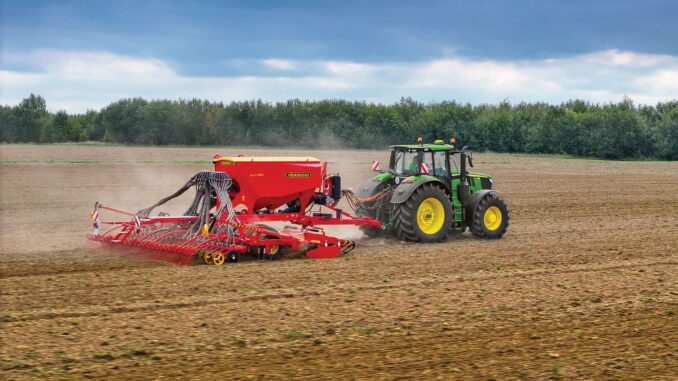
John Deere 9R Series Tractor Models and Maintenance Guide
The John Deere 9R Series is John Deere’s high-horsepower articulated four-wheel-drive and tracked tractor family, built for commercial-scale farming, earthmoving, and other heavy-draft applications. Models in the broader 9 Series family include wheeled 9R tractors, two-track 9RT tractors, and four-track 9RX tractors.
This page is an across-time directory for current and legacy North American 9R-family machines. Use it as a starting point for model-specific specifications, service information, fault diagnosis, and ownership research. It conceptually links to individual model pages such as the “9R 540 maintenance & troubleshooting guide,” as well as broader maintenance and repair hubs. For smaller property, loader, mowing, or acreage work, start instead with the General John Deere Compact Tractor Guide, since 9R Series tractors are fundamentally large agricultural and construction-capable machines rather than compact tractors.
And See:
John Deere R Series Repair Guide
About the John Deere 9R Series
John Deere introduced the modern 9R Series designation in the early 2010s as the successor family to earlier high-horsepower 4WD machines. The range has evolved through several naming generations: early 9360R through 9560R models; later 9420R through 9620R machines; 2015–2020-era 9370R through 9620R tractors; and the current 9R 390 through 9R 640 lineup. Deere also extended the family into the two-track 9RT and four-track 9RX configurations.
Depending on generation and configuration, the 9R family spans roughly 360 to 830 rated engine horsepower. Current conventional wheeled 9R models range from 390 to 640 rated engine hp, while the current 9RX lineup extends to 830 hp in North American heavy-draft and scraper-oriented applications. Deere’s current public product listing includes 9R 640 and 9RX 490 models, while current 9 Series product material identifies six wheeled 9R models from 390 to 640 hp and four-track models from 490 to 640 hp.deere+1
These are large articulated or tracked tractors, not sub-compact, compact, or small utility tractors. They are typically used on broad-acre grain, corn, soybean, cotton, and specialty-crop farms where operators need to pull wide tillage tools, planters, seed drills, air carts, strip-till equipment, grain carts, manure equipment, and land-leveling or scraper systems. Their size, ballast capacity, hydraulic output, traction options, and guidance technology make them suitable for long field days and very high draft loads.
The principal chassis choices are:
-
9R: Articulated four-wheel-drive tractor on tires. It offers a broad choice of tire groups and tread settings, with current models supporting tire spacing choices ranging from about 70.2 to 160.5 inches, depending on configuration.deere
-
9RT: Two-track articulated tractor. These are designed for high traction, reduced compaction, and straight-line heavy-draft work. Current product information describes 106-inch tread spacing and 30- or 36-inch track options.deere
-
9RX: Four-track articulated tractor. This configuration distributes the tractor’s weight over four independently driven track assemblies and is often selected for very soft soils, controlled-traffic systems, wide planters, and maximum traction. Current 9RX tractors offer 80-, 88-, or 120-inch tread spacing and 18-, 24-, 30-, or 36-inch track options.deere
Modern machines use electronically managed PowerShift transmissions—such as the e18 PowerShift with Efficiency Manager—and current scraper-special machines may use an e21 PowerShift. They also use high-capacity closed-center, pressure/flow-compensated hydraulics and multiple selective control valves for large implements. Current Deere scraper-special specifications list four standard SCVs with up to six optional on certain 9R/9RT tractors, while 9RX models can be configured with up to six.deere
Technology has changed considerably over the life of the series. Depending on model year and specification, operators may encounter CommandARM controls, Generation 4 or G5 displays, AutoTrac guidance, JDLink connectivity, ISOBUS implement control, section control, documentation, automated headland-turn functions, hydraulic intelligent power management, and comfort systems such as HydraCushion front-axle suspension on wheeled 9R tractors, AirCushion on 9RT tractors, and cab suspension on 9RX machines. Deere states that current 9 Series tractors include standard JDLink and five years of connected service, alongside automated end-of-row turning capability.deere
John Deere 9R Series Tractor Models
The table below is an across-time North American directory. Horsepower figures are approximate rated engine horsepower and can vary by model year, engine-rating standard, and whether a source reports rated, maximum, or PTO power. “Scraper Special” versions are purpose-built configurations for earthmoving and scraper applications; they should be treated as variants of their corresponding core tractor model when planning maintenance content.
| Repair Guide | ||
| John Deere 9RX | ||
Early 9R wheel tractors included the 9360R, 9410R, 9460R, 9510R, and 9560R, and Deere’s North American operator material confirms that lineup. The early model range included 360-, 410-, 460-, 510-, and 560-hp rated classes.manuals.deere+1
The first production 9RX four-track models were the 9470RX, 9520RX, 9570RX, and 9620RX, with rated engine-power classes of 470, 520, 570, and 620 hp. Deere’s related literature also listed 9470RX, 9520RX, and 9570RX Scraper Special versions.farmprogress+1
9R Series Maintenance Guides
Routine Service and Checks
A 9R Series maintenance plan should begin with the operator’s manual and the exact serial-number-specific maintenance schedule. These tractors vary significantly by generation, engine, axle arrangement, track system, transmission, and hydraulic package. A 9360R and a current 9RX 640 may share broad maintenance principles, but their capacities, part numbers, diagnostic systems, emissions equipment, and service intervals can differ substantially.
At minimum, establish a documented inspection routine around engine oil and filter service, fuel filtration, cooling-system condition, air-intake restriction, DEF system checks where applicable, transmission/hydraulic oil condition, axle and final-drive lubricant levels, grease points, electrical connections, and tire or track condition. On high-hour tractors, oil analysis is especially valuable because it can identify developing engine, transmission, hydraulic, and final-drive concerns before they become expensive failures.
For example, Deere’s service material for the earlier 9360R through 9560R models identifies different cooling-system and crankcase capacities across the range. The 9360R used a roughly 11.1-gallon cooling-system capacity and approximately 9.0 gallons of crankcase oil with filter, while the larger 9410R through 9560R machines were listed with roughly 14.6 gallons of coolant and 12.7 gallons of crankcase oil with filter. Always confirm capacities by the exact tractor serial number rather than using a range-wide figure.deere
Conceptual internal links for this section include:
-
“9R Series tractor service interval checklist”
-
“DIY maintenance for John Deere 9R, 9RT, and 9RX tractors”
-
“John Deere 9R engine oil, filter, and fluid capacity guide”
-
“9R Series fuel-system maintenance and water-separator service”
-
“How to inspect articulated tractor grease points and pivot joints”
-
“9RX track undercarriage inspection checklist”
Hydraulics, Hitch, and Drawbar
Hydraulic maintenance is central to 9R ownership because these tractors often operate equipment that demands continuous, high-volume hydraulic flow. Planters, air seeders, hydraulic motors, variable-rate systems, grain carts, scrapers, and advanced tillage implements can place much greater demands on the hydraulic system than conventional three-point implements.
Before connecting an implement, inspect couplers for contamination, damaged seals, restricted flow, cross-connected hoses, and heat-damaged lines. Keep remote couplers capped when not in use, especially in dusty or muddy conditions. A small amount of contamination can cause expensive trouble in proportional valves, hydraulic motors, implement control systems, and tractor hydraulic circuits.
Operators should also inspect remote hydraulic hoses, coupler retainers, cylinder pins, drawbar hardware, safety chains, hitch components, and implement electrical connectors before major field operations. When an implement runs slowly or overheats, distinguish between a tractor hydraulic concern and an implement-side restriction, bypass, motor issue, or incorrect SCV setting.
Useful conceptual links include “Hydraulic maintenance and leak diagnosis on John Deere 9R Series tractors” and “9R, 9RT, and 9RX remote hydraulic troubleshooting guide.” For scraper configurations, a dedicated “John Deere Scraper Special hydraulic inspection and setup guide” is worth maintaining because these machines can operate with unusually high and sustained hydraulic demands.
Transmission and Drivetrain
Modern 9R-family tractors use electronically controlled PowerShift transmissions rather than hydrostatic drives. Depending on model year, that may mean a PowrSync, e18 PowerShift, or e21 PowerShift arrangement. The system combines mechanical drivetrain components with electronic controls, sensors, solenoids, calibration procedures, and software-based fault reporting.
Routine checks should include transmission/hydraulic oil level and condition, fault codes, articulation-joint condition, driveline guards, axle seals, differential and final-drive lubricant levels, tire pressure or track tension, and wheel or undercarriage fasteners. On wheeled tractors, inspect tire condition and matched rolling circumference. Mismatched tire sizes or severe pressure differences can affect traction performance, ride, and drivetrain loading. On tracked machines, inspect track alignment, tension, drive-wheel condition, idlers, mid-rollers, bogie components, and signs of heat, leakage, abnormal wear, or debris packing.
Tracked tractors deserve their own maintenance workflow. A 9RT’s two-track system and a 9RX’s four-track system have different inspection points, operating characteristics, and wear patterns. Track alignment, mid-roller condition, idler damage, and debris accumulation can become costly if ignored.
Use “Transmission and driveline maintenance across John Deere 9R Series tractors,” “9R articulation joint and steering inspection guide,” and “9RT and 9RX track undercarriage maintenance guide” as conceptual maintenance targets.
9R Series Troubleshooting Guides
Starting, Engine, and Fuel Problems
Common no-start and poor-running complaints on 9R Series tractors include low batteries, weak ground connections, starter or relay faults, fuel contamination, air entering the fuel system, plugged filters, water in the separator, restricted air intake, sensor failures, DEF or emissions-system faults, and electronic interlock conditions.
Start diagnosis with the simple checks:
-
Confirm battery state of charge and clean, tight cable connections.
-
Check whether the display reports active or stored diagnostic codes.
-
Verify adequate fuel quantity and drain the water separator if required.
-
Inspect fuel filters and service history.
-
Look for leaks, damaged wiring, rodent damage, and loose harness connectors.
-
Confirm that safety and starting interlocks are satisfied.
-
Check air-filter restriction indicators and inspect the intake system.
-
Avoid repeatedly cranking a diesel engine without identifying the cause of a no-start condition.
Power loss under load is often not a single “engine problem.” It may result from restricted fuel flow, poor fuel quality, overheating, intake restriction, a turbocharger or charge-air issue, derate conditions, exhaust aftertreatment faults, an overloaded implement, excessive wheel slip, or hydraulic demand that is consuming available engine power.
Conceptual links should include “John Deere 9R Series starting problems – diagnostics and fixes,” “Engine and fuel-system issues across John Deere 9R models,” and “9R power loss, engine derate, and warning-code troubleshooting.”
Hydraulic and Implement Performance Issues
Weak hydraulics, slow lift, jerky cylinders, overheating oil, or an implement that will not operate correctly can come from low oil level, incorrect SCV settings, contaminated oil, blocked couplers, a leaking cylinder, an internal implement bypass, worn hydraulic components, electrical-control faults, or excessive demand from the implement.
A useful first distinction is whether the problem affects:
-
One remote circuit only.
-
Every hydraulic remote.
-
The hitch or drawbar-mounted equipment only.
-
A particular implement rather than the tractor.
-
Operation only when the oil is cold or only after the machine heats up.
If one remote has a problem but others work normally, inspect the specific coupler, hose, SCV setup, valve, and implement circuit before assuming the tractor’s main hydraulic pump is at fault. If every function is slow or weak, check oil level, hydraulic temperature, filters, pump performance, pressure, error codes, and possible restrictions.
Build individual support pages around “Hydraulic performance problems on John Deere 9R Series tractors,” “9R remote hydraulic coupler and SCV troubleshooting,” and “Loader, hitch, and implement hydraulics on John Deere 9R models.” While front loaders are not typical for this tractor class, heavy three-point and drawbar-mounted equipment, hydraulic planters, air carts, and scrapers make hydraulic diagnosis equally important.
Transmission, Drive, and PTO Problems
Drive complaints can include delayed engagement, erratic shifts, poor pulling performance, loss of travel in a gear range, transmission warnings, excessive slip, unusual axle noise, or reduced hill-climbing performance. On track tractors, an operator may describe a traction or steering concern as “transmission slip,” even where the underlying problem is track tension, undercarriage condition, ballast setup, soil conditions, or an implement that exceeds practical traction capacity.
Start with fault codes, oil level, oil condition, service history, and a careful description of when the issue occurs. Note the selected gear or range, engine speed, load, hydraulic use, oil temperature, whether the fault is intermittent, and whether it occurs in both travel directions. Avoid continuing to operate a tractor with transmission warning messages, repeated harsh shifts, metal contamination, or loss of drive until the cause has been investigated.
PTO issues can arise on models equipped with PTO options and may involve engagement settings, shaft speed selection, electronic controls, wiring, implement driveline problems, overload conditions, or safety interlocks. Because PTO availability varies by model and configuration, individual model pages should clearly state whether the tractor has a PTO option before presenting PTO-specific fault procedures.
Useful hub targets include:
-
“Drive and transmission problems on John Deere 9R Series tractors”
-
“9R PowerShift transmission warning codes and diagnosis”
-
“9RT and 9RX track drive troubleshooting”
-
“PTO will not engage or drops out on John Deere 9R Series tractors”
-
“Articulated tractor steering and driveline fault diagnosis”
Attachments and Implements
The 9R Series works primarily with large agricultural implements and heavy earthmoving equipment rather than the loaders, mid-mount mowers, rotary cutters, and snow blowers commonly associated with compact tractors. That distinction matters when organizing site content: an article that treats a 9R 540 like a 1 Series or 3 Series compact tractor will not match real owner needs.
Typical 9R Series equipment includes:
-
Wide field cultivators, vertical-tillage tools, disc harrows, and deep-ripping equipment.
-
High-capacity air seeders, air carts, drills, strip-till equipment, and precision planters.
-
Grain carts, manure equipment, rollers, and large pull-type implements.
-
Rear-mounted three-point equipment where the tractor is configured with a hitch.
-
Hydraulic-motor-driven planters, seeders, and specialty implements.
-
Land planes, scrapers, and scraper trains on Scraper Special models.
-
Guidance, documentation, and implement-control equipment integrated through display, receiver, ISOBUS, and precision-agriculture systems.
Compatibility is not simply a horsepower question. Confirm the required drawbar load, hitch category and lift requirements, PTO needs if applicable, hydraulic flow and pressure requirements, number of remote circuits, return-flow requirements, electrical and ISOBUS compatibility, hydraulic-motor case-drain requirements, operating width, transport dimensions, ballast, tire or track selection, and field conditions.
For 9RX tractors, track width and spacing can affect implement and hitch compatibility. Deere noted that certain 9RX models configured with 120-inch track spacing could not be paired with a three-point hitch; its guidance stated that 9RX machines needing a three-point hitch required the 87-inch spacing arrangement with 30-inch tracks in the cited model-generation context.