
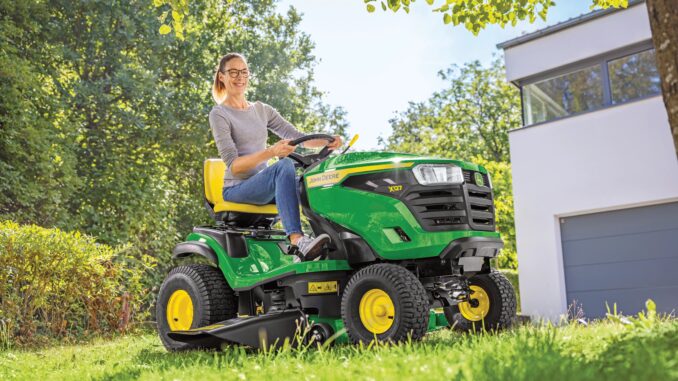
The John Deere E120 is a 100 Series lawn tractor aimed at homeowner mowing duty, with a 42-inch Edge cutting deck and hydrostatic two-pedal transmission layout, making it suitable for regular lawn care rather than ground-engaging or commercial work.
This guide covers the areas most owners actually need: common John Deere E120 starting and running problems, cut-quality faults, vibration, drive complaints, maintenance intervals, parts ordering, and practical DIY boundaries.
John Deere E120 overview
The John Deere E120 sits in Deere’s entry homeowner tractor range and shares many service patterns with other 100 Series machines, especially around engine tune-up parts, deck setup, and safety interlock diagnosis. For owners in the USA and Canada, Deere directs users to the operator’s manual, JDParts, and the Technical Information Store for service literature and parts identification support.
Key John Deere E120 systems owners deal with most often include the engine and fuel system, mower deck and blade drive, hydrostatic drive system, and the electrical/safety switch circuit. On this model, common service parts regularly replaced by owners include the fuel filter AM116304, Easy Change oil system filter AUC12916, spark plug M78543, and air filter MIU13963 for 42-inch deck versions listed in the maintenance guide.
John Deere E120 troubleshooting approach
The best way to diagnose a John Deere E120 is to start with the symptom the owner sees, not the part they assume has failed. That matters because one symptom, such as “won’t start,” can come from several very different causes including stale fuel, a safety switch issue, a weak battery, or a loose plug wire.
Main John Deere E120 symptom groups usually fall into:
-
Starting issues, no crank, slow crank, or cranks but will not fire.
-
Running issues, surging, rough idle, poor power, or stalling.
-
Cut-quality problems, uneven cut, uncut strips, clumping, or discharge issues.
-
Vibration and noise, often linked to blades, deck buildup, or loose hardware.
-
Overheating, burning smells, leaks, or heavy debris buildup around the engine and deck.
-
Transmission or drive complaints, poor ground speed, weak hill performance, or freewheel confusion.
-
Electrical and safety circuit faults, especially seat, brake, PTO, fuse, battery, and switch-related problems.
Emergency John Deere E120 repair needs
Some John Deere E120 problems should be handled immediately because they affect safe operation or can turn a small repair into a costly one. Deere specifically warns about fire risk from grass and debris buildup near the muffler, engine cooling areas, deck belt zones, transmission, battery wiring, and fuse block.
John Deere E120 starting issues
A no-start or no-crank problem matters because owners often keep cycling the key, draining the battery and masking the original fault. If the engine cranks but will not start, stale fuel, a disconnected spark plug wire, or a fuel delivery issue are common first suspects.
Common causes:
-
Weak battery or bad battery cable connection.
-
Safety switch or brake/PTO interlock issue.
-
Loose spark plug wire.
-
Stale or improper fuel.
-
Dirty air filter or restricted fuel filter.
Basic checks:
-
Confirm PTO is off, brake is applied, and the operator is seated correctly.
-
Check battery terminals for looseness or corrosion.
-
Verify spark plug wires are fully seated.
-
Smell and inspect the fuel; replace stale fuel if needed.
-
Check the fuel filter and air filter if the engine cranks but will not fire cleanly.
John Deere E120 cut-quality problems
Poor cut quality matters because many owners assume a blade or spindle failure when the real issue is deck setup, mowing conditions, or dull blades. Deere’s deck-level guidance is especially important here, since the front of the deck should run slightly lower than the rear to avoid double cutting and brown grass tips.
Common causes:
-
Dull or worn blades.
-
Unequal tire pressure.
-
Deck out of level.
-
Grass too wet, too tall, or travel speed too fast.
-
Deck packed with clippings.
Basic checks:
-
Inspect blades for dull edges, bends, or damage.
-
Check tire pressures before touching deck adjustments.
-
Clean the underside and top of the deck.
-
Verify side-to-side level and front-to-rear pitch.
-
Slow down and avoid mowing wet grass.
John Deere E120 vibration and noise
Sudden vibration should be treated seriously because a bent blade, loose hardware, or debris jam can damage spindles, belts, and deck components quickly. Deere also advises stopping and inspecting the machine immediately after striking an object.
Common causes:
-
Bent blade or damaged blade hardware.
-
Heavy deck buildup.
-
Loose mower or engine hardware.
-
Worn or slipping belt.
Basic checks:
-
Shut the machine down, remove the key, and wait for all moving parts to stop.
-
Inspect both blades and blade mounting points.
-
Check deck top and underside for packed debris.
-
Inspect the deck belt and visible pulleys.
-
Tighten any obviously loose hardware before further use.
John Deere E120 overheating and leak issues
Heat, smell, or smoke on a John Deere E120 often comes from blocked cooling fins, muffler-area debris, or oil/fuel leakage collecting dust and clippings. Deere’s cleanout guidance specifically calls for inspecting the exhaust manifold, muffler, intake screens, cooling fins, deck belt areas, transmission area, and left-side wiring/battery area.
Common causes:
-
Grass and leaf buildup near hot engine parts.
-
Dirty intake screens or cooling fins.
-
Oil or fuel leaks attracting debris.
-
Overworked mower in hot, heavy grass.
Basic checks:
-
Let the tractor cool fully before cleaning.
-
Remove debris from the muffler, engine shrouds, intake screens, and deck top.
-
Inspect for wet oil or fuel residue.
-
Check the air filter and cooling fin area.
-
Do not continue mowing until the source is identified.
John Deere E120 transmission and drive problems
Drive complaints on the E120 are often owner-observed as weak motion, no motion, or confusion over the freewheel bypass rather than an immediate internal transmission failure. Hydrostatic complaints should be approached carefully because linkage, brake drag, and operating technique can mimic more serious issues.
Common causes:
-
Freewheel/bypass rod left in tow position.
-
Brake not fully released.
-
Drive belt wear or slippage.
-
Internal transaxle wear or failure.
Basic checks:
-
Confirm the freewheel rod is in the normal drive position.
-
Make sure the park brake is fully released.
-
Inspect visible drive belt condition if accessible.
-
Test on level ground before diagnosing slope performance.
-
Escalate persistent no-drive or weak-drive issues to dealer-level diagnosis.
John Deere E120 electrical problems
Electrical faults on the John Deere E120 commonly show up as no crank, intermittent stalling when leaving the seat, charging complaints, or blown fuse behavior. Because the safety switch circuit is part of the starting and operating logic, owners should inspect it before replacing major components.
Common causes:
-
Corroded battery terminals.
-
Weak battery or dead cell.
-
Blown fuse or damaged wiring near debris-prone areas.
-
Faulty seat, brake, or PTO safety switch.
Basic checks:
-
Clean and tighten battery terminals.
-
Inspect visible wiring near the battery and fuse area.
-
Verify safety-switch conditions one by one.
-
Check for recurring debris buildup rubbing wiring.
-
Replace battery only after confirming charging and connection basics.
John Deere E120 DIY or dealer?
The John Deere E120 is owner-serviceable for normal maintenance and a fair number of straightforward repairs, but internal hydrostatic work, valve clearance adjustment, and deeper electrical diagnosis usually cross into dealer territory. Deere’s own schedule pushes valve clearance at 200 hours to dealer service, which is a good marker for where most homeowner DIY work should stop.
Good DIY jobs:
-
Air filter, fuel filter, spark plug, and engine oil service.
-
Blade sharpening or replacement.
-
Deck cleaning, deck leveling, and anti-scalp wheel adjustment.
-
Battery terminal cleaning and basic battery replacement.
-
Basic belt inspection and some deck-belt replacement if the owner is experienced.
Advanced DIY or dealer jobs:
-
Valve clearance adjustment.
-
Hydrostatic transmission diagnosis or internal repair.
-
Persistent charging or wiring faults.
-
Spindle replacement if mounting damage or shaft wear is involved.
Skill level guide:
-
Beginner: filters, spark plugs, battery, deck cleaning, tire pressure, blade inspection.
-
Intermediate: blade replacement, deck leveling, belt inspection, fuel-system cleanup.
-
Advanced: electrical tracing, spindle work, transmission diagnosis, engine valve service.
John Deere E120 parts and part numbers
Before ordering John Deere E120 parts, gather the full model name, machine Product Identification Number, engine serial number, and deck size or attachment version. Deere specifically states that dealers and JDParts rely on the serial number or PIN for correct ordering, especially where production changes or attachment combinations matter.
OEM vs aftermarket guidance for the John Deere E120 is straightforward: use OEM for belts, safety switches, fit-sensitive deck-drive parts, and serial-number-sensitive components; aftermarket is usually acceptable for consumables like batteries, some filters, and some blades if the cross-reference is exact and the quality is proven. For a mower that depends on correct belt tracking and safety interlock function, cheap unknown-brand replacements often create more troubleshooting than they solve.
John Deere E120 manuals and diagrams
Useful sources for John Deere E120 documentation and parts lookup include:
-
Official operator’s manual / operator manual view for safety, operating controls, deck leveling, and servicing procedures.
-
John Deere Technical Information Store for official parts catalog and technical manual purchases.
-
JDParts for online parts ordering and exploded diagrams.
-
Green Farm Parts E120 parts page for model-focused aftermarket/OEM shopping and quick visual category browsing.
Each source serves a different purpose: the operator’s manual helps with maintenance and adjustments, JDParts and TechPub give the most authoritative parts and publication references, and a Deere-focused retailer can be faster for quick owner part lookup by model.
How to find John Deere E120 serial numbers
These numbers matter because Deere and dealers use them to confirm the correct parts, manuals, and any serial-break changes for the machine or engine. On 100 Series machines, Deere tells owners to record both the machine PIN and the engine serial number before ordering service parts.
Steps:
-
Park the tractor safely on level ground, remove the key, and let moving parts stop.
-
Find the John Deere E120 Product Identification Number on the left side of the frame.
-
Record the full PIN exactly as shown.
-
Locate the engine serial number on the engine identification area shown in the operator’s manual for V-twin engines.
-
Keep both numbers with your maintenance records before shopping for parts online or at a dealer.
Buying John Deere E120 parts
The best buying strategy is to identify the exact OEM part number first, then decide whether the job calls for Deere OEM or a reliable aftermarket equivalent. That approach prevents the common E120 owner mistake of buying a “fits many models” part that does not match the actual deck, engine, or production version.
Use these channels:
-
Online: verify the OEM number against your PIN and machine setup first; good places to start are JDParts, TechPubs, and Green Farm Parts.
-
Dealer counter: best for serial-sensitive items, electrical parts, and anything related to safety interlocks, linkage, or deck fit.
-
Retail stores: acceptable for common oil, spark plugs, some batteries, and clearly cross-referenced filters where the packaging explicitly lists the E120 or exact OEM equivalent.
John Deere E120 fitting guide
These are the higher-value DIY jobs most E120 owners actually perform to cure common reliability problems. Always park safely, remove the key, and disconnect spark plug wires or the negative battery cable when the job requires hands near moving parts.
John Deere E120 air filter replacement
A fresh air filter helps fix hard starting, rough running, rich operation, and loss of power under load.
-
Park safely and let the engine cool.
-
Open the engine cover and remove the air cleaner cover.
-
Remove the old filter element and any precleaner if fitted.
-
Wipe loose dust from the housing without pushing dirt into the intake.
-
Install the new filter element and refit the cover securely.
-
Check that the cover seals properly before restarting.
John Deere E120 fuel filter replacement
Replacing the fuel filter helps with stalling, lean running, and crank-no-start complaints caused by poor fuel flow.
-
Clamp or manage the fuel line as needed and work on a cool engine.
-
Use pliers to move the hose clamps away from the filter body.
-
Remove the old filter carefully, noting fuel-flow direction if marked.
-
Install the new AM116304 filter in the correct orientation.
-
Reposition clamps securely and inspect for leaks.
-
Start the engine and verify steady running.
John Deere E120 spark plug replacement
Fresh spark plugs help with poor starting, misfire, and rough running on the John Deere E120.
-
Pull the spark plug boot straight off each plug.
-
Remove the old plug with the proper spark plug socket.
-
Check the new plug gap; Deere’s E120 maintenance video shows 0.030 inch as the target in that demonstration.
-
Start the new plug by hand to avoid cross-threading.
-
Tighten it snugly, then refit the plug wire firmly.
-
Repeat for the second cylinder if equipped.
John Deere E120 blade service
Blade service restores cut quality and reduces clumping, ragged grass tips, and vibration when done correctly.
-
Park safely, disconnect spark plug wires, and wear gloves.
-
Raise the deck for access or remove it if needed.
-
Block the blade with wood to keep it from turning during removal.
-
Remove, sharpen or replace the blades as required.
-
Reinstall correctly seated on the mounting hardware and tighten to the specified torque where the manual provides it for blade-related service.
-
Test cut quality only after checking deck cleanliness and level.
John Deere E120 maintenance to prevent repeat faults
Regular maintenance prevents most repeat John Deere E120 complaints because the common failures on this model are usually buildup, neglect, stale fuel, dull blades, worn tune-up parts, or out-of-adjustment deck settings rather than catastrophic defects. Owners who stay ahead of lubrication, cleaning, and seasonal tune-up work usually avoid the most frustrating starting, mowing, and overheating problems.
Focus areas:
-
Starting reliability: fresh fuel, clean battery terminals, spark plugs, fuel filter, air filter.
-
Cut quality: sharp blades, correct tire pressure, deck level, clean deck.
-
Fire and overheating prevention: clean muffler, engine screens, cooling fins, belt zones, and transmission area.
-
Drive performance: inspect belts and make sure bypass and brake functions are correct.
-
Electrical reliability: keep battery area and left-side wiring clean and inspect for abrasion or corrosion.
John Deere E120 maintenance schedule
The E120 maintenance schedule published in Deere-focused parts guides calls for initial service at 8 hours, lubrication every 25 hours, annual or 50-hour service for the main tune-up items, and valve clearance inspection at 200 hours. Deere’s official operator literature also emphasizes a daily checklist that includes safety-system checks, tire pressure, oil level, debris removal, air intake cleaning, leak inspection, and loose-hardware inspection.
Daily or before each use
-
Check and test safety systems.
-
Check tire pressure and brakes.
-
Check fuel level and use proper fuel.
-
Check engine oil level.
-
Remove grass and debris from engine compartment, muffler area, and top of deck.
-
Check for leaks and loose hardware.
After 8 hours
-
Lubricate mower spindles and pivot points.
-
Lubricate front axle pivot and axle spindles.
-
Lubricate front axle wheel bushings.
-
Check mower deck spindle brakes on manual PTO versions where applicable.
Every 25 hours
-
Lubricate front axle pivot and axle spindles.
-
Lubricate front axle wheel bushings.
-
Lubricate mower spindles and pivot points.
Every 50 hours or yearly
-
Replace engine oil and filter, or Easy Change oil system if equipped.
-
Replace the air filter element and precleaner as applicable.
-
Replace the fuel filter.
-
Replace spark plug(s).
-
Clean engine cooling fins.
-
Sharpen or replace mower blades.
-
Check or replace mower drive belts.
-
Check and level mower deck.
-
Clean mower deck and battery terminals.
Every 200 hours
-
Check and adjust valve clearance.
-
Treat this as dealer-level service unless the owner has strong engine-service experience.
Seasonal checklist
-
Spring: change oil and filter if due, replace tune-up items, sharpen blades, level deck, clean battery terminals.
-
Mid-season: inspect belts, keep deck and cooling fins clean, lubricate grease points, check cut quality and tire pressures.
-
Fall or storage prep: clean the whole machine, remove debris from hot areas, repair worn parts, and store only after the machine has cooled.
Repair, upgrade, or replace?
For a John Deere E120, repair usually makes sense when the machine is structurally sound and the fault is limited to tune-up parts, blades, belts, switches, or deck adjustment. Upgrade or replace becomes more sensible when multiple systems are worn at once, hydrostatic performance is poor, or the owner’s workload now exceeds what a 100 Series homeowner tractor is designed to handle.
Repair if:
-
The engine and transmission are fundamentally sound.
-
The issue is maintenance-related or isolated to common wear parts.
-
The deck shell, frame, and steering are still in good shape.
Upgrade if:
-
You need better hill performance, heavier towing, or a stronger mowing platform than the E120 was built for.
-
Repeated mowing conditions are beyond normal homeowner lawn duty.
Replace if:
-
The tractor has combined engine, transmission, and deck wear.
-
Parts costs are stacking up across several major systems at once.
-
Safety-critical structure or multiple assemblies are no longer economical to restore.
John Deere E120 troubleshooting FAQ
1. Why will my John Deere E120 not start?
The most common E120 no-start causes are stale fuel, a weak battery, loose spark plug wires, or a safety interlock not being satisfied. Start by checking PTO off, brake applied, battery condition, and fresh fuel before buying parts.
2. Why does my John Deere E120 crank but not fire?
If it cranks normally but will not fire, look first at fuel quality, fuel delivery, spark plug condition, and plug wire connection. A restricted fuel filter or fouled spark plug can cause this exact symptom.
3. Why is my John Deere E120 battery not charging?
A charging complaint can come from a weak battery cell, poor cable connection, or charging-system fault. Clean and tighten the terminals first, then test the battery before assuming the alternator circuit is bad.
4. Why does my John Deere E120 click but not crank?
A click with no crank usually points to low battery voltage, poor cable contact, or starter-circuit issues. Corroded battery terminals are a common and simple first check.
5. Why does my John Deere E120 stall after starting?
Stalling soon after startup often means restricted fuel flow, dirty air filtration, stale fuel, or ignition weakness. If it also surges before dying, the fuel system and air intake are strong first suspects.
6. Why is my John Deere E120 running rough?
Rough running commonly comes from an overdue spark plug, dirty air filter, fuel contamination, or partial fuel restriction. Start with the scheduled tune-up items before chasing deeper engine faults.
7. Why does my John Deere E120 lose power in tall grass?
Tall or wet grass increases deck load, especially if blades are dull or the deck underside is packed with clippings. Slowing down, mowing dry grass, and sharpening blades usually helps quickly.
8. Why does my John Deere E120 cut unevenly?
Uneven cutting is often caused by incorrect tire pressure, a deck that is out of level, or blade wear. Deere’s leveling procedure starts with correct tire pressure before any deck adjustment.
9. Why does my John Deere E120 leave strips of uncut grass?
Uncut strips usually point to dull blades, improper overlap, deck buildup, or incorrect deck leveling. A bent blade can also create this symptom if one side is no longer cutting properly.
10. Why does my John Deere E120 clump grass?
Clumping usually happens when grass is wet, too tall, or being cut too fast for conditions. A dirty deck and dull blades make the problem worse by reducing airflow and lift.
11. Why are there brown tips after mowing with my John Deere E120?
Brown grass tips are commonly caused by dull blades or incorrect deck pitch causing double cutting. Deere specifies the front of the deck should run 3–6 mm lower than the rear.
12. Why is my John Deere E120 vibrating badly?
Strong vibration usually means bent blades, damaged blade hardware, impact damage, or heavy debris accumulation. Stop mowing immediately and inspect before using it again.
13. Why is my John Deere E120 making a rattling deck noise?
A rattling deck can come from loose blade hardware, loose deck hardware, belt issues, or debris contacting moving parts. After any strike, Deere advises stopping and inspecting the machine immediately.
14. Why does my John Deere E120 smell hot?
A hot smell often means debris around the muffler or cooling fins, slipping belt friction, or oil and debris buildup on hot components. Clean the machine fully before further operation.
15. Why is my John Deere E120 overheating?
Cooling problems often trace back to clogged intake screens, dirty cooling fins, or debris packed around the engine and muffler. Overdue cleaning is one of the most common preventable causes.
16. Why does my John Deere E120 mower deck belt keep slipping?
A slipping belt can be caused by wear, contamination, pulley issues, or grass buildup affecting belt routing and traction. OEM belts are usually the safer choice on fit-sensitive deck-drive systems.
17. Why does my John Deere E120 belt keep coming off?
Belts can roll off because of wrong belt fit, pulley alignment issues, worn guides, debris, or damage after a jam. Replacing a thrown belt without checking pulley condition often leads to repeat failures.
18. Why does my John Deere E120 have poor bagging performance?
Poor bagging usually comes from wet grass, clogged chute, dirty hopper screen, worn blades, or mowing too fast. Deere’s bagging guidance also stresses full engine speed and good airflow through a clean deck and chute.
19. Why does my John Deere E120 deck clog so easily?
Wet grass, slow blade lift from dull blades, and a dirty deck are the main reasons the discharge area plugs. Clean the underside often and mow only when conditions are dry enough.
20. Why won’t my John Deere E120 move forward or reverse?
First check that the freewheel or bypass rod is not left in tow position, because that can mimic a major transmission failure. If the bypass is correct, inspect brake release and then consider drive-belt or hydrostatic issues.
21. Why is my John Deere E120 weak on hills?
Some hill weakness is normal for a homeowner tractor, but worsened performance can reflect belt wear, hydrostatic wear, or operating beyond the machine’s intended use. Deere also places firm slope-safety limits on these tractors.
22. Why does my John Deere E120 stop when I get off the seat?
That is often normal safety interlock behavior if the PTO is engaged or the machine is not in the correct parked condition. If shutdowns seem random, inspect the seat switch and related wiring.
23. Why does my John Deere E120 blow fuses?
Blown fuses can point to wiring damage, shorted components, or debris rubbing the harness near the battery and fuse area. Focus on visible chafing and moisture or corrosion before replacing parts blindly.
24. How often should I change John Deere E120 oil?
Deere-linked E120 maintenance references list engine oil and filter service yearly or every 50 hours, with some guides also calling out more frequent service under dusty conditions. If your machine has the Easy Change system, follow the correct Deere interval for that setup.
25. How often should I replace the John Deere E120 air filter?
The E120 maintenance guides list the air filter as a yearly or 50-hour service item, with more frequent service in dusty conditions. Heavy debris season or dry summer mowing can justify shorter intervals.
26. How often should I replace the John Deere E120 fuel filter?
The fuel filter is listed as a regular yearly or 50-hour maintenance item in Deere-focused E120 service schedules. It is a small part that can prevent a lot of hard-start and lean-running complaints.
27. How often should I change John Deere E120 spark plugs?
Spark plugs are listed in the regular annual or 50-hour service grouping in E120 maintenance references. Replace them sooner if the machine shows hard starting, misfire, or obvious fouling.
28. When should valve clearance be checked on a John Deere E120?
Valve clearance is listed at every 200 hours in the E120 schedule. Deere-focused parts guidance indicates this is normally dealer service rather than a routine homeowner job.
29. How do I level the John Deere E120 mower deck?
Start with the tractor on a flat surface and tire pressures set correctly, then check side-to-side level and front-to-rear pitch. Deere specifies the front should sit 3–6 mm lower than the rear for correct cut performance.
30. Why are my John Deere E120 anti-scalp wheels digging in?
Anti-scalp wheels should not be carrying the deck full-time, and Deere notes they should sit about 3 to 13 mm from the ground in normal adjustment. If they are digging constantly, the wheel position or deck height setup is wrong.
31. Can I use aftermarket parts on a John Deere E120?
Yes, but the safest rule is OEM for belts, safety-related parts, and fit-sensitive drive or deck components, with quality aftermarket used only where the cross-reference is exact. Cheap universal parts often create repeat troubleshooting on mower decks and interlock systems.
32. Where is the PIN on a John Deere E120?
Deere’s operator literature places the machine Product Identification Number on the left side of the frame for these 100 Series tractors. Record it before ordering any parts.
33. Where is the engine serial number on a John Deere E120?
The operator literature shows a separate engine serial number location on the V-twin engine. You need that number as well as the machine PIN for some engine-related parts lookups.
34. Is the John Deere E120 easy to maintain at home?
Yes, routine E120 maintenance is relatively homeowner-friendly because the common service items are filters, plugs, blades, grease points, deck cleaning, and simple checks. The main line to avoid crossing is internal transmission work and advanced engine service such as valve adjustment.
35. When should I stop DIY repair on my John Deere E120?
Stop at the point where the job involves internal engine work, hydrostatic diagnosis, persistent electrical faults, or any repair where safe operation cannot be verified afterward. Deere repeatedly advises contacting the dealer when service procedures are not understood or when the operator is uncomfortable doing the work.