
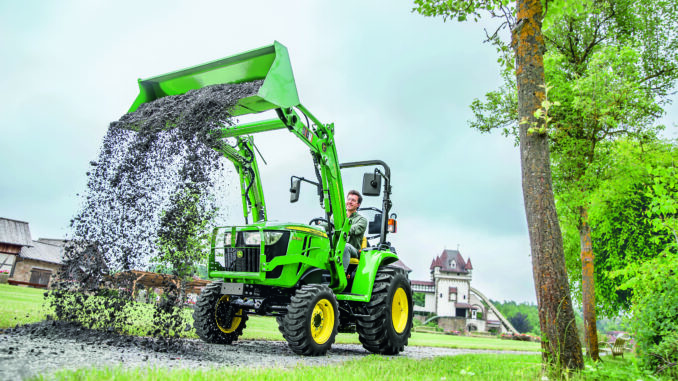
John Deere 3D Series Compact Tractor Models and Maintenance Guide
The John Deere 3D Series is a straightforward, gear-drive compact tractor range built for acreage owners, small farms, estates, equestrian properties, and users who want a durable utility tractor without the additional complexity of a hydrostatic transmission or premium cab-focused specification. These tractors are particularly suited to regular loader work, mowing, driveway maintenance, hauling, light cultivation, fencing jobs, snow work, and general property upkeep.
This page is a working hub for John Deere 3D Series model-specific guides, service information, repair references, and symptom-based troubleshooting articles. Use it alongside the General John Deere Compact Tractor Guide, which provides broader information on Deere’s compact tractor ranges, ownership considerations, attachments, and common operating systems.
The current North American 3D family consists of the 3025D, 3035D, and 3043D. Unlike the 3E and 3R ranges, the 3D tractors use a simple mechanical 8F/8R gear transmission, standard four-wheel drive, and an open operator station. The three models share a closely related platform but offer progressively more engine and PTO power for heavier implements and larger properties.deere+1
About the John Deere 3D Series Compact Tractor Series
John Deere positions the 3D Series as an economical, work-oriented part of its 3 Series compact tractor family. It fills the space between smaller sub-compact and compact machines in the 1 and 2 Series ranges and the more feature-rich 3E and 3R compact tractors. The 3D range is intended for owners who value mechanical simplicity, strong pulling ability, standard four-wheel drive, and a conventional gear transmission.
Across the current USA and Canada lineup, engine output runs from approximately 24.7 hp to 42.2 hp. The 3025D is the entry model, the 3035D adds useful PTO and engine power for heavier mowing and implement work, and the 3043D is the largest model, with a turbocharged three-cylinder diesel engine and roughly 36 hp available at the PTO.deere+2
These are full compact utility tractors rather than sub-compacts. They are substantially heavier and physically more capable than a 1 Series machine, with shipping weights broadly around 2,778 lb to 2,840 lb depending on model. Their common platform includes a roughly 62-inch wheelbase, Category 1 three-point hitch, rear PTO, open station, power steering, and standard mechanical four-wheel drive.deere+1
The principal transmission is an 8-forward/8-reverse synchronized-style gear-drive arrangement rather than a hydrostatic transmission. This makes the 3D Series attractive for tasks that involve steady travel speed, pulling, towing, grading, rotary cutting, or repeated field work. A gear tractor can be very durable and efficient when operated correctly, although it is generally less convenient than a hydrostatic model for frequent forward-reverse shuttle work around buildings, pallets, livestock areas, or tight landscaping.
The 3D Series is also deliberately simpler than Deere’s premium compact tractor offerings:
3D tractors can be paired with front loaders, rear-mounted finish mowers, rotary cutters, box blades, rear blades, landscape rakes, spreaders, tillers, snow equipment, and other Category 1 implements. John Deere also lists an available rear hydraulic remote kit with two independent hydraulic spools, allowing the use of attachments such as hydraulic-angle rear blades and certain snow-removal equipment.deere
John Deere 3D Series Compact Tractor Models
The following table is an across-time North American directory for known John Deere 3D Series compact tractors. Public John Deere lineup information identifies three core 3D models: the 3025D, 3035D, and 3043D. Unlike some older Deere tractor family names, the 3D designation appears to have remained a focused three-model range rather than a long-running sequence of numerous legacy numbered tractors. The models below should therefore form the principal index structure for USA and Canadian 3D Series content.deere+1
John Deere 3025D
The 3025D is the smallest tractor in the 3D range, but it is not a sub-compact. It provides a meaningful step up in chassis size, stability, ground clearance, towing ability, and implement capability compared with many lawn tractors and smaller compact machines.
John Deere lists the 3025D at approximately 24.7 engine hp and 20 PTO hp. It uses a four-wheel-drive platform, Category 1 three-point hitch, open station, and 8F/8R gear transmission. This makes it a practical option for owners who need a compact tractor primarily for field and property work rather than delicate lawn-only use.deere
Useful supporting content for this model can include:
-
3025D maintenance & troubleshooting guide
-
3025D service intervals and fluid capacities
-
3025D gear transmission operation guide
-
3025D loader problems and hydraulic checks
-
3025D PTO and three-point hitch troubleshooting
-
3025D buyer’s guide for used compact tractor shoppers
John Deere 3035D
The 3035D occupies the middle of the 3D Series range. Its additional engine and PTO power make it better suited to operators using larger rear implements, working tougher grass and brush, or managing a larger property where productivity matters more than the smallest possible footprint.
John Deere lists the 3035D at approximately 34.7 engine hp and 31 PTO hp. It retains the same basic 3D Series formula: open station, standard 4WD, Category 1 three-point hitch, power steering, and an 8-forward/8-reverse gear-drive transmission.deere+1
A 3035D may be particularly useful for regular rotary-cutting work, rear grading, loader use, larger finish mowers, and moderate ground-engaging tasks within the limitations of a compact tractor chassis.
Recommended supporting content can include:
-
3035D maintenance & troubleshooting guide
-
3035D problems and fixes overview
-
3035D engine oil, fuel filter, and air filter service
-
3035D hydraulic system troubleshooting
-
3035D clutch, gearshift, and driveline checks
-
3035D PTO implement-matching guide
John Deere 3043D
The 3043D is the largest and highest-powered 3D Series tractor. It is aimed at users who still want a simple gear-drive compact tractor but require stronger PTO output, more reserve power for cutting and hauling, and a better match for larger Category 1 implements.
John Deere lists the 3043D at approximately 42.2 engine hp and 36.3 PTO hp. It uses a three-cylinder, turbocharged Yanmar diesel engine, standard four-wheel drive, an open operator station, and a Category 1 three-point hitch. John Deere Canada lists an approximate open-station shipping weight of 2,840 lb.deere+1
The 3043D is often the most suitable 3D Series choice for demanding acreage maintenance, regular brush cutting, larger mowing decks, heavier rear-blade and box-blade work, frequent loader use, snow removal, and jobs where a smaller compact tractor would be operating near its practical limit.
Recommended supporting content can include:
-
3043D maintenance & troubleshooting guide
-
3043D buyer’s guide
-
3043D engine power loss and fuel-system diagnostics
-
3043D hydraulic and loader performance guide
-
3043D problems and fixes overview
-
3043D PTO, clutch, and drivetrain troubleshooting
3D Series Compact Tractor Maintenance Guides
The 3D Series is mechanically simple by modern compact-tractor standards, but it still depends on regular inspection, correct lubricants, clean fuel, clean air intake components, and careful use of the clutch, transmission, hydraulic system, PTO, and four-wheel-drive components.
Maintenance requirements can differ by serial number, emissions configuration, attachment setup, regional specification, and production year. Always verify capacities, service intervals, filter part numbers, and fluid specifications using the operator’s manual and the tractor’s serial number before ordering parts or carrying out major service work.
Routine Service and Checks
Routine service begins with daily or pre-use checks. Walk around the tractor before starting work, particularly if it is used with a loader, rotary cutter, rear implement, or trailer. Check engine oil level, coolant level only when the engine is cold, fuel supply, visible leaks, tire damage, wheel hardware, loader mounting points, hitch pins, PTO shields, and safety interlocks.
Engine oil and filter changes should follow the stated interval in the manual, but should also be considered sooner if the tractor operates in dusty, hot, wet, high-load, or short-trip conditions. A compact tractor that spends long periods idling, working in fine dust, or doing intermittent loader work can accumulate contamination and operating stress that is not obvious from the hour meter alone.
Air-filter service deserves special attention on rotary-cutting, mowing, tillage, and dry-lot work. Do not over-clean or damage the primary element, and inspect the intake ducting, dust-unloader valve, clamps, and airbox seal. A poorly seated air filter can cause far more serious engine damage than an overdue oil change.
Fuel-system maintenance should include using clean diesel, draining water where applicable, replacing fuel filters at the recommended interval, and investigating any signs of algae contamination, water in fuel, restricted flow, or air entering the fuel circuit. In cold weather, ensure that the seasonal diesel fuel is appropriate and that any approved anti-gel treatment is used correctly.
Useful internal maintenance targets for a 3D Series content hub include:
-
3D Series compact tractor service interval checklist
-
DIY maintenance for 3D Series compact tractors
-
John Deere 3D Series engine oil and filter change guide
-
John Deere 3D Series fuel, air-filter, and cooling-system maintenance
-
Hydraulic maintenance and leak diagnosis on 3D Series tractors
-
Loader and three-point hitch maintenance for 3D Series
Hydraulics, Loader, and 3-Point Hitch
The hydraulic system powers the three-point hitch and, on loader-equipped tractors, the loader lift and bucket functions. Hydraulic oil condition, correct reservoir level, hose integrity, clean couplers, and proper linkage adjustment all affect performance.
Before diagnosing a weak loader or slow three-point hitch, first confirm that the engine is at appropriate operating speed, the hydraulic oil level is correct, the oil is not excessively cold, and all quick couplers are fully connected. A partially seated coupler can restrict or block hydraulic flow, while contaminated oil or a restricted filter can cause sluggish or inconsistent operation.
Inspect loader pins, bushings, grease fittings, cylinder pivot points, hose routing, hose abrasion points, and loader-mounting hardware. Grease points should be lubricated at the interval appropriate to the workload; frequent loader users may need to grease more often than operators who only fit the loader occasionally.
For the three-point hitch, inspect lift-arm pins, stabilizers, sway control components, top-link threads, draft links, retaining clips, and implement connection points. Bent pins, worn balls, seized adjusters, or incorrectly adjusted stabilizers can make implement hookup difficult and cause excess movement or uneven implement operation.
The optional rear remote kit expands the kinds of hydraulic implements a 3D tractor can operate, but it also creates additional hoses, couplers, valve functions, and leak points to inspect. John Deere describes the kit as adding two independent rear hydraulic spools for compatible rear attachments.deere
Transmission and Drivetrain
The 3D Series uses an 8F/8R gear-drive transmission rather than a hydrostatic unit. That means routine transmission care should focus on correct clutch use, deliberate gear selection, proper shifting technique, linkage condition, lubricant level, and inspection of the driveline and four-wheel-drive components.
Avoid forcing the gear lever if a gear will not engage. Depress the clutch fully, let the driveline stop, select the appropriate range and gear, and investigate persistent resistance rather than applying excessive force. Problems that appear to be “bad gears” can sometimes result from incomplete clutch release, shift-linkage issues, low or incorrect transmission/hydraulic fluid, or driveline load.
Four-wheel drive is especially useful for loader work, hills, snow, soft ground, and pulling implements. However, avoid prolonged 4WD use on high-traction paved surfaces where driveline wind-up can occur. Check front axle housing, seals, driveshaft protection, steering joints, front tire condition, and the matched rolling circumference of front and rear tires.
A useful internal article is Transmission and driveline maintenance across 3D Series compact tractors. Model-specific posts can then cover issues such as 3025D hard shifting, 3035D clutch adjustment symptoms, or 3043D four-wheel-drive troubleshooting.
3D Series Compact Tractor Troubleshooting Guides
A good troubleshooting structure should begin with symptoms rather than assumptions. The same complaint—such as poor power, weak lift, or inability to move—can arise from a simple operating issue, a maintenance fault, an attachment mismatch, an adjustment problem, or a genuine mechanical failure.
For every diagnosis, start with safety. Park on level ground where possible, lower implements, set the parking brake, stop the engine before inspecting moving components, remove the key, and relieve hydraulic pressure before disconnecting hoses. Never work beneath unsupported loader arms or a raised implement.
Starting, Engine, and Fuel Problems
Common starting complaints on compact diesel tractors include slow cranking, no crank, crank-but-no-start, hard cold starting, stalling after starting, irregular idle, excessive smoke, and power loss under load. The correct diagnostic path depends on whether the engine is failing to turn over or turns over normally but does not start.
For a no-crank complaint, check the battery state, cable cleanliness, ground connection, starter circuit, ignition switch, neutral-start and PTO safety interlocks, clutch-pedal switch where fitted, and fuse condition. Battery-terminal corrosion or a weak ground cable can produce intermittent electrical symptoms that look more serious than they are.
For a crank-but-no-start complaint, look at fuel supply, fuel shutoff position, fuel quality, water contamination, filter restriction, air in the fuel system, and cold-start conditions. If the tractor recently ran out of fuel, had a filter changed, or was stored for a long period, it may require correct bleeding or priming procedures as specified in the operator’s manual.
Power loss under load may result from a clogged fuel filter, restricted air filter, contaminated fuel, an attachment that exceeds practical PTO capacity, dragging brakes, incorrect gear selection, or a more serious engine or emissions-system issue. The 3043D’s turbocharged engine also adds intake and turbocharger plumbing that should be checked for loose connections, damaged hoses, or restricted airflow.deere+1
Useful hub articles include:
-
3D Series compact tractor starting problems – diagnostics and fixes
-
Engine and fuel system issues across 3D Series models
-
John Deere 3D Series diesel fuel contamination symptoms
-
3025D, 3035D, and 3043D power-loss troubleshooting
Hydraulic and Loader Performance Issues
Slow hydraulics, weak lift, jerky movement, poor bucket curl, a loader that drifts down, or a three-point hitch that will not raise should be addressed methodically. Start with fluid level, oil temperature, engine rpm, hydraulic filter service status, quick-coupler engagement, external leaks, and whether the implement is within the tractor’s lifting and hydraulic capacity.
Hydraulic oil can be sluggish in cold conditions. Allowing the tractor to warm gradually at moderate engine speed can improve operation, but a persistent problem after warm-up needs further inspection. A system that remains slow after reaching operating temperature may have a restricted filter, air ingestion, internal leakage, valve issue, pump problem, or cylinder seal fault.
If a loader is weak only in one direction, compare the symptoms between lift, lower, curl, and dump functions. A fault affecting all functions may point toward fluid supply, pump performance, engine speed, or control-valve supply. A fault affecting one cylinder or one movement may instead suggest a coupler, hose, cylinder, valve spool, or attachment-related issue.
Avoid attempting to locate pinhole hydraulic leaks with bare hands. High-pressure hydraulic fluid can penetrate skin and requires emergency medical attention.
Useful internal articles include:
-
Hydraulic performance problems on 3D Series compact tractors
-
Loader will not lift or is slow on 3D Series models
-
Three-point hitch will not raise on John Deere 3D tractors
-
Diagnosing hydraulic leaks, couplers, and cylinder drift
Transmission, Drive, and PTO Problems
A tractor that will not move, moves only in certain gears, slips under load, has poor hill performance, or will not engage four-wheel drive needs a careful distinction between transmission, clutch, brake, linkage, and operating issues.
On a gear-drive 3D tractor, first verify the transmission range and gear selection, clutch operation, parking-brake release, 4WD selection where needed, and whether the tractor is overloaded for the chosen gear. A tractor that bogs heavily in too tall a gear may feel like it has a driveline problem when the solution is to select a lower gear and operate at the engine speed required for the task.
Signs that deserve closer investigation include repeated gear disengagement, grinding despite correct clutch use, inability to select gears, clutch slip under load, unusual driveline noise, front axle leaks, one-wheel spinning despite 4WD engagement, or vibration that changes with ground speed.
PTO complaints can include failure to engage, a PTO that disengages unexpectedly, abnormal noise, poor implement speed, or a shaft that continues turning after disengagement for longer than expected. Confirm correct PTO selection, safe implement connection, guard condition, driveline length, and whether the implement itself is seized or overloaded before condemning the tractor.
Useful hub articles include:
-
Drive and transmission problems on 3D Series compact tractors
-
PTO will not engage or drops out across 3D Series models
-
John Deere 3D Series clutch and gearshift troubleshooting
-
Four-wheel-drive and front-axle problem diagnosis for 3D tractors
Individual model articles can then direct readers to specific content, such as a 3025D hard-shifting guide, a 3035D PTO troubleshooting guide, or a 3043D loss-of-drive diagnostic checklist.
Attachments and Implements for the 3D Series Compact Tractor Series
The John Deere 3D Series is designed around practical attachment use. A front loader is often the most important accessory for property owners, allowing the tractor to move soil, gravel, mulch, firewood, feed, manure, snow, fence materials, and general debris. Rear implements expand the tractor’s usefulness for mowing, grading, levelling, driveway maintenance, pasture work, landscaping, and seasonal snow removal.
Typical 3D Series implements include:
-
Front-end loaders and compatible buckets
-
Pallet-fork frames and forks matched to loader capacity
-
Mid-mount or rear-mounted mowing equipment where applicable
-
Rear finish mowers
-
Rotary cutters and brush mowers
-
Box blades and rear grader blades
-
Landscape rakes and pulverizers
-
Post-hole diggers
-
Broadcast spreaders and sprayers
-
Tillers sized to PTO output and soil conditions
-
Rear-mounted snow blowers
-
Hydraulic-angle rear blades where rear remotes are fitted
-
Ballast boxes and wheel ballast for safer loader work
-
Trailers and drawbar-mounted equipment within rated towing limits
Compatibility should never be based on horsepower alone. Check the tractor’s three-point hitch category, practical lift capacity, PTO horsepower, PTO speed, implement weight, hydraulic requirements, rear-remote requirement, tire type, terrain, and the need for front or rear ballast.
The 3025D can handle many standard Category 1 implements, but it may reach practical limits sooner when operating a wide rotary cutter, large tiller, heavy snow blower, or ground-engaging attachment. The 3035D and 3043D offer more PTO reserve for larger mower decks, tougher grass, and more demanding rear equipment. The 3043D’s additional power is valuable, but implement width and weight must still match the compact tractor chassis, traction, stability, and three-point hitch capacity.deere+1
For safe loader work, counterbalance matters. A loaded bucket shifts substantial weight forward, reducing rear-wheel traction and increasing the risk of instability. Use an appropriately sized rear implement, ballast box, or other approved counterweight, keep the load low while travelling, avoid steep side slopes, and do not exceed the loader or tractor capacity.