
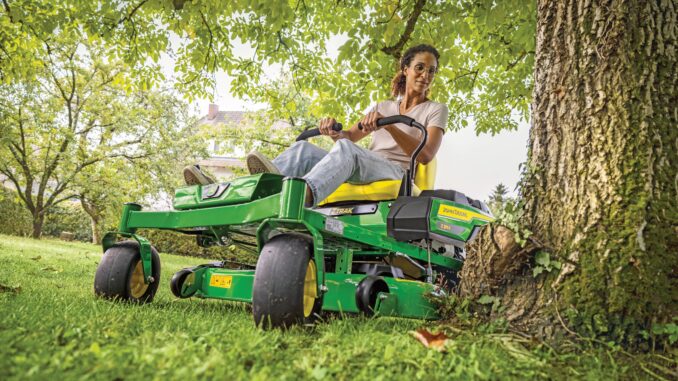
Most standard lawn tractors are designed for relatively gentle slopes and should not be taken much beyond about 10–15 degrees (roughly 17–26% grade) when operated in the conventional residential way.
However, purpose‑built “slope‑capable” lawn tractors and compact tractors can safely handle up to about 20–30 degrees (36–57% grade) if they are specifically engineered for it and you follow strict operating procedures.
1. Typical maximum slope for ordinary lawn tractors
Most owner’s manuals for residential lawn tractors and zero‑turn mowers state that you should avoid slopes steeper than 15 degrees (about 26% grade). Some manufacturers express this as a 1:4 or 1:3 incline ratio, meaning:
-
1:4 = 1 foot of rise for 4 feet of run → about 14°
-
1:3 = 1 foot of rise for 3 feet of run → about 18–19°
In practice, many “regular” lawn tractors will still move up and down slopes somewhat steeper than 15°, especially if traction is good and the operator is light‑footed. However, safety and stability drop sharply beyond those angles, and the risk of tipping or loss of traction increases dramatically.
For typical ride‑on mowers, guidelines often translate to:
-
≤10° (≈18%) – Comfortable, low‑risk operation.
-
10–15° (≈18–26%) – Operable if you follow best practices.
-
>15° – Often considered “too steep” for standard lawn tractors.
2. Slope‑oriented lawn tractors and compact tractors
Some manufacturers produce units explicitly marketed for slopes, and these can handle up to 20–25° or more. For example:
-
Cub Cadet “slope‑suitable” lawn tractors quote safe gradients up to around 25° or more when equipped with all‑wheel drive and traction‑oriented tires.
-
Ventrac 4500 lists 20° slope mowing capacity, and up to 30° hillside operation when fitted with a dual‑wheel kit.
-
Some commercial or specialty tractors (often 2‑wheel‑drive with wide stance or dual wheels) are rated for up to roughly 25–30° under ideal conditions.
These higher limits come with caveats:
-
Dual‑wheel kits or wide‑stance setups significantly increase stability.
-
Engine and transmission design must cope with oiling and cooling on steep angles.
-
Manufacturer instructions usually require short working periods at maximum slope (for example, 10 minutes at 30° then returning to flatter ground to cool the engine).
3. How slope is measured: degrees vs. percent grade
Manufacturers and safety guides often mix degrees and percent grade, which can be confusing. Here’s how they relate:
For many manuals, 15° or about 1:4 (≈25%) is the practical “ceiling” for ordinary lawn tractors, while 1:3 (≈1:3, ≈18°) is often treated as the absolute upper limit. Beyond that, you are effectively in compact‑tractor or slope‑specific territory.
4. Why slope matters: stability, tipping, and traction
There are three main problems when you climb steep slopes with a lawn tractor:
-
Tipping risk
-
A lawn tractor is essentially a narrow, tall chassis with a heavy deck hanging low.
-
As the angle increases, the center of gravity moves toward the downhill side, raising the risk of rolling sideways if you ever cut across the slope.
-
Side‑slope stability is always worse than climbing straight up or down, which is why manuals insist on only going up and down the fall line, never across.
-
-
Loss of traction
-
On steep ground, weight shifts. On a rear‑drive tractor climbing a hill, front‑wheel weight drops, reducing steering control but also reducing the chance of rear‑wheel wheel‑spin.
-
On a downgrade, the rear wheels must work harder to brake the machine, increasing the chance of skidding if the drive tires are worn or the grass is slick.
-
-
Engine and transmission limits
-
Engines with “pressure” or “forced feed” lubrication can keep the internals oiled on an incline, but exceeding the rated slope can cause oil starvation in the lubrication system.
-
Continuously operating at maximum angle (e.g., 30° on a Ventrac) for long periods can cause overheating and mechanical stress, which is why manufacturers often recommend limited time at the steepest angle.
-
5. Factors that raise or lower the safe slope limit
Even if two lawn tractors are rated for the same degree, the real‑world safe slope can vary widely depending on setup and conditions.
Design and setup
-
Drive type
-
Rear‑wheel drive: Works well on modest slopes, but lateral grip is limited.
-
Four‑wheel or all‑wheel drive: Greatly improves traction and usable slope because all four wheels can help pull and brake.
-
-
Wheelbase and stance
-
Wider wheelbase or dual‑wheel kits increase rollover resistance and can push the effective safe slope from ~15° toward 20–25° or more.
-
-
Weight and ballast
-
Adding rear ballast (per the manual) lowers the center of gravity and improves climbing traction.
-
Too much weight, however, can make the machine harder to steer and more prone to sliding if the brakes are marginal.
-
Tires and tires
-
Tread pattern
-
“AS”‑style or aggressively lugged tires are designed for slopes and can handle 20–25° gradients where slick or worn tires might slide at 15°.
-
-
Snow chains
-
Chains can help on very steep or slippery slopes, but they destroy lawns and are usually only appropriate on utility or rough‑terrain tractors, not show‑lawn mowers.
-
Ground and weather conditions
-
Wet grass or mud reduces traction and can make a 15° slope feel like 20°.
-
Dry, hard soil with good grip can let a capable machine handle near‑maximum rated angles, provided the operator is smooth on the controls.
-
Loose stones, roots, or holes dramatically increase the risk of knocking the machine off‑balance and triggering a rollover.
6. Best practices for operating on slopes
If you must run a lawn tractor on a hill, following these rules dramatically reduces your risk, even when you stay within the manufacturer’s stated slope limit.
-
Always travel up and down, never across the fall line
-
Moving straight up or down keeps the center of gravity between the wheels and minimizes rollover risk.
-
Turning across the slope is one of the most common causes of tipping.
-
-
Clear the slope before you start
-
Walk the area and remove rocks, sticks, and filled‑in animal holes so the tractor doesn’t suddenly dip or jolt on a steep section.
-
-
Use slow, steady speeds
-
Aggressive acceleration or braking can unweight the wheels or cause skids.
-
Smooth inputs give the tires a better chance to maintain grip.
-
-
Avoid starting, stopping, or turning on the steepest part
-
Do all sharp maneuvers on the flattest available ground at the top or bottom of the slope.
-
If you must stop, choose the least steep section and keep the deck raised if traction is borderline.
-
-
Stay off the slope in low light or poor visibility
-
Dusk, early morning, or shaded areas make it harder to see holes and changes in grade, increasing the chance of a sudden loss of stability.
-
-
Respect the manufacturer’s limits
-
If your manual says “maximum slope 15°,” treat that as a hard rule, not a theoretical maximum you can “feel your way beyond.”
-
Specialty tractors may have higher limits, but those are only valid when the machine is set up exactly as specified (dual wheels, correct tires, etc.).
-
7. When to choose a different tool instead of pushing a lawn tractor
Some slopes are simply too steep or too dangerous for any riding mower. In those cases, safer alternatives include:
-
Walk‑behind lawn mowers
-
Designed for steeper terrain than many ride‑ons, often rated up to about 17–25° depending on model.
-
The operator is on the ground, so the risk and severity of a rollover are much lower.
-
-
Lawn trimmers and brush cutters
-
For very steep or rocky sections, a walk‑behind rotary mower or heavy‑duty trimmer can finish the edges where the tractor cannot safely go.
-
-
Robotic lawn mowers
-
Many modern robotic mowers are rated for up to about 45° or 50% grade, depending on model and traction.
-
They are ideal for uniform, moderately steep slopes where you do not need rapid cutting but want consistent coverage.
-
-
Special slope‑specific tractors or mowers
-
Some compact tractors or slope‑mowing machines (e.g., hillside‑specific units) are built specifically for 25–30° terrain and incorporate ROPS, wide stance, and slope‑sensors.
-
8. Practical takeaway for your property
Putting this all together:
-
For a typical residential lawn tractor (RWD, 22–42″ deck) aim to keep working slopes under 10–15° (≈18–26% grade) and always mow up and down, not across.
-
For lawn tractors or compact tractors explicitly rated for slopes (4WD, dual‑wheel kits, slope sensors) you may safely work on up to 20–25°; in rare cases, up to 30° under strict operating conditions.
-
Beyond about 25–30°, you enter territory where non‑riding tools (walk‑behind mowers, trimmers, or robotic mowers) become the safer and often more practical choice.
How to measure slope degrees on my lawn
1. Understand slope in degrees vs. percent
-
Percent grade = (rise/run)×100.
-
Degrees = tan−1(rise/run).
For example:
-
Rise 30 cm over 150 cm run → 20% grade → about 11°.
-
A 1:4 slope (1 up in 4 along) ≈ 14°.
You can use an online slope‑to‑degrees calculator once you know “rise over run.”
2. Method 1 – String and stakes (manual measurement)
You need
-
Two wooden stakes (or tall metal rods).
-
String or thin rope.
-
A small line level (or any small spirit level).
-
A tape measure or retractable measuring tape.
Steps
-
Pick two points along the slope
-
One at the top of the section, one at the bottom, in a straight line with the fall of the land.
-
Mark them with stakes driven into the ground.
-
-
Tie string between the stakes
-
Tie the string to the top stake so it passes just above the ground.
-
Pull the string tight to the bottom stake and loosely tie it for now.
-
-
Level the string
-
Place a line level on the taut string.
-
Adjust the string on the lower stake up or down until the bubble is centered (the string is level).
-
Mark where the string meets the lower stake after leveling.
-
-
Measure the run (horizontal distance)
-
Measure along the ground from the top stake to the bottom stake (or along the level string if you measured that distance).
-
Call this run.
-
-
Measure the rise (vertical height difference)
-
Measure from the ground at the bottom stake up to the marked level‑string height on that stake.
-
This is the rise.
-
-
Calculate percent grade, then degrees
-
Percent grade = (rise/run)×100.
-
Degrees = tan−1(rise/run).
-
You can plug your rise/run into an online calculator or use a scientific calculator phone app to get degrees.
3. Method 2 – Simple 1‑m or 3‑ft rule (quick estimate)
If you want a rough check without leveling string:
-
Place two stakes 1 m (or 3 ft) apart, aligned with the fall.
-
Measure the vertical drop from the ground at the top stake to where a level string would be over the bottom stake (or use a ruler held vertically).
-
Percent grade = (drop in cm)/100 × 100 (for 1 m distance).
-
Example: 15 cm drop over 1 m → 15% grade ≈ 8.5°.
-
Repeat along different parts of the lawn to see where the slope is steepest.
4. Method 3 – Using a smartphone app
Many phones have built‑in level/slope apps that show incline in degrees directly:
-
Open a level, inclinometer, or slope app (e.g., “Angleometer”, “Clinometer”, or generic “level” in your phone’s tools).
-
Place the phone on a straight board laid across the slope so it reflects the ground angle.
-
Read the angle shown in degrees.
This method is quick and good for checking several spots around your lawn, though it can be less precise than the string method if the board is short.
5. Practical tips for your lawn
-
Test multiple sections
-
A lawn can have gentle slopes in some areas and much steeper patches elsewhere.
-
Always check the steepest section you plan to mow.
-
-
Match the slope to your equipment
-
Residential lawn tractors are usually safe only up to about 10–15° (≈18–26%).
-
If your measurement is above 15°, you should either
-
Use a walk‑behind mower or trimmer on that section, or
-
Choose a tractor or mower specifically rated for slopes.
-
-
Safety tips for mowing steep hills with tractor
1. Know your slope and your tractor’s limits
-
Measure the slope (in degrees or percent grade) using a string‑level method or a phone app.
-
Respect the manufacturer’s maximum slope rating (often 10–15° for standard lawn tractors; 20–25°+ for slope‑rated compact tractors).
-
If the slope is steeper than the rating, use a walk‑behind mower, trimmer, or robot mower instead.
2. Inspect the hill before starting
-
Walk the area and fill in holes, level ruts, and remove rocks, sticks, and animal burrows that could trip the tractor.
-
Check for soft or wet soil, roots, or loose debris that can reduce traction or cause the tractor to slide.
-
Look for drop‑offs or edges and mark them clearly so you never creep too close while mowing.
3. Set up the tractor correctly
-
Use low‑range gears and keep engine RPMs high enough to maintain traction but avoid sudden acceleration.
-
If your tractor has a dual‑wheel kit or wider stance, install it exactly as the manual specifies for slopes.
-
Ensure brakes are fully functional and that there are no fluid leaks or steering issues.
-
Keep the mower deck raised slightly higher on steep sections to reduce pull and prevent the tractor from “hanging up” on dips.
4. How to drive on the slope
For riding lawn tractors and compact tractors on slopes:
-
Always travel straight up and down the fall line, not across.
-
Going up is generally safer; going down in reverse (with the attachment lowered) can give better traction and stability on very steep slopes, but keep the speed very low.
-
Avoid sharp turns, rapid speed changes, or sudden stops while on the steepest part of the slope.
Key rules:
-
Start, stop, and turn on the flattest available ground, not on the steepest section.
-
Never mow across the slope with a riding mower or tractor; this dramatically increases the risk of tipping.
-
If you need to stop on the hill, keep the tractor facing directly up or down and apply the parking brake.
5. Reduce risk from traction and skidding
-
Use appropriate tires or chains (if allowed) for the surface and slope; avoid overly worn tires on steep banks.
-
On wet or slick grass, avoid mowing the steepest sections; wait until the surface is drier.
-
If you feel the tractor starting to slide or lose traction, ease off the throttle and let it slow down gradually; do not lock the brakes suddenly.
6. Personal safety and mindset
-
Wear proper footwear, high‑visibility clothing, and no loose gear that could catch on levers.
-
Assume that any slope can become dangerous if you rush, get distracted, or try to mow too quickly.
-
If you are uncomfortable, unsure of the slope, or the ground feels unstable, stop and reassess; better to do a second pass or finish the area by hand.
7. When to avoid mowing on steep hills altogether
Some situations are not worth the risk, even with a capable tractor:
-
Slopes steeper than the tractor’s rated angle, especially if traction is poor.
-
Very narrow terraces or edges close to drop‑offs, ditches, or embankments.
-
Wet, muddy, or recently frozen ground that can suddenly give way.
In those cases, use a walk‑behind mower, brush cutter, or remote‑controlled/slope‑specific mower for the steep bits and keep the tractor for the gentler areas.
Common accidents when mowing steep hills and how to prevent
1. Rollovers and tip‑overs
How it happens
-
Tractors and lawn mowers roll sideways when mowing across a slope, hitting a hole, or making a sharp turn on a steep section.
-
Backing down steep slopes, especially improperly, can cause the tractor to “sit” on the rear wheels and flip backward.
How to prevent
-
Always mow straight up and down the fall line, never across.
-
Avoid sharp turns or sudden stops on the steepest part of the hill; turn at the top or bottom where the ground is flatter.
-
If backing is necessary, keep the attachment low for stability, use low speed, and keep the tractor pointed directly up or down the slope.
2. Skidding, sliding, and runaways
How it happens
-
On wet, muddy, or loose ground, the tractor can lose traction and start sliding downhill, especially during braking or when the load shifts.
-
Rough or potholed terrain on a slope can cause a wheel to drop suddenly, leading to a失控 (“runaway”) situation.
How to prevent
-
Avoid mowing steep slopes when the ground is wet, muddy, or icy.
-
Walk the slope first to fill holes, level ruts, and remove loose rocks or roots.
-
Use low range gears, keep engine RPM high, and brake gently, not abruptly.
3. Blade‑contact and thrown‑object injuries
How it happens
-
On a steep slope, the operator is more likely to slip or lose footing when getting on/off the mower or walking near the blades, especially if the mower is running.
-
Rocks, sticks, or debris roll down the slope into the mower and are thrown at high speed, injuring the operator or bystanders.
How to prevent
-
Always stop the engine and disengage the blades before getting off, even for a short inspection.
-
Wear closed‑toe shoes, eye protection, and hearing protection; keep bystanders and children well away from the work area.
-
Walk the slope before mowing to pick up stones, branches, and other debris.
4. Over‑estimating the slope or the machine
How it happens
-
Many accidents occur on slopes steeper than the owner believes, or when the operator ignores the manufacturer’s stated maximum grade (often around 15–27% / 8–15° for riding mowers).
-
Driving too fast, hauling extra attachments, or running with worn tires or weak brakes on slopes increases the risk of a catastrophic failure.
How to prevent
-
Measure the slope (rise/run) and convert to percent grade or degrees; if it exceeds the manual’s limit, switch to a walk‑behind mower or a slope‑rated machine.
-
Service the tractor regularly: check brakes, tires, steering, and ballast; keep the center of gravity low with proper weight distribution.
-
If you feel uncomfortable, rushed, or fatigued, stop and reassess; do not try to “push through” a marginal slope.
5. Edge‑and‑embankment‑related accidents
How it happens
-
Tractors and mowers easily roll over the edge of ditches, drop‑offs, steep embankments, or near waterways when the operator gets too close while trying to get a clean cut.
-
Running along narrow terrace edges increases the chance that one wheel will hang over and cause an overturn.
How to prevent
-
Keep a safe margin (often 1–2 meters / 3–6 feet) from drop‑offs, ditches, and water edges.
-
Use a walk‑behind mower or trimmer to finish the edge instead of risking the tractor on the brink.
-
Never ride passengers on the tractor or mower; extra weight near the edge greatly increases rollover risk.
Quick safety checklist for steep‑slope mowing
-
Slope within the manufacturer’s rated angle or percent grade.
-
Always travel up and down the slope, never across.
-
Clear obstacles, fill holes, and remove debris from the slope.
-
Use low speed, low gear, and smooth controls.
-
Keep brakes and tires in good condition and add ballast if appropriate.
-
Wear proper PPE and keep people and children away.
-
If in doubt, stop and use a safer machine (walk‑behind, trimmer, or robot).