Kubota RTV Snow Removal: Models, Snowblowers, Parts, and Repairs
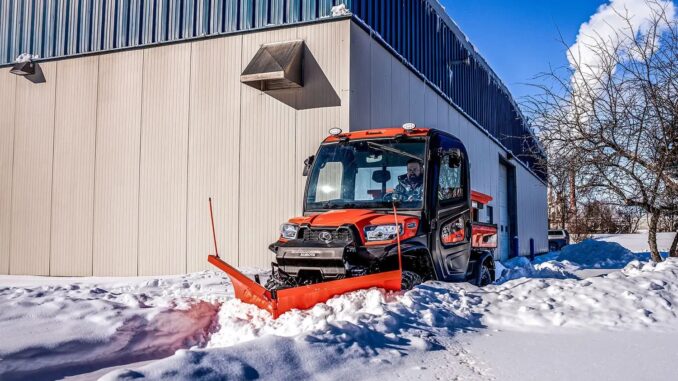
Kubota RTV utility vehicles can handle snow removal with an approved plow, spreader, or—in selected configurations—a powered front snowblower. The correct equipment depends on the exact RTV model, mounting system, attachment drive, suspension requirements, electrical supply, and operating limits.
For owners, compatibility is the most important starting point. A snowblower listed for an RTV-X CAB does not automatically fit an RTV520, Sidekick, original RTV900, or RTV-X CREW. Kubota also uses different generations of quick hitches, hydraulic equipment, and PTO K-Connect components, which must be identified separately.kubotausa
This guide covers the principal current and legacy US RTV models, explains the main snow-removal systems, and focuses on replacement parts, repairs, troubleshooting, and used-equipment inspections.
Kubota RTV Models: Current and Legacy US Vehicles
The RTV name covers several mechanically different vehicle families. Some use gasoline engines and belt-type transmissions; others use gasoline or diesel engines with hydrostatic drive.
Do not apply diesel, coolant, transmission, or attachment advice across the entire range without checking the individual model.
Current US RTV families
| Model or marketed family | Engine and drive arrangement | Main snow-removal consideration |
|---|---|---|
| RTV520 | Liquid-cooled gasoline engine with VHT hydrostatic transmission | Use attachments specifically approved for this smaller vehicle |
| RTV-XG850 Sidekick | Gasoline utility vehicle; distinct from the diesel RTV-X family | Verify Sidekick-specific mounting and operating requirements |
| RTV-X | Diesel work utility vehicle with VHT-X transmission | Match attachment package to the exact vehicle configuration |
| RTV-X CAB | Diesel VHT-X vehicle with factory enclosed cab | Verify hitch, PTO or hydraulic equipment, suspension, and attachment application |
| RTV-X CREW | Diesel vehicle with convertible passenger and cargo arrangement | Payload changes with seating configuration; verify attachment approval |
| RTV-X LONG BED | Diesel long-bed work vehicle | Check long-bed-specific mounting and accessory applications |
Kubota’s current US utility-vehicle lineup distinguishes the RTV520, Sidekick, and full-size diesel RTV-X families. Its current diesel range includes RTV-X, CAB, CREW, and LONG BED versions.kubotausa+3
Legacy and earlier US RTV models
| Model family | Important model names and designations | Parts and repair priority |
|---|---|---|
| Compact gasoline | RTV400Ci | Air-cooled engine and CVT; do not apply RTV500 hydrostatic procedures |
| Compact gasoline | RTV500 | Liquid-cooled gasoline engine and VHT transmission |
| Original full-size diesel | RTV900, including RTV900XT configurations | Identify full model, production version, and attachment mounting |
| Original factory-cab diesel | RTV1100 | Do not confuse with RTV-X1100C |
| Original convertible passenger/cargo diesel | RTV1140CPX | Verify passenger configuration, payload, mounting, and driveline |
| Earlier RTV-X diesel | RTV-X900 | Separate application from the original RTV900 |
| Earlier higher-output RTV-X | RTV-X1120D and RTV-X1120 designations | Preserve the full identification used on the machine and catalog |
| Earlier factory-cab RTV-X | RTV-X1100C | Important established application for PTO K-Connect snow equipment |
| Earlier convertible RTV-X | RTV-X1140 | Do not assume all CREW parts or accessories interchange |
| Earlier long-bed RTV-X | RTV-X1130 | Verify exact application rather than ordering by the newer LONG BED name |
Kubota’s older brochures, accessory catalogs, and operator-manual listings identify these earlier gasoline and diesel vehicles separately. The original RTV900, RTV1100, and RTV1140CPX are not simply alternate names for their later X-Series counterparts.shop.kubotausa+4
Names, trim levels, and production changes
Orange, camouflage, worksite, recreational, and other package names do not always identify a different mechanical base model. However, a package can change tires, suspension equipment, guards, electrical accessories, and mounting provisions.
Record the complete model and serial number from the vehicle. Do not order a steering, brake, suspension, or attachment part using “RTV900 orange model” as the only description.
Later CAB, CREW, and LONG BED names also should not be treated as proof that every component matches an earlier X1100C, X1140, or X1130.
Check Safety Recalls Before Winter Work
Owners should have a Kubota dealer check the vehicle’s complete serial number for open safety recalls before installing or using snow equipment.
A May 1, 2025 US recall covered specified serial ranges of the RTV520, RTV-X1120, RTV-X1130, RTV-X1140, RTV-X, RTV-X900, and RTV-X1100C. The reported hazard involved a front suspension ball joint that could loosen and separate, creating a crash risk.cpsc
For affected vehicles, the CPSC instruction is to stop using the vehicle and contact an authorized Kubota dealer for a free inspection and repair. This is not a routine owner adjustment or a reason to tighten suspension hardware without the recall procedure.cpsc
Recall status matters especially when buying a used RTV, where service history may be incomplete.
Identify the Complete RTV Snow-Removal System
A winter attachment installation can include components from several separate parts catalogs.
Record these identification details
Keep a permanent record of:
-
Vehicle model and serial number.
-
Engine identification.
-
Snowblower or plow model.
-
Attachment serial number.
-
Front hitch model and revision.
-
PTO K-Connect model and revision.
-
Auxiliary hydraulic pump, where fitted.
-
Valve and control-kit identification.
-
Suspension upgrade components.
-
Spreader model and controller.
-
Cab or enclosure equipment.
Photograph the complete installation before dismantling it, including wiring, couplers, hoses, guards, shafts, and mounting brackets.
Keep the appropriate manuals together
| Document | What it helps establish |
|---|---|
| RTV operator’s manual | Safe operation, payload, towing, fluids, and routine maintenance |
| RTV workshop manual | Diagnosis, measurements, and vehicle repair procedures |
| Attachment operator’s manual | Snowblower, plow, broom, or spreader operation and maintenance |
| Illustrated parts catalog | Component identification and serial applicability |
| Hitch installation instructions | Mounting, locks, hardware, and vehicle application |
| PTO or hydraulic-kit instructions | Drive components, routing, guards, and setup |
| Controller instructions | Wiring, fuses, switches, and accessory diagnosis |
An exploded parts diagram is not a complete repair procedure. It may not explain bearing fits, shaft alignment, hydraulic testing, or safe release of spring tension.
Kubota RTV Snowblowers and PTO K-Connect
The best-known factory RTV snowblower arrangement uses Kubota’s dedicated front hitch and PTO K-Connect equipment.
It is not a conventional tractor rear PTO, nor does a cargo-bed hydraulic outlet automatically provide the correct power for a snowblower.
V5296 commercial snowblower
Kubota identifies the V5296 as a 66-inch PTO-driven, two-stage commercial snowblower with hydraulic chute rotation and deflection. Its published equipment includes skid shoes and drift cutters.kubotausa
The listed installation requires:
-
An appropriate four-point K-Connect system.
-
The applicable PTO Drive K-Connect.
-
The specified heavy-duty front strut or spring equipment.
-
Correct vehicle-specific installation components.
These requirements must be checked against the exact vehicle and current instructions.kubotausa
V5293 and V5299 revisions
Kubota’s accessory information includes V5293-family four-point hitches and V5299-family PTO drive systems, including revised suffixes.
Do not delete the suffix when ordering parts. The same accessory page explicitly distinguishes compatibility between different hitch and PTO revisions for other powered attachments, demonstrating why “K-Connect” alone is not a complete identification.kubotausa
Older RTV-X1100C installations
Kubota’s dedicated RTV-X1100C PTO K-Connect literature documents snowblower and sweeper applications. This makes the X1100C an important used-equipment application, but it does not establish fitment to every earlier or later RTV.kubotausa
When buying a used package, identify the vehicle it came from and obtain an inventory of every tractor-side—or, in this case, vehicle-side—component.
What a complete used snowblower package should include
Ask for:
-
Snowblower.
-
Four-point hitch.
-
PTO drive system.
-
Connecting shafts and guards.
-
Mounting brackets.
-
Controls and wiring.
-
Hydraulic hoses and couplers.
-
Required suspension components.
-
Installation hardware.
-
Manuals.
A blower body without the correct drive package may be an expensive project rather than a bargain.
RTV Snowblower Parts and Repairs
Skid shoes and cutting edge
Inspect for uneven wear, loose fasteners, worn-through material, and distorted brackets.
Set working clearance for the surface according to the attachment manual. Gravel needs particular care because loose stones can enter the blower and become projectiles.
Kubota lists the V5297 plastic cutting-edge and skid-shoe package for the V5296. Confirm the actual attachment and current part application before ordering.kubotausa
Auger and impeller
With the engine stopped, key removed, power isolated, and all motion stopped, inspect:
-
Bent auger flights.
-
Cracked welds.
-
Loose hardware.
-
Wrapped debris.
-
Housing contact.
-
Damaged impeller blades.
-
Abnormal shaft movement.
Never reach into the auger, impeller, or chute. Stored mechanical energy can move components after power is disconnected.
Stop using the blower if unexplained vibration develops.
Shear protection
Use only the specified protective fasteners at the locations identified in the attachment manual.
Do not install stronger bolts to stop repeated failures. Incorrect hardware can defeat the protection system or damage mounting holes.
Keep approved spares labeled separately from general workshop bolts.
Bearings, shafts, and gearboxes
Inspect for loose supports, damaged seals, corrosion, shaft movement, lubricant leakage, and abnormal noise.
A failed bearing can result from a bent shaft, misalignment, or water entry. Replacing the bearing alone may leave the cause unresolved.
Internal gearbox work and shaft replacement may require pullers, a press, alignment checks, and model-specific service information.
PTO Drive and Hydraulic Repairs
PTO drive inspection
Inspect accessible:
-
Shaft connections.
-
Universal joints.
-
Support bearings.
-
Guards.
-
Retaining components.
-
Mounts.
-
Drive components identified in the kit instructions.
Do not operate exposed rotating equipment to see where motion stops.
Any drive-belt procedure must match the installed PTO kit. Do not apply a Sidekick transmission-belt procedure to a K-Connect attachment drive.
Independent hydraulics versus vehicle hydraulics
Some RTV attachments use an independent power unit; others require a vehicle-specific auxiliary pump and valves.
Kubota lists different auxiliary pump applications for X900, X1120/X1100, and X1130/X1140-type vehicles. A matching coupler does not establish correct hydraulic compatibility.kubotausa
Cargo-bed couplers are not universal attachment power
Kubota specifically describes its V5276 hydraulic coupler outlet as intended for stationary applications and states that it cannot power hydraulic motor applications.kubotausa
Do not connect a hydraulic snowblower or broom to an outlet merely because the fittings match.
Slow or weak hydraulic functions
Check approved routine items first:
-
Correct connections.
-
Fully seated couplers.
-
Fluid level.
-
Cold-weather warm-up.
-
Accessible hose damage.
-
Mechanical obstruction.
Never locate a hydraulic leak with bare hands. Pressure testing and internal valve or pump repair require suitable tools and training.
Kubota RTV Snow Plows: Models and Repair Priorities
Plows are often more practical than snowblowers where snow can be pushed into a safe storage area.
Important factory blade families
| Attachment | Published description | Installation distinction |
|---|---|---|
| V5008 | 72-inch general-duty blade | Electric lift and manual angle; specified guard and suspension requirements |
| V5060 | 72-inch heavy-duty blade | Self-contained electro-hydraulic lift and angle |
| V5290 | 72-inch commercial straight blade | V5289 quick hitch and specified hydraulic equipment |
| V5291 | 72-inch V-plow | V5289 quick hitch and additional hydraulic control requirements |
| V5294A | 78-inch K-Connect straight blade | Four-point K-Connect application |
| V5295A | 78-inch K-Connect V-blade | Four-point K-Connect application |
These are distinct installation families. A V5289 quick-hitch package should not be assumed equivalent to a V5293-family K-Connect system.kubotausa
Blade wear parts
Inspect:
-
Cutting edges.
-
Skid shoes.
-
Pivot pins.
-
Retainers.
-
Hinge points.
-
Hydraulic cylinders.
-
Hoses.
-
Trip mechanisms.
-
Mounting hardware.
Kubota lists separate shoes, curb guards, and alternative cutting edges for particular blade models. Match replacements by attachment model rather than blade width alone.kubotausa
Trip springs and V-plow mechanisms
Do not adjust loaded springs or disassemble trip mechanisms without the approved procedure.
Repeated tripping may result from hidden obstacles, incorrect setup, or excessive operating speed. Locking out the protection system is not a repair.
Winch-lift aftermarket blades
A winch-lift blade requires a verified vehicle mount, appropriate winch, correct line routing, and a complete approved installation.
Inspect the line, fairlead, hook, switches, and mounts. Never work beneath a blade supported only by the winch.
Spreaders, Brooms, and Ice-Control Equipment
Kubota spreader families
Kubota lists several RTV spreader options, including:
-
V5002-A rock salt spreader.
-
V5003-A tailgate spreader.
-
V5005 cargo-box spreader.
-
V5004 drop spreader.
Their mounting, material capacity, controllers, and applications differ.kubotausa
Payload matters more than hopper volume
Count the weight of:
-
Spreader.
-
Material.
-
Occupants.
-
Cab accessories.
-
Other cargo.
-
Any additional approved ballast.
CREW-type vehicles have different cargo limits depending on seating configuration. Kubota’s CREW literature explicitly distinguishes the one-row and two-row arrangements.kubotausa
Do not fill a hopper to its nominal volume without checking total vehicle and axle limits.
Spreader repairs
With power isolated, inspect:
-
Spinner.
-
Feed mechanism.
-
Bearings.
-
Motor and gearbox.
-
Wiring.
-
Controller.
-
Fuse protection.
-
Corrosion.
-
Material bridging.
Do not reach into a powered hopper or bypass a controller to force a stalled motor.
Rotary brooms
Kubota lists both a 60-inch hydraulically powered broom arrangement and a 66-inch PTO K-Connect broom.
These require different power and mounting equipment. The hydraulic arrangement includes additional pump, valve, cooler, and throttle requirements.kubotausa
Gasoline and Diesel RTV Maintenance Must Stay Separate
RTV400Ci: air-cooled gasoline and CVT
The RTV400Ci uses an air-cooled gasoline engine and CVT Plus transmission.
Keep cooling air passages clear. Do not add coolant procedures intended for an RTV500 or diesel RTV. Its transmission diagnosis also differs from the hydrostatic models.kubotausa
RTV500 and RTV520: liquid-cooled gasoline and VHT
The RTV500 uses a liquid-cooled gasoline engine and hydrostatic transmission. The RTV520 also combines a liquid-cooled gasoline engine with VHT.kubotausa+1
Check the specified spark plugs, fuel system, coolant, and transmission service items. Diesel additives and diesel starting procedures do not apply.
Sidekick: separate gasoline platform
Identify the full Sidekick model and use its own service information.
Do not apply diesel RTV-X transmission or PTO instructions simply because the vehicle carries RTV branding.
Diesel RTVs
Use clean winter-suitable diesel and inspect the water separator as instructed.
No. 2 diesel generally offers greater energy content, while approved winter blends and No. 1 diesel can improve severe-cold flow.
Use approved anti-gel before cold-flow problems develop. Never add gasoline, alcohol, or unapproved solvents.
Batteries, Electrical Accessories, and Cab Repairs
Snow work can combine lights, wipers, heaters, spreaders, and attachment controls.
Charging-system checks
Inspect terminals, grounds, cables, connectors, and accessory wiring.
A battery that repeatedly goes flat may have a charging problem, parasitic drain, poor connection, or excessive accessory demand. A larger battery does not automatically correct the cause.
Never increase fuse ratings to compensate for repeated failures.
Cab heat and defrost
The RTV-X CAB has factory heat, air conditioning, and defrost. Earlier and aftermarket enclosures vary.kubotausa
Check airflow, controls, seals, wipers, and coolant condition where applicable.
Refrigerant work, serious coolant contamination, and persistent electrical faults require qualified service.
Tires, Chains, Suspension, and Ballast
Check tire size, load rating, pressure, and condition using the vehicle instructions.
Before fitting chains, verify clearance around suspension, brake hoses, steering components, and bodywork through the permitted movement.
Four-wheel drive does not prevent sliding or eliminate increased stopping distance.
Do not use cargo-bed ballast as a substitute for a required front suspension kit. Conversely, heavy-duty springs do not increase the vehicle’s published payload or axle limits.
Troubleshooting RTV Snow-Removal Problems
| Symptom | Likely causes | Safe first checks | Professional service needed |
|---|---|---|---|
| Plow will not lift | Electrical supply, coupler, hydraulic, or mechanical fault | Check approved connections, fuse, and obstruction | Pump, valve, wiring, or structural fault |
| Blade angles slowly | Cold fluid, low level, coupler issue, binding | Warm correctly and inspect routine items | Persistent weak response or leakage |
| Blower does not turn | Drive connection, protection, PTO-kit fault | Isolate power and inspect manual-listed parts | Internal drive or gearbox fault |
| Weak discharge | Excess feed, blockage, drive problem | Reduce speed and review instructions | Persistent weakness or abnormal noise |
| Repeated shear failure | Obstacles, wrong hardware, binding | Verify parts and inspect | Continued unexplained failure |
| Strong vibration | Debris, bent components, bearings | Stop immediately | Rotating-assembly damage |
| Spreader stops | Bridging, fuse, wiring, motor overload | Isolate power and inspect | Motor, controller, or recurring electrical fault |
| RTV loses drive | Incorrect range, cold fluid, transmission fault | Check permitted routine items | Persistent slipping, noise, or loss of propulsion |
| Battery repeatedly discharges | Weak battery, charging fault, accessory load | Inspect and test battery and connections | Charging-system or parasitic-drain diagnosis |
| Poor steering or suspension response | Load, tire, component, or recall issue | Stop and inspect safely | Recall remedy, loose ball joint, damaged suspension |
Daily Safety and Storage
Before starting, inspect leaks, fluids, tires, mounts, lights, windows, guards, and attachment locks.
Warm up according to the vehicle and attachment instructions. Test steering, braking, lift, and controls in a clear area.
During work:
-
Travel slowly.
-
Avoid abrupt direction changes.
-
Mark hidden hazards.
-
Keep people away from discharge areas.
-
Wear the seat belt as instructed.
-
Carry passengers only in approved seats.
-
Keep loads within limits.
-
Never idle in an enclosed building.
To clear a blockage, stop, lower equipment, shut down, remove the key, isolate power, and wait for movement to stop. Use the specified clean-out tool.
For storage, remove salt and debris, dry the equipment, lubricate specified points, protect exposed metal, and label detached components. Use approved stands—not hydraulic pressure or a winch—to support attachments.
Frequently Asked Questions
Can every Kubota RTV operate a snowblower?
No. Powered front snowblowers require a specifically approved mounting and drive system. Do not assume compatibility across RTV520, Sidekick, original RTV, and RTV-X families.
Is V5296 a hydraulic snowblower?
Kubota describes it as PTO-driven, with hydraulic chute rotation and deflection. Those hydraulic controls do not mean the auger and impeller are powered from an ordinary hydraulic outlet.kubotausa
Are V5293 and V5293A parts identical?
Do not assume so. Preserve suffixes and confirm the current parts application.
Can I use the cargo-bed hydraulic outlet to run a broom?
Not automatically. Kubota states that the V5276 outlet is for stationary applications and cannot power hydraulic motors.kubotausa
Does heavy-duty suspension increase payload?
No. Required suspension equipment does not authorize exceeding the vehicle’s published load limits.
Should I buy a used plow without its mount?
Only after confirming the correct mount, controls, suspension requirements, availability, and total installation cost.
Why does my RTV keep blowing an accessory fuse?
Possible causes include damaged wiring, corrosion, a stalled motor, frozen mechanism, or excessive load. Do not install a larger fuse.
What should I check first on a used winter RTV?
Confirm model and serial number, recall status, suspension and steering condition, attachment completeness, corrosion, and service history.
Complete Repairs Before Severe Weather
Keep one parts record for the vehicle, hitch, drive kit, attachment, and controls.
Resolve recall work, worn mounts, damaged guards, repeated fuse failures, vibration, and lubricant leaks before winter service. Use the vehicle and attachment manuals together, and refer structural, high-pressure hydraulic, internal transmission, and complex electrical repairs to qualified personnel.