
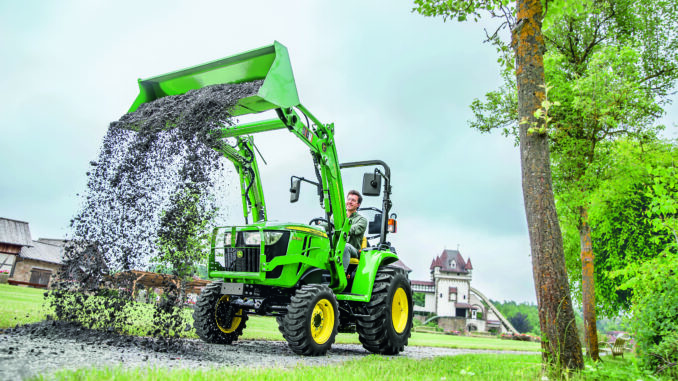
The John Deere 870 is a compact utility tractor built by Yanmar for John Deere, with a 1.4L three-cylinder diesel engine, 28 net engine horsepower, and either two-wheel drive or four-wheel drive depending on configuration. It sits in Deere’s older 800 Series compact utility range and is still popular with acreage owners who need a simple diesel tractor for mowing, loader work, light grading, and general property maintenance.
This guide is written for DIY owners in the USA and Canada who want practical help with John Deere 870 repair decisions, troubleshooting, routine maintenance, common parts, diagrams, manuals, and realistic boundaries between home repair and dealer-level work. The approach is symptom-first, because most owners do not start with a failed part number; they start with a tractor that will not start, runs poorly, leaks fluid, or will not drive or lift properly.
John Deere 870 model overview
The John Deere 870 is a compact utility tractor rather than a lawn tractor, so its repair pattern is closer to a small diesel farm or estate machine than a residential riding mower. Key systems include the Yanmar diesel engine and fuel system, the mechanical clutch and transmission, the hydraulic and three-point hitch system, PTO driveline, brakes, steering, and the 12-volt charging and starting system.
In the Deere lineup, the 870 was sold alongside the 970 and 1070 as part of the same general tractor family, which matters because some service information and quick-reference maintenance documents group those models together. That shared family support is useful when looking for filters, fluids, diagrams, and operator manual references.
Common John Deere 870 service parts owners often buy
Owners commonly look for engine oil filters, air filters, fuel filters, hydraulic oil filters, batteries, glow/start electrical items, and wear items linked to loader, PTO, or hydraulic use. A Deere quick-reference guide for the 870 family lists these commonly used service parts:
-
Engine oil filter: M806419.
-
Primary air filter: UC11955.
-
Secondary air filter: CH12881.
-
Engine fuel filter: T111383.
-
Hydraulic oil filter: RE27284.
Because many John Deere 870 tractors are now older machines, owners also frequently shop by category for hoses, clutches, lights, switches, brakes, steering parts, water pumps, and PTO-related parts through Deere catalogs and specialist tractor parts suppliers.
Troubleshooting a John Deere 870 by symptom
The best way to diagnose a John Deere 870 is to begin with the symptom the owner sees: hard starting, weak cranking, loss of power, hydraulic problems, odd noises, or drivetrain trouble. That method reduces random parts swapping and helps separate fuel, electrical, hydraulic, and mechanical faults before money is spent on unnecessary components.
The main symptom groups on this tractor are:
-
Starting issues.
-
Running and power-loss issues.
-
Hydraulic and three-point hitch problems.
-
Transmission, clutch, and drive complaints.
-
Electrical and charging faults.
-
Vibration, leaks, overheating, and abnormal noise.
Emergency John Deere 870 repair needs
Some faults should not be postponed because they create a safety risk or can quickly damage expensive assemblies. On a compact utility tractor like the John Deere 870, the highest-risk issues are brake weakness, steering looseness, hydraulic leaks under pressure, overheating, major charging or starter cable faults, and driveline noises that suggest clutch, transmission, PTO, or axle damage.
John Deere 870 starting issues
A no-start or hard-start problem usually shows up as slow cranking, no cranking, smoke without firing, or a tractor that starts and then dies. On a diesel compact tractor, this matters because repeated failed starts can drain the battery, overheat cables, and hide a fuel-delivery or compression-related issue.
Common causes:
-
Weak or failing 12-volt battery.
-
Dirty or loose battery terminals.
-
Faulty starter, solenoid, or ignition switch circuit.
-
Restricted fuel filter or dirty fuel supply.
-
Air in the fuel system after filter service.
-
Cold-weather starting problems or glow-related issues on an older machine.
Basic checks:
-
Check battery voltage, cable tightness, and ground connections.
-
Confirm the tractor actually cranks at normal speed before blaming fuel.
-
Inspect the fuel shutoff position and fuel level.
-
Check whether the fuel filter is overdue for cleaning or replacement.
-
After any fuel service, bleed the system correctly before repeated cranking.
John Deere 870 running and power-loss problems
If the engine starts but lacks power, smokes excessively, surges, or stalls under load, the issue is often tied to air, fuel, or overdue maintenance. This matters because continued use under load can foul the system further and increase heat and soot buildup.
Common causes:
-
Dirty primary air filter or restricted intake.
-
Fuel contamination or partially blocked fuel filter.
-
Old diesel fuel or water in fuel.
-
Throttle linkage or injection-related wear.
-
Overloading the tractor beyond PTO or hydraulic capacity.
Basic checks:
-
Inspect the air filter condition before moving deeper into diagnosis.
-
Check fuel quality and replace suspect fuel if contamination is visible.
-
Service the fuel filter if the interval is unknown.
-
Make sure the engine reaches rated operating speed under normal use.
-
Reduce implement load and test again.
John Deere 870 hydraulic and hitch problems
Hydraulic complaints usually appear as slow loader response, weak three-point lift, noisy hydraulics, or a hitch that will not raise, hold, or lower correctly. These faults matter because low oil, clogged filters, or internal leakage can turn a simple service issue into pump damage.
Common causes:
-
Low hydraulic/transmission oil level.
-
Overdue hydraulic oil filter service.
-
Suction leaks or contaminated oil.
-
Relief valve or pump wear.
-
Internal leakage in cylinders or control valves.
Basic checks:
-
Check hydraulic/transmission oil level on level ground.
-
Inspect for external leaks at hoses, couplers, and cylinders.
-
Review whether the hydraulic oil filter is overdue at the 500-hour interval.
-
Listen for pump whining that changes with engine speed.
-
Stop using the tractor if hydraulics are jerky or foamy, because aeration can damage components.
John Deere 870 transmission and drive problems
Transmission or drive problems may feel like hard shifting, clutch slippage, grinding gears, weak pull, or PTO engagement trouble. These faults matter because unsynchronized or partially synchronized gear tractors can be damaged quickly by improper shifting or continued operation with clutch or driveline wear.
Common causes:
-
Clutch wear or poor adjustment.
-
Low or contaminated transmission-hydraulic oil.
-
Gear linkage wear.
-
Differential lock or brake drag.
-
Internal transmission or PTO driveline wear.
Basic checks:
-
Confirm correct clutch pedal free play and engagement feel.
-
Check transmission-hydraulic oil level and condition.
-
Test the problem in more than one gear range.
-
Stop immediately if grinding, banging, or repeated gear jump-out occurs.
-
Refer transmission teardown or clutch split work to a qualified repair shop.
John Deere 870 electrical problems
Electrical faults on an older tractor often show up as weak charging, intermittent starting, dead lights, blown fuses, or safety/start circuit inconsistencies. These matter because poor charging can mimic a bad starter or fuel issue while damaged wiring can create fire risk.
Common causes:
-
Weak battery or low cold-cranking performance.
-
Corroded cable ends or ground strap.
-
Alternator output issues; the tractor uses a 12-volt system with a 20-amp charging setup.
-
Failed key switch, relay, or wiring connector.
-
Age-related insulation damage.
Basic checks:
-
Clean and tighten both battery terminals first.
-
Verify charging output after startup.
-
Inspect visible harness sections for rubbed or brittle insulation.
-
Check lights and gauges for signs of broader system voltage loss.
-
Repair overheated cables immediately.
DIY or dealer for John Deere 870 repairs?
The John Deere 870 is a good owner-service tractor because many routine jobs are mechanical, accessible, and supported by Deere manuals, parts catalogs, and quick-reference maintenance information. The normal DIY line includes filters, fluids, battery service, minor electrical repairs, and basic hydraulic leak inspection, while the dealer or an experienced independent shop is the better choice for engine internals, injection pump work, clutch splitting, transmission rebuilds, hydraulic pump diagnosis beyond simple service, and brake or steering repairs involving major disassembly.
Good DIY jobs
-
Engine oil and filter service.
-
Air filter inspection and replacement.
-
Fuel filter cleaning/service.
-
Hydraulic oil filter replacement at the correct interval.
-
Battery replacement and cable cleaning.
-
Light, fuse, and obvious wiring repairs.
-
Hose replacement where routing is simple and safe.
Advanced DIY or dealer jobs
-
Clutch adjustment that does not respond to normal setup.
-
Starter or alternator replacement when access is tight or wiring is damaged.
-
Hydraulic pump, valve, or internal hitch diagnosis.
-
Front axle or brake overhaul.
-
Transmission noise, gear jump-out, or PTO internal problems.
-
Engine compression, injection, or head-gasket diagnosis.
Skill level guide
-
Beginner: oil and filter changes, battery service, air filter inspection, visual leak checks.
-
Intermediate: fuel system bleeding, hydraulic filter replacement, starter/alternator swap, hose replacement, switch testing.
-
Advanced: clutch work, hydraulic valve diagnosis, brake overhaul, drivetrain repairs, internal engine work.
John Deere 870 parts, OEM numbers, and ordering details
Before ordering parts for a John Deere 870, gather the full model name, the tractor Product Identification Number or serial number, any attachment model details, and the engine information when engine-side parts are involved. This matters because Deere changed serial ranges during production and because older compact tractors often have optional driveline, steering, and attachment differences that affect fit.
John Deere 870 service parts table
For this tractor, OEM is usually the safest choice for filters, hydraulic components, switches, seals, and fit-sensitive driveline parts. Aftermarket can be fine for batteries, some filters, lights, and general service items, but only when the supplier clearly cross-references the John Deere 870 and the exact OEM number.
John Deere 870 manuals, diagrams, and parts catalogs
The most useful manual and diagram sources are the official Deere manual portal, Deere parts lookup, and a reliable model reference source that helps confirm specifications and serial-era details. For owners trying to keep an older compact tractor in service, using more than one source is smart because manuals tell you how to service it while parts catalogs tell you exactly how Deere exploded the assemblies.
-
John Deere Manuals and Training for official operator manuals, technical manuals, and publications.
-
John Deere Parts for parts lookup, diagrams, and current OEM part searches.
-
Deere quick-reference guide PDF for 870/970/1070 for service filters, intervals, and capacities.
-
TractorData John Deere 870 reference page for specifications, production range notes, and operator manual publication references.
How to identify your John Deere 870 correctly
Correct identification prevents wrong parts orders and wasted downtime, especially on older Deere tractors that may have been repainted, modified, or paired with aftermarket loaders and implements. Engine-side parts can also differ from chassis-side parts, so one number is not always enough.
-
Find the tractor serial number or PIN plate and record it exactly as stamped.
-
Note whether the tractor is 2WD or 4WD, because axle and steering parts may differ.
-
Record any loader, mower, or implement model numbers separately.
-
Check the engine data plate on the Yanmar diesel if you are ordering engine-specific components.
-
Use those numbers together when checking Deere diagrams or speaking with a dealer parts counter.
Buying John Deere 870 parts online and locally
The best buying strategy is to confirm the OEM number first, then compare price, stock status, and return policy. That approach matters more on the John Deere 870 than on newer machines because older tractor inventories are spread between Deere, legacy stockists, and aftermarket suppliers.
-
Online: use Deere’s parts site first for diagrams and number confirmation, then compare with specialist suppliers that clearly list the John Deere 870.
-
Dealer counter: best for serial-sensitive items, hydraulic components, seals, switches, and any part where the diagram has multiple revisions.
-
Retail stores: acceptable for common consumables such as batteries, fluids, and some filters if the packaging clearly cross-references the exact Deere part.
Useful links:
Step-by-step John Deere 870 fitting guide
These are the most practical owner-service jobs on this tractor because they directly affect starting reliability, engine life, and hydraulic performance. Always park on level ground, lower implements, shut off the engine, remove the key, and allow hot components to cool before starting work.
Change the John Deere 870 engine oil and oil filter
This job helps prevent premature engine wear and supports easier cold starts and better lubrication. Deere’s quick-reference guide says to replace the oil filter after the first 50 hours and then every 200 hours.
-
Warm the engine briefly so the oil drains more completely.
-
Park safely, shut the engine off, and place a drain pan under the crankcase.
-
Remove the drain plug and let the oil fully drain.
-
Spin off the old oil filter and make sure the old gasket comes off with it.
-
Lightly oil the new filter gasket, install the new M806419 filter, and tighten it correctly.
-
Refill with the correct oil quantity, then run the engine and recheck for leaks and correct level; Deere lists crankcase capacity with filter at about 4.8 L for the 870.
Service the John Deere 870 fuel filter
A restricted fuel filter often shows up as hard starting, weak running, or power loss under load. Deere’s quick-reference guide lists the fuel filter as T111383 and says to clean it every 200 hours.
-
Shut off the fuel supply if equipped and clean the area around the filter first.
-
Remove the filter bowl or element carefully so dirt does not enter the system.
-
Inspect for water, sludge, or contaminated diesel.
-
Install the cleaned or replacement filter element and reseal the housing properly.
-
Bleed the fuel system as needed before restarting.
-
Start the tractor and check for leaks or air-related stumbling.
Replace the John Deere 870 air filters
Air restriction reduces power and can increase smoke under load, especially on older diesel tractors used around dust, hay, or gravel. Deere lists the primary air filter as UC11955 and the secondary as CH12881, with the primary changed every 400 hours and the secondary changed as required.
-
Open the air cleaner housing and remove the primary filter carefully.
-
Inspect the housing for dust buildup and wipe it clean without forcing dirt inward.
-
Replace the primary filter if dirty or damaged.
-
Inspect the secondary element and replace it if contaminated or damaged.
-
Reassemble the housing correctly and confirm a good seal.
-
Do not run the tractor with the housing loose or the filter omitted.
Change the John Deere 870 hydraulic oil filter
This is a high-value maintenance task because contaminated hydraulic filtration can affect steering assist, hitch response, loader performance, and pump life. Deere lists hydraulic filter RE27284 with a 500-hour replacement interval.
-
Lower all implements and relieve hydraulic pressure before service.
-
Clean the filter area thoroughly so dirt does not enter the system.
-
Remove the old hydraulic filter and inspect for metal or debris.
-
Install the new RE27284 filter and tighten it to spec.
-
Check hydraulic oil level and top up if needed.
-
Start the tractor, cycle hydraulic functions slowly, and recheck for leaks.
Maintenance to prevent John Deere 870 problems
Most repeat John Deere 870 failures come from neglected filters, contaminated fuel, low hydraulic oil, old wiring connections, and infrequent inspections rather than from sudden catastrophic failure. The official Deere quick-reference guide gives a useful baseline for filter and fluid intervals, and those intervals are the best starting point for preventive maintenance.
Focus areas:
-
Starting reliability: keep battery cables clean, protect the charging system, and service the fuel filter on time.
-
Engine breathing: inspect the air filter often in dusty conditions and replace the primary at the official interval.
-
Hydraulic performance: keep the combined transmission-hydraulic system full and change the hydraulic filter on schedule.
-
Leak prevention: inspect hoses, clamps, and fittings before small seepage becomes major fluid loss.
-
Electrical reliability: clean corrosion from battery posts and inspect aging harness sections regularly.
John Deere 870 maintenance schedule
The Deere quick-reference guide provides the clearest published service intervals among the sources reviewed, and it should be treated as the baseline schedule for routine service on this tractor family. Capacities listed by Deere for the 870 include about 4.8 L crankcase with filter, 5.2 L cooling system, 32 L fuel tank, and 21 L transmission-hydraulic capacity.
Daily or before each use
-
Check engine oil level.
-
Check coolant level visually.
-
Look for fuel, oil, and hydraulic leaks.
-
Inspect tires, steering feel, and brake response.
-
Make sure lights and warning indicators are functioning.
After first 50 hours
-
Replace engine oil filter M806419.
-
Change engine oil at the same time as part of initial service best practice.
-
Recheck for loose fasteners, hose seepage, and belt or linkage issues.
Every 200 hours or yearly
-
Replace engine oil filter M806419.
-
Clean the engine fuel filter T111383.
-
Change engine oil.
-
Perform a full battery and cable inspection.
-
Check clutch and control linkages for wear.
Every 400 hours
-
Replace primary air filter UC11955.
-
Inspect the secondary air filter CH12881 and replace as required.
-
Clean the air cleaner housing and intake path.
Every 500 hours
-
Replace hydraulic oil filter RE27284.
-
Inspect hydraulic oil condition and system response.
-
Check hoses, couplers, and lift functions under load.
Seasonal checklist
-
Spring: change engine oil and filter if due, inspect battery, check coolant, and inspect the air intake system.
-
Mid-season: clean debris from radiator and engine area, inspect for leaks, and verify hydraulic response.
-
Fall or pre-winter: service fuel filtration, confirm cold-start readiness, and repair charging issues before temperatures drop.
Repair, upgrade, or replace a John Deere 870?
The John Deere 870 is often worth repairing when the engine, transmission, and hydraulics are fundamentally sound because it is a simple compact utility tractor with strong ongoing owner interest and good parts support through Deere and aftermarket channels. Upgrade makes more sense when the tractor still works but the owner needs more loader capacity, hydrostatic convenience, or modern operator comfort, while replacement becomes easier to justify when major engine, clutch, transmission, and hydraulic repairs stack up on the same machine.
Repair if
-
The tractor starts and runs well but needs overdue maintenance.
-
The issue is limited to filters, hoses, battery, charging, starter, or minor hydraulics.
-
The chassis, driveline, and hitch are still solid.
Upgrade if
-
You need more comfort, easier shuttle or hydro operation, or better attachment compatibility.
-
The tractor is serviceable but no longer matches the workload.
-
Repeated downtime is costing time during key seasons.
Replace if
-
The tractor has major engine wear plus clutch or transmission problems.
-
Hydraulic performance is poor and repair estimates are high across multiple systems.
-
Structural wear, severe corrosion, or parts-machine economics no longer make sense.
John Deere 870 troubleshooting FAQ
1. Why will my John Deere 870 not start?
The usual starting path is battery, cables, cranking speed, and then fuel delivery. If the engine does not spin properly, start with the 12-volt battery and terminal condition; if it cranks but will not fire, inspect fuel supply and filter condition first.
2. Why does my John Deere 870 crank slowly?
Slow cranking usually points to battery weakness, poor cable connections, ground corrosion, or starter drag. Because the 870 is a diesel, low cranking speed matters more than on a gasoline lawn tractor, since it may never reach proper ignition conditions.
3. Why does my John Deere 870 start and then die?
This often happens when fuel delivery is restricted or air has entered the fuel system after service. A dirty fuel filter, contaminated diesel, or incomplete bleeding can all produce a short run followed by stalling.
4. Why is my John Deere 870 hard to start in cold weather?
Cold-weather diesel starting is affected by battery strength, fuel condition, oil viscosity, and the health of the starting system. Even a battery that seems acceptable in warm weather may be too weak once temperatures drop.
5. Why does my John Deere 870 have low engine power?
Low power usually comes from restricted air intake, dirty fuel filtration, poor fuel quality, or operating load that exceeds what a 28 hp compact tractor can comfortably handle. Start with the simplest items first, especially air and fuel service.
6. Why is my John Deere 870 smoking?
Smoke on a diesel can indicate overload, poor combustion, restricted airflow, or fuel system issues. If the air filter is overdue or the engine is lugging under PTO or drawbar load, smoke may increase quickly.
7. Why does my John Deere 870 lose power under load?
A tractor that feels acceptable at idle but weak in work often has a partially restricted fuel or air system. Check filter service history and make sure the tractor is being matched to an implement load it can actually carry.
8. Why is my John Deere 870 using more fuel than usual?
Increased fuel use usually follows from dirty air filtration, heavy lugging, injection wear, or tasks that exceed the tractor’s comfortable power band. If power has also fallen, service the intake and fuel side before assuming a major engine problem.
9. Why is my John Deere 870 hydraulic lift weak?
Weak hitch or loader lift commonly points to low hydraulic oil, overdue filter service, or internal hydraulic wear. Start with oil level and filter history because Deere specifies the hydraulic oil filter at a 500-hour interval.
10. Why does my John Deere 870 three-point hitch leak down?
A hitch that slowly settles can indicate internal cylinder leakage, valve wear, or seal problems. Small leak-down over time is different from rapid drop, which deserves faster diagnosis because it can affect safe implement handling.
11. Why are my John Deere 870 hydraulics noisy?
Hydraulic whining often means low oil level, aeration, restriction, or pump wear. If the sound rises with engine speed and the hydraulics feel jerky, stop and check oil level and leaks before further use.
12. Why is my John Deere 870 steering heavy?
Heavy steering may be normal on manual-steering versions at low speed, but sudden extra effort can point to low front tire pressure, mechanical wear, or hydraulic assist issues on power-steering-equipped tractors. Compare current feel with how the tractor normally behaves.
13. Why is my John Deere 870 overheating?
Overheating usually starts with low coolant, blocked cooling passages, debris in the radiator area, or prolonged heavy load. Deere lists cooling system capacity for the 870 at about 5.2 L, so even a modest coolant loss matters.
14. Why is my John Deere 870 leaking hydraulic oil?
Most hydraulic leaks come from hoses, fittings, couplers, seals, or filter sealing surfaces. Clean the area first, identify the highest wet point, and repair leaks early so the pump does not run low on oil.
15. Why is my John Deere 870 leaking engine oil?
Common engine oil leak points include the filter seal, drain plug, valve cover area, and older gaskets or seals. After an oil change, always recheck the filter and drain area once the engine has run and oil pressure has stabilized.
16. Why does my John Deere 870 battery keep going flat?
Repeated battery discharge usually means either a weak battery or a charging problem. TractorData lists a 20-amp charging system and 12-volt electrical system, so charging output should be tested before replacing more parts.
17. Why are the lights weak on my John Deere 870?
Dim lights can indicate low system voltage, poor grounds, corroded connectors, or battery weakness. If dim lights also come with slow cranking, start your diagnosis at the battery and charging system.
18. Why does the John Deere 870 starter just click?
A click with no crank usually points to low battery voltage, poor cable connection, bad solenoid contacts, or a starter motor problem. Clean and tighten connections before assuming the starter itself has failed.
19. Why is my John Deere 870 not charging?
Charging faults usually involve wiring, belt drive to the alternator if equipped externally, poor ground path, or alternator failure. Confirm actual charging voltage at the battery with the engine running rather than relying only on symptoms.
20. Why is my John Deere 870 difficult to shift?
Hard shifting may come from clutch adjustment, worn linkage, incorrect operating technique, or internal gearbox wear. Because the 870 used gear transmissions, forcing the shift can make a manageable problem worse.
21. Why does my John Deere 870 grind going into gear?
Grinding often means the clutch is not fully releasing or the operator is shifting too quickly for the transmission design. Continued grinding can damage gears, so clutch and linkage checks should come before more use.
22. Why does my John Deere 870 slip under load?
If the tractor revs but does not pull properly, think clutch wear, clutch adjustment, or driveline issues. This is not a job to ignore because slippage creates heat and can turn an adjustment problem into a full clutch replacement.
23. Why does my John Deere 870 PTO not work correctly?
PTO complaints may involve engagement linkage, clutch function, driveline wear, or internal PTO problems. Because the rear PTO is live through the tractor’s clutch arrangement, correct clutch operation matters to PTO performance.
24. Why is my John Deere 870 vibrating?
Vibration can come from engine mounting issues, driveline wear, bent PTO shafts, wheel problems, or implement imbalance. Separate engine-speed vibration from ground-speed vibration because that distinction helps narrow the cause quickly.
25. Why is my John Deere 870 making a knocking noise?
Knocking can be minor, such as loose sheet metal, or serious, such as engine or driveline distress. Any sharp new knock that rises with load deserves immediate shutdown until the source is identified.
26. Why does my John Deere 870 brake poorly?
Poor braking can be caused by adjustment issues, contamination, wear, or internal brake problems. Since the 870 uses wet disc brakes, brake weakness is a safety item and should not be left for later.
27. How often should I change the John Deere 870 oil filter?
Deere’s quick-reference guide says the engine oil filter M806419 should be replaced after the first 50 hours and then every 200 hours. Many owners also combine that with yearly oil service when hour usage is low.
28. How often should I replace the John Deere 870 air filter?
Deere lists the primary air filter UC11955 at every 400 hours, while the secondary CH12881 is changed as required. In dusty use, inspection should happen much sooner than the maximum interval.
29. How often should I service the John Deere 870 fuel filter?
Deere’s quick-reference guide lists the fuel filter T111383 and says to clean it every 200 hours. If fuel contamination is suspected, service it sooner rather than waiting for the full interval.
30. How often should I change the John Deere 870 hydraulic filter?
Deere specifies hydraulic oil filter RE27284 at every 500 hours. If the system has had a failure, contamination event, or unknown service history, earlier replacement is often sensible.
31. What oil capacity does the John Deere 870 have?
Deere lists crankcase capacity with filter at about 4.8 L for the 870. Always confirm level on the dipstick after refilling rather than relying on capacity alone.
32. What is the hydraulic capacity of the John Deere 870?
Deere lists transmission and hydraulic system capacity at about 21 L for the 870, while TractorData reports hydraulic system capacity at 5.5 gallons or 20.8 L. Those figures align closely, but the dipstick or level check should always be the final reference during service.
33. What engine is in the John Deere 870?
TractorData lists a Yanmar 1.4L three-cylinder diesel engine in the John Deere 870. That engine identity matters when ordering engine-side service parts or looking up engine data tags.
34. Is the John Deere 870 worth repairing?
In many cases yes, especially when the tractor has a sound engine, hydraulics, and transmission and mainly needs maintenance catch-up. It is a simple compact utility platform with ongoing parts availability through Deere and aftermarket channels.
35. Where can I get John Deere 870 diagrams and manuals?
The best starting points are Deere’s official manuals portal and Deere parts lookup, with the 870/970/1070 quick-reference PDF as a fast service reference. TractorData is also useful for model context and operator manual publication references.
Common electrical issues in John Deere 870 compact tractors
The most common John Deere 870 electrical issues are weak or dead batteries, corroded or loose connections (especially at the battery and grounds), alternator/charging faults, and age‑related wiring or safety‑circuit problems.
Typical electrical symptoms on a John Deere 870
Owners of compact utility tractors like the 870 most often report no‑crank, slow‑crank, sudden total power loss, or “cranks but won’t start” complaints that turn out to be electrical rather than fuel. On older machines, intermittent charging, dim lights, and blown fuses also appear as wiring and connectors age.
Main symptom buckets:
-
No power at all (dead dash, no click, no crank).
-
Cranks but will not fire.
-
Slow cranking.
-
Battery repeatedly going flat.
-
Lights weak or intermittent.
-
Charging light on / low charge voltage.
Battery and cable issues
Battery and cable problems are the single most common electrical failure mode on older compact tractors.
Typical issues:
-
Loose or detached battery cables (including at the starter end).
-
Heavy corrosion on posts and clamps creating high resistance.
-
Aged battery with low cold‑cranking amps even if it “shows” 12 volts.
What to check:
-
Confirm both battery clamps are tight and fully seated; a John Deere 870 can completely shut down if a main cable pops off, then crank but not start after reconnection due to disturbed connections or low charge.
-
Clean posts and clamps to shiny metal, then retighten.
-
Load‑test the battery or at least check voltage during cranking; a healthy unit should not dip excessively under load.
Ground and harness connection problems
Older 870s can suffer from corroded ground straps and degraded harness connections that cause intermittent or total loss of power.
Common trouble spots:
-
Frame‑to‑engine ground strap corroded or loose.
-
Dirty or loose ring terminals at the starter, solenoid, or battery.
-
A connector in the main harness that has corrosion or a broken wire, especially in the charging lead from the alternator back to the battery; owners have reported broken charging wires in compact tractor harnesses causing “no charge” complaints.
Basic approach:
-
Trace the main positive cable from battery to starter and the main ground from battery to frame/engine; clean and tighten all points.
-
Flex harness sections gently while watching for power to cut in/out, which can reveal broken conductors.
-
Repair broken wires with proper crimp/heat‑shrink rather than twisted joints to avoid repeat failures.
Charging system faults (alternator and wiring)
A John Deere 870 uses a 12‑volt system with alternator output sized for compact tractor loads, so any failure in alternator or its wiring shows up as a battery that keeps going flat.
Typical signs:
-
Battery repeatedly discharged after normal use.
-
Lights dimming noticeably with engine speed changes.
-
Charge indicator behavior out of normal range.
Likely causes:
-
Broken or corroded alternator‑to‑battery wire in the harness.
-
Failed alternator or internal regulator.
-
Poor ground at alternator mounting.
Owner checks:
-
Fully charge the battery, then measure voltage at idle and at higher rpm; healthy charging generally shows a rise above standing battery voltage.
-
Inspect the alternator output wire and connector for damage or breaks.
-
Clean alternator and mounting grounds; on older tractors, rust and paint under mounting ears can add resistance.
Fuses and safety/start interlock issues
Even if the 870’s interlock layout is simpler than modern compacts, blown fuses and safety switches can still prevent cranking or fuel delivery.
Typical problems:
-
Blown main or start‑circuit fuse after a short or incorrect jump‑start.
-
Seat, PTO, or neutral switches not closing as designed, preventing the start circuit from completing.
-
Loose or oxidized spade connectors on switches.
Basic steps:
-
Refer to the operator or service manual’s fuse layout before pulling fuses; replace only with the specified rating.
-
Wiggle or test safety switches while attempting start (with care) to see if contact is intermittent.
-
Repair or replace clearly failed switches rather than bypassing them, to maintain safety.
Age‑related wiring deterioration
Because many John Deere 870s are now decades old, insulation and connectors naturally degrade.
Patterns seen on older compact tractors:
-
Brittle insulation cracking where harnesses flex, leading to shorts or opens.
-
Previous owner “repairs” with household wire, wire nuts, or undersized connectors.
-
Moisture ingress into connectors, especially around the engine bay and under the dash.
What an owner can realistically do:
-
Visually inspect and re‑loom chafed sections; replace obviously damaged runs rather than taping over them.
-
Standardize on proper automotive/tractor cable, crimp terminals, and heat‑shrink.
-
Leave complex harness replacement or major dash rewiring to a dealer or experienced auto‑electrician if multiple circuits are affected.