
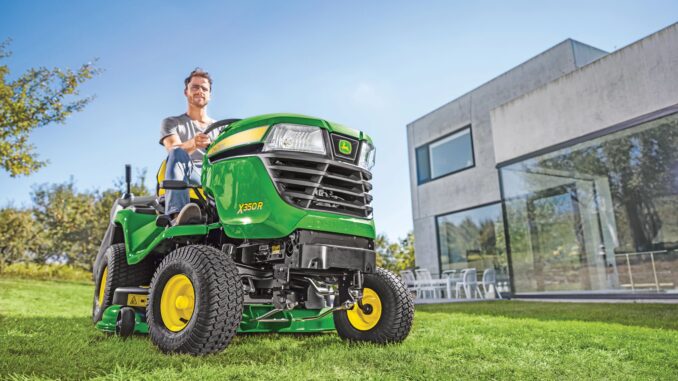
John Deere X500 Series Lawn and Garden Tractor Models and Maintenance Guide
The John Deere X500 Series is a premium residential lawn and garden tractor family built for larger lawns, acreage properties, frequent mowing, towing, and seasonal work. It bridges the gap between lighter lawn tractors and the larger X700 Series garden tractors, combining heavier-duty frames, larger engines, integrated hydrostatic transaxles, and stronger attachment capability than basic residential machines.
This page is a working directory for the X500 Series across its full North American history. Use it to identify individual models, plan routine maintenance, diagnose mowing and drive problems, and choose compatible attachments. For broader information that applies beyond this family, start with the General John Deere Lawn and Garden Tractor Guide, then work into model-specific maintenance and troubleshooting content.
About the John Deere X500 Series
John Deere introduced the X500 Select Series as a more capable residential tractor platform for owners who need more than a basic lawn mower. Across the series, machines have generally used V-twin gasoline engines in roughly the 24 to 25.5 horsepower range, paired with heavier lawn-and-garden chassis components, large rear tires, and hydrostatic transmissions designed for regular mowing, hauling, and attachment use.
The original X500-generation models included the X500, X520, X530, X534, and X540. These tractors established the core format: 48-inch or 54-inch mid-mount mower decks, Twin Touch foot-controlled hydrostatic drive, traction-assist or differential-lock capability, and a more substantial frame than entry-level lawn tractors. Equipment levels varied considerably. Earlier X500 and X520 models were more basic, while the X530, X534, and X540 added features such as hydraulic lift, power steering, tilt steering, and, on selected models, four-wheel steering or liquid cooling.
The current-generation X500 Series includes the X570, X580, X584, and X590. These machines retain the heavy-duty residential format with 48-inch and 54-inch Accel Deep mower deck options, integrated K72 hydrostatic transaxles, Twin Touch pedals, cruise control, traction assist, and electronic PTO engagement. The X584 is the four-wheel-steer version, while the X590 is the fuel-injected, higher-output model with electronic throttle control.
These tractors are two-wheel-drive machines, but many have traction-assist or differential-lock systems to help when one rear tire loses grip. They are well suited to mowing larger lawns, towing utility carts, collecting grass, managing leaves, operating snow equipment, and pulling light lawn-care implements. They are more substantial than S Series lawn tractors and generally more capable for regular attachment work than many X300 Series models, while remaining below the X700 Series in overall size, implement capacity, and heavy-duty garden-tractor capability.
John Deere X500 Series Lawn and Garden Tractor Models
The X500 Series naming system does not always tell the whole story. A model ending in “4,” such as the X534 or X584, generally indicates four-wheel steering. Higher-specification models commonly add power steering, hydraulic deck lift, improved seating, fuel injection, or other convenience features, but exact equipment can vary by production period, deck configuration, and regional specification.
X500 Series Lawn and Garden Tractor Maintenance Guides
Routine Service and Checks
Routine service should begin with the operator’s manual and the hour meter rather than the calendar alone. A tractor used for weekly mowing may need more frequent air-cleaner service than one with relatively low annual hours, especially in dusty conditions, dry grass, or leaf-heavy fall work.
Check engine oil before use or at regular intervals, and change engine oil and the oil filter at the specified service interval for the engine installed in the tractor. Inspect and service the air filter more often when mowing dry or dusty ground. Gasoline models also need periodic spark plug inspection or replacement, fuel-filter checks where fitted, cooling-fin cleaning, and fuel-system attention before and after long storage periods.
The X500 Series uses hydrostatic drive systems, so owners should inspect the transmission area for leaks, keep cooling fins and the transaxle fan clear of grass buildup, and follow the correct service procedure for hydrostatic fluid and filter changes on applicable models. Do not assume that every model uses the same filter, fluid specification, drain location, or interval.
Useful supporting content for this section includes:
-
X500 Series lawn and garden tractor service interval checklist
-
DIY maintenance for X500 Series lawn tractors
-
Engine oil, air filter, and tune-up service for X500 Series tractors
-
Hydrostatic transmission and transaxle maintenance on X500 Series tractors
-
Seasonal storage and spring commissioning for John Deere lawn tractors
Before each mowing session, inspect tire condition and inflation, check for oil or fuel leaks, clear debris from the engine compartment and muffler area, confirm that the parking brake holds, and test the safety-interlock system. A machine that cranks with the PTO engaged, moves with the park brake applied, or does not stop correctly when the operator leaves the seat needs attention before further use.
Mower Deck, Cutting Quality, and Belt Care
The 48-inch and 54-inch decks used across the X500 Series need regular cleaning, leveling, blade inspection, and belt checks. A mower deck can look serviceable from above while having a packed grass layer below that reduces airflow, worsens cut quality, and promotes corrosion.
Keep blades sharp and balanced. Dull blades tear grass instead of cutting it cleanly, leaving browned tips and making the engine work harder. Replace blades that are bent, cracked, excessively worn, or damaged around the mounting hole. Check blade bolts and spindle areas whenever blades are removed.
Deck leveling should be checked on level ground with correctly inflated tires. A typical setup places the deck level side to side, with the front blade tips slightly lower than the rear blade tips. If the cut is uneven, investigate tire pressure, deck hangers, anti-scalp wheel position, blade condition, spindle wear, and bent deck components before making major adjustment changes.
Useful internal targets include Mower deck maintenance and cutting quality on X500 Series tractors, Deck belt and spindle service for X500 Series lawn and garden tractors, and John Deere X500 Series mower deck leveling and blade service.
Steering, Axle, and Chassis Maintenance
The X500 Series is heavier and more capable than a basic lawn tractor, but its steering, front axle, wheels, and chassis still need inspection. Check steering response before mowing and investigate excess steering-wheel play, wandering, vibration, stiff steering, or unusual tire wear.
Inspect front wheel bearings or bushings, steering linkages, tie-rod ends, spindle pivots, axle pivots, and grease points where applicable. On power-steering and four-wheel-steer models, watch for damaged hoses, leaks, loose hardware, uneven steering response, or binding at full lock. Four-wheel-steer machines also require particular care when fitting tire chains or making steering-stop adjustments.
Keep the chassis clean enough to spot cracks, loose deck hangers, damaged mounting pins, and worn attachment brackets. Check wheel lug hardware, deck lift linkage, seat mounting, hood hinges, and the condition of rear hitch points before towing.
A useful guide title for this subject is Steering and front axle maintenance across X500 Series lawn and garden tractors.
X500 Series Lawn and Garden Tractor Troubleshooting Guides
Starting, Engine, and Fuel / Ignition Problems
A no-start condition should be diagnosed systematically. Start with the basics: battery condition, cable connections, fuse condition, brake-pedal position, PTO switch position, seat switch, park-brake switch, and starter-solenoid operation. The safety-interlock system can prevent cranking even when the battery and starter are otherwise functional.
If the engine cranks but does not start, check fuel age, fuel level, fuel shutoff position where fitted, fuel filter condition, venting at the fuel cap, carburetor condition on carbureted engines, and ignition-spark quality. Old gasoline, water contamination, varnish buildup, and blocked fuel passages are common causes of poor starting after seasonal storage.
Hard starting, surging, black smoke, loss of power, or stalling under load can also result from a dirty air filter, fouled spark plugs, cooling-fin blockage, carburetor problems, restricted fuel delivery, or incorrect choke operation. On EFI-equipped X590 models, diagnosis should also consider electrical supply, fuel pressure, sensor-related faults, and the electronic throttle system.
Useful support content includes X500 Series lawn and garden tractor starting problems – diagnostics and fixes and Engine and fuel system issues across X500 Series tractors.
Mower Deck, PTO, and Cutting Performance Problems
A deck that will not engage may have a PTO-switch, interlock, wiring, fuse, clutch, belt, or connector problem. Before testing electrical parts, make sure the PTO is disengaged, the machine is parked safely, and all moving components have stopped.
If the mower engages but the blades slow or stop in heavy grass, check the belt for glazing, cracking, contamination, incorrect routing, or loss of tension. Also inspect blade sharpness, spindle condition, grass buildup, and travel speed. Cutting overly tall or wet grass too quickly can overload an otherwise healthy deck.
Uneven cutting, scalping, vibration, or abnormal deck noise should be treated as mechanical inspection issues. Check blade condition and balance, blade mounting, spindle bearings, deck shell damage, deck level, anti-scalp wheel adjustment, tire pressure, and loose pulleys. A deck with a new vibration should not be used until the cause is found.
Useful guide titles include PTO and deck engagement problems on X500 Series lawn tractors and Cut quality and deck vibration issues on X500 Series models.
Drive, Transmission, and Traction Problems
Hydrostatic drive complaints often appear as weak travel speed, delayed response, no forward or reverse movement, excessive whine, or reduced pulling power. First confirm that the parking brake is fully released, the bypass valve is in the operating position, the drive belt is intact and correctly routed where applicable, and no debris is preventing pedal or linkage movement.
Heat is a major factor in hydrostatic performance. Clean grass and debris from the transaxle cooling fins, fan, and surrounding area. Inspect for fluid leaks, damaged cooling parts, and loose linkage. A machine that works normally when cold but loses travel power after warming up may need more detailed transaxle diagnosis.
Traction problems are not always transmission failures. Worn turf tires, incorrect tire pressure, wet grass, steep terrain, loose soil, and excessive towing loads can all cause wheel spin. Use traction assist only when needed, understand that it changes turning behavior, and avoid operating across slopes where loss of control is possible.
Useful content for this area includes Drive and transmission problems on X500 Series lawn and garden tractors and Traction and hill performance issues across X500 Series models. Individual guides such as X350 maintenance & troubleshooting guide, X590 maintenance & troubleshooting guide, and 318 maintenance & troubleshooting guide can then help readers distinguish model-specific systems from problems that apply broadly across John Deere lawn and garden tractors.
Attachments and Implements for the X500 Series
The X500 Series is designed to do more than mow. Depending on the model, production year, deck configuration, and installed brackets, common equipment may include mid-mount mower decks, MulchControl components, grass baggers, material collection systems, utility carts, front snow blades, snow blowers, front-mounted brushes, spreaders, aerators, dethatchers, lawn sweepers, and selected yard-maintenance attachments.
Attachment compatibility depends on more than whether an implement physically fits. Confirm the model number, serial-number range, deck size, frame design, PTO or belt-drive arrangement, lift system, rear hitch or front-mount hardware, tire clearance, and electrical requirements. A snow blower, for example, may require model-specific mounting hardware, a drive belt, lift components, ballast, tire chains, and a compatible front attachment point.
Power steering and hydraulic lift can make snow and attachment work easier, but they do not eliminate the need for correct ballast and careful setup. Rear weights may be necessary with front-mounted snow equipment, while front weights can improve steering control when a rear bagger or collection system is installed. Four-wheel-steer models require extra attention to chain clearance and steering-stop settings.
Useful internal guide names include Attachments and implement options for X500 Series lawn and garden tractors and Setting up and using snow equipment and yard attachments on X500 Series tractors.